Loading page, please wait…
Vaidra Logo
Vaidra

Top 4 items + smart groups

UPSC GPT
New
Current Affairs
Daily Solutions
Daily Puzzle
Mains Evaluator

Version 2.0.0 • Built with ❤️ for UPSC aspirants

Loading...
Loading...
Loading...
Loading...
Loading...
Loading...
Loading...
Loading...
Loading...
Loading...
Loading...
Loading...
Loading...
Back
All Subjects

Topics

0 topics • 0 completed

Loading topics...
Loading...
Loading...
Loading...
Loading...
Loading...
Overall Progress0%
What are the Initiatives Shaping India’s Energy Transition? - UPSC Economy

What are the Initiatives Shaping India’s Energy Transition? - UPSC Economy

What is What are the Initiatives Shaping India’s Energy Transition? in UPSC Economy?

What are the Initiatives Shaping India’s Energy Transition? is a key topic under Economy for UPSC Civil Services Examination. Key points include: FAME India Scheme (2015) promotes faster adoption and manufacturing of electric and hybrid vehicles.. It operates in two phases, with FAME II (2019) focusing on public and commercial transport and charging infrastructure.. Key components include demand incentives for EVs and significant investment in charging networks.. Understanding this topic is essential for both UPSC Prelims and Mains preparation.

Why is What are the Initiatives Shaping India’s Energy Transition? important for UPSC exam?

What are the Initiatives Shaping India’s Energy Transition? is a Medium-level topic in UPSC Economy. It is tested in both Prelims (factual MCQs) and Mains (analytical answer writing). Previous year UPSC questions have frequently covered aspects of What are the Initiatives Shaping India’s Energy Transition?, making it essential for comprehensive IAS preparation.

How to prepare What are the Initiatives Shaping India’s Energy Transition? for UPSC?

To prepare What are the Initiatives Shaping India’s Energy Transition? for UPSC: (1) Study the comprehensive notes covering all key concepts on Vaidra. (2) Practice previous year questions on this topic. (3) Connect it with current affairs using daily updates. (4) Revise using key takeaways and mind maps available for Economy. (5) Write practice answers linking What are the Initiatives Shaping India’s Energy Transition? to related GS Paper topics.

Key takeaways of What are the Initiatives Shaping India’s Energy Transition? for UPSC

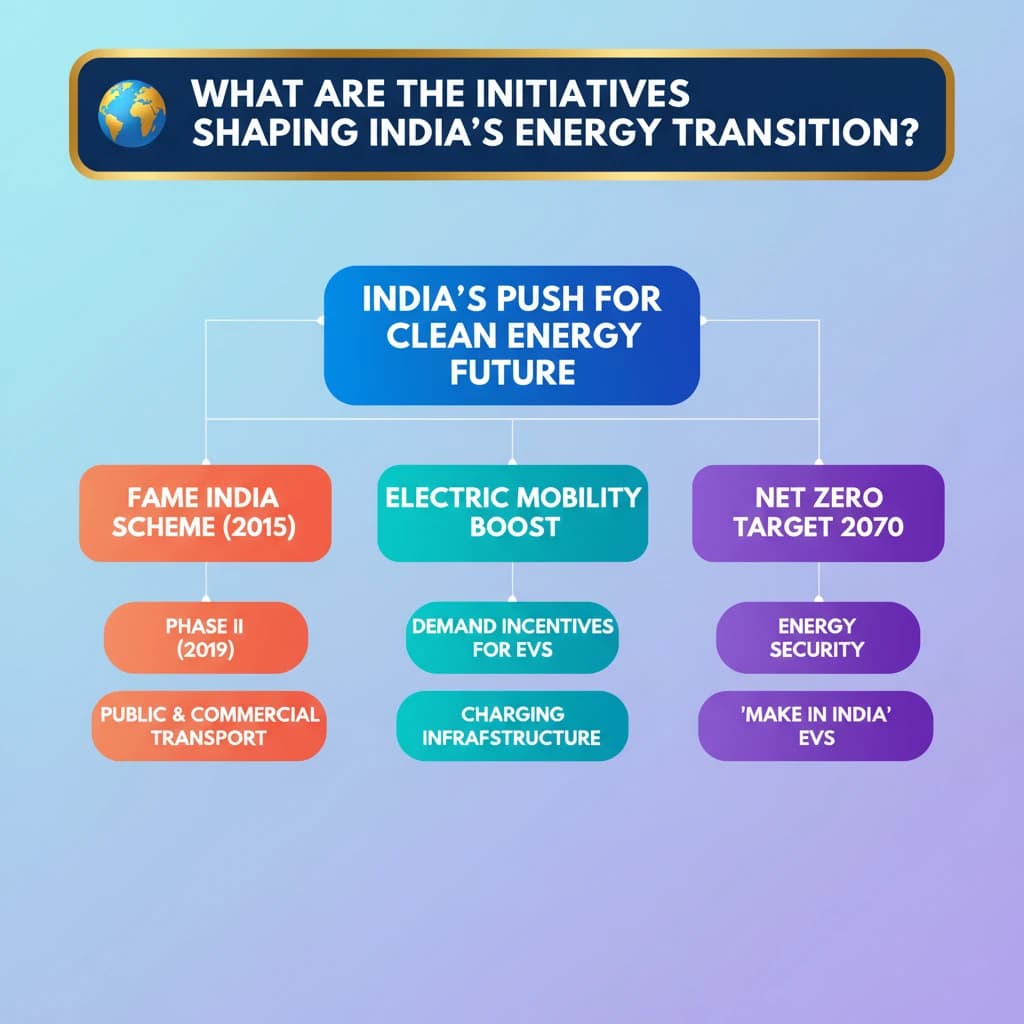
  • FAME India Scheme (2015) promotes faster adoption and manufacturing of electric and hybrid vehicles.
  • It operates in two phases, with FAME II (2019) focusing on public and commercial transport and charging infrastructure.
  • Key components include demand incentives for EVs and significant investment in charging networks.
  • FAME contributes to India's energy security, reduces pollution, and supports 'Make in India' for EVs.
  • It is a crucial initiative for achieving India's climate commitments, including Net Zero by 2070.
What are the Initiatives Shaping India’s Energy Transition?

What are the Initiatives Shaping India’s Energy Transition?

Medium⏱️ 8 min read✓ 95% Verified
economy

📖 Introduction

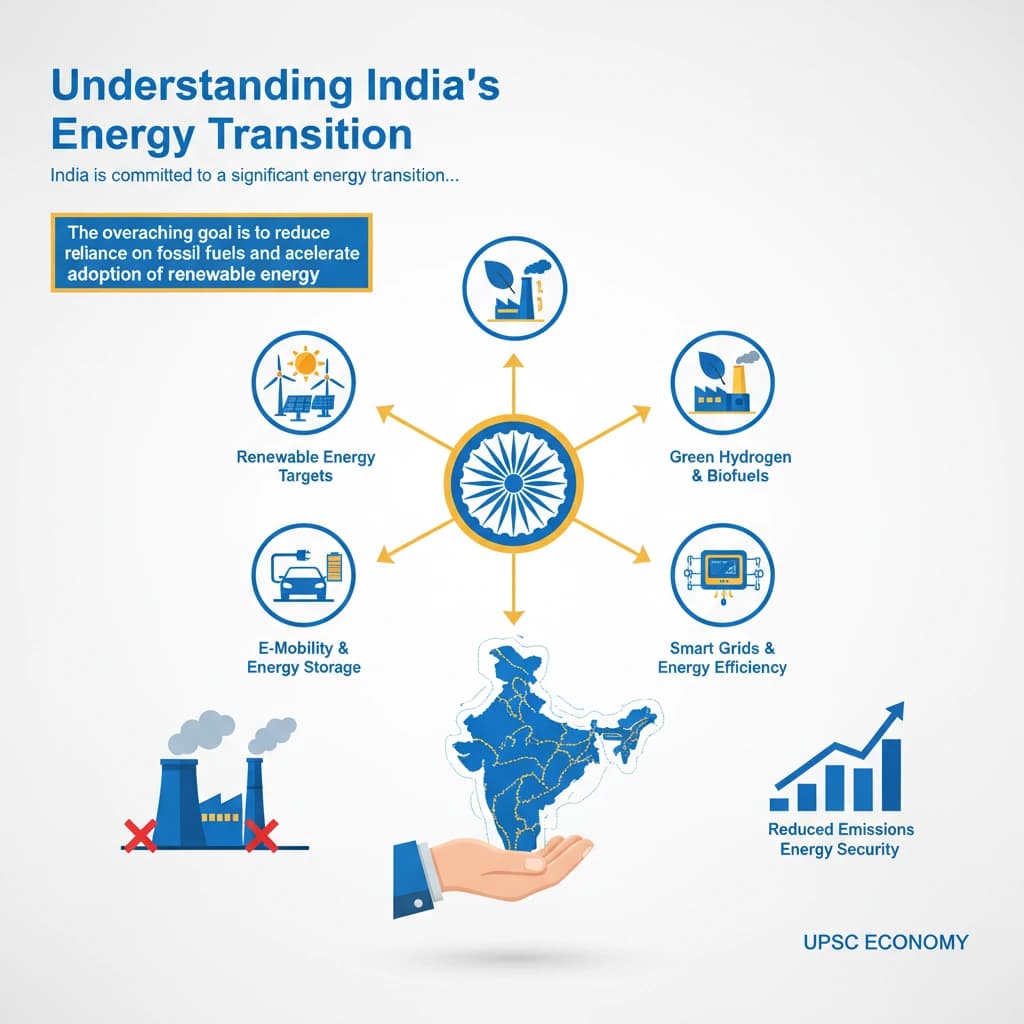
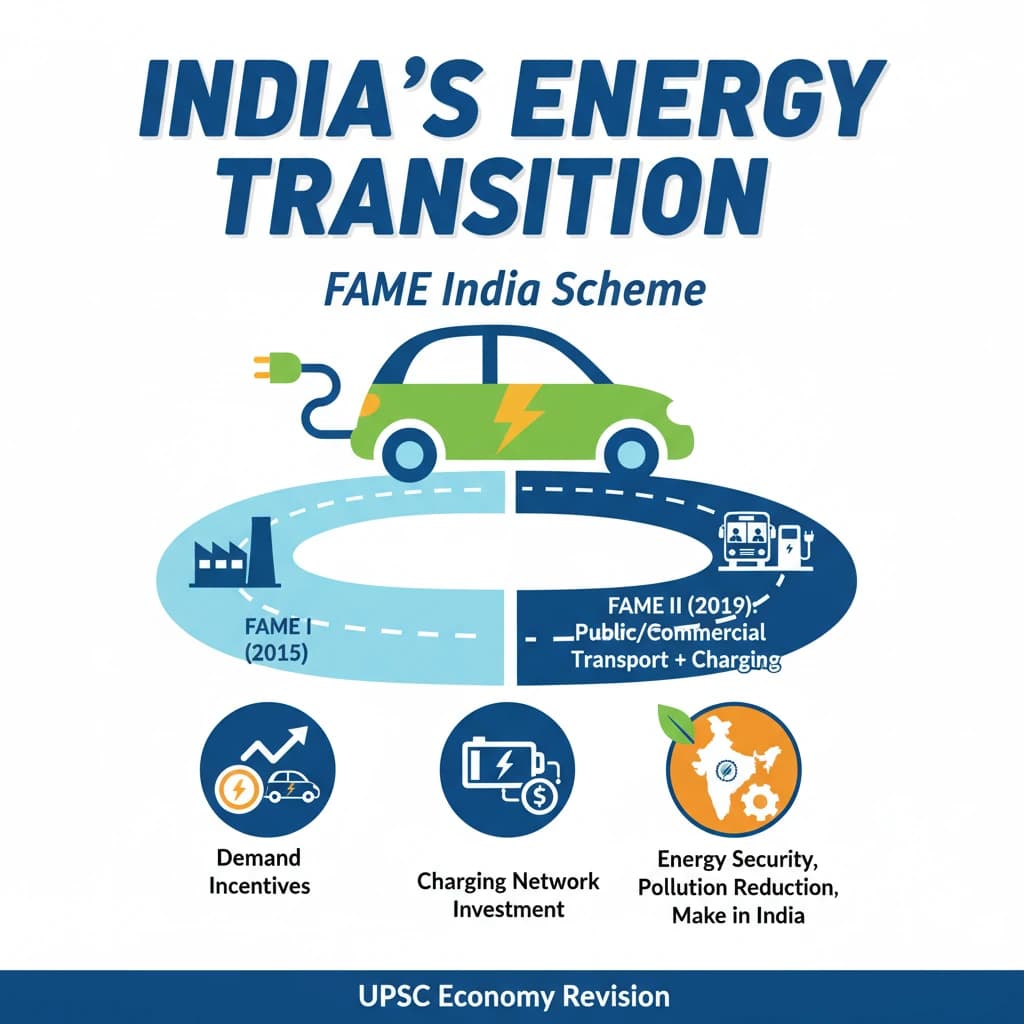
<h4>Understanding India's Energy Transition</h4><p>India is committed to a significant <strong>energy transition</strong>, aiming to shift its energy mix towards cleaner and more sustainable sources. This transition is crucial for achieving energy security, reducing air pollution, and meeting international climate commitments.</p><div class='key-point-box'><p>The overarching goal is to reduce reliance on <strong>fossil fuels</strong> and accelerate the adoption of <strong>renewable energy</strong> and <strong>electric mobility</strong> across various sectors.</p></div><h4>The FAME India Scheme: A Catalyst for E-Mobility</h4><p>The <strong>Faster Adoption and Manufacturing of (Hybrid) & Electric Vehicles (FAME) India Scheme</strong> is a flagship initiative by the Government of India. It falls under the <strong>National Electric Mobility Mission Plan (NEMMP) 2020</strong>, launched in <strong>2015</strong>.</p><p>Its primary objective is to promote the manufacturing of electric and hybrid vehicles and encourage their faster adoption by providing financial incentives and developing supporting infrastructure.</p><div class='info-box'><p><strong>FAME India</strong> is implemented by the <strong>Ministry of Heavy Industries</strong>. It aims to reduce the country's dependence on fossil fuels and address environmental concerns.</p></div><h4>Phases of FAME India</h4><p>The scheme has been implemented in two phases, each with specific targets and focus areas.</p><ul><li><strong>FAME India Phase I (2015-2019):</strong> Focused on demand creation, technology development, pilot projects, and charging infrastructure. It supported various vehicle segments, including two-wheelers, three-wheelers, four-wheelers, and buses.</li><li><strong>FAME India Phase II (2019-present):</strong> Aims for a more ambitious push towards electrification, with a budget of <strong>₹10,000 crore</strong> for a period of three years, extended multiple times. It primarily focuses on public and commercial transport.</li></ul><h4>Key Components of FAME India Phase II</h4><p><strong>FAME II</strong> has a well-defined strategy to achieve its goals, primarily through demand incentives and infrastructure development.</p><ol><li><strong>Demand Incentives:</strong> Subsidies are provided for the purchase of electric vehicles, particularly electric two-wheelers, three-wheelers, four-wheelers, and buses. The focus is on encouraging the shift from internal combustion engine (ICE) vehicles.</li><li><strong>Charging Infrastructure:</strong> Significant emphasis is placed on establishing a robust network of <strong>charging stations</strong> across the country. This includes both public and private charging facilities to alleviate range anxiety among potential EV buyers.</li><li><strong>Inter-Ministerial Coordination:</strong> The scheme involves coordination with various ministries and state governments to create a conducive ecosystem for electric mobility.</li></ol><div class='exam-tip-box'><p>For <strong>UPSC Mains GS-III</strong>, understanding the phased approach and specific components of FAME II is crucial. It demonstrates a structured policy intervention for a national objective.</p></div><h4>Impact and Future Outlook</h4><p>FAME India has played a pivotal role in accelerating the adoption of EVs in India. It has led to increased sales of electric two-wheelers and buses, and a growing interest in electric cars.</p><p>The scheme is a cornerstone of India's strategy to achieve its <strong>net-zero emissions target by 2070</strong> and reduce its import bill for crude oil.</p>
Concept Diagram

💡 Key Takeaways

  • •FAME India Scheme (2015) promotes faster adoption and manufacturing of electric and hybrid vehicles.
  • •It operates in two phases, with FAME II (2019) focusing on public and commercial transport and charging infrastructure.
  • •Key components include demand incentives for EVs and significant investment in charging networks.
  • •FAME contributes to India's energy security, reduces pollution, and supports 'Make in India' for EVs.
  • •It is a crucial initiative for achieving India's climate commitments, including Net Zero by 2070.

🧠 Memory Techniques
Memory Aid
95% Verified Content

📚 Reference Sources

•NITI Aayog reports on Electric Mobility
•Press Information Bureau (PIB) releases on FAME India
•Economic Survey of India (latest editions)

Related Topics

Loading related topics...
Explore:Economy Topics·All Subjects·Daily Current Affairs·Editorial Analysis·Previous Year Questions·UPSC GPT