Loading page, please wait…
Vaidra Logo
Vaidra

Top 4 items + smart groups

UPSC GPT
New
Current Affairs
Daily Solutions
Daily Puzzle
Mains Evaluator

Version 2.0.0 • Built with ❤️ for UPSC aspirants

Loading...
Loading...
Loading...
Loading...
Loading...
Loading...
Loading...
Loading...
Loading...
Loading...
Loading...
Loading...
Loading...
Back
All Subjects

Topics

0 topics • 0 completed

Loading topics...
Loading...
Loading...
Loading...
Loading...
Loading...
Overall Progress0%
Article 22 (1) of Trade-Related Aspects of Intellectual Property Rights (TRIPS) - UPSC Economy

Article 22 (1) of Trade-Related Aspects of Intellectual Property Rights (TRIPS) - UPSC Economy

What is Article 22 (1) of Trade-Related Aspects of Intellectual Property Rights (TRIPS) in UPSC Economy?

Article 22 (1) of Trade-Related Aspects of Intellectual Property Rights (TRIPS) is a key topic under Economy for UPSC Civil Services Examination. Key points include: Article 22(1) of TRIPS defines GIs as products identified by origin, with qualities linked to that origin.. GIs cover both agricultural and non-agricultural (e.g., handicrafts) products.. The Paris Convention (1883) and TRIPS Agreement (1995) are key international frameworks.. Understanding this topic is essential for both UPSC Prelims and Mains preparation.

Why is Article 22 (1) of Trade-Related Aspects of Intellectual Property Rights (TRIPS) important for UPSC exam?

Article 22 (1) of Trade-Related Aspects of Intellectual Property Rights (TRIPS) is a Medium-level topic in UPSC Economy. It is tested in both Prelims (factual MCQs) and Mains (analytical answer writing). Previous year UPSC questions have frequently covered aspects of Article 22 (1) of Trade-Related Aspects of Intellectual Property Rights (TRIPS), making it essential for comprehensive IAS preparation.

How to prepare Article 22 (1) of Trade-Related Aspects of Intellectual Property Rights (TRIPS) for UPSC?

To prepare Article 22 (1) of Trade-Related Aspects of Intellectual Property Rights (TRIPS) for UPSC: (1) Study the comprehensive notes covering all key concepts on Vaidra. (2) Practice previous year questions on this topic. (3) Connect it with current affairs using daily updates. (4) Revise using key takeaways and mind maps available for Economy. (5) Write practice answers linking Article 22 (1) of Trade-Related Aspects of Intellectual Property Rights (TRIPS) to related GS Paper topics.

Key takeaways of Article 22 (1) of Trade-Related Aspects of Intellectual Property Rights (TRIPS) for UPSC

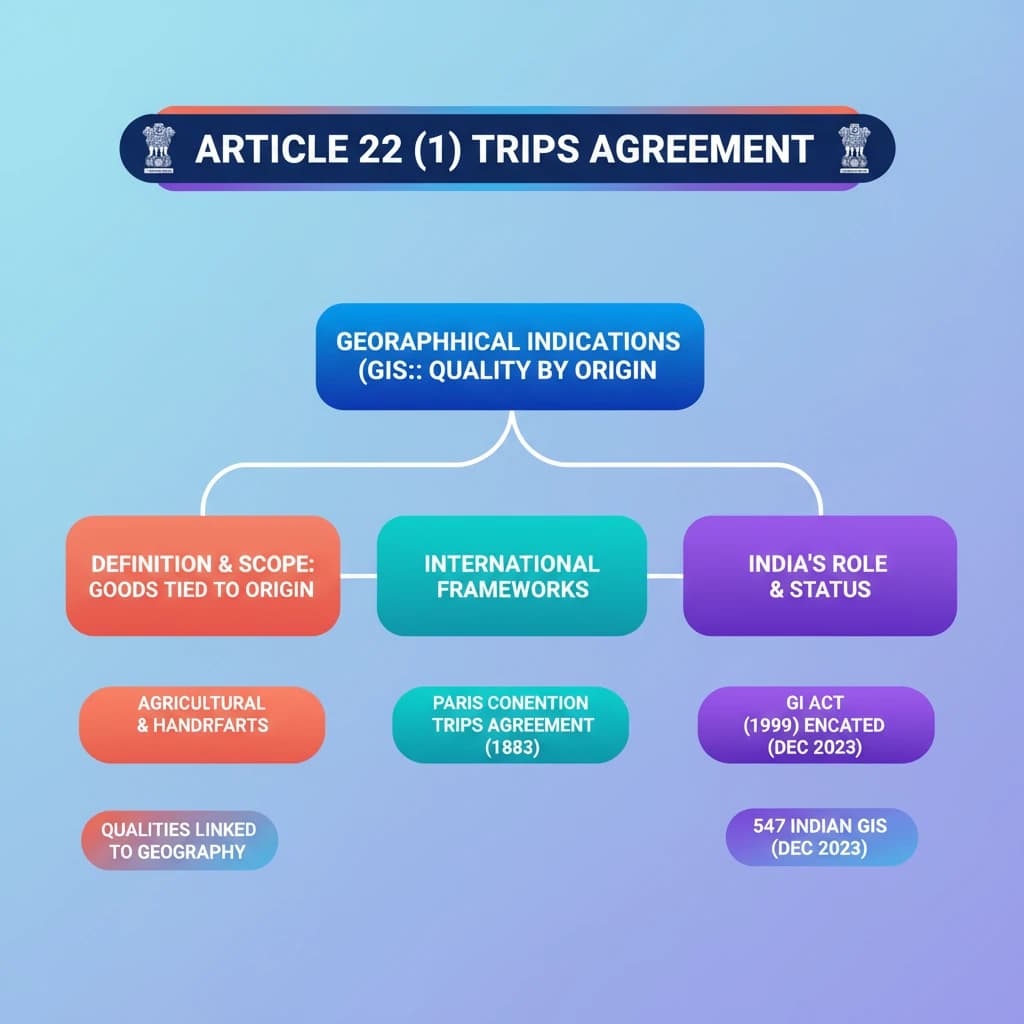
  • Article 22(1) of TRIPS defines GIs as products identified by origin, with qualities linked to that origin.
  • GIs cover both agricultural and non-agricultural (e.g., handicrafts) products.
  • The Paris Convention (1883) and TRIPS Agreement (1995) are key international frameworks.
  • India enacted the GI Act in 1999 to register and protect GIs domestically.
  • India has significantly fewer GI registrations (547 by Dec 2023) compared to global leaders like Germany and China.
  • Handicrafts (45%) and agriculture (30%) dominate India's GI product categories.
  • GIs are vital for rural economies, preserving traditional knowledge, and boosting exports.
Article 22 (1) of Trade-Related Aspects of Intellectual Property Rights (TRIPS)

Article 22 (1) of Trade-Related Aspects of Intellectual Property Rights (TRIPS)

Medium⏱️ 8 min read✓ 98% Verified
economy

📖 Introduction

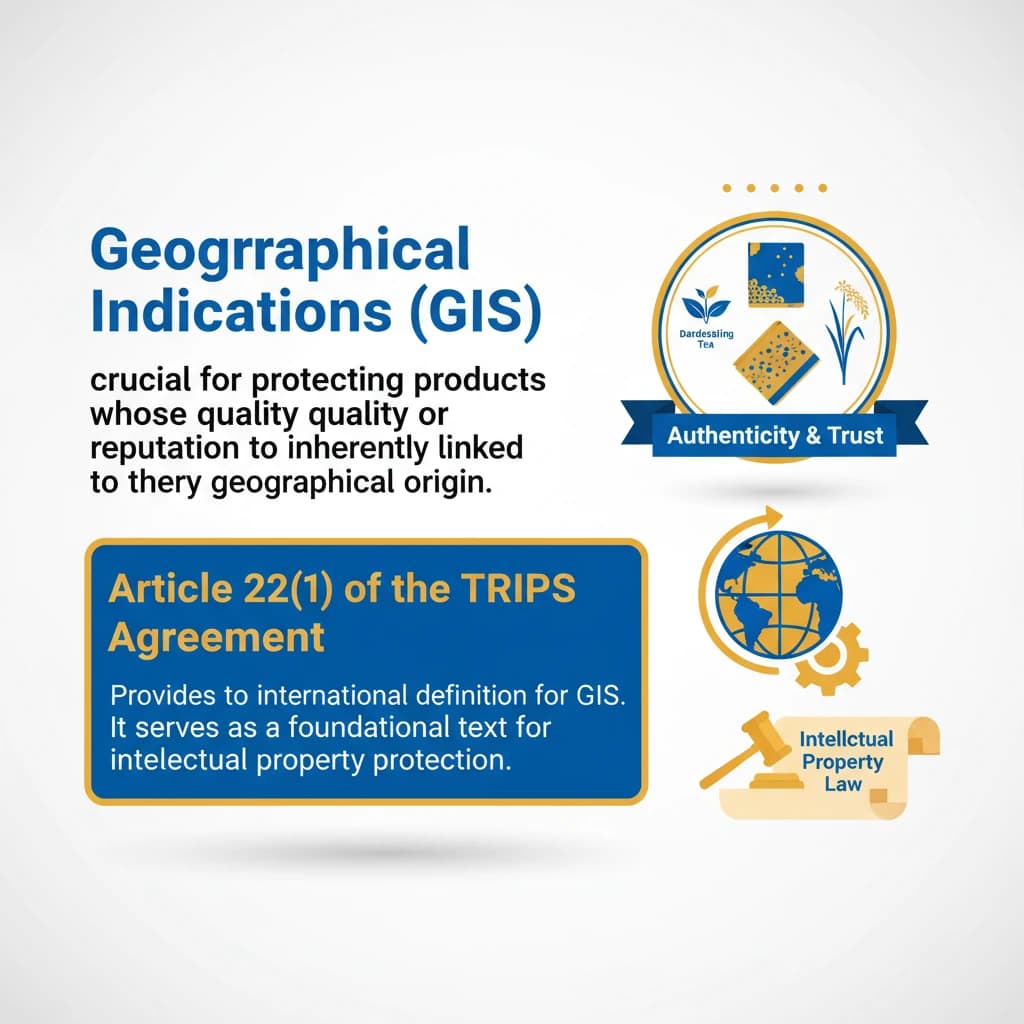
<h4>Understanding Geographical Indications (GIs)</h4><p><strong>Geographical Indications (GIs)</strong> are crucial for protecting products whose quality or reputation is inherently linked to their geographical origin. This mechanism ensures that consumers can trust the authenticity of such products.</p><div class='key-point-box'><p><strong>Article 22(1) of the TRIPS Agreement</strong> provides the international definition for GIs. It serves as a foundational text for intellectual property protection in this domain.</p></div><h4>Definition of Geographical Indications</h4><p><strong>Article 22(1) of the Trade-Related Aspects of Intellectual Property Rights (TRIPS) Agreement</strong> defines GIs as “indications which identify a good as originating in the territory of a member, or a region or locality in that territory.”</p><div class='info-box'><p>A key criterion is that the <strong>quality</strong>, <strong>reputation</strong>, or other characteristics of the product are essentially attributable to its <strong>geographical origin</strong>. This link is fundamental to GI protection.</p></div><h4>Scope of GI Protection</h4><p>Initially, GIs were often associated with agricultural products like wines and spirits. However, their scope has significantly broadened over time.</p><p>GI protection is now also extended to <strong>non-agricultural products</strong>. This includes handicrafts and other manufactured goods whose unique qualities stem from human skills, materials, and resources available in specific areas.</p><h4>The Inherent Link to Origin</h4><p>The core principle behind GIs is the intrinsic connection between a product's attributes and its place of origin. This connection can be due to natural factors like climate and soil, or human factors like traditional manufacturing methods.</p><div class='key-point-box'><p>The reputation of these products is not just about branding; it's about the collective knowledge and environmental conditions of a specific region that make the product <strong>unique</strong> and of high quality.</p></div><h4>Global and Indian Status of GI Registrations</h4><p>Globally, there's a varying landscape of GI registrations. Some countries have robust systems and a high number of registered products.</p><div class='info-box'><p>As per <strong>2020 data from the World Intellectual Property Organization (WIPO)</strong>, <strong>Germany</strong> leads in GI registrations with <strong>15,566</strong> products. <strong>China</strong> follows with <strong>7,247</strong> registered products, showcasing significant activity in this area.</p></div><p>In contrast, <strong>India lags in GI registration</strong> compared to many other nations. Despite a rich tradition of unique products, the number of registered GIs remains relatively low.</p><div class='info-box'><p>By <strong>December 2023</strong>, <strong>Intellectual Property India</strong> had received <strong>1,167 applications</strong> for GI tags. Out of these, only <strong>547 products</strong> had been successfully registered, indicating a substantial gap.</p></div><p>Within India, the majority of registered GI products fall into two main categories. <strong>Handicrafts</strong> comprise approximately <strong>45%</strong> of the total GIs, reflecting India's diverse artisan traditions.</p><p><strong>Agriculture products</strong> account for about <strong>30%</strong> of India's GI registrations. This highlights the importance of protecting unique food items and agricultural produce linked to specific regions.</p><div class='exam-tip-box'><p><strong>UPSC Insight:</strong> Questions on <strong>GI tags</strong> often appear in <strong>Prelims</strong> (e.g., matching GI products with states) and <strong>Mains GS-III</strong> (e.g., role in rural economy, intellectual property rights). Understanding the definition and global/Indian status is crucial.</p></div>
Concept Diagram

💡 Key Takeaways

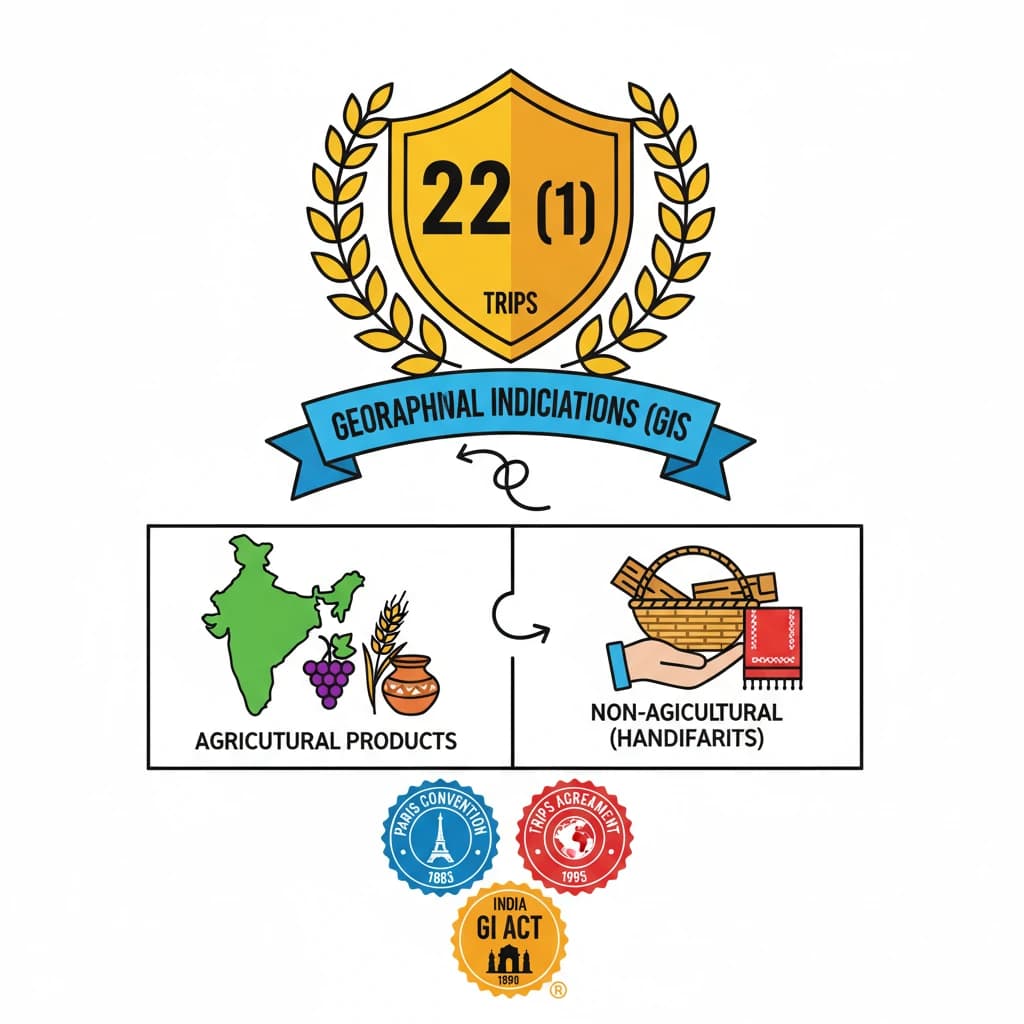
  • •Article 22(1) of TRIPS defines GIs as products identified by origin, with qualities linked to that origin.
  • •GIs cover both agricultural and non-agricultural (e.g., handicrafts) products.
  • •The Paris Convention (1883) and TRIPS Agreement (1995) are key international frameworks.
  • •India enacted the GI Act in 1999 to register and protect GIs domestically.
  • •India has significantly fewer GI registrations (547 by Dec 2023) compared to global leaders like Germany and China.
  • •Handicrafts (45%) and agriculture (30%) dominate India's GI product categories.
  • •GIs are vital for rural economies, preserving traditional knowledge, and boosting exports.

🧠 Memory Techniques
Memory Aid
98% Verified Content

📚 Reference Sources

•World Trade Organization (WTO) - TRIPS Agreement text
•Intellectual Property India (Controller General of Patents, Designs & Trade Marks) - GI Registry data
•World Intellectual Property Organization (WIPO) - Global GI statistics

Related Topics

Loading related topics...
Explore:Economy Topics·All Subjects·Daily Current Affairs·Editorial Analysis·Previous Year Questions·UPSC GPT