📖 Introduction
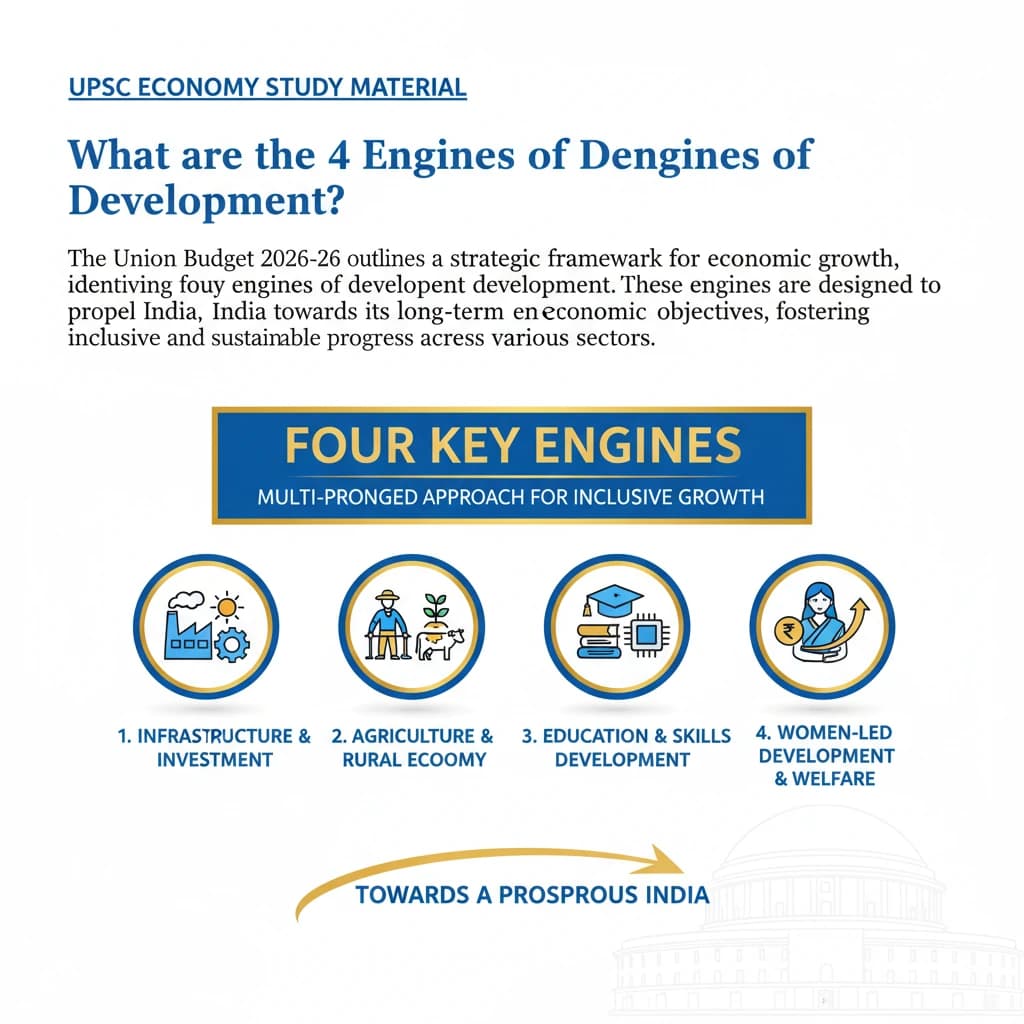
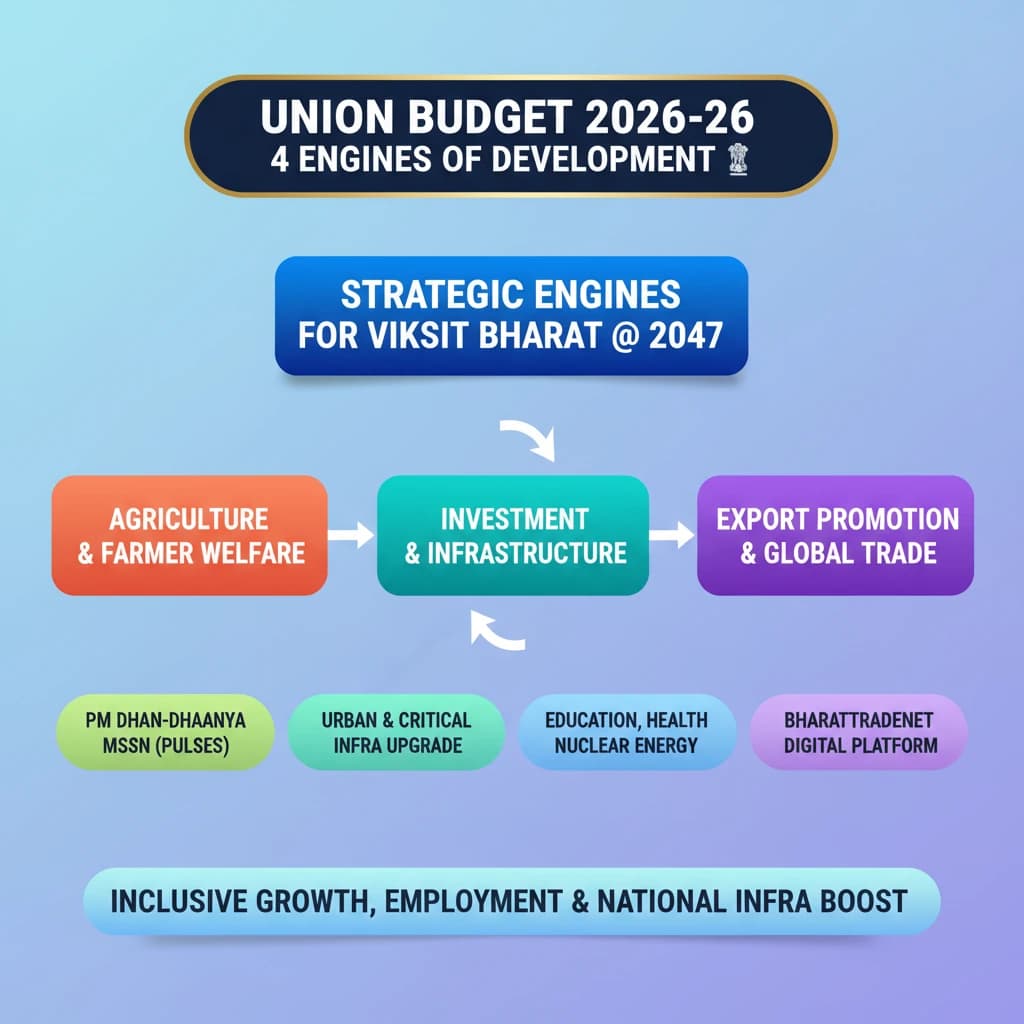
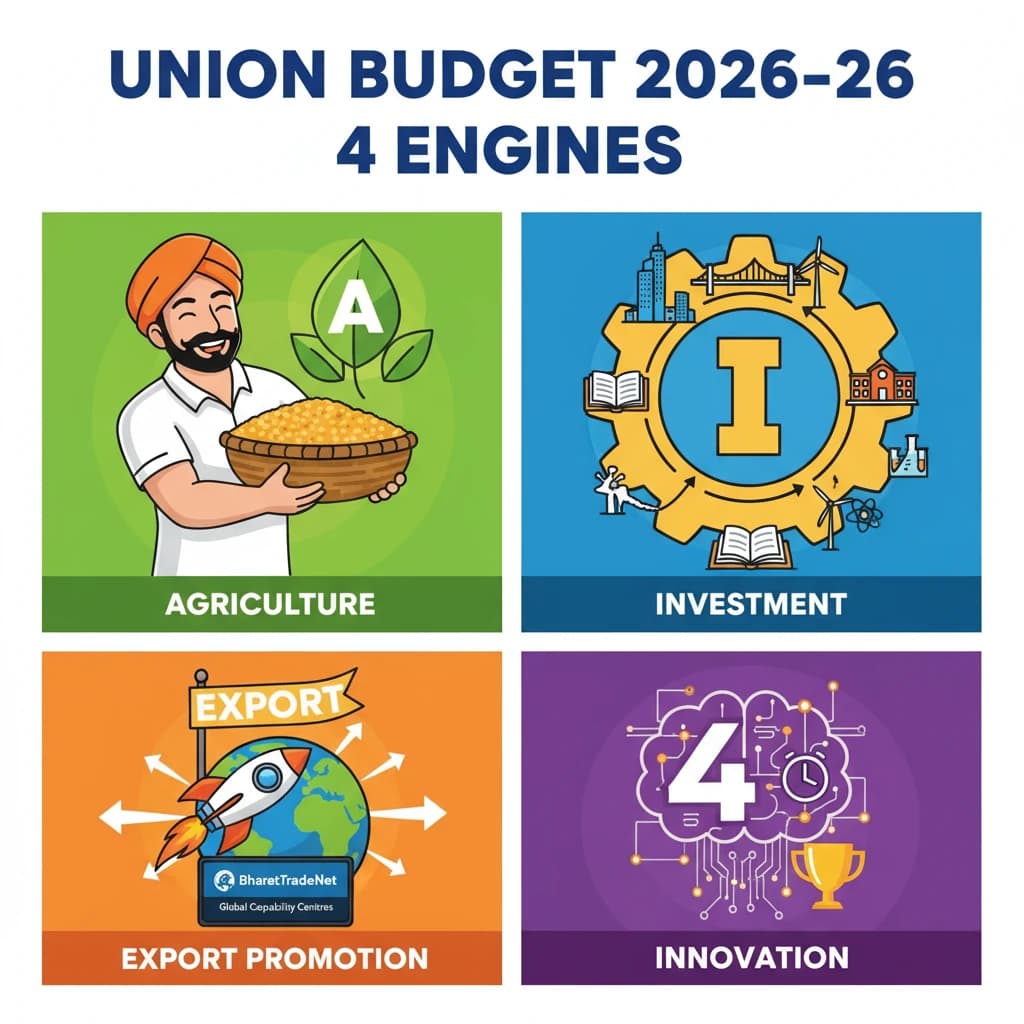
<h4>Introduction to the 4 Engines of Development</h4><p>The <strong>Union Budget 2026-26</strong> outlines a strategic framework for economic growth, identifying <strong>four key engines of development</strong>. These engines are designed to propel India towards its long-term economic objectives, fostering inclusive and sustainable progress across various sectors.</p><div class='key-point-box'><p>These <strong>four engines</strong> represent a multi-pronged approach, focusing on critical sectors to ensure holistic development and enhance India's global competitiveness, with specific details provided for Agriculture, Investment, and Export Promotion.</p></div><h4>1st Engine: Agriculture</h4><p>The agricultural sector is identified as a primary driver, with several initiatives aimed at boosting productivity, farmer welfare, and resilience. The focus is on ensuring food security and enhancing rural prosperity.</p><h5>Prime Minister Dhan-Dhaanya Krishi Yojana</h5><div class='info-box'><ul><li><strong>Coverage:</strong> To be implemented in <strong>1.00 lakh low agricultural productivity districts</strong>.</li><li><strong>Beneficiaries:</strong> Expected to benefit <strong>1.7 crore farmers</strong>.</li><li><strong>Key Focus Areas:</strong> Enhancing <strong>irrigation facilities</strong> and improving <strong>post-harvest storage facilities</strong>.</li></ul></div><h5>Rural Prosperity and Resilience Programme</h5><p>A new <strong>'Rural Prosperity and Resilience' programme</strong> is slated for launch in partnership with states. This initiative aims to tackle <strong>agricultural underemployment</strong> effectively.</p><p>The programme will address underemployment through strategic interventions in <strong>skilling, investment, and technology adoption</strong>, empowering rural populations.</p><h5>Atma Nirbharta in Pulses Mission</h5><p>A significant <strong>6-year mission</strong> is announced to achieve <strong>self-reliance (Atma Nirbharta) in pulses</strong>. This mission will specifically focus on three key pulses: <strong>Tur, Urad, and Masoor</strong>.</p><p>The mission emphasizes ensuring the availability of <strong>climate-resilient seeds</strong> and guaranteeing <strong>remunerative prices</strong> for farmers producing these pulses.</p><div class='info-box'><p><strong>Procurement Strategy:</strong> <strong>Central agencies</strong> like <strong>NAFED</strong> and <strong>NCCF</strong> will be prepared to procure these three pulses directly from farmers over the next <strong>four years</strong>.</p></div><h5>Enhanced Kisan Credit Card (KCC) Limit</h5><p>To facilitate better credit flow, the <strong>Kisan Credit Card (KCC) limit</strong> has been significantly raised. This enhancement aims to provide greater financial support to farmers.</p><div class='info-box'><p><strong>New Limit:</strong> Increased from <strong>₹3 lakh to ₹5 lakh</strong>.</p><p><strong>Beneficiaries:</strong> This enhanced credit facility will benefit approximately <strong>7.7 crore farmers</strong> across the country.</p></div><h5>National Mission on High Yielding Seeds</h5><p>This mission is designed to strengthen <strong>agricultural research</strong> and development. Its primary goal is to ensure the widespread availability of superior seed varieties.</p><div class='info-box'><p><strong>Target:</strong> To ensure availability of <strong>100+ high-yielding and pest-resistant seed varieties</strong>, boosting crop productivity and resilience.</p></div><h5>Mission for Cotton Productivity</h5><p>A comprehensive <strong>5-year initiative</strong> is planned to revitalize the cotton sector. The mission promotes sustainable farming practices.</p><p>It aims to increase the production of <strong>extra-long-staple cotton</strong> and significantly improve its overall quality, benefiting cotton farmers and the textile industry.</p><h4>3rd Engine: Investment</h4><p>Investment is highlighted as a crucial engine, focusing on urban development, infrastructure, education, health, and strategic sectors like nuclear energy and aviation.</p><h5>Urban Challenge Fund</h5><p>A substantial <strong>Urban Challenge Fund</strong> has been allocated to support various urban development initiatives. This fund aims to transform cities into economic powerhouses.</p><div class='info-box'><ul><li><strong>Total Allocation:</strong> <strong>₹1 lakh crore</strong>.</li><li><strong>Key Themes:</strong> Supporting <strong>'Cities as Growth Hubs,' 'Creative Redevelopment of Cities,'</strong> and improving <strong>'Water and Sanitation'</strong>.</li><li><strong>2025-26 Allocation:</strong> <strong>₹10,000 crore</strong> specifically allocated for the upcoming fiscal year.</li></ul></div><h5>Jal Jeevan Mission</h5><p>The successful <strong>Jal Jeevan Mission</strong> receives an enhanced budget and an extension, reaffirming the government's commitment to universal piped water access.</p><div class='info-box'><ul><li><strong>Total Budget Outlay:</strong> Enhanced to <strong>₹5,67,000 Crore</strong>.</li><li><strong>Extension:</strong> Mission extended until <strong>2028</strong>.</li><li><strong>Impact:</strong> <strong>15 crore households</strong>, representing <strong>80% of India’s rural population</strong>, have already benefited from piped water coverage.</li></ul></div><h5>Maritime Development Fund</h5><p>A dedicated fund is established to bolster India's maritime sector. This aims to provide long-term financial support for critical infrastructure and industries.</p><div class='info-box'><ul><li><strong>Fund Size:</strong> <strong>₹25,000 crore</strong>.</li><li><strong>Government Contribution:</strong> <strong>49%</strong> of the fund will be contributed by the government.</li><li><strong>Support Areas:</strong> Financing for <strong>shipbuilding, port development</strong>, and enhancing <strong>logistics infrastructure</strong>.</li></ul></div><h5>Expansion of IITs and PM Research Fellowship</h5><p>Investment in technical education and advanced research is a key priority. This includes expanding premier institutions and supporting high-end research.</p><div class='info-box'><ul><li><strong>IIT Expansion:</strong> Additional infrastructure to accommodate <strong>6,500 more students</strong>, significantly boosting India’s technical education capacity.</li><li><strong>PM Research Fellowship:</strong> <strong>10,000 fellowships</strong> allocated for advanced research in leading institutions like <strong>IITs and IISc</strong>.</li></ul></div><h5>Day Care Cancer Centers</h5><p>To improve healthcare accessibility, particularly for cancer treatment, a network of new centers will be established nationwide.</p><div class='info-box'><ul><li><strong>Target:</strong> To be set up in <strong>all district hospitals</strong> within the next <strong>three years</strong>.</li><li><strong>Initial Phase:</strong> <strong>200 Centers</strong> to become operational in <strong>2025-26</strong>, ensuring affordable treatment.</li></ul></div><h5>Bharatiya Bhasha Pustak Scheme</h5><p>This scheme focuses on leveraging digital technology to enhance educational access across different linguistic backgrounds.</p><p>It aims to provide <strong>digital Indian language books</strong>, thereby improving accessibility for both school and higher education students.</p><h5>Nuclear Energy Mission for Viksit Bharat</h5><p>A significant mission is launched to advance India's nuclear energy capabilities, crucial for achieving energy independence and sustainability goals.</p><div class='info-box'><ul><li><strong>Outlay:</strong> <strong>₹20,000 crore</strong> allocated for the mission.</li><li><strong>Focus:</strong> Development of <strong>Small Modular Reactors (SMRs)</strong>.</li><li><strong>Target:</strong> At least <strong>5 indigenously developed SMRs</strong> to be operational by <strong>2033</strong>.</li></ul><p><strong>Policy Reforms:</strong> Amendments to the <strong>Atomic Energy Act</strong> and the <strong>Civil Liability for Nuclear Damage Act</strong> will be undertaken to facilitate active partnership with the <strong>private sector</strong>.</p></div><h5>UDAN - Regional Connectivity Scheme</h5><p>The revised <strong>UDAN scheme</strong> continues to prioritize enhancing air connectivity to underserved regions, fostering economic development and tourism.</p><div class='info-box'><ul><li><strong>Expansion:</strong> Will enhance regional connectivity to <strong>120 new destinations</strong>.</li><li><strong>Passenger Target:</strong> Aims to carry <strong>4 crore passengers</strong> over the next several years.</li><li><strong>Support:</strong> Also supports the development of <strong>helipads and smaller airports</strong> in <strong>hilly, aspirational, and North East regions</strong>.</li></ul></div><h5>Greenfield Airport in Bihar & Western Koshi Canal ERM Project</h5><p>Specific regional development projects are earmarked to boost infrastructure and agricultural productivity in Bihar.</p><div class='info-box'><ul><li><strong>Bihar Airports:</strong> Development of <strong>Greenfield airports in Bihar</strong>, alongside the expansion of <strong>Patna airport</strong> and a brownfield airport at <strong>Bihta (Patna)</strong>.</li><li><strong>Western Koshi Canal ERM Project:</strong> Financial support for crucial <strong>irrigation infrastructure</strong> in the <strong>Mithilanchal region of Bihar</strong>.</li></ul></div><h5>Tourism for Employment-Led Growth</h5><p>Tourism is recognized as a key sector for generating employment and promoting local economies. A challenge mode approach is adopted for development.</p><p>The <strong>top 50 tourist destinations</strong> across the country will be developed in partnership with states, utilizing a <strong>challenge mode</strong> to encourage competitive proposals.</p><h4>4th Engine: Export Promotion</h4><p>The final engine focuses on boosting India's exports, enhancing global trade competitiveness, and creating a supportive ecosystem for exporters.</p><h5>Export Promotion Mission</h5><p>A dedicated mission is established to strategically drive export growth. This initiative will involve multi-ministerial collaboration.</p><div class='info-box'><ul><li><strong>Establishment:</strong> An <strong>Export Promotion Mission</strong> will be set up.</li><li><strong>Targets:</strong> Will have clear <strong>sectoral and ministerial targets</strong>.</li><li><strong>Leadership:</strong> Led collaboratively by the <strong>Ministries of Commerce, MSME, and Finance</strong>.</li></ul></div><h5>BharatTradeNet (BTN)</h5><p>A unified digital platform is introduced to streamline international trade processes, making them more efficient and accessible for businesses.</p><div class='info-box'><p><strong>Function:</strong> A <strong>unified digital platform</strong> designed to facilitate <strong>international trade documentation</strong> and provide comprehensive <strong>financing solutions</strong>.</p></div><h5>National Framework for GCC (Global Capability Centres)</h5><p>This framework aims to attract and promote the establishment of Global Capability Centres within India, particularly in emerging cities.</p><div class='info-box'><p><strong>Objective:</strong> Policy incentives will be provided to promote <strong>outsourcing hubs (Global Capability Centres)</strong> in emerging <strong>Tier-2 cities</strong>, fostering job creation and economic diversification.</p></div><h5>Warehousing Facility for Air Cargo</h5><p>To support high-value and perishable exports, specialized infrastructure development is prioritized.</p><p>This involves the development of advanced <strong>storage infrastructure</strong> specifically for <strong>high-value perishable exports</strong>, ensuring their quality and timely delivery.</p>