Loading page, please wait…
Vaidra Logo
Vaidra

Top 4 items + smart groups

UPSC GPT
New
Current Affairs
Daily Solutions
Daily Puzzle
Mains Evaluator

Version 2.0.0 • Built with ❤️ for UPSC aspirants

Loading...
Loading...
Loading...
Loading...
Loading...
Loading...
Loading...
Loading...
Loading...
Loading...
Loading...
Loading...
Loading...
Back
All Subjects

Topics

0 topics • 0 completed

Loading topics...
Loading...
Loading...
Loading...
Loading...
Loading...
Overall Progress0%

What are Payment Banks? - UPSC Economy

What is What are Payment Banks? in UPSC Economy?

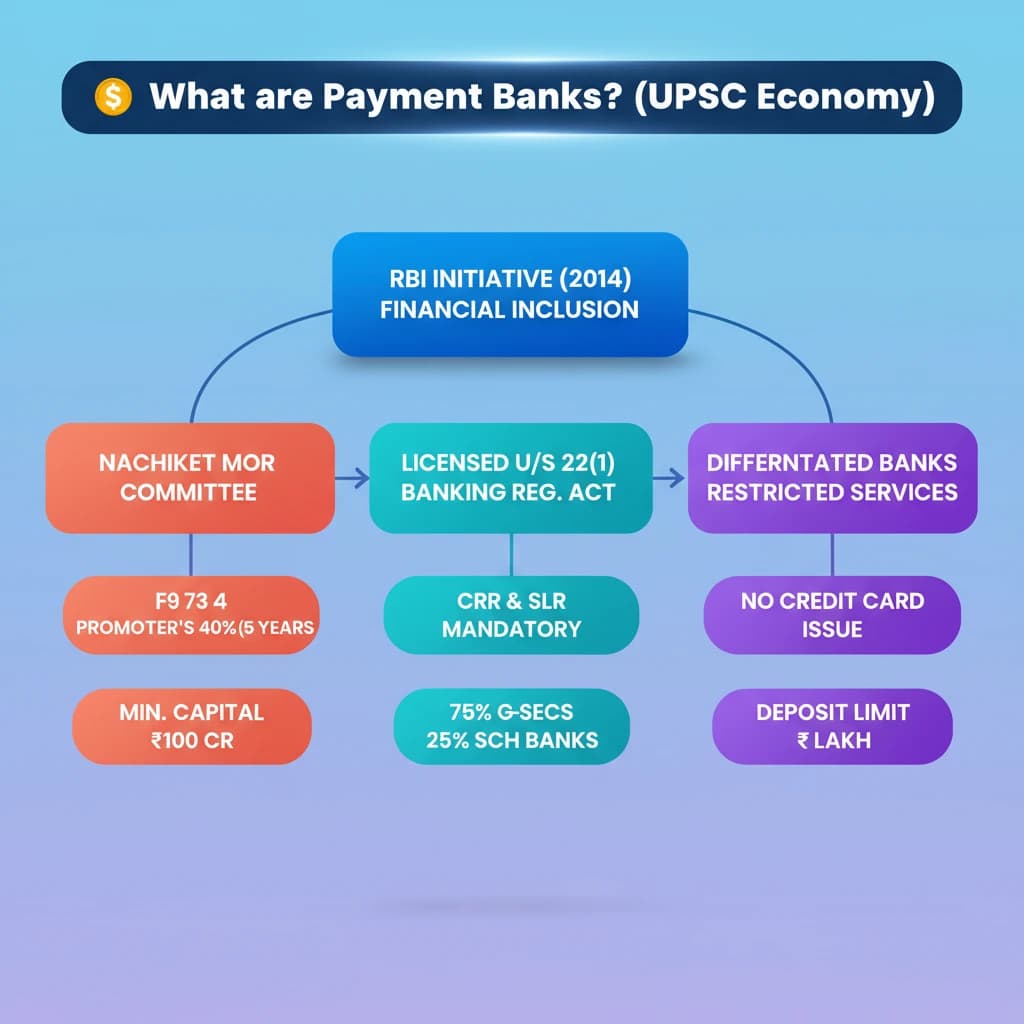
What are Payment Banks? is a key topic under Economy for UPSC Civil Services Examination. Key points include: Payment Banks are specialized banks introduced by RBI in 2014 to promote financial inclusion.. They were established based on the recommendations of the Nachiket Mor committee.. Licensed under Section 22 (1) of the Banking Regulation Act, 1949, as differentiated banks with restricted services.. Understanding this topic is essential for both UPSC Prelims and Mains preparation.

Why is What are Payment Banks? important for UPSC exam?

What are Payment Banks? is a Medium-level topic in UPSC Economy. It is tested in both Prelims (factual MCQs) and Mains (analytical answer writing). Previous year UPSC questions have frequently covered aspects of What are Payment Banks?, making it essential for comprehensive IAS preparation.

How to prepare What are Payment Banks? for UPSC?

To prepare What are Payment Banks? for UPSC: (1) Study the comprehensive notes covering all key concepts on Vaidra. (2) Practice previous year questions on this topic. (3) Connect it with current affairs using daily updates. (4) Revise using key takeaways and mind maps available for Economy. (5) Write practice answers linking What are Payment Banks? to related GS Paper topics.

Key takeaways of What are Payment Banks? for UPSC

  • Payment Banks are specialized banks introduced by RBI in 2014 to promote financial inclusion.
  • They were established based on the recommendations of the Nachiket Mor committee.
  • Licensed under Section 22 (1) of the Banking Regulation Act, 1949, as differentiated banks with restricted services.
  • Required to maintain CRR and SLR; 75% of demand deposits in G-secs/T-bills (up to 1 year), 25% in other scheduled commercial banks.
  • Minimum paid-up equity capital is ₹100 crore; promoter's initial contribution is 40% for the first 5 years.
  • They cannot undertake lending activities, issue credit cards, or accept large deposits (currently capped at ₹2 lakh per customer).
  • Primary focus is on deposits, remittances, and payment services, often leveraging digital platforms.
What are Payment Banks?

What are Payment Banks?

Medium⏱️ 7 min read✓ 98% Verified
economy

📖 Introduction

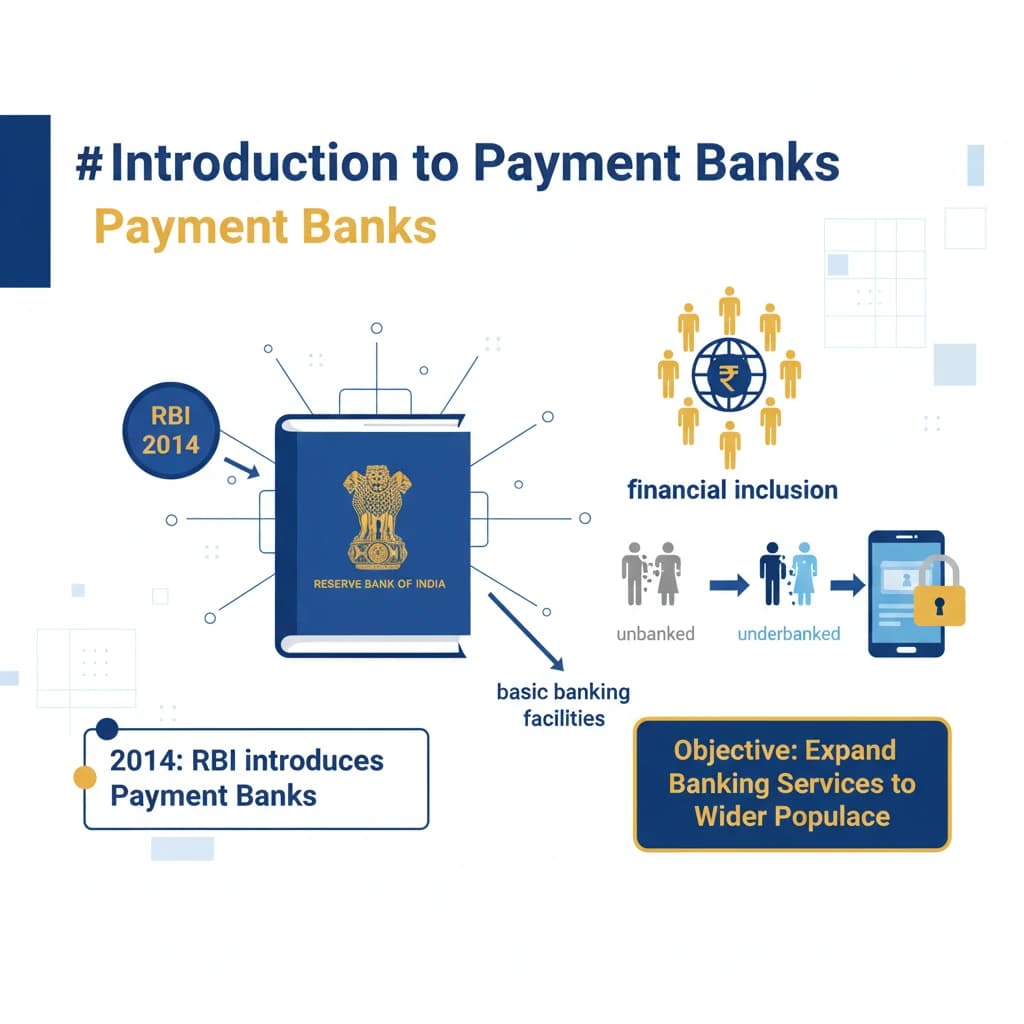
<h4>Introduction to Payment Banks</h4><p><strong>Payment Banks</strong> are a specialized category of financial institutions introduced by the <strong>Reserve Bank of India (RBI)</strong> in <strong>2014</strong>. They represent a unique model designed to expand banking services to a wider populace.</p><p>Their primary objective is to foster <strong>financial inclusion</strong> by providing basic banking facilities to the <strong>unbanked</strong> and <strong>underbanked</strong> segments of society, especially in remote and rural areas.</p><h4>Origin and Recommendations</h4><p>The establishment of <strong>Payment Banks</strong> was a direct outcome of the recommendations put forth by the <strong>Nachiket Mor committee</strong>. This committee was constituted by the <strong>RBI</strong> to comprehensively examine financial services for <strong>small businesses</strong> and <strong>low-income households</strong>.</p><div class='key-point-box'>The committee's insights highlighted the need for a differentiated banking approach to cater specifically to these underserved groups, leading to the creation of Payment Banks.</div><h4>Licensing Framework</h4><p><strong>Payment Banks</strong> are officially licensed under <strong>Section 22 (1) of the Banking Regulation Act, 1949</strong>. This legal framework grants them the authority to operate within India's banking system.</p><p>They fall under the <strong>differentiated bank license</strong> category, which means they are restricted from offering the full spectrum of services provided by conventional commercial banks. The <strong>RBI</strong> grants two main types of banking licenses: <strong>universal bank licenses</strong> and <strong>differentiated bank licenses</strong>.</p><div class='exam-tip-box'>Understanding the 'differentiated' nature is crucial for <strong>UPSC</strong>. It implies a focused mandate and specific operational limitations compared to universal banks.</div><h4>Key Features: Reserve Requirements</h4><p>Like other banks, <strong>Payment Banks</strong> are mandated to adhere to certain reserve requirements to ensure financial stability and liquidity. They are required to maintain both the <strong>Cash Reserve Ratio (CRR)</strong> and the <strong>Statutory Liquidity Ratio (SLR)</strong>.</p><div class='info-box'><ul><li><strong>SLR Investment:</strong> A minimum of <strong>75%</strong> of their <strong>demand deposit balances</strong> must be invested in <strong>Statutory Liquidity Ratio (SLR) eligible G-securities/T-bills</strong> with a maturity period of up to <strong>one year</strong>.</li><li><strong>Other Deposits:</strong> A maximum of <strong>25%</strong> of their demand deposit balances can be held in <strong>current and time/fixed deposits</strong> with other <strong>scheduled commercial banks</strong>, in addition to maintaining their <strong>CRR</strong> requirements.</li></ul></div><h4>Key Features: Capital Requirements</h4><p>To ensure a robust financial foundation, specific capital requirements have been stipulated for <strong>Payment Banks</strong>.</p><div class='info-box'><ul><li><strong>Minimum Paid-up Capital:</strong> The minimum required <strong>paid-up equity capital</strong> for a <strong>Payment Bank</strong> has been fixed at <strong>₹100 crore</strong>.</li><li><strong>Promoter's Contribution:</strong> The promoter's minimum initial contribution to the paid-up equity capital must be at least <strong>40%</strong>, and this contribution needs to be maintained for the <strong>first 5 years</strong> of the bank's operations.</li></ul></div>
Concept Diagram

💡 Key Takeaways

  • •Payment Banks are specialized banks introduced by RBI in 2014 to promote financial inclusion.
  • •They were established based on the recommendations of the Nachiket Mor committee.
  • •Licensed under Section 22 (1) of the Banking Regulation Act, 1949, as differentiated banks with restricted services.
  • •Required to maintain CRR and SLR; 75% of demand deposits in G-secs/T-bills (up to 1 year), 25% in other scheduled commercial banks.
  • •Minimum paid-up equity capital is ₹100 crore; promoter's initial contribution is 40% for the first 5 years.
  • •They cannot undertake lending activities, issue credit cards, or accept large deposits (currently capped at ₹2 lakh per customer).
  • •Primary focus is on deposits, remittances, and payment services, often leveraging digital platforms.

🧠 Memory Techniques

Memory Aid
98% Verified Content

📚 Reference Sources

•Reserve Bank of India (RBI) website - Guidelines for Licensing of Payments Banks
•Reports of the Nachiket Mor Committee (Committee on Comprehensive Financial Services for Small Businesses and Low-Income Households)

Related Topics

Loading related topics...
Explore:Economy Topics·All Subjects·Daily Current Affairs·Editorial Analysis·Previous Year Questions·UPSC GPT
What are Payment Banks? - UPSC Economy