Loading page, please wait…
Vaidra Logo
Vaidra

Top 4 items + smart groups

UPSC GPT
New
Current Affairs
Daily Solutions
Daily Puzzle
Mains Evaluator

Version 2.0.0 • Built with ❤️ for UPSC aspirants

Loading...
Loading...
Loading...
Loading...
Loading...
Loading...
Loading...
Loading...
Loading...
Loading...
Loading...
Loading...
Loading...
What are the Four Labour Codes? - UPSC Economy

What are the Four Labour Codes? - UPSC Economy

What is What are the Four Labour Codes? in UPSC Economy?

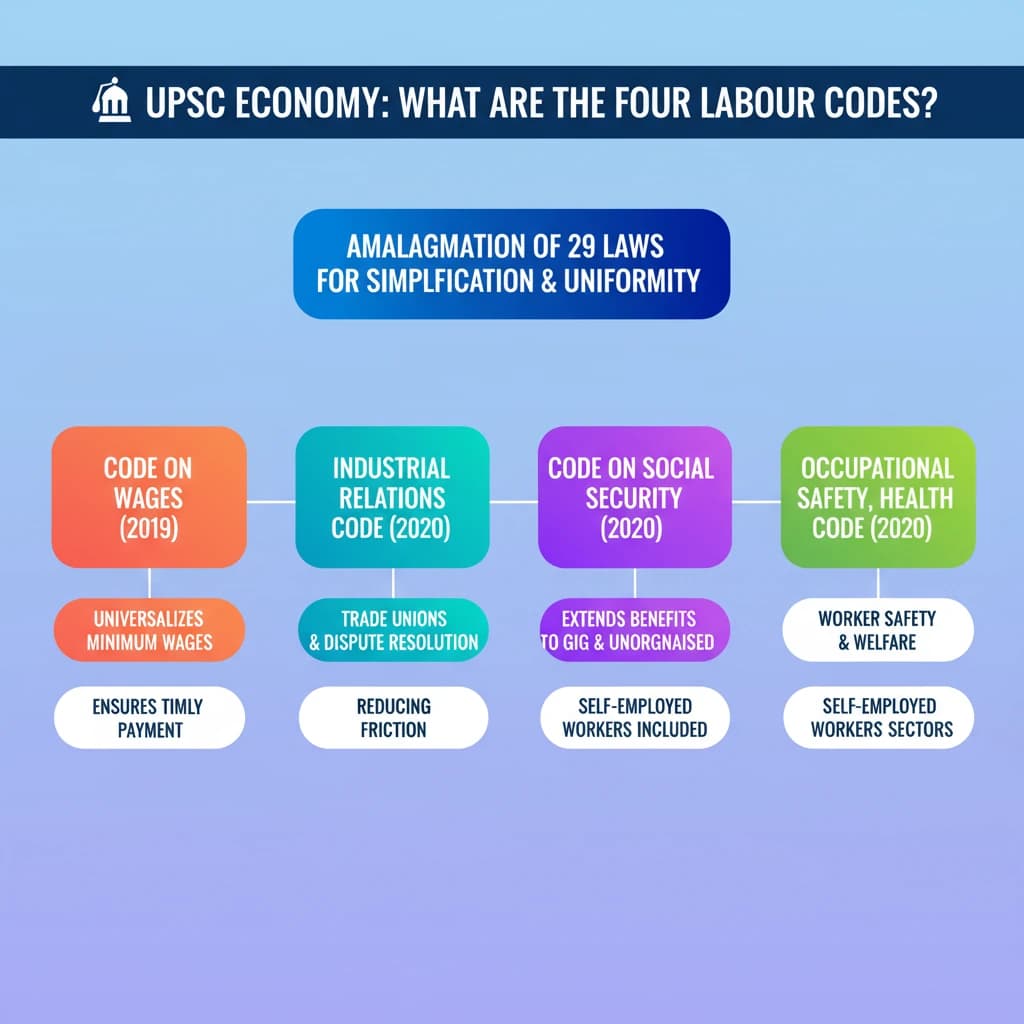
What are the Four Labour Codes? is a key topic under Economy for UPSC Civil Services Examination. Key points include: Four Labour Codes amalgamate 29 existing labour laws for simplification and uniformity.. Code on Wages (2019) universalizes minimum wages and ensures timely payment for all workers.. Industrial Relations Code (2020) focuses on trade unions, reducing friction, and efficient dispute resolution.. Understanding this topic is essential for both UPSC Prelims and Mains preparation.

Why is What are the Four Labour Codes? important for UPSC exam?

What are the Four Labour Codes? is a Medium-level topic in UPSC Economy. It is tested in both Prelims (factual MCQs) and Mains (analytical answer writing). Previous year UPSC questions have frequently covered aspects of What are the Four Labour Codes?, making it essential for comprehensive IAS preparation.

How to prepare What are the Four Labour Codes? for UPSC?

To prepare What are the Four Labour Codes? for UPSC: (1) Study the comprehensive notes covering all key concepts on Vaidra. (2) Practice previous year questions on this topic. (3) Connect it with current affairs using daily updates. (4) Revise using key takeaways and mind maps available for Economy. (5) Write practice answers linking What are the Four Labour Codes? to related GS Paper topics.

Key takeaways of What are the Four Labour Codes? for UPSC

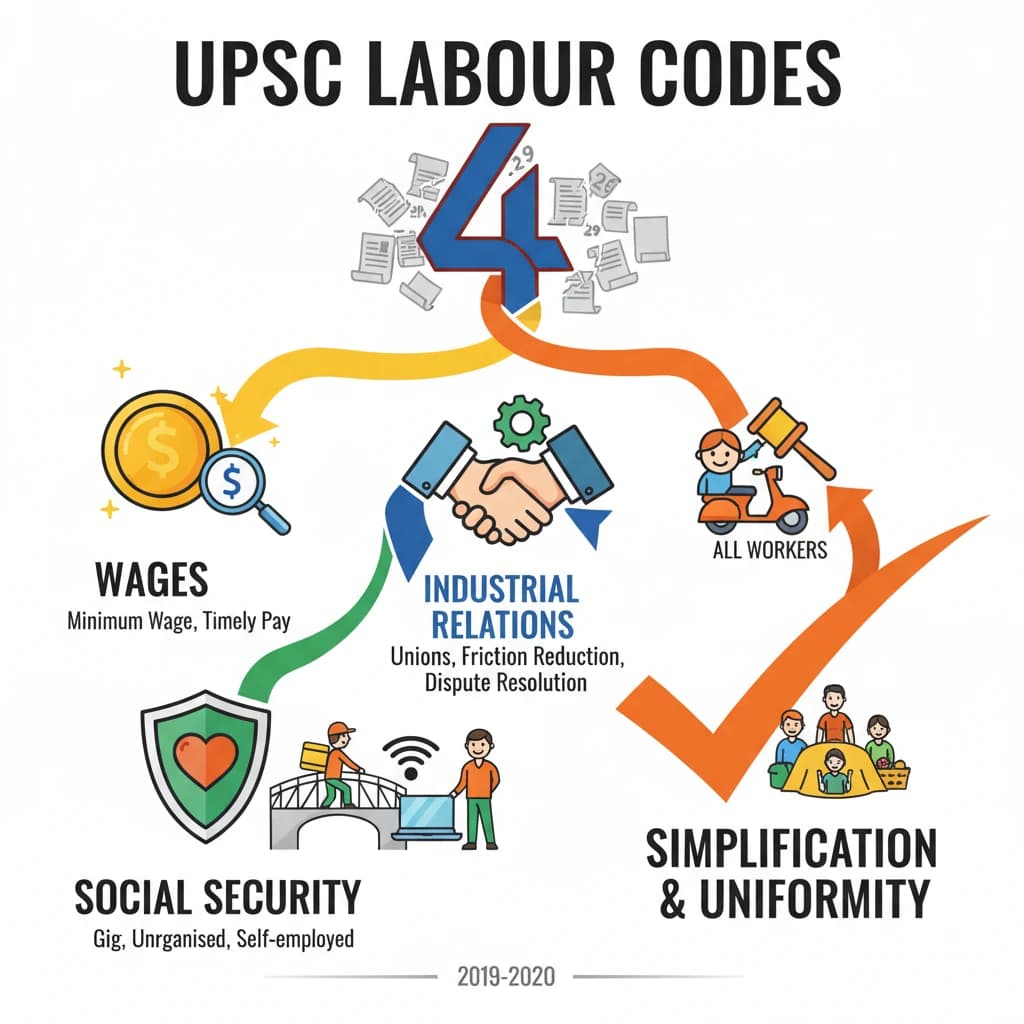
  • Four Labour Codes amalgamate 29 existing labour laws for simplification and uniformity.
  • Code on Wages (2019) universalizes minimum wages and ensures timely payment for all workers.
  • Industrial Relations Code (2020) focuses on trade unions, reducing friction, and efficient dispute resolution.
  • Code on Social Security (2020) extends social security benefits to self-employed, gig, and unorganised sector workers.
  • Occupational Safety, Health and Working Conditions Code (2020) emphasizes worker safety and welfare across various sectors.
  • The codes aim to balance worker protection with promoting ease of doing business and fostering industrial harmony.
What are the Four Labour Codes?

What are the Four Labour Codes?

Medium⏱️ 7 min read✓ 95% Verified
economy

📖 Introduction

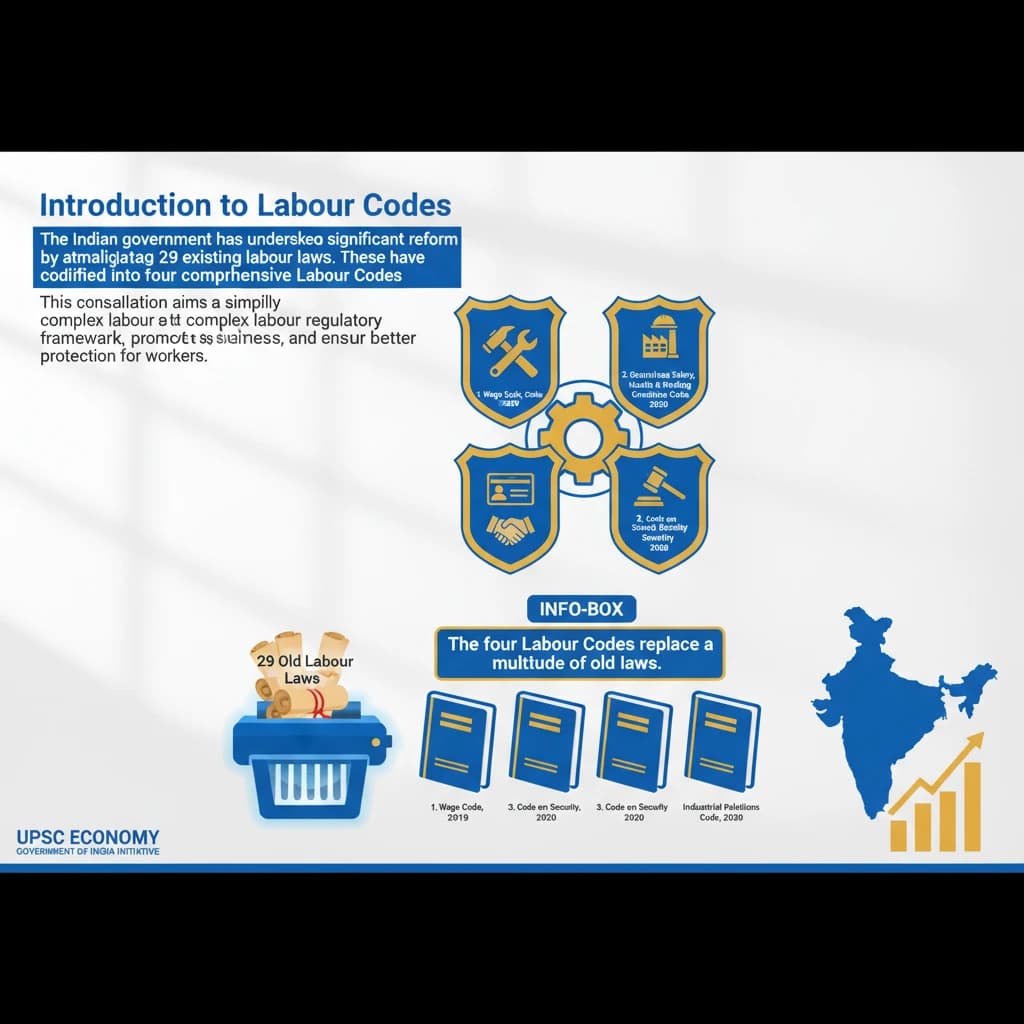
<h4>Introduction to Labour Codes</h4><p>The Indian government has undertaken a significant reform by <strong>amalgamating 29 existing labour laws</strong>. These have been codified into <strong>four comprehensive Labour Codes</strong>.</p><p>This consolidation aims to simplify the complex labour regulatory framework, promote <strong>ease of doing business</strong>, and ensure better protection for workers.</p><div class='info-box'>The <strong>four Labour Codes</strong> replace a multitude of older, often overlapping, and sometimes contradictory labour legislations.</div><h4>Code on Wages, 2019</h4><p>The <strong>Code on Wages, 2019</strong>, is designed to universalize the provisions related to <strong>minimum wages</strong> and <strong>timely payment</strong>. Its core objective is to ensure the <strong>“Right to Sustenance”</strong> for every worker in India.</p><p>It consolidates four existing laws: the <strong>Payment of Wages Act, 1936</strong>; the <strong>Minimum Wages Act, 1948</strong>; the <strong>Payment of Bonus Act, 1965</strong>; and the <strong>Equal Remuneration Act, 1976</strong>.</p><div class='key-point-box'>This Code mandates specific payment timelines: <strong>monthly salaried employees</strong> by the 7th of the following month, <strong>weekly wage workers</strong> by the week's end, and <strong>daily wage earners</strong> on the same day.</div><h4>Industrial Relations Code, 2020</h4><p>The <strong>Industrial Relations Code, 2020</strong>, provides a structured framework for managing industrial relations. It focuses on protecting workers' rights to form <strong>trade unions</strong>.</p><p>Furthermore, it seeks to reduce friction between employers and workers and establishes clear regulations for the <strong>settlement of industrial disputes</strong>.</p><div class='info-box'>This Code subsumes three key laws: the <strong>Trade Unions Act, 1926</strong>; the <strong>Industrial Employment (Standing Orders) Act, 1946</strong>; and the <strong>Industrial Disputes Act, 1947</strong>.</div><div class='key-point-box'>The primary aim is to foster <strong>industrial peace and harmony</strong> through effective and efficient resolution mechanisms for disputes.</div><h4>Code on Social Security, 2020</h4><p>The <strong>Code on Social Security, 2020</strong>, significantly expands the scope of social security benefits. It aims to include various categories of workers previously outside formal schemes.</p><p>This includes <strong>self-employed</strong>, <strong>home-based</strong>, <strong>wage workers</strong>, <strong>migrant workers</strong>, <strong>unorganised sector workers</strong>, and <strong>gig workers</strong>.</p><div class='info-box'>Key social security schemes covered include <strong>life and disability insurance</strong>, <strong>health and maternity benefits</strong>, and <strong>provident fund</strong> provisions.</div><div class='exam-tip-box'>UPSC often asks about the inclusion of <strong>gig workers</strong> and <strong>unorganised sector workers</strong> in social security nets, making this Code highly relevant for <strong>GS Paper II (Social Justice)</strong>.</div><h4>Occupational Safety, Health and Working Conditions Code, 2020</h4><p>The <strong>Occupational Safety, Health and Working Conditions Code, 2020</strong>, consolidates laws related to the health, safety, and welfare of workers. It emphasizes creating a safe working environment.</p><p>It applies to workers across diverse sectors such as <strong>industry</strong>, <strong>manufacturing</strong>, and <strong>factories</strong>.</p><div class='info-box'>This Code is specifically applicable to <strong>factories having 20 or more workers</strong> where the manufacturing process is carried on with the aid of power.</div><div class='key-point-box'>The Code aims to standardize and improve working conditions, preventing accidents and occupational diseases.</div>
Concept Diagram

💡 Key Takeaways

  • •Four Labour Codes amalgamate 29 existing labour laws for simplification and uniformity.
  • •Code on Wages (2019) universalizes minimum wages and ensures timely payment for all workers.
  • •Industrial Relations Code (2020) focuses on trade unions, reducing friction, and efficient dispute resolution.
  • •Code on Social Security (2020) extends social security benefits to self-employed, gig, and unorganised sector workers.
  • •Occupational Safety, Health and Working Conditions Code (2020) emphasizes worker safety and welfare across various sectors.
  • •The codes aim to balance worker protection with promoting ease of doing business and fostering industrial harmony.

🧠 Memory Techniques
Memory Aid
95% Verified Content

📚 Reference Sources

•Press Information Bureau (PIB) releases on Labour Reforms
•Ministry of Labour & Employment official documents

Related Topics

Loading related topics...
Explore:Economy Topics·All Subjects·Daily Current Affairs·Editorial Analysis·Previous Year Questions·UPSC GPT
Back
All Subjects

Topics

0 topics • 0 completed

Loading topics...
Loading...
Loading...
Loading...
Loading...
Loading...
Overall Progress0%