Loading page, please wait…
Vaidra Logo
Vaidra

Top 4 items + smart groups

UPSC GPT
New
Current Affairs
Daily Solutions
Daily Puzzle
Mains Evaluator

Version 2.0.0 • Built with ❤️ for UPSC aspirants

Loading...
Loading...
Loading...
Loading...
Loading...
Loading...
Loading...
Loading...
Loading...
Loading...
Loading...
Loading...
Loading...
DILRMP and Digitisation of Land Records - UPSC Economy
Back
All Subjects

Topics

0 topics • 0 completed

Loading topics...
Loading...
Loading...
Loading...
Loading...
Loading...
Overall Progress0%

DILRMP and Digitisation of Land Records - UPSC Economy

What is DILRMP and Digitisation of Land Records in UPSC Economy?

DILRMP and Digitisation of Land Records is a key topic under Economy for UPSC Civil Services Examination. Key points include: <strong>DILRMP</strong> (launched <strong>2008</strong>) aims to modernize and digitize all land records.. As of <strong>2024</strong>, <strong>98.5%</strong> of <strong>rural land records</strong> have been digitized.. <strong>SVAMITVA scheme</strong> focuses on creating land records for <strong>inhabited areas</strong> using modern technology.. Understanding this topic is essential for both UPSC Prelims and Mains preparation.

Why is DILRMP and Digitisation of Land Records important for UPSC exam?

DILRMP and Digitisation of Land Records is a Medium-level topic in UPSC Economy. It is tested in both Prelims (factual MCQs) and Mains (analytical answer writing). Previous year UPSC questions have frequently covered aspects of DILRMP and Digitisation of Land Records, making it essential for comprehensive IAS preparation.

How to prepare DILRMP and Digitisation of Land Records for UPSC?

To prepare DILRMP and Digitisation of Land Records for UPSC: (1) Study the comprehensive notes covering all key concepts on Vaidra. (2) Practice previous year questions on this topic. (3) Connect it with current affairs using daily updates. (4) Revise using key takeaways and mind maps available for Economy. (5) Write practice answers linking DILRMP and Digitisation of Land Records to related GS Paper topics.

Key takeaways of DILRMP and Digitisation of Land Records for UPSC

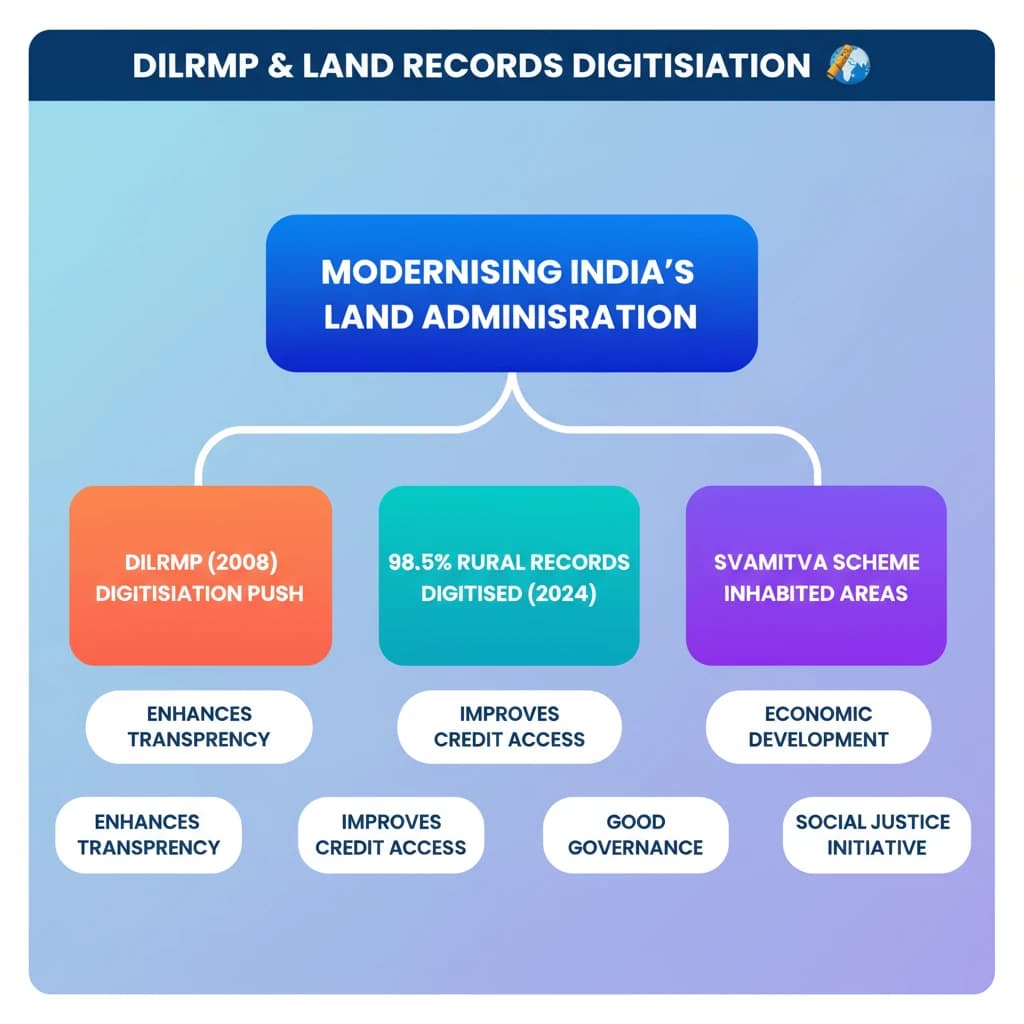
  • <strong>DILRMP</strong> (launched <strong>2008</strong>) aims to modernize and digitize all land records.
  • As of <strong>2024</strong>, <strong>98.5%</strong> of <strong>rural land records</strong> have been digitized.
  • <strong>SVAMITVA scheme</strong> focuses on creating land records for <strong>inhabited areas</strong> using modern technology.
  • Digitization enhances transparency, reduces land disputes, and improves access to credit.
  • These initiatives are vital for good governance, economic development, and social justice in India.
DILRMP and Digitisation of Land Records

DILRMP and Digitisation of Land Records

Medium⏱️ 5 min read✓ 95% Verified
economy

📖 Introduction

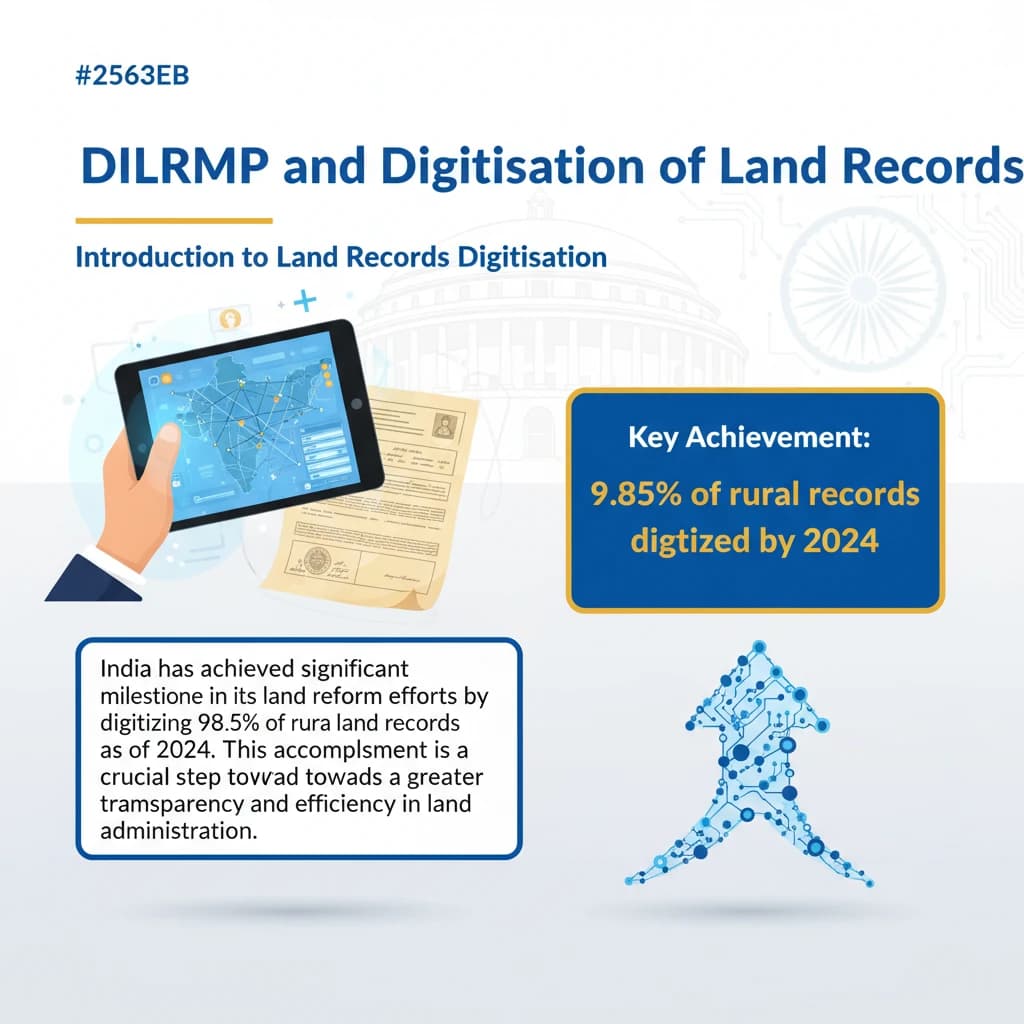
<h4>Introduction to Land Records Digitisation</h4><p>India has achieved a significant milestone in its land reform efforts by digitizing <strong>98.5%</strong> of <strong>rural land records</strong> as of <strong>2024</strong>. This accomplishment is a crucial step towards greater transparency and efficiency in land administration.</p><div class='info-box'><p><strong>Key Achievement:</strong> <strong>98.5%</strong> of <strong>rural land records</strong> digitized by <strong>2024</strong>.</p><p><strong>Objective:</strong> Enhance <strong>transparency</strong> and reduce <strong>land-related disputes</strong>.</p></div><h4>Digital India Land Records Modernization Programme (DILRMP)</h4><p>This extensive digitization drive is a core component of the <strong>Digital India Land Records Modernization Programme (DILRMP)</strong>. The programme was officially launched in <strong>2008</strong>.</p><p>The primary aim of <strong>DILRMP</strong> is to develop a modern, comprehensive, and transparent land records management system. It integrates various land-related processes, making them more accessible and reliable.</p><div class='key-point-box'><p><strong>DILRMP Launch Year:</strong> <strong>2008</strong></p><p><strong>Core Mandate:</strong> Modernize and digitize all land records, including mutation, survey, and settlement operations.</p></div><h4>SVAMITVA Scheme: Addressing Inhabited Areas</h4><p>Complementing <strong>DILRMP</strong> is the <strong>SVAMITVA scheme</strong>, which stands for <strong>Survey of Villages and Mapping with Improvised Technology in Village Areas</strong>. This scheme focuses specifically on creating accurate land records for <strong>inhabited areas</strong>.</p><p>The <strong>SVAMITVA scheme</strong> is designed to provide clarity on property ownership in rural inhabited areas, which traditionally lacked proper surveys. This helps in minimizing <strong>land-related disputes</strong> in these regions.</p><div class='exam-tip-box'><p><strong>UPSC Insight:</strong> Understand the distinction between <strong>DILRMP</strong> (broader land records modernization) and <strong>SVAMITVA</strong> (specific focus on inhabited areas). Both are critical for land governance and rural development, relevant for <strong>GS Paper II</strong> and <strong>GS Paper III</strong>.</p></div>
Concept Diagram

💡 Key Takeaways

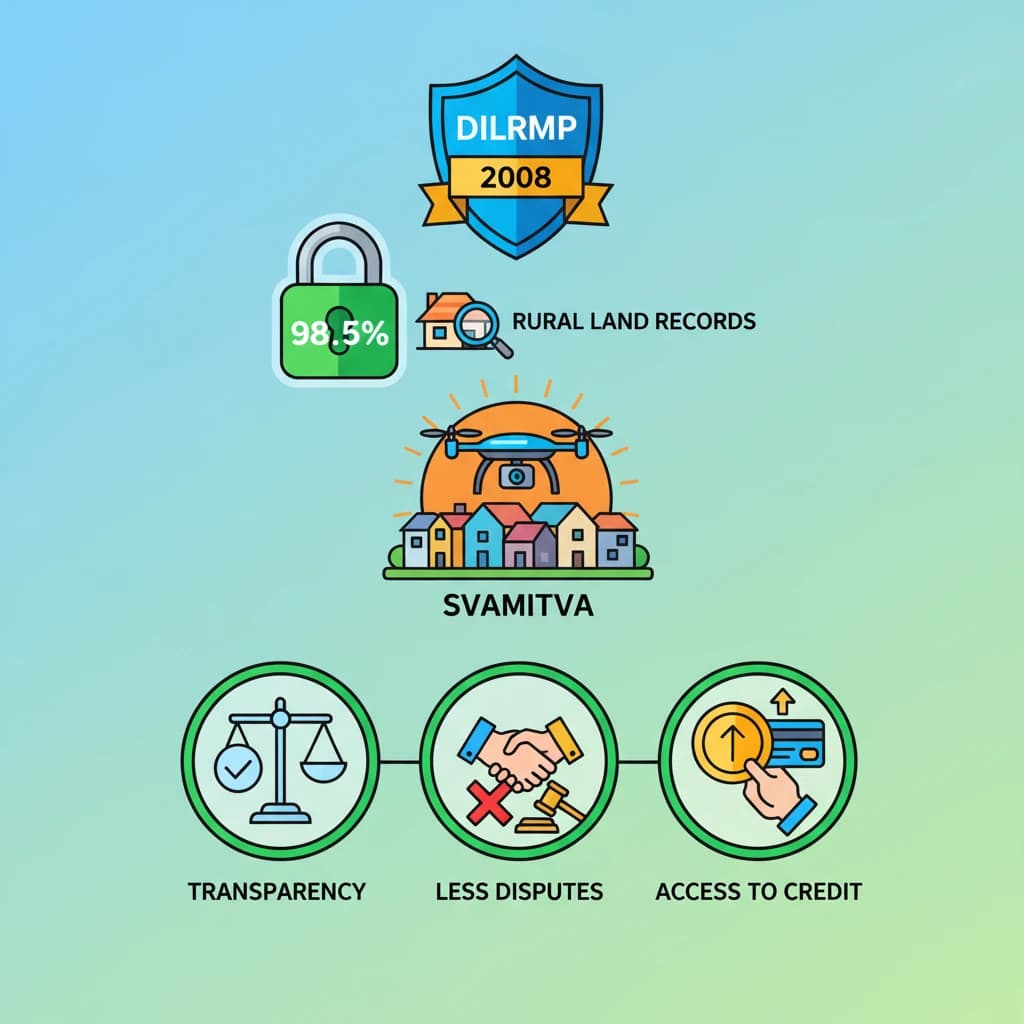
  • •<strong>DILRMP</strong> (launched <strong>2008</strong>) aims to modernize and digitize all land records.
  • •As of <strong>2024</strong>, <strong>98.5%</strong> of <strong>rural land records</strong> have been digitized.
  • •<strong>SVAMITVA scheme</strong> focuses on creating land records for <strong>inhabited areas</strong> using modern technology.
  • •Digitization enhances transparency, reduces land disputes, and improves access to credit.
  • •These initiatives are vital for good governance, economic development, and social justice in India.

🧠 Memory Techniques
Memory Aid
95% Verified Content

📚 Reference Sources

•Ministry of Rural Development, Government of India (for DILRMP details)
•Ministry of Panchayati Raj, Government of India (for SVAMITVA details)

Related Topics

Loading related topics...
Explore:Economy Topics·All Subjects·Daily Current Affairs·Editorial Analysis·Previous Year Questions·UPSC GPT