Loading page, please wait…
8th Pay Commission (PC) - UPSC Economy
What is 8th Pay Commission (PC) in UPSC Economy?
8th Pay Commission (PC) is a key topic under Economy for UPSC Civil Services Examination. Key points include: 8th Pay Commission approved by Union government for central employees, pensioners, and defence personnel.. Pay Commissions assess and recommend revisions to pay scales, allowances, and benefits.. Key factors considered include inflation, impact on remuneration, and cost of living.. Understanding this topic is essential for both UPSC Prelims and Mains preparation.
Why is 8th Pay Commission (PC) important for UPSC exam?
8th Pay Commission (PC) is a Easy-level topic in UPSC Economy. It is tested in both Prelims (factual MCQs) and Mains (analytical answer writing). Previous year UPSC questions have frequently covered aspects of 8th Pay Commission (PC), making it essential for comprehensive IAS preparation.
How to prepare 8th Pay Commission (PC) for UPSC?
To prepare 8th Pay Commission (PC) for UPSC: (1) Study the comprehensive notes covering all key concepts on Vaidra. (2) Practice previous year questions on this topic. (3) Connect it with current affairs using daily updates. (4) Revise using key takeaways and mind maps available for Economy. (5) Write practice answers linking 8th Pay Commission (PC) to related GS Paper topics.
Key takeaways of 8th Pay Commission (PC) for UPSC
- 8th Pay Commission approved by Union government for central employees, pensioners, and defence personnel.
- Pay Commissions assess and recommend revisions to pay scales, allowances, and benefits.
- Key factors considered include inflation, impact on remuneration, and cost of living.
- A new Pay Commission is typically established approximately every 10 years.
- Administered by the Department of Expenditure under the Ministry of Finance.
8th Pay Commission (PC)
Easy⏱️ 5 min read
economy
📖 Introduction
Introduction to the 8th Pay Commission
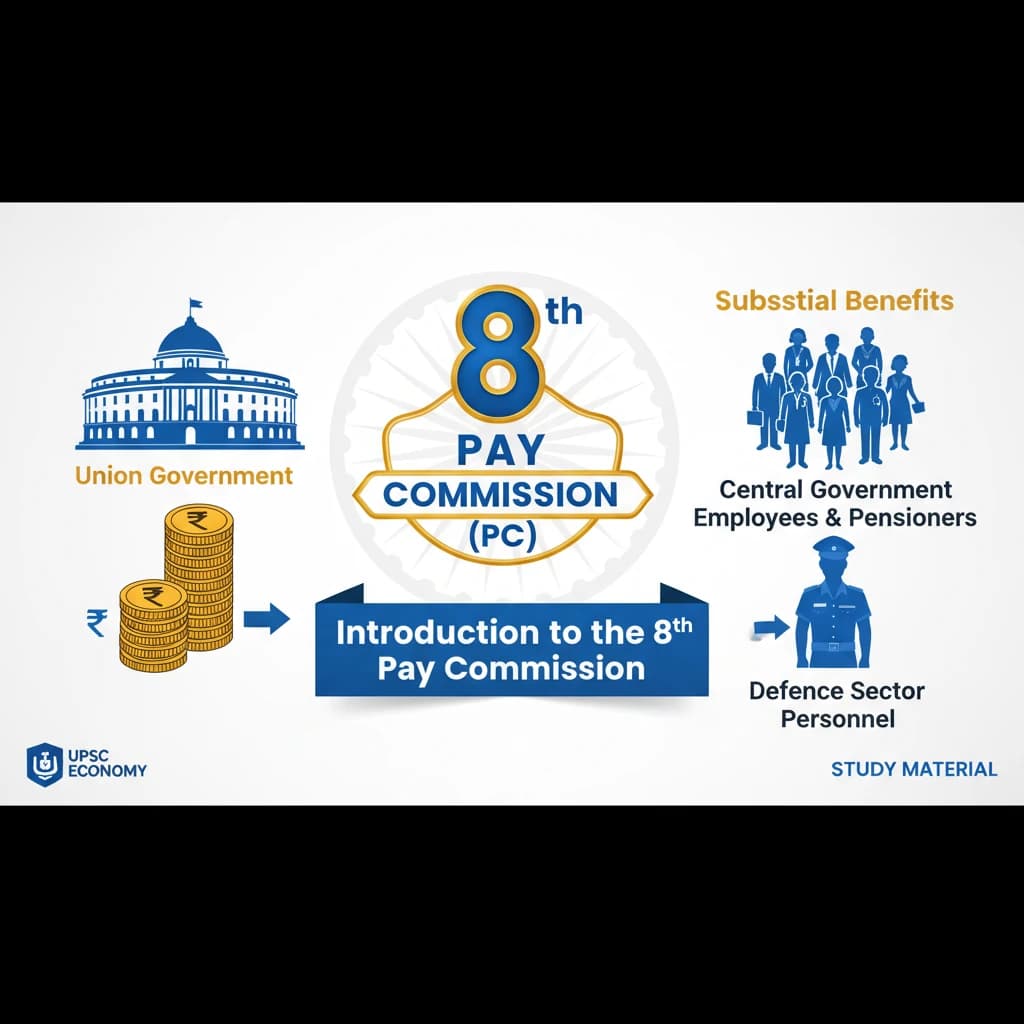
The Union government has recently given its approval for the formation of the 8th Pay Commission (PC).
This significant decision is poised to bring substantial benefits to a wide array of central government employees and pensioners across the nation.
Notably, personnel from the defence sector are also included among the beneficiaries of this upcoming commission.
Understanding Pay Commissions
A Pay Commission (PC) is an administrative body constituted by the Government of India.
Its primary role is to examine and recommend changes to the pay scales, allowances, and benefits for central government employees.
The commission undertakes a thorough assessment, taking into account various economic factors that influence the financial well-being of government personnel.
Key Considerations and Mandate
When formulating its recommendations, the Pay Commission specifically considers the prevailing rates of inflation.
It analyzes the impact of inflation on the overall remuneration structure and the evolving cost of living for employees.
The objective is to ensure that the compensation package remains fair, competitive, and adequate to maintain a reasonable standard of living.
Establishment and Administration
Historically, a new Pay Commission is typically established at regular intervals to review and revise the compensation structure.
It is a standard practice that a new Pay Commission is constituted approximately every 10 years.
The administrative oversight and establishment of the Pay Commission fall under the purview of the Department of Expenditure.
This department operates within the larger framework of the Ministry of Finance, Government of India.
UPSC Insight: Understanding the mandate and periodicity of Pay Commissions is crucial for topics related to public finance, governance, and social welfare schemes in GS Paper II and GS Paper III.

💡 Key Takeaways
- •8th Pay Commission approved by Union government for central employees, pensioners, and defence personnel.
- •Pay Commissions assess and recommend revisions to pay scales, allowances, and benefits.
- •Key factors considered include inflation, impact on remuneration, and cost of living.
- •A new Pay Commission is typically established approximately every 10 years.
- •Administered by the Department of Expenditure under the Ministry of Finance.
🧠 Memory Techniques

95% Verified Content
📚 Reference Sources
•General knowledge of Indian Pay Commissions (e.g., historical context, administrative body)