Loading page, please wait…
Vaidra Logo
Vaidra

Top 4 items + smart groups

UPSC GPT
New
Current Affairs
Daily Solutions
Daily Puzzle
Mains Evaluator

Version 2.0.0 • Built with ❤️ for UPSC aspirants

Loading...
Loading...
Loading...
Loading...
Loading...
Loading...
Loading...
Loading...
Loading...
Loading...
Loading...
Loading...
Loading...
Back
All Subjects

Topics

0 topics • 0 completed

Loading topics...
Loading...
Loading...
Loading...
Loading...
Loading...
Overall Progress0%

NPS vs. OPS: Opposition, Somanathan Committee & Unified Pension Scheme - UPSC Economy

What is NPS vs. OPS: Opposition, Somanathan Committee & Unified Pension Scheme in UPSC Economy?

NPS vs. OPS: Opposition, Somanathan Committee & Unified Pension Scheme is a key topic under Economy for UPSC Civil Services Examination. Key points include: NPS allows employee contribution and market-linked returns, offering flexibility in investment choices.. Opposition to NPS stems from lower guaranteed returns and mandatory employee contributions compared to OPS.. OPS offered higher guaranteed returns and no employee contribution, making it preferred by many.. Understanding this topic is essential for both UPSC Prelims and Mains preparation.

Why is NPS vs. OPS: Opposition, Somanathan Committee & Unified Pension Scheme important for UPSC exam?

NPS vs. OPS: Opposition, Somanathan Committee & Unified Pension Scheme is a Medium-level topic in UPSC Economy. It is tested in both Prelims (factual MCQs) and Mains (analytical answer writing). Previous year UPSC questions have frequently covered aspects of NPS vs. OPS: Opposition, Somanathan Committee & Unified Pension Scheme, making it essential for comprehensive IAS preparation.

How to prepare NPS vs. OPS: Opposition, Somanathan Committee & Unified Pension Scheme for UPSC?

To prepare NPS vs. OPS: Opposition, Somanathan Committee & Unified Pension Scheme for UPSC: (1) Study the comprehensive notes covering all key concepts on Vaidra. (2) Practice previous year questions on this topic. (3) Connect it with current affairs using daily updates. (4) Revise using key takeaways and mind maps available for Economy. (5) Write practice answers linking NPS vs. OPS: Opposition, Somanathan Committee & Unified Pension Scheme to related GS Paper topics.

Key takeaways of NPS vs. OPS: Opposition, Somanathan Committee & Unified Pension Scheme for UPSC

  • NPS allows employee contribution and market-linked returns, offering flexibility in investment choices.
  • Opposition to NPS stems from lower guaranteed returns and mandatory employee contributions compared to OPS.
  • OPS offered higher guaranteed returns and no employee contribution, making it preferred by many.
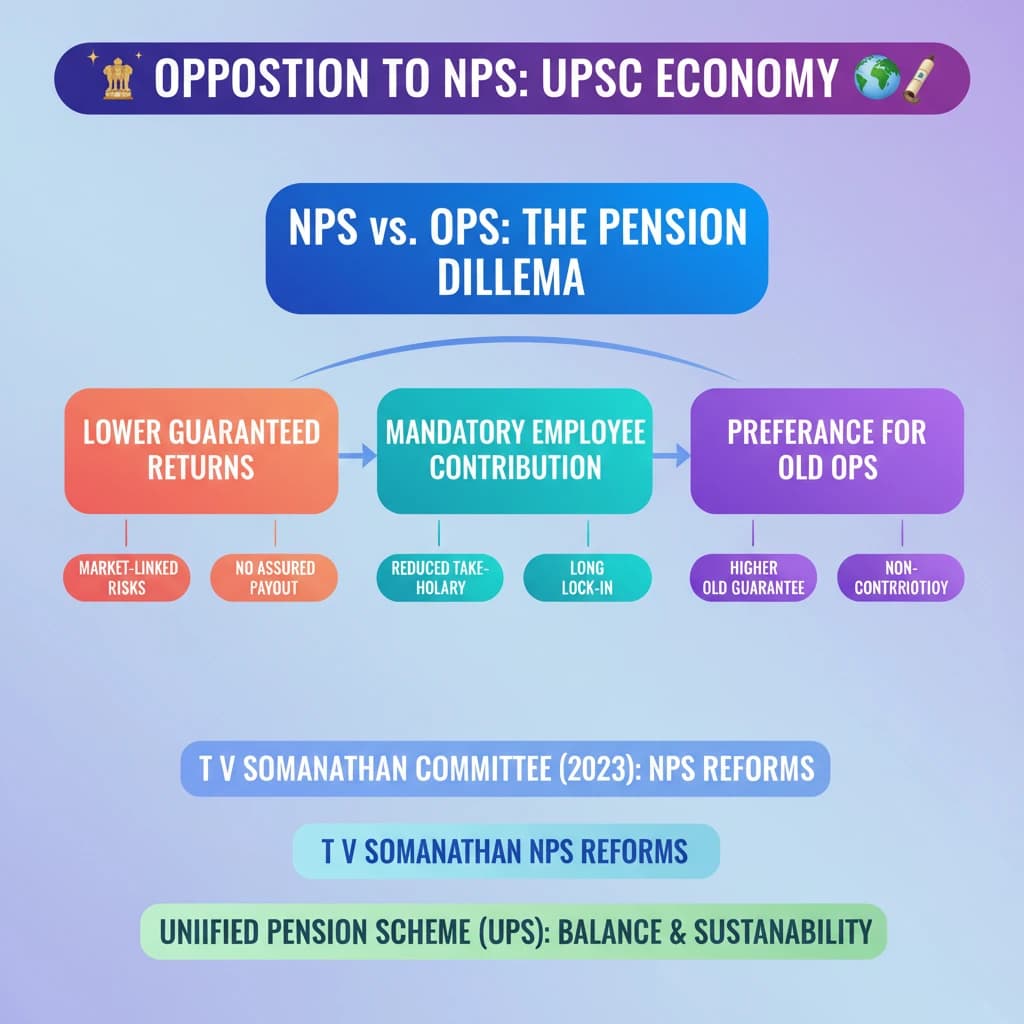
  • The T V Somanathan Committee (2023) was formed to address NPS concerns and recommend reforms.
  • The new Unified Pension Scheme (UPS) is introduced as a response, aiming to balance employee security with fiscal sustainability.

NPS vs. OPS: Opposition, Somanathan Committee & Unified Pension Scheme

NPS vs. OPS: Opposition, Somanathan Committee & Unified Pension Scheme

Medium⏱️ 8 min read✓ 95% Verified
economy

📖 Introduction

<h4>Introduction to NPS Features</h4><p>The <strong>National Pension System (NPS)</strong> offers individuals flexibility in managing their retirement savings. Subscribers can choose from a range of <strong>schemes</strong> and <strong>pension fund managers</strong>.</p><p>This includes the option to invest through various <strong>private companies</strong>, allowing for diversified portfolio management tailored to individual risk appetites.</p><div class='info-box'><p><strong>NPS Flexibility:</strong> Allows subscribers to select their investment patterns and fund managers, providing a market-linked approach to pension accumulation.</p></div><h4>Core Reasons for Opposition to NPS</h4><p>Significant opposition to the <strong>NPS</strong> arose primarily from <strong>government employees</strong>. Their concerns stemmed from a comparison with the older <strong>Old Pension Scheme (OPS)</strong>.</p><div class='key-point-box'><p>Under <strong>NPS</strong>, employees faced <strong>lower guaranteed returns</strong> compared to <strong>OPS</strong>. Additionally, they were required to <strong>contribute a portion of their salary</strong> towards their pension.</p></div><p>In contrast, the <strong>OPS</strong> provided <strong>higher guaranteed returns</strong> and did not require any <strong>employee contributions</strong>, making it a more attractive option for many.</p><h4>Government's Response and New Scheme</h4><p>Amid widespread calls for a return to the <strong>OPS</strong>, the <strong>Union Government</strong> took action. In <strong>2023</strong>, a committee was established to review the pension system.</p><div class='info-box'><p>The committee was led by <strong>T V Somanathan</strong>, the Finance Secretary, tasked with finding a sustainable solution to address employee concerns while maintaining fiscal prudence.</p></div><p>The recommendations of the <strong>T V Somanathan Committee</strong> have since led to the introduction of the <strong>new Unified Pension Scheme (UPS)</strong>, aiming to balance employee welfare with financial sustainability.</p><div class='exam-tip-box'><p><strong>UPSC Insight:</strong> Understanding the differences between <strong>OPS</strong>, <strong>NPS</strong>, and the proposed <strong>UPS</strong> is crucial for questions on social security, fiscal policy, and public administration (GS2, GS3).</p></div>
Concept Diagram

💡 Key Takeaways

  • •NPS allows employee contribution and market-linked returns, offering flexibility in investment choices.
  • •Opposition to NPS stems from lower guaranteed returns and mandatory employee contributions compared to OPS.
  • •OPS offered higher guaranteed returns and no employee contribution, making it preferred by many.
  • •The T V Somanathan Committee (2023) was formed to address NPS concerns and recommend reforms.
  • •The new Unified Pension Scheme (UPS) is introduced as a response, aiming to balance employee security with fiscal sustainability.

🧠 Memory Techniques
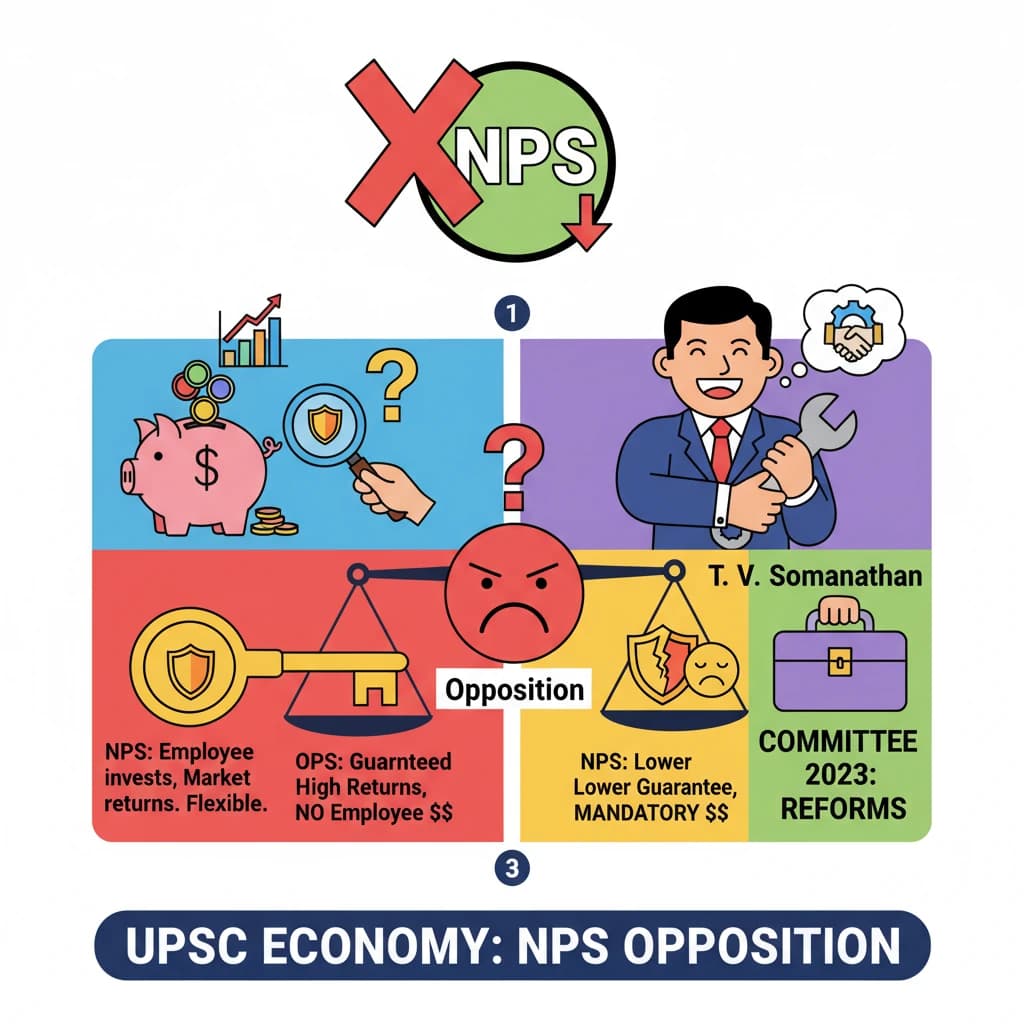
Memory Aid
95% Verified Content

📚 Reference Sources

•Press Information Bureau (PIB) releases regarding T V Somanathan Committee (2023)
•Ministry of Finance, Department of Financial Services (DFS) official communications on NPS and pension reforms
•Reports and analysis by economic think tanks on India's pension system

Related Topics

Loading related topics...
Explore:Economy Topics·All Subjects·Daily Current Affairs·Editorial Analysis·Previous Year Questions·UPSC GPT
NPS vs. OPS: Opposition, Somanathan Committee & Unified Pension Scheme - UPSC Economy