Loading page, please wait…
Vaidra Logo
Vaidra

Top 4 items + smart groups

UPSC GPT
New
Current Affairs
Daily Solutions
Daily Puzzle
Mains Evaluator

Version 2.0.0 • Built with ❤️ for UPSC aspirants

Loading...
Loading...
Loading...
Loading...
Loading...
Loading...
Loading...
Loading...
Loading...
Loading...
Loading...
Loading...
Loading...
Back
All Subjects

Topics

0 topics • 0 completed

Loading topics...
Loading...
Loading...
Loading...
Loading...
Loading...
Overall Progress0%

Modern Navigational Aids - UPSC Economy

What is Modern Navigational Aids in UPSC Economy?

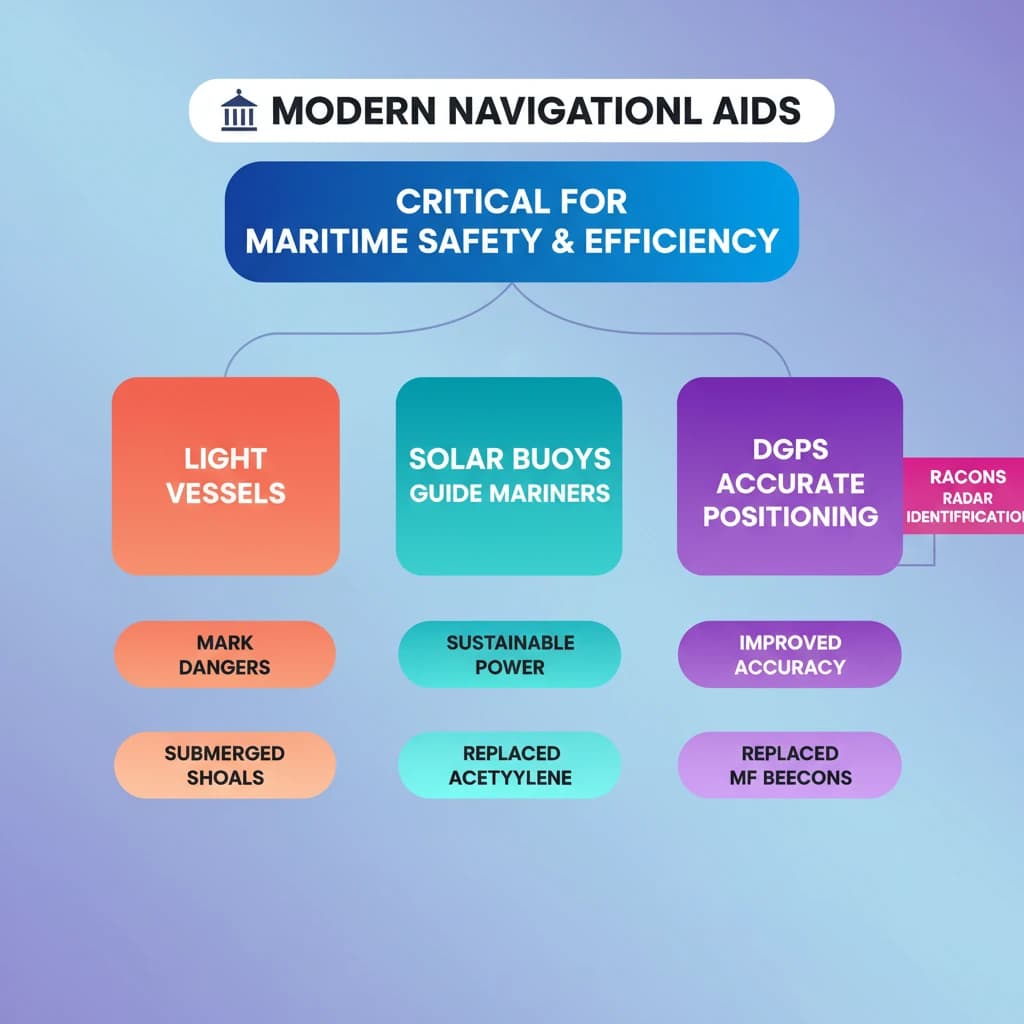
Modern Navigational Aids is a key topic under Economy for UPSC Civil Services Examination. Key points include: Modern Navigational Aids are critical for maritime safety, efficiency, and environmental protection.. Light Vessels mark isolated dangers where lighthouses are impractical, like submerged shoals.. Buoys have evolved from acetylene to sustainable solar-powered electric lights, guiding mariners.. Understanding this topic is essential for both UPSC Prelims and Mains preparation.

Why is Modern Navigational Aids important for UPSC exam?

Modern Navigational Aids is a Easy-level topic in UPSC Economy. It is tested in both Prelims (factual MCQs) and Mains (analytical answer writing). Previous year UPSC questions have frequently covered aspects of Modern Navigational Aids, making it essential for comprehensive IAS preparation.

How to prepare Modern Navigational Aids for UPSC?

To prepare Modern Navigational Aids for UPSC: (1) Study the comprehensive notes covering all key concepts on Vaidra. (2) Practice previous year questions on this topic. (3) Connect it with current affairs using daily updates. (4) Revise using key takeaways and mind maps available for Economy. (5) Write practice answers linking Modern Navigational Aids to related GS Paper topics.

Key takeaways of Modern Navigational Aids for UPSC

  • Modern Navigational Aids are critical for maritime safety, efficiency, and environmental protection.
  • Light Vessels mark isolated dangers where lighthouses are impractical, like submerged shoals.
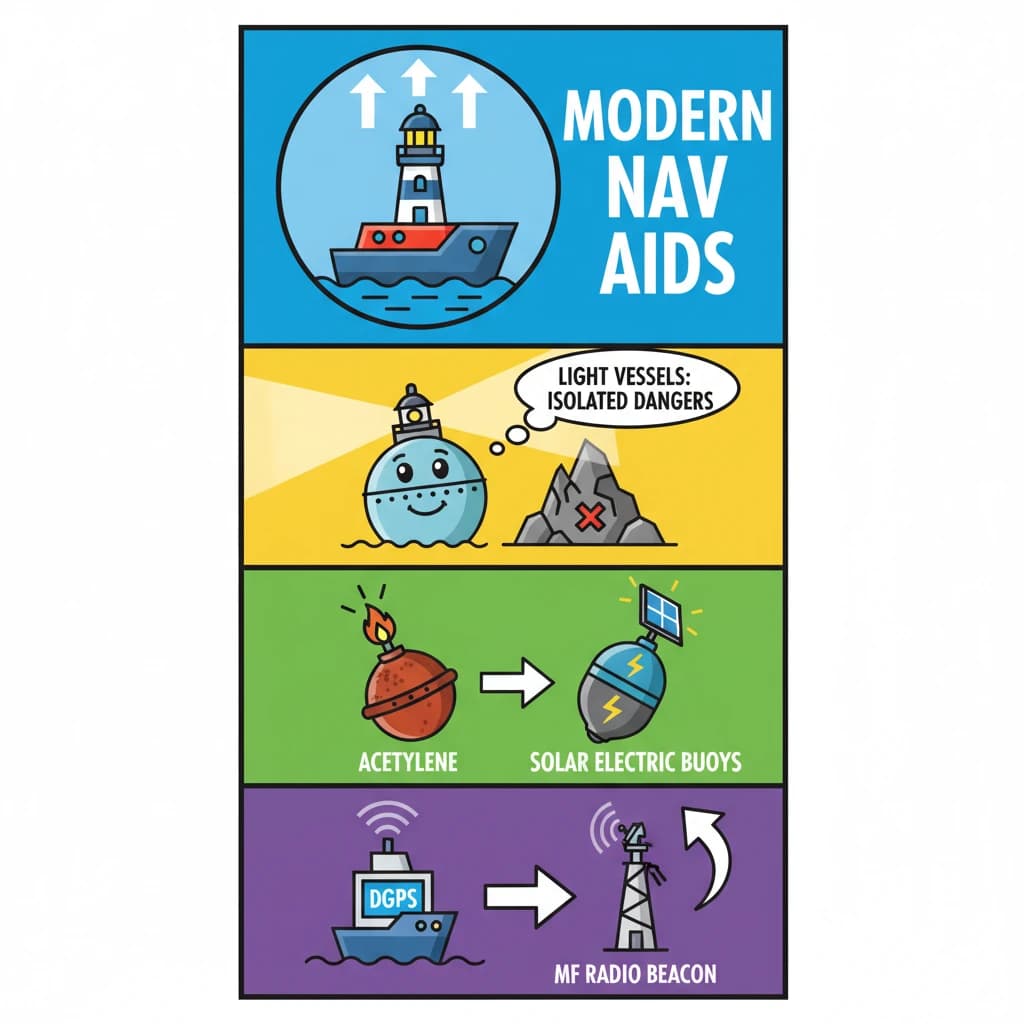
  • Buoys have evolved from acetylene to sustainable solar-powered electric lights, guiding mariners.
  • DGPS (Differential Global Positioning System) replaced MF Radio Beacons for significantly improved positioning accuracy.
  • Racons (Radar Transponder Beacons) provide distinctive radar signals for identification, range, and bearing of key points.
  • These aids are vital for global trade, national security, and underpin initiatives like India's Sagarmala Programme.
Modern Navigational Aids

Modern Navigational Aids

Easy⏱️ 5 min read✓ 95% Verified
economy

📖 Introduction

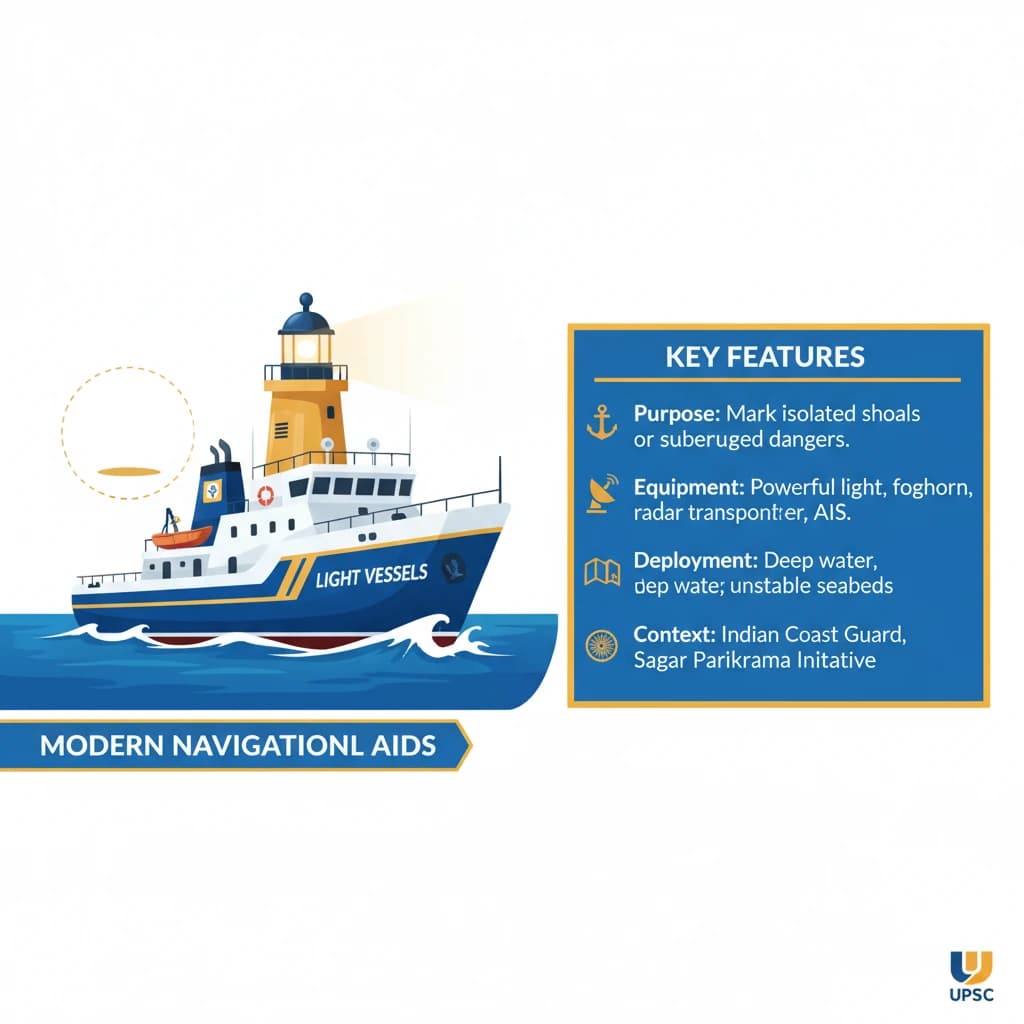
<h4>Light Vessels</h4><p><strong>Light Vessels</strong> are specialized floating aids used to mark hazards in maritime navigation.</p><p>They are deployed in areas where constructing a fixed <strong>lighthouse</strong> is not practical, often due to deep water or unstable seabed conditions.</p><div class="info-box"><ul><li><strong>Purpose:</strong> Mark <strong>isolated shoals</strong> or <strong>submerged dangers</strong>, ensuring vessels avoid hazardous areas.</li><li><strong>Equipment:</strong> Equipped with powerful <strong>lanterns</strong> and advanced <strong>optical equipment</strong> to emit clear signals.</li><li><strong>Stability:</strong> Designed to neutralize vessel inclinations caused by strong waves, maintaining a stable and visible light source.</li></ul></div><h4>Buoys</h4><p><strong>Buoys</strong> serve as crucial navigational markers, providing essential directions and warnings to mariners.</p><p>Their design and power sources have evolved significantly over time to enhance reliability and operational efficiency.</p><div class="info-box"><ul><li><strong>Early Technology:</strong> Initially, buoys relied on <strong>acetylene gas</strong> for their illumination, requiring periodic refueling.</li><li><strong>Modern Technology:</strong> Today, they operate on efficient <strong>electric lights</strong>, providing consistent illumination.</li><li><strong>Power Source:</strong> These electric lights are primarily powered by <strong>solar photovoltaic modules</strong>, promoting sustainability and reducing maintenance.</li></ul></div><h4>M.F Radio Beacons and DGPS</h4><p><strong>Medium Frequency (M.F) Radio Beacons</strong> were an important electronic navigational aid during the mid-20th century.</p><p>They provided crucial positioning data to vessels, aiding safe passage before more advanced systems emerged.</p><div class="info-box"><ul><li><strong>Installation Period:</strong> These beacons were predominantly installed between <strong>1955 and 1960</strong> across various maritime regions.</li><li><strong>Replacement:</strong> M.F Radio Beacons were eventually replaced due to limitations in accuracy and the advent of superior technology.</li><li><strong>Successor:</strong> The <strong>Differential Global Positioning System (DGPS)</strong> took over, offering significantly improved accuracy in maritime positioning and navigation.</li></ul></div><h4>Racons (Radar Transponder Beacons)</h4><p><strong>Racons</strong>, short for <strong>Radar Transponder Beacons</strong>, are sophisticated electronic navigational aids that enhance radar visibility.</p><p>They help mariners identify specific navigational points on their ship's radar screen, improving situational awareness.</p><div class="info-box"><ul><li><strong>Function:</strong> When interrogated by a ship's radar, a Racon returns a distinctive <strong>code signal</strong>, often a Morse code character.</li><li><strong>Data Provided:</strong> This signal provides vital information including <strong>range</strong>, <strong>bearing</strong>, and unique <strong>identification data</strong> of the Racon's location.</li><li><strong>Benefit:</strong> Helps pinpoint position relative to critical markers such as lighthouses, buoys, or landfalls, especially in poor visibility.</li></ul></div>
Concept Diagram

💡 Key Takeaways

  • •Modern Navigational Aids are critical for maritime safety, efficiency, and environmental protection.
  • •Light Vessels mark isolated dangers where lighthouses are impractical, like submerged shoals.
  • •Buoys have evolved from acetylene to sustainable solar-powered electric lights, guiding mariners.
  • •DGPS (Differential Global Positioning System) replaced MF Radio Beacons for significantly improved positioning accuracy.
  • •Racons (Radar Transponder Beacons) provide distinctive radar signals for identification, range, and bearing of key points.
  • •These aids are vital for global trade, national security, and underpin initiatives like India's Sagarmala Programme.

🧠 Memory Techniques
Memory Aid
95% Verified Content

Related Topics

Loading related topics...
Explore:Economy Topics·All Subjects·Daily Current Affairs·Editorial Analysis·Previous Year Questions·UPSC GPT
Modern Navigational Aids - UPSC Economy