Loading page, please wait…
Vaidra Logo
Vaidra

Top 4 items + smart groups

UPSC GPT
New
Current Affairs
Daily Solutions
Daily Puzzle
Mains Evaluator

Version 2.0.0 • Built with ❤️ for UPSC aspirants

Loading...
Loading...
Loading...
Loading...
Loading...
Loading...
Loading...
Loading...
Loading...
Loading...
Loading...
Loading...
Loading...
Insurance for All by 2047 - UPSC Economy
Back
All Subjects

Topics

0 topics • 0 completed

Loading topics...
Loading...
Loading...
Loading...
Loading...
Loading...
Overall Progress0%

Insurance for All by 2047 - UPSC Economy

What is Insurance for All by 2047 in UPSC Economy?

Insurance for All by 2047 is a key topic under Economy for UPSC Civil Services Examination. Key points include: IRDAI aims for 'Insurance for All' by 2047, covering life, health, property for citizens, and solutions for enterprises.. The vision rests on three pillars: customers, providers, and distributors.. Key focus areas include product innovation, grievance redressal, ease of business, and regulatory alignment.. Understanding this topic is essential for both UPSC Prelims and Mains preparation.

Why is Insurance for All by 2047 important for UPSC exam?

Insurance for All by 2047 is a Medium-level topic in UPSC Economy. It is tested in both Prelims (factual MCQs) and Mains (analytical answer writing). Previous year UPSC questions have frequently covered aspects of Insurance for All by 2047, making it essential for comprehensive IAS preparation.

How to prepare Insurance for All by 2047 for UPSC?

To prepare Insurance for All by 2047 for UPSC: (1) Study the comprehensive notes covering all key concepts on Vaidra. (2) Practice previous year questions on this topic. (3) Connect it with current affairs using daily updates. (4) Revise using key takeaways and mind maps available for Economy. (5) Write practice answers linking Insurance for All by 2047 to related GS Paper topics.

Key takeaways of Insurance for All by 2047 for UPSC

  • IRDAI aims for 'Insurance for All' by 2047, covering life, health, property for citizens, and solutions for enterprises.
  • The vision rests on three pillars: customers, providers, and distributors.
  • Key focus areas include product innovation, grievance redressal, ease of business, and regulatory alignment.
  • It's crucial for financial inclusion, economic stability, and social security.
  • Leveraging technology and a principle-based regulatory regime are central to its success.
Insurance for All by 2047

Insurance for All by 2047

Medium⏱️ 8 min read✓ 95% Verified
economy

📖 Introduction

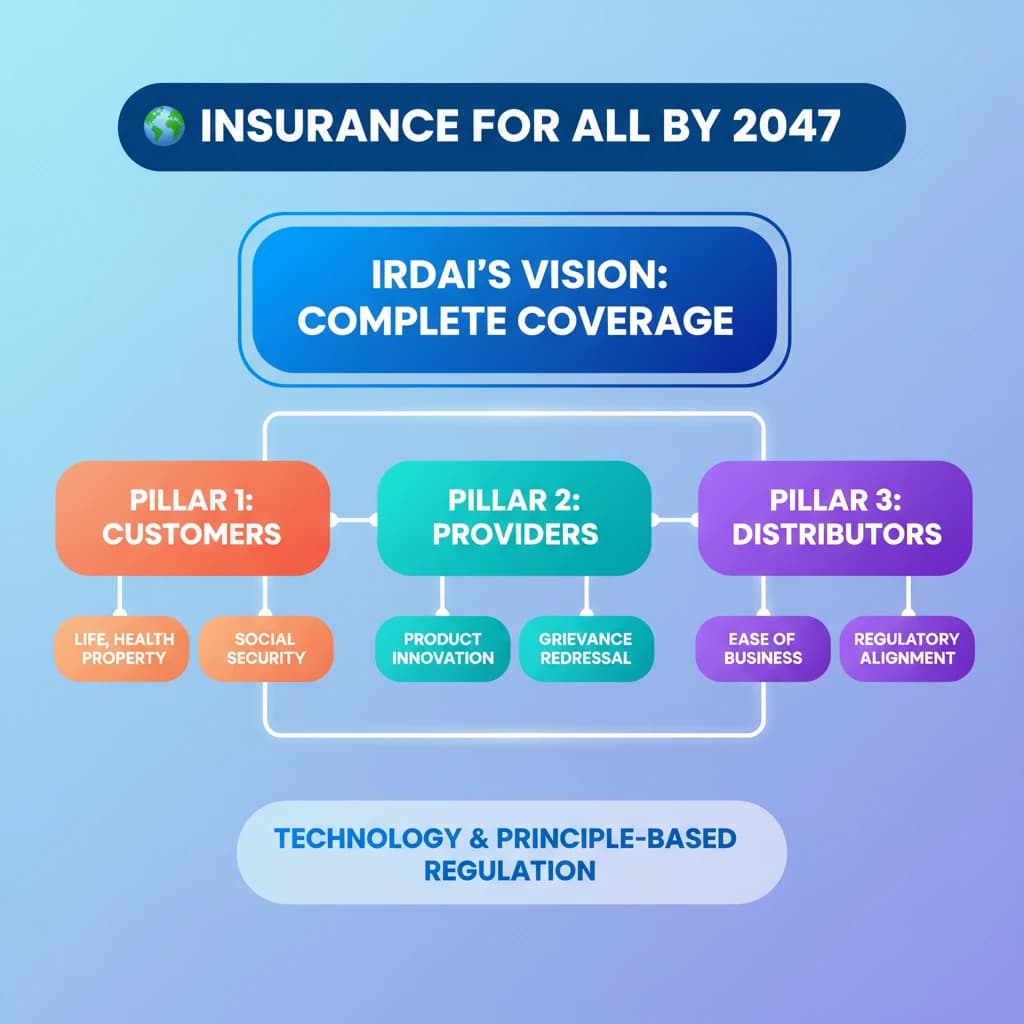
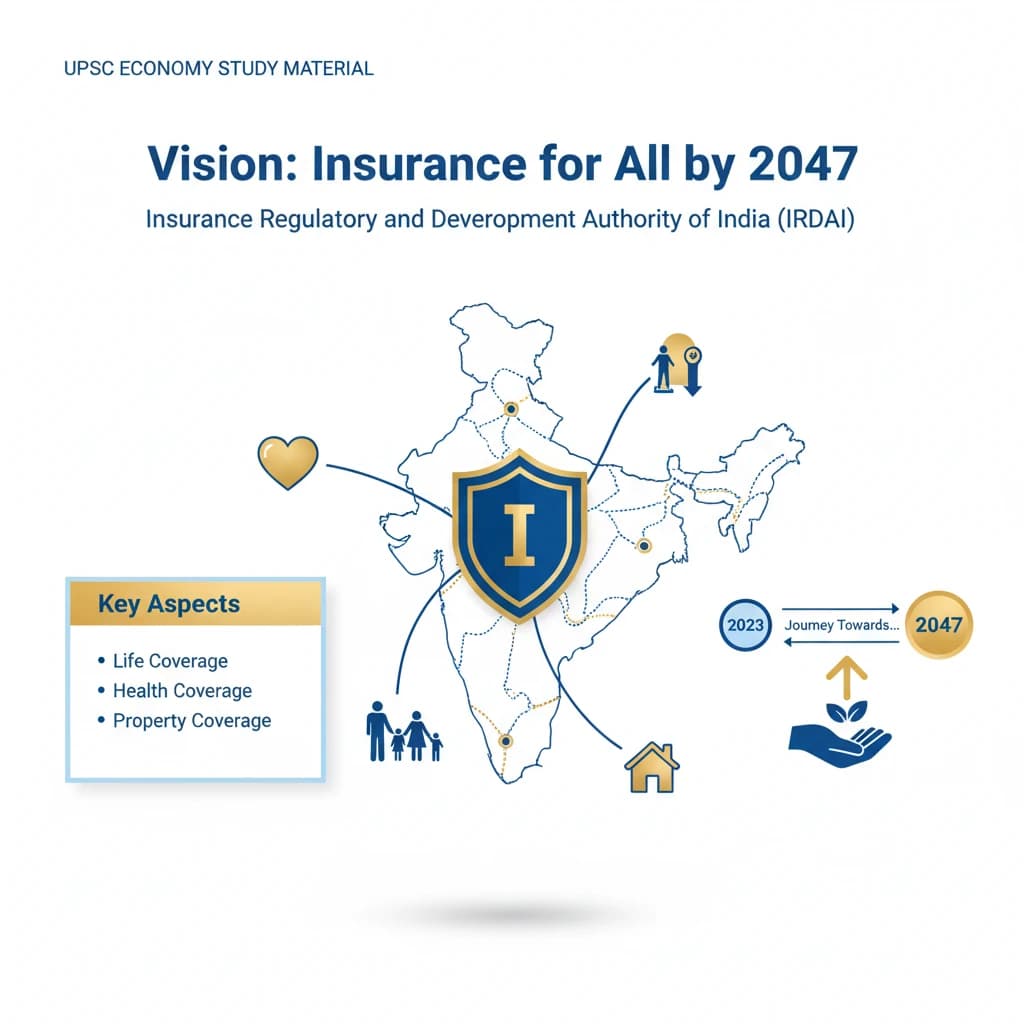
<h4>Vision: Insurance for All by 2047</h4><p>The <strong>Insurance Regulatory and Development Authority of India (IRDAI)</strong> has set an ambitious goal: to achieve <strong>'Insurance for All' by the year 2047</strong>. This initiative aims to ensure comprehensive insurance coverage across India.</p><div class='info-box'><p>The vision of <strong>'Insurance for All' by 2047</strong> encompasses several critical aspects. It seeks to provide every citizen with <strong>life, health, and property insurance coverage</strong>.</p><p>Furthermore, it aims to support <strong>enterprises</strong> with appropriate and tailored insurance solutions, fostering economic stability and growth.</p></div><h4>The Three Pillars of Insurance for All</h4><p>The IRDAI's vision is built upon a robust framework involving three fundamental pillars. These pillars represent the key stakeholders essential for the successful implementation of this ambitious goal.</p><div class='key-point-box'><ul><li><strong>Insurance Customers (Policyholders):</strong> These are the individuals and entities who purchase and benefit from insurance policies.</li><li><strong>Insurance Providers (Insurers):</strong> These are the companies that offer various insurance products and services.</li><li><strong>Insurance Distributors (Intermediaries):</strong> This category includes agents, brokers, and other channels that facilitate the sale and distribution of insurance policies.</li></ul></div><h4>Key Focus Areas for Achieving the Vision</h4><p>To realize the <strong>'Insurance for All' by 2047</strong> objective, IRDAI has identified several critical focus areas. These areas are designed to strengthen the insurance ecosystem and enhance its reach and effectiveness.</p><ul><li><strong>Product Alignment:</strong> Ensuring the availability of <strong>right products to right customers</strong>, tailored to their specific needs and risk profiles.</li><li><strong>Grievance Redressal:</strong> Creating a <strong>robust grievance redressal mechanism</strong> to efficiently address policyholder complaints and ensure consumer protection.</li><li><strong>Ease of Doing Business:</strong> Facilitating <strong>ease of doing business</strong> in the insurance sector, reducing regulatory hurdles and encouraging participation.</li><li><strong>Regulatory Alignment:</strong> Ensuring the <strong>regulatory architecture is aligned with market dynamics</strong>, adapting to evolving industry trends and technological advancements.</li><li><strong>Innovation and Competition:</strong> Boosting <strong>innovation</strong> and promoting healthy <strong>competition</strong> among insurers to offer better products and services.</li><li><strong>Distribution Efficiencies:</strong> Enhancing <strong>distribution efficiencies</strong> by mainstreaming technology and expanding reach, especially in underserved areas.</li><li><strong>Principle-Based Regulation:</strong> Moving towards a <strong>principle-based regulatory regime</strong>, providing flexibility while maintaining oversight and stability.</li></ul><div class='exam-tip-box'><p>For <strong>UPSC Mains GS-III (Economy)</strong>, understanding these focus areas is crucial. They highlight the multi-faceted approach required for financial sector development and inclusion. Be prepared to analyze how these areas contribute to broader economic goals.</p></div>
Concept Diagram

💡 Key Takeaways

  • •IRDAI aims for 'Insurance for All' by 2047, covering life, health, property for citizens, and solutions for enterprises.
  • •The vision rests on three pillars: customers, providers, and distributors.
  • •Key focus areas include product innovation, grievance redressal, ease of business, and regulatory alignment.
  • •It's crucial for financial inclusion, economic stability, and social security.
  • •Leveraging technology and a principle-based regulatory regime are central to its success.

🧠 Memory Techniques

Memory Aid
95% Verified Content

📚 Reference Sources

•Ministry of Finance publications
•Economic Survey of India
•NITI Aayog reports on financial inclusion

Related Topics

Loading related topics...
Explore:Economy Topics·All Subjects·Daily Current Affairs·Editorial Analysis·Previous Year Questions·UPSC GPT