Loading page, please wait…
Vaidra Logo
Vaidra

Top 4 items + smart groups

UPSC GPT
New
Current Affairs
Daily Solutions
Daily Puzzle
Mains Evaluator

Version 2.0.0 • Built with ❤️ for UPSC aspirants

Loading...
Loading...
Loading...
Loading...
Loading...
Loading...
Loading...
Loading...
Loading...
Loading...
Loading...
Loading...
Loading...
Back
All Subjects

Topics

0 topics • 0 completed

Loading topics...
Loading...
Loading...
Loading...
Loading...
Loading...
Overall Progress0%

What are Cross-Border Payments? - UPSC Economy

What is What are Cross-Border Payments? in UPSC Economy?

What are Cross-Border Payments? is a key topic under Economy for UPSC Civil Services Examination. Key points include: Cross-Border Payments (CBPs) are financial transactions between a payer and recipient in different countries.. They are vital for international trade, global investment, and personal remittances.. Key characteristics include multiple currencies, intermediaries (banks, PSPs), and complex regulatory compliance.. Understanding this topic is essential for both UPSC Prelims and Mains preparation.

Why is What are Cross-Border Payments? important for UPSC exam?

What are Cross-Border Payments? is a Medium-level topic in UPSC Economy. It is tested in both Prelims (factual MCQs) and Mains (analytical answer writing). Previous year UPSC questions have frequently covered aspects of What are Cross-Border Payments?, making it essential for comprehensive IAS preparation.

How to prepare What are Cross-Border Payments? for UPSC?

To prepare What are Cross-Border Payments? for UPSC: (1) Study the comprehensive notes covering all key concepts on Vaidra. (2) Practice previous year questions on this topic. (3) Connect it with current affairs using daily updates. (4) Revise using key takeaways and mind maps available for Economy. (5) Write practice answers linking What are Cross-Border Payments? to related GS Paper topics.

Key takeaways of What are Cross-Border Payments? for UPSC

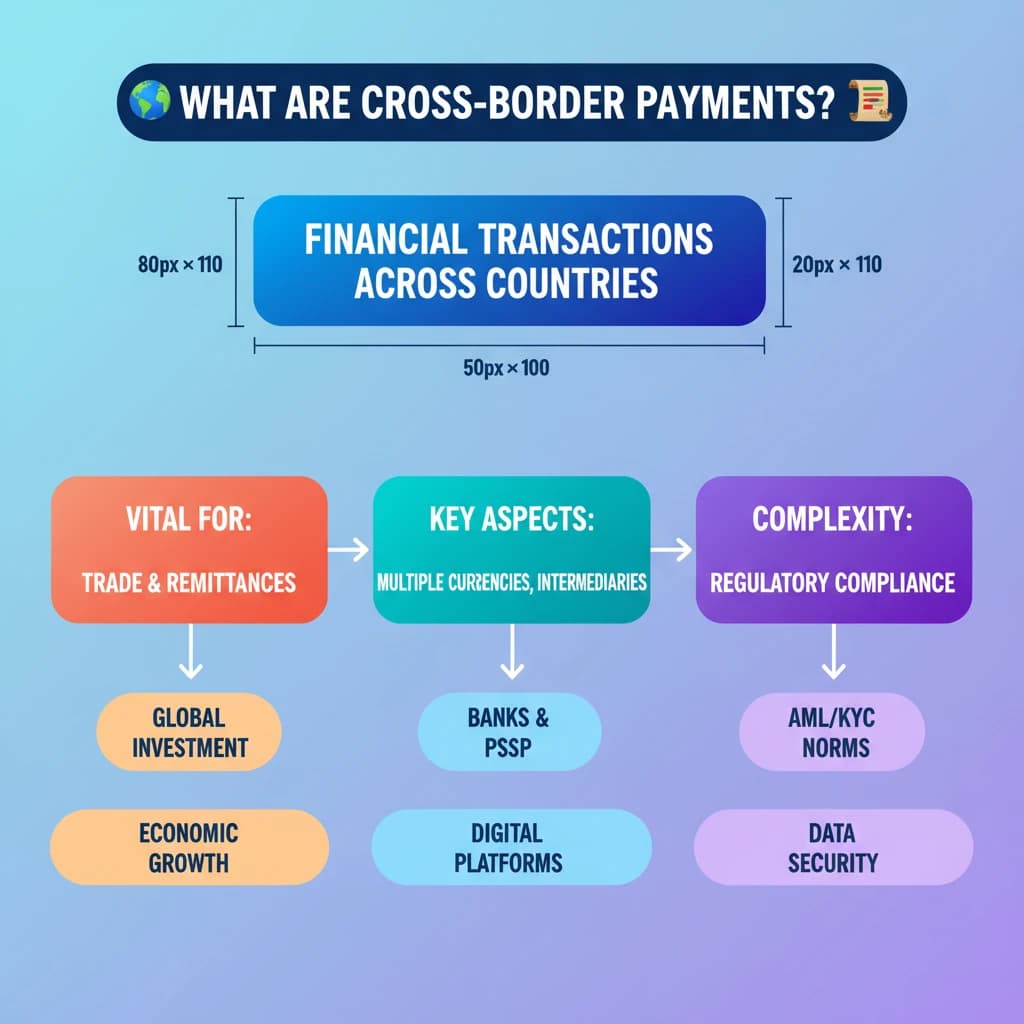
  • Cross-Border Payments (CBPs) are financial transactions between a payer and recipient in different countries.
  • They are vital for international trade, global investment, and personal remittances.
  • Key characteristics include multiple currencies, intermediaries (banks, PSPs), and complex regulatory compliance.
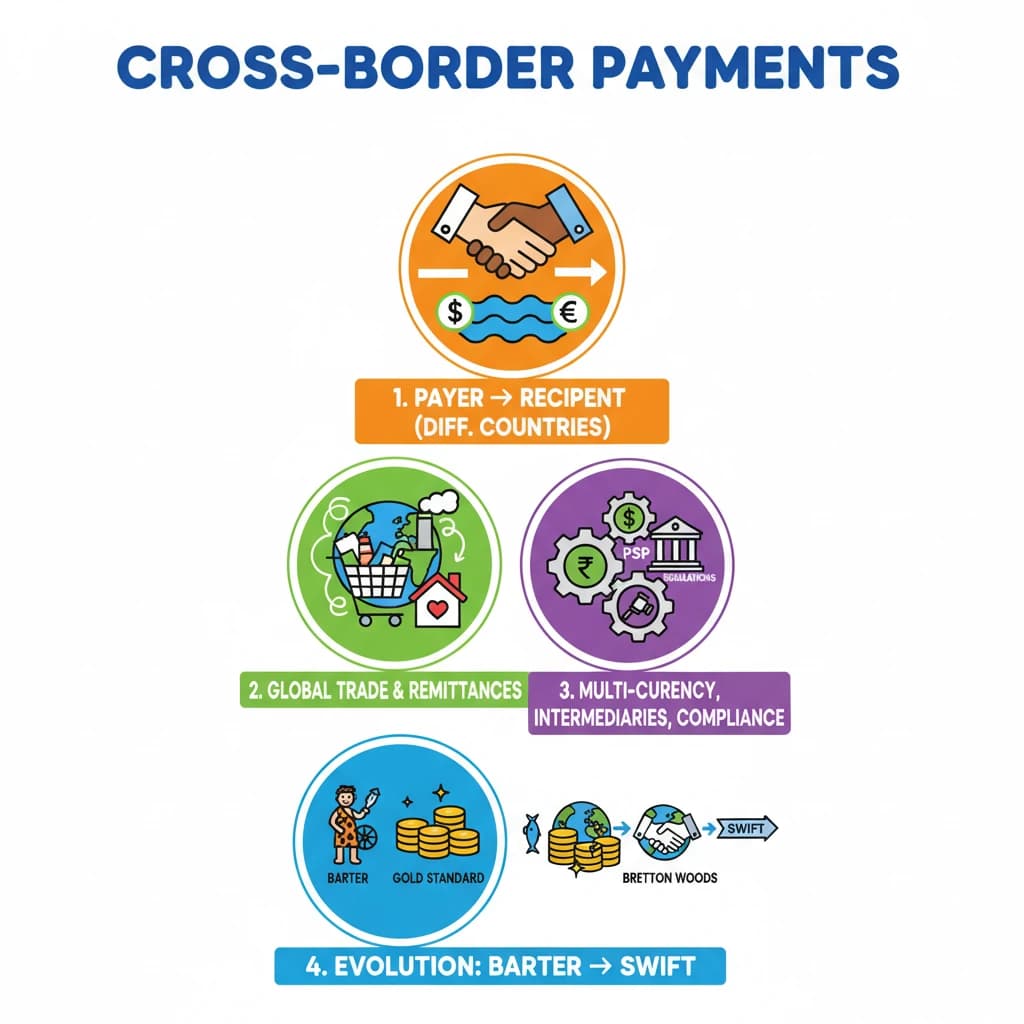
  • Historically, CBPs evolved from barter to the gold standard, Bretton Woods, and SWIFT.
  • Modern CBPs are being revolutionized by digital platforms, blockchain, CBDCs, and linkages of fast payment systems (e.g., UPI).
  • Challenges include high costs, slow speeds, and lack of transparency, which global efforts aim to resolve.
What are Cross-Border Payments?

What are Cross-Border Payments?

Medium⏱️ 8 min read✓ 95% Verified
economy

📖 Introduction

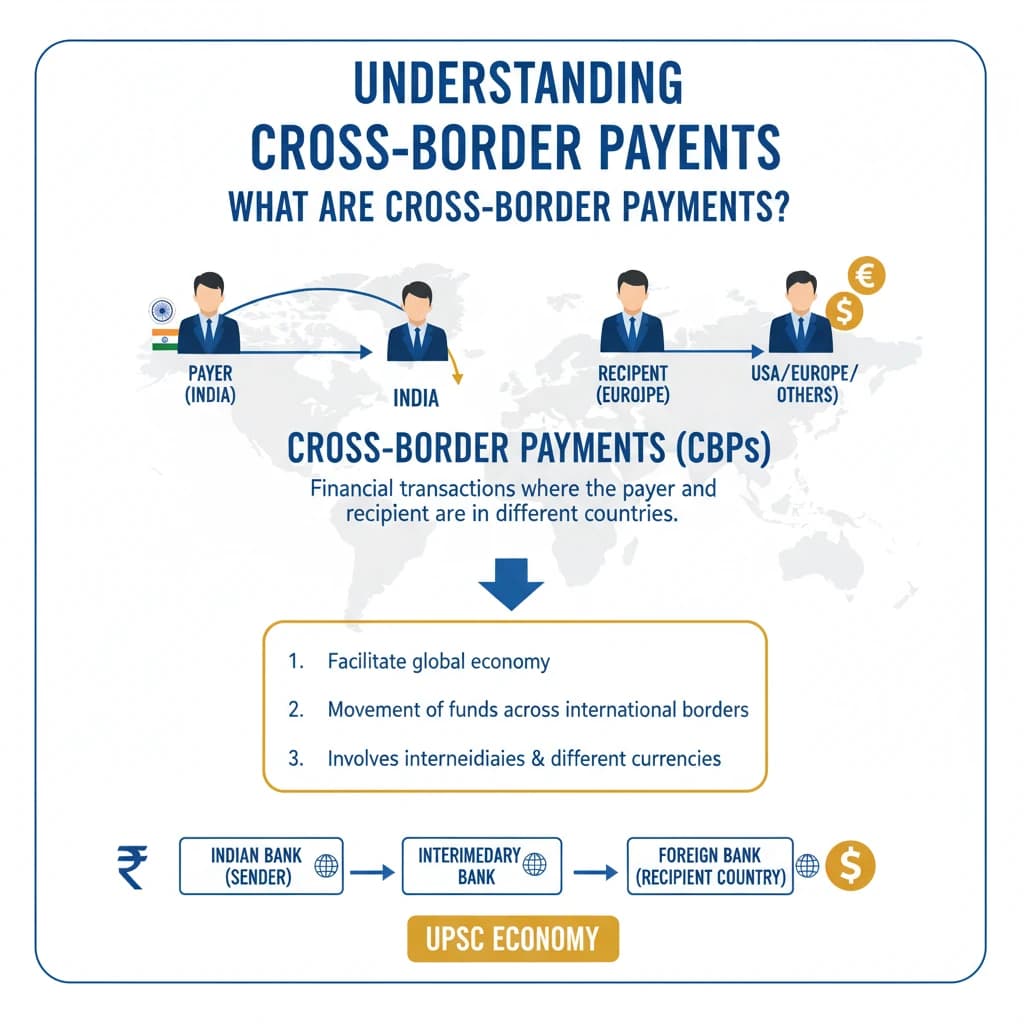
<h4>Understanding Cross-Border Payments</h4><p><strong>Cross-Border Payments (CBPs)</strong> are financial transactions where the <strong>payer</strong> and the <strong>recipient</strong> are located in different countries. These transactions are fundamental to the global economy.</p><p>They facilitate the movement of funds across international borders, enabling various economic activities. The process often involves multiple intermediaries and different currencies.</p><div class='info-box'><p><strong>Definition:</strong> A <strong>Cross-Border Payment</strong> occurs when money is transferred from one country to another, involving distinct national jurisdictions for the sender and receiver.</p></div><h4>Vital Role in Global Economy</h4><p>Cross-Border Payments are absolutely <strong>vital</strong> for several key aspects of the international economic landscape. Their efficient functioning underpins global connectivity.</p><p>They are essential for driving <strong>international trade</strong>, allowing businesses to buy and sell goods and services across borders. This includes everything from raw materials to finished products.</p><p>Furthermore, CBPs are crucial for <strong>investment flows</strong>, facilitating foreign direct investment (FDI) and portfolio investments. This enables capital to move to areas of higher return or need.</p><p>Finally, they are indispensable for <strong>personal transfers</strong>, commonly known as remittances. Migrant workers frequently send money home to support their families, significantly contributing to many national economies.</p><div class='key-point-box'><p><strong>Key Importance:</strong> CBPs underpin <strong>international trade</strong>, facilitate <strong>global investment</strong>, and enable crucial <strong>personal remittances</strong>, making them a backbone of the interconnected world economy.</p></div><h4>Key Characteristics of CBPs</h4><p>Cross-Border Payments involve several unique characteristics that differentiate them from domestic transactions. These factors often contribute to their complexity and cost.</p><ul><li><strong>Multiple Currencies:</strong> Transactions typically involve the conversion of one currency to another (e.g., INR to USD).</li><li><strong>Intermediaries:</strong> Banks, payment service providers (PSPs), and money transfer operators (MTOs) often act as intermediaries.</li><li><strong>Regulatory Compliance:</strong> Each country has its own regulatory framework, including anti-money laundering (AML) and counter-terrorist financing (CTF) laws.</li><li><strong>Time and Cost:</strong> Historically, CBPs have been slower and more expensive than domestic payments due to the involvement of multiple parties and systems.</li></ul><div class='exam-tip-box'><p><strong>UPSC Insight:</strong> Understanding <strong>Cross-Border Payments</strong> is crucial for topics like <strong>Balance of Payments</strong>, <strong>International Trade</strong>, <strong>Remittances</strong>, and the role of <strong>Digital Public Infrastructure (DPI)</strong> in India's economy. Be prepared to discuss challenges and solutions.</p></div>
Concept Diagram

💡 Key Takeaways

  • •Cross-Border Payments (CBPs) are financial transactions between a payer and recipient in different countries.
  • •They are vital for international trade, global investment, and personal remittances.
  • •Key characteristics include multiple currencies, intermediaries (banks, PSPs), and complex regulatory compliance.
  • •Historically, CBPs evolved from barter to the gold standard, Bretton Woods, and SWIFT.
  • •Modern CBPs are being revolutionized by digital platforms, blockchain, CBDCs, and linkages of fast payment systems (e.g., UPI).
  • •Challenges include high costs, slow speeds, and lack of transparency, which global efforts aim to resolve.

🧠 Memory Techniques
Memory Aid
95% Verified Content

📚 Reference Sources

•Bank for International Settlements (BIS) reports on Cross-Border Payments
•World Bank reports on Remittances and Migration
•NITI Aayog documents on Digital India and Fintech
•SWIFT official documentation and reports

Related Topics

Loading related topics...
Explore:Economy Topics·All Subjects·Daily Current Affairs·Editorial Analysis·Previous Year Questions·UPSC GPT
What are Cross-Border Payments? - UPSC Economy