Loading page, please wait…
Vaidra Logo
Vaidra

Top 4 items + smart groups

UPSC GPT
New
Current Affairs
Daily Solutions
Daily Puzzle
Mains Evaluator

Version 2.0.0 • Built with ❤️ for UPSC aspirants

Loading...
Loading...
Loading...
Loading...
Loading...
Loading...
Loading...
Loading...
Loading...
Loading...
Loading...
Loading...
Loading...
India Becomes 3rd Most Powerful Nation in Asia - UPSC Economy
Back
All Subjects

Topics

0 topics • 0 completed

Loading topics...
Loading...
Loading...
Loading...
Loading...
Loading...
Overall Progress0%

India Becomes 3rd Most Powerful Nation in Asia - UPSC Economy

What is India Becomes 3rd Most Powerful Nation in Asia in UPSC Economy?

India Becomes 3rd Most Powerful Nation in Asia is a key topic under Economy for UPSC Civil Services Examination. Key points include: India is now the 3rd most powerful nation in Asia, surpassing Japan, as per the Asia Power Index 2024.. Key drivers include strong post-pandemic economic recovery (4.2-point rise in Economic Capability) and significant Future Resources (8.2-point rise, signaling demographic dividend).. India's non-aligned strategy enhances its diplomatic influence, evidenced by its 6th rank in diplomatic dialogues in 2023.. Understanding this topic is essential for both UPSC Prelims and Mains preparation.

Why is India Becomes 3rd Most Powerful Nation in Asia important for UPSC exam?

India Becomes 3rd Most Powerful Nation in Asia is a Medium-level topic in UPSC Economy. It is tested in both Prelims (factual MCQs) and Mains (analytical answer writing). Previous year UPSC questions have frequently covered aspects of India Becomes 3rd Most Powerful Nation in Asia, making it essential for comprehensive IAS preparation.

How to prepare India Becomes 3rd Most Powerful Nation in Asia for UPSC?

To prepare India Becomes 3rd Most Powerful Nation in Asia for UPSC: (1) Study the comprehensive notes covering all key concepts on Vaidra. (2) Practice previous year questions on this topic. (3) Connect it with current affairs using daily updates. (4) Revise using key takeaways and mind maps available for Economy. (5) Write practice answers linking India Becomes 3rd Most Powerful Nation in Asia to related GS Paper topics.

Key takeaways of India Becomes 3rd Most Powerful Nation in Asia for UPSC

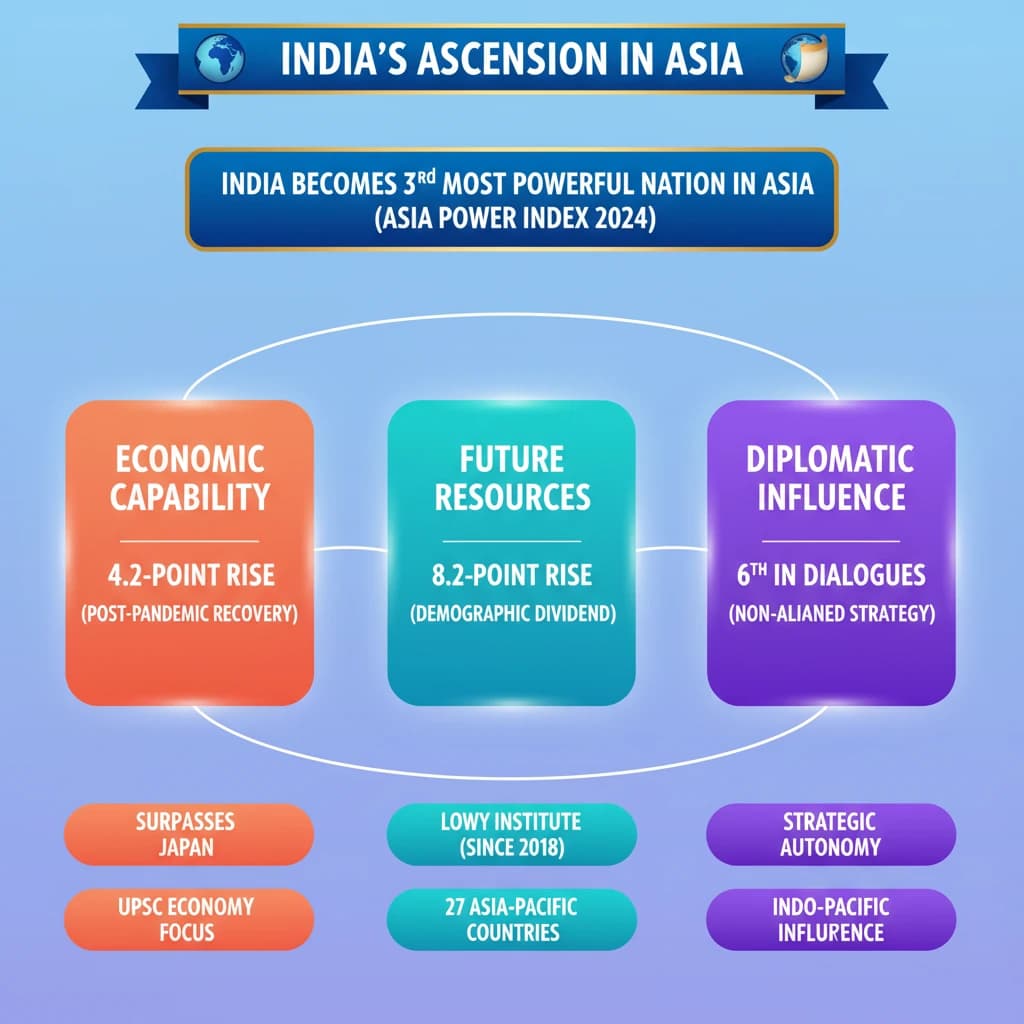
  • India is now the 3rd most powerful nation in Asia, surpassing Japan, as per the Asia Power Index 2024.
  • Key drivers include strong post-pandemic economic recovery (4.2-point rise in Economic Capability) and significant Future Resources (8.2-point rise, signaling demographic dividend).
  • India's non-aligned strategy enhances its diplomatic influence, evidenced by its 6th rank in diplomatic dialogues in 2023.
  • The Lowy Institute's Asia Power Index (launched 2018) assesses 27 Asia-Pacific countries based on material capabilities and international influence.
  • India's growing influence is critical for the Indo-Pacific region, driven by its resource base, economic growth, and strategic autonomy.
India Becomes 3rd Most Powerful Nation in Asia

India Becomes 3rd Most Powerful Nation in Asia

Medium⏱️ 8 min read✓ 95% Verified
economy

📖 Introduction

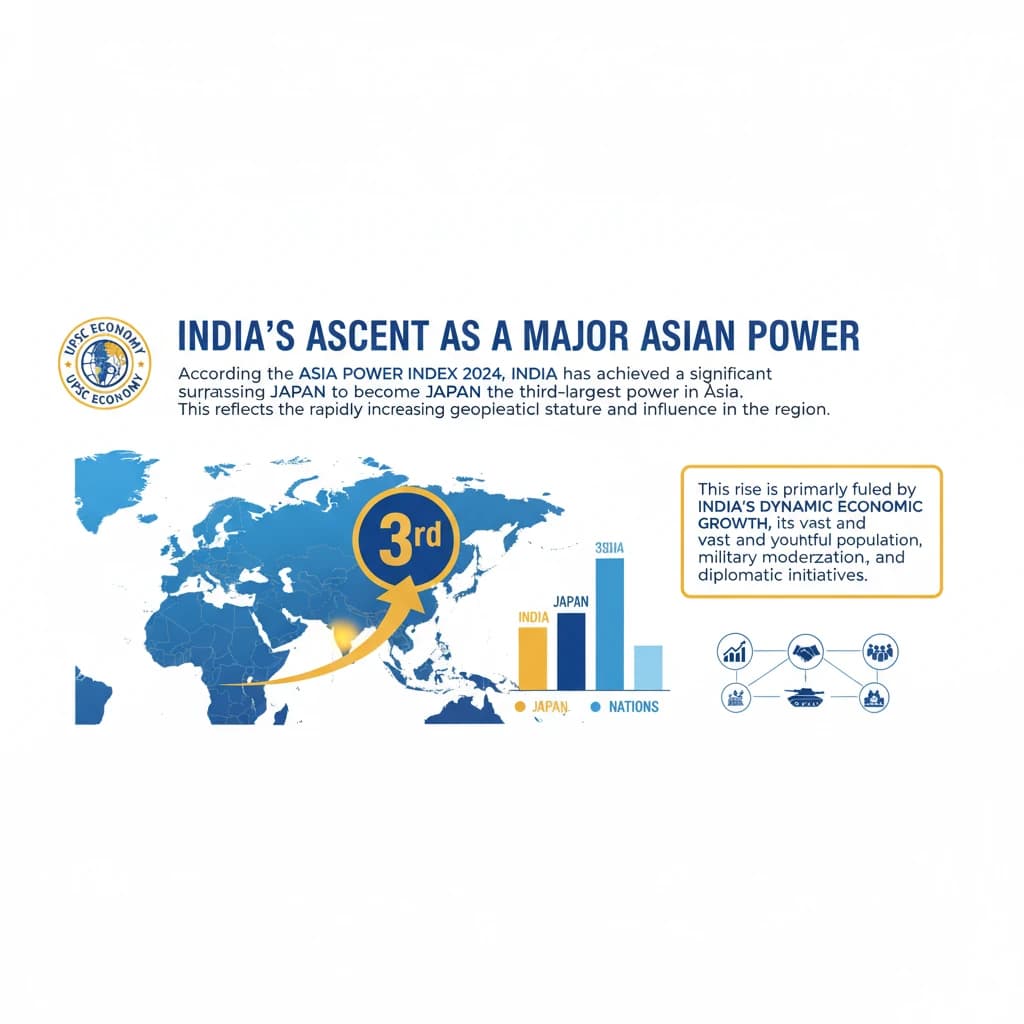
<h4>India's Ascent as a Major Asian Power</h4><p>According to the <strong>Asia Power Index 2024</strong>, <strong>India</strong> has achieved a significant milestone, surpassing <strong>Japan</strong> to become the <strong>third-largest power in Asia</strong>. This reflects the nation's rapidly increasing <strong>geopolitical stature</strong> and influence in the region.</p><div class='key-point-box'><p>This rise is primarily fueled by <strong>India’s dynamic economic growth</strong>, its vast and <strong>fulfilling population</strong>, and a continuously <strong>expanding economy</strong>. These factors collectively solidify India's position as a leading force within the Asian continent.</p></div><h4>Key Factors Driving India's Enhanced Power</h4><p>Several crucial elements have contributed to India's upward trajectory in the <strong>Asia Power Index</strong>:</p><ul><li><strong>Strong Post-Pandemic Economic Recovery:</strong> India has demonstrated a robust economic rebound.</li><li><strong>Increased Economic Capability:</strong> This recovery led to a significant <strong>4.2-point increase</strong> in its <strong>Economic Capability</strong> score, indicating improved economic strength.</li></ul><div class='info-box'><p><strong>Economic Capability:</strong> A measure reflecting a nation's economic size, growth, and integration into the global economy, crucial for projecting power.</p></div><ul><li><strong>Future Resources & Demographic Dividend:</strong> India's score in <strong>Future Resources</strong> saw an impressive <strong>8.2-point increase</strong>.</li><li><p>This surge signals the immense potential of <strong>India's demographic dividend</strong>, indicating a large, young, and productive workforce for future growth.</p></li></ul><div class='info-box'><p><strong>Future Resources:</strong> Assesses a country's potential for future power based on demographics, human capital, and resource availability.</p></div><ul><li><strong>Strategic Autonomy & Diplomatic Engagement:</strong> India's commitment to a <strong>non-aligned strategy</strong> has proven effective.</li><li><p>This approach allows India to adeptly navigate complex global dynamics, enhancing its independent foreign policy.</p></li><li><p>In <strong>2023</strong>, India ranked <strong>6th in diplomatic dialogues</strong>, showcasing its active and influential role in various <strong>multilateral forums</strong> and international relations.</p></li></ul><h4>India's Expanding Role in Asia</h4><p><strong>India's growing influence</strong> across Asia is underpinned by its substantial <strong>resource base</strong> and its unwavering commitment to <strong>strategic autonomy</strong>.</p><p>With consistent <strong>economic growth</strong> and a rapidly expanding <strong>workforce</strong>, India is exceptionally well-positioned to broaden its regional and global footprint.</p><div class='exam-tip-box'><p>Pay special attention to India's strategic focus on the <strong>Indo-Pacific region</strong>. This area is critical for trade, security, and geopolitical competition, where India's role is increasingly pivotal for UPSC answers.</p></div><h4>Understanding the Asia Power Index</h4><p>The <strong>Asia Power Index</strong> is a vital tool for assessing geopolitical shifts in the region.</p><ul><li><strong>Launch:</strong> It was launched by the prestigious <strong>Lowy Institute</strong> in <strong>2018</strong>.</li><li><strong>Scope:</strong> The index systematically assesses power dynamics across <strong>27 countries and territories</strong> in the <strong>Asia-Pacific region</strong>.</li><li><strong>2024 Edition:</strong> The <strong>2024 edition</strong> is highlighted as the most comprehensive to date.</li><li><p>It includes a holistic measurement of both <strong>material capabilities</strong> (like economic and military strength) and a nation's <strong>international influence</strong> (diplomacy, cultural appeal).</p></li></ul>
Concept Diagram

💡 Key Takeaways

  • •India is now the 3rd most powerful nation in Asia, surpassing Japan, as per the Asia Power Index 2024.
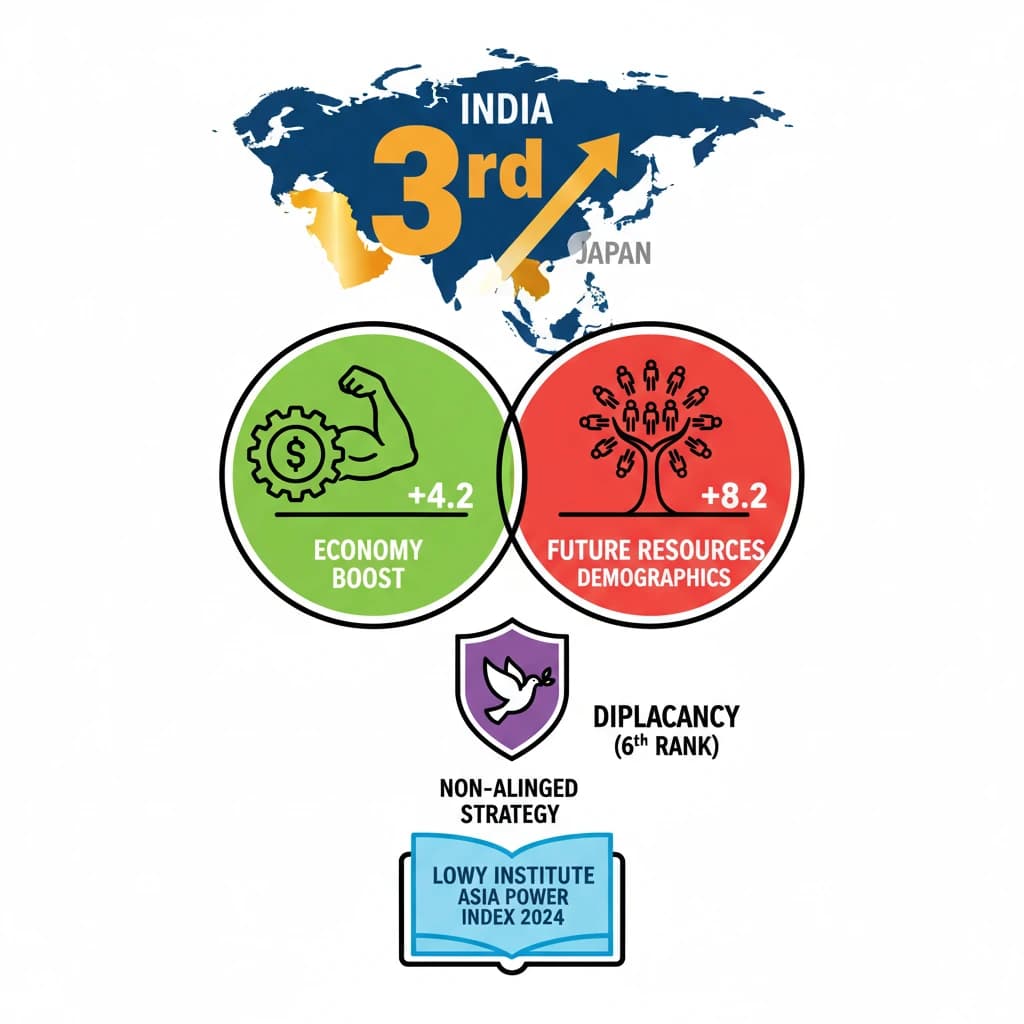
  • •Key drivers include strong post-pandemic economic recovery (4.2-point rise in Economic Capability) and significant Future Resources (8.2-point rise, signaling demographic dividend).
  • •India's non-aligned strategy enhances its diplomatic influence, evidenced by its 6th rank in diplomatic dialogues in 2023.
  • •The Lowy Institute's Asia Power Index (launched 2018) assesses 27 Asia-Pacific countries based on material capabilities and international influence.
  • •India's growing influence is critical for the Indo-Pacific region, driven by its resource base, economic growth, and strategic autonomy.

🧠 Memory Techniques
Memory Aid
95% Verified Content

📚 Reference Sources

•Lowy Institute's Asia Power Index 2024 (implied primary source)

Related Topics

Loading related topics...
Explore:Economy Topics·All Subjects·Daily Current Affairs·Editorial Analysis·Previous Year Questions·UPSC GPT