📖 Introduction
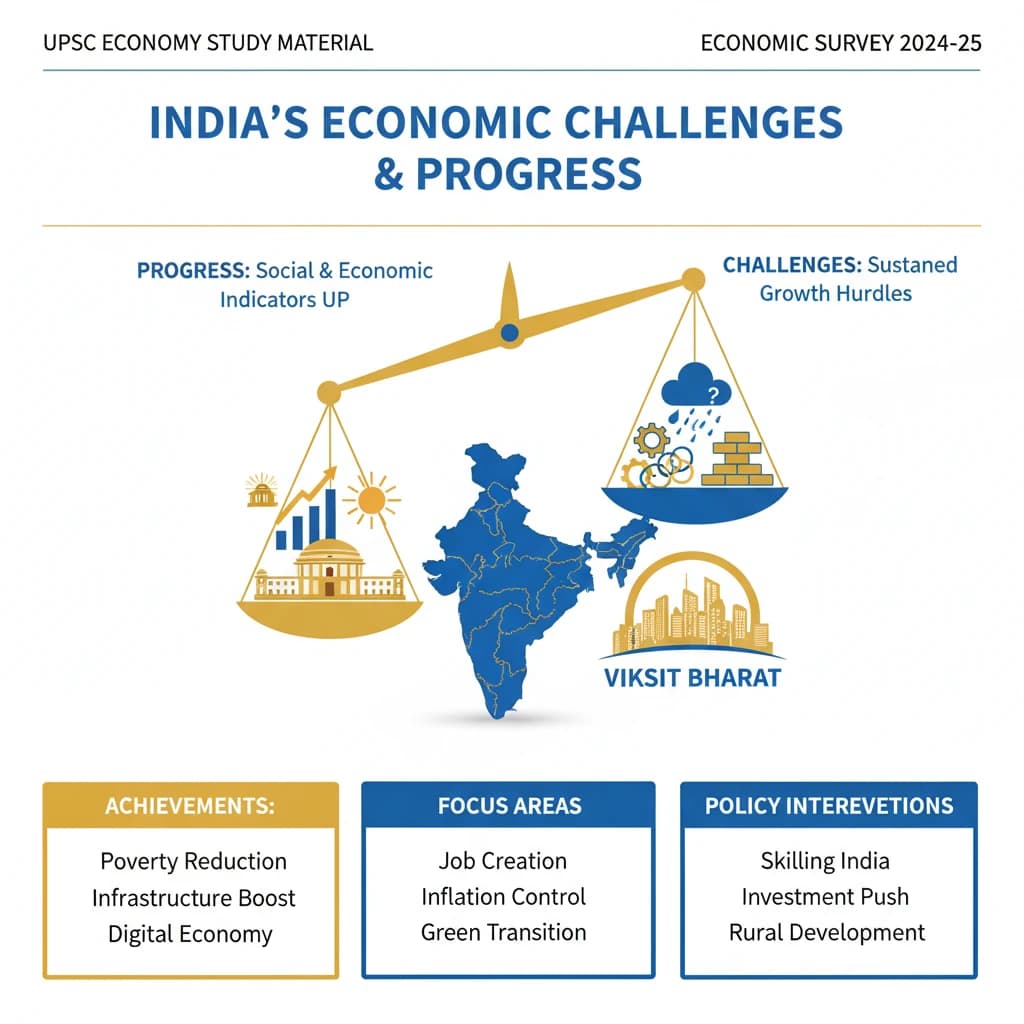
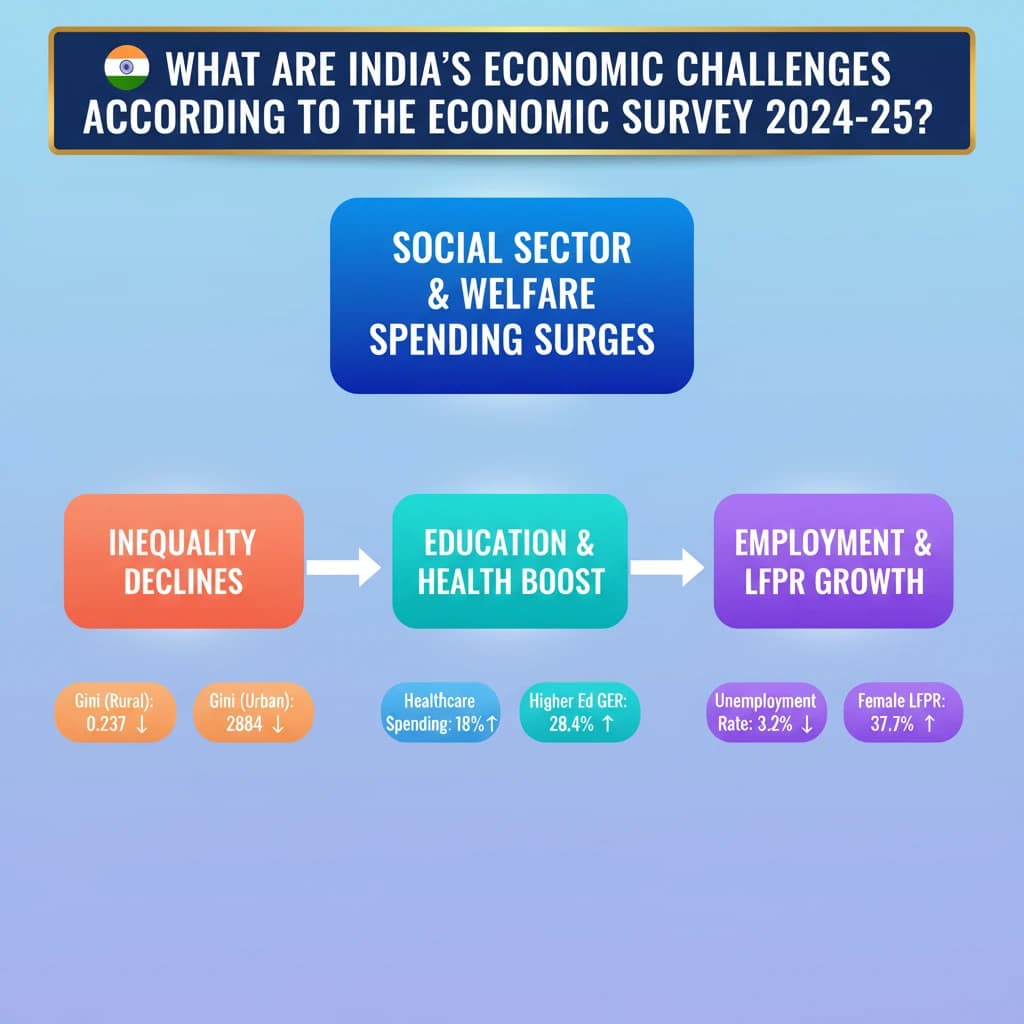
<h4>India's Economic Challenges and Progress: An Overview</h4><p>The <strong>Economic Survey 2024-25</strong> highlights India's significant progress in various social and economic indicators, while also pointing out critical challenges that need addressing for sustained growth and the realization of <strong>Viksit Bharat</strong> goals.</p><p>The survey provides a comprehensive look at the nation's economic health, emphasizing both achievements and areas requiring focused policy interventions.</p><h4>Social Sector Development</h4><p>India has demonstrated robust growth in its <strong>social sector spending</strong>. This includes crucial investments in education, healthcare, and welfare programs.</p><div class='info-box'><p><strong>Social Sector Spending Growth:</strong></p><ul><li>Increased at a <strong>15% CAGR</strong> from <strong>FY21 to FY25</strong>.</li><li>Reached <strong>₹25.7 lakh crore</strong> in <strong>FY25</strong>.</li></ul></div><p>These investments are aimed at improving the quality of life and reducing disparities across the population.</p><h4>Reducing Inequality: Gini Coefficient Trends</h4><p>A key indicator of income inequality, the <strong>Gini coefficient</strong>, has shown positive trends, reflecting efforts to foster more equitable distribution of wealth.</p><div class='info-box'><p><strong>Gini Coefficient Decline:</strong></p><ul><li><strong>Rural areas:</strong> Fell to <strong>0.237</strong> in <strong>2023-24</strong> from <strong>0.266</strong> in <strong>2022-23</strong>.</li><li><strong>Urban areas:</strong> Decreased to <strong>0.284</strong> in <strong>2023-24</strong> from <strong>0.314</strong> in <strong>2022-23</strong>.</li></ul></div><p>This reduction suggests that fiscal policies and welfare schemes are having a tangible impact on the economic well-being of lower-income groups.</p><h4>Progress in Education and Skill Development</h4><p>The education sector has witnessed substantial investment and improved outcomes, crucial for building a skilled workforce.</p><div class='info-box'><p><strong>Education Spending & Outcomes:</strong></p><ul><li><strong>Spending:</strong> Rose by <strong>12% CAGR</strong> to <strong>₹5.92 lakh crore</strong>.</li><li><strong>Dropout Rates:</strong> Reduced to <strong>1.9%</strong> (primary) and <strong>14.1%</strong> (secondary).</li><li><strong>Higher Education Enrolment:</strong> Increased by <strong>26.5%</strong> (2014-2022).</li><li><strong>Gross Enrolment Ratio (GER):</strong> Reached <strong>28.4%</strong>.</li></ul></div><p>These figures underscore the government's commitment to enhancing educational access and quality from primary to higher education levels.</p><h4>Healthcare and Social Security Initiatives</h4><p>Significant strides have been made in healthcare, with flagship schemes providing financial relief and access to medical services.</p><div class='info-box'><p><strong>Healthcare Spending & Impact:</strong></p><ul><li><strong>Spending:</strong> Surged by <strong>18%</strong> to <strong>₹8.61 lakh crore</strong>.</li><li><strong>Ayushman Bharat Pradhan Mantri Jan Arogya Yojana (AB-PM-JAY):</strong> Saved <strong>₹1.25 lakh crore</strong> in medical expenses for beneficiaries.</li></ul></div><p><strong>AB-PM-JAY</strong> has been instrumental in protecting millions of households from catastrophic health expenditures, reinforcing social security nets.</p><h4>Welfare Programs and Inequality Reduction</h4><p>Government welfare programs have played a vital role in ensuring food security and reducing consumption inequality.</p><div class='info-box'><p><strong>Welfare Program Impact:</strong></p><ul><li><strong>Pradhan Mantri Garib Kalyan Anna Yojana (PMGKAY):</strong> Provides free food grains to <strong>80 crore people</strong>.</li><li><strong>Coverage:</strong> Reaches <strong>84%</strong> of households via ration cards.</li></ul></div><p>Fiscal policies have been effective in reducing inequality, with consumption among the <strong>bottom 5%</strong> of rural and urban populations rising significantly.</p><div class='info-box'><p><strong>Consumption Growth (Bottom 5%):</strong></p><ul><li><strong>Rural:</strong> Increased by <strong>22%</strong>.</li><li><strong>Urban:</strong> Increased by <strong>19%</strong>.</li></ul></div><p>This indicates an improved standard of living for the most vulnerable sections of society.</p><h4>Employment and Labour Market Trends</h4><p>India's labour market has shown positive trends, with a decline in unemployment and an increase in labour force participation.</p><div class='info-box'><p><strong>Employment Statistics:</strong></p><ul><li><strong>Unemployment Rate:</strong> Declined from <strong>6%</strong> (2017-18) to <strong>3.2%</strong> (2023-24).</li><li><strong>Labour Force Participation Rate (LFPR):</strong> Rose to <strong>60.1%</strong>.</li></ul></div><p>These improvements reflect a growing economy and increased opportunities for employment across various sectors.</p><h4>Leveraging the Demographic Dividend</h4><p>India is poised to benefit from its large working-age population, presenting a significant demographic advantage.</p><div class='info-box'><p><strong>Demographic Dividend Potential:</strong></p><ul><li><strong>Working-age population (15-59 years):</strong> Projected to reach <strong>923.9 million</strong> by <strong>2026</strong>.</li><li><strong>Youth (10-24 years):</strong> Constitute <strong>26%</strong> of the population.</li></ul></div><div class='key-point-box'><p>The <strong>demographic dividend</strong> offers a unique window for accelerated economic growth if the youth are adequately skilled and employed.</p></div><h4>Rising Female Labour Force Participation</h4><p>A notable trend is the significant increase in female participation in the labour force, especially in rural areas.</p><div class='info-box'><p><strong>Female LFPR Growth:</strong></p><ul><li>Increased from <strong>23.3%</strong> (2017-18) to <strong>37.7%</strong> (2023-24).</li><li>Primarily driven by the increased participation of <strong>rural women</strong>.</li></ul></div><p>This rise is crucial for inclusive growth and harnessing the full potential of India's human capital.</p><h4>Employment Structure and Formalization</h4><p>The nature of employment is evolving, with a growing emphasis on self-employment and formal sector jobs.</p><div class='info-box'><p><strong>Employment Structure:</strong></p><ul><li><strong>Self-employment:</strong> Rose to <strong>58.4%</strong>.</li><li><strong>Regular wage jobs:</strong> Remained at <strong>21.7%</strong>.</li></ul></div><p>The formal sector has seen substantial growth, indicating a shift towards more organized employment.</p><div class='info-box'><p><strong>Formal Sector Job Growth:</strong></p><ul><li><strong>Employees’ Provident Fund Organisation (EPFO)</strong> net payroll additions doubled from <strong>61 lakh</strong> (FY19) to <strong>131 lakh</strong> (FY24).</li></ul></div><p>This formalization provides greater social security and benefits to workers.</p><h4>Skill Development and Job Creation Initiatives</h4><p>Government initiatives are actively promoting entrepreneurship and skill enhancement to meet the demands of emerging sectors.</p><ul><li><strong>Startup India:</strong> Supported <strong>73,151 startups</strong> with women directors.</li><li><strong>Skill India</strong> and <strong>Mudra Yojana:</strong> Provided crucial support for entrepreneurship and vocational training.</li></ul><p>The burgeoning <strong>digital economy</strong> and <strong>renewable energy sectors</strong> are identified as key drivers for job creation, essential for achieving <strong>Viksit Bharat</strong>.</p><p>The government is proactively enhancing skills to align with global trends such as <strong>Artificial Intelligence (AI)</strong> and <strong>climate change</strong>. Schemes like the <strong>PM-Internship Scheme</strong> are further boosting employment and self-employment opportunities.</p><h4>Labour in the AI Era: Opportunities and Risks</h4><p>The advent of <strong>Artificial Intelligence (AI)</strong> presents a dual landscape of opportunities and potential risks for global labour markets, including India.</p><div class='info-box'><p><strong>Global AI Impact on Jobs:</strong></p><ul><li><strong>ILO 2024:</strong> Estimated <strong>7 million global jobs</strong> at risk.</li><li><strong>Goldman Sachs:</strong> Projected <strong>300 million full-time roles</strong> exposed to AI.</li></ul></div><p>For India, adapting to this technological shift is paramount. The country's AI market is set for significant expansion.</p><div class='info-box'><p><strong>India's AI Market Growth:</strong></p><ul><li>Expected to grow at <strong>25-35% CAGR</strong> by <strong>2027</strong> (NASSCOM).</li></ul></div><div class='key-point-box'><p>To navigate this transition effectively, <strong>workforce upskilling</strong>, robust <strong>regulatory oversight</strong>, and fostering <strong>human-AI collaboration</strong> are critical for a balanced and inclusive future.</p></div><h4>Investment & Infrastructure Bottlenecks</h4><p>Despite significant public investment, challenges persist in attracting private capital and improving logistics efficiency.</p><div class='info-box'><p><strong>Investment Trends:</strong></p><ul><li><strong>Public Capex:</strong> Grew at <strong>38.8% CAGR</strong> (FY20-FY24).</li><li><strong>Private Investment:</strong> Remains cautious due to global uncertainties and regulatory concerns.</li></ul></div><p>High logistics costs continue to hinder India's industrial competitiveness, impacting overall economic efficiency.</p><div class='info-box'><p><strong>Logistics Costs:</strong></p><ul><li>Remain high at <strong>13-14% of GDP</strong>.</li><li>Limits industrial competitiveness despite efforts under the <strong>National Logistics Policy</strong>.</li></ul></div><div class='exam-tip-box'><p>UPSC aspirants should note that while public investment is driving growth, sustained private sector participation and efficient infrastructure are crucial for long-term economic stability and competitiveness (<strong>GS-III: Indian Economy</strong>).</p></div>