Loading page, please wait…
Vaidra Logo
Vaidra

Top 4 items + smart groups

UPSC GPT
New
Current Affairs
Daily Solutions
Daily Puzzle
Mains Evaluator

Version 2.0.0 • Built with ❤️ for UPSC aspirants

Loading...
Loading...
Loading...
Loading...
Loading...
Loading...
Loading...
Loading...
Loading...
Loading...
Loading...
Loading...
Loading...
Back
All Subjects

Topics

0 topics • 0 completed

Loading topics...
Loading...
Loading...
Loading...
Loading...
Loading...
Overall Progress0%
What is Legal Status of Cryptocurrency in India? - UPSC Economy

What is Legal Status of Cryptocurrency in India? - UPSC Economy

What is What is Legal Status of Cryptocurrency in India? in UPSC Economy?

What is Legal Status of Cryptocurrency in India? is a key topic under Economy for UPSC Civil Services Examination. Key points include: Cryptocurrency in India is unregulated but not banned; it is not legal tender.. Profits from Virtual Digital Assets (VDAs) are taxed at 30% since Union Budget 2022-23.. India has launched its own Central Bank Digital Currency (CBDC), the 'e-RUPI', which is legal tender.. Understanding this topic is essential for both UPSC Prelims and Mains preparation.

Why is What is Legal Status of Cryptocurrency in India? important for UPSC exam?

What is Legal Status of Cryptocurrency in India? is a Medium-level topic in UPSC Economy. It is tested in both Prelims (factual MCQs) and Mains (analytical answer writing). Previous year UPSC questions have frequently covered aspects of What is Legal Status of Cryptocurrency in India?, making it essential for comprehensive IAS preparation.

How to prepare What is Legal Status of Cryptocurrency in India? for UPSC?

To prepare What is Legal Status of Cryptocurrency in India? for UPSC: (1) Study the comprehensive notes covering all key concepts on Vaidra. (2) Practice previous year questions on this topic. (3) Connect it with current affairs using daily updates. (4) Revise using key takeaways and mind maps available for Economy. (5) Write practice answers linking What is Legal Status of Cryptocurrency in India? to related GS Paper topics.

Key takeaways of What is Legal Status of Cryptocurrency in India? for UPSC

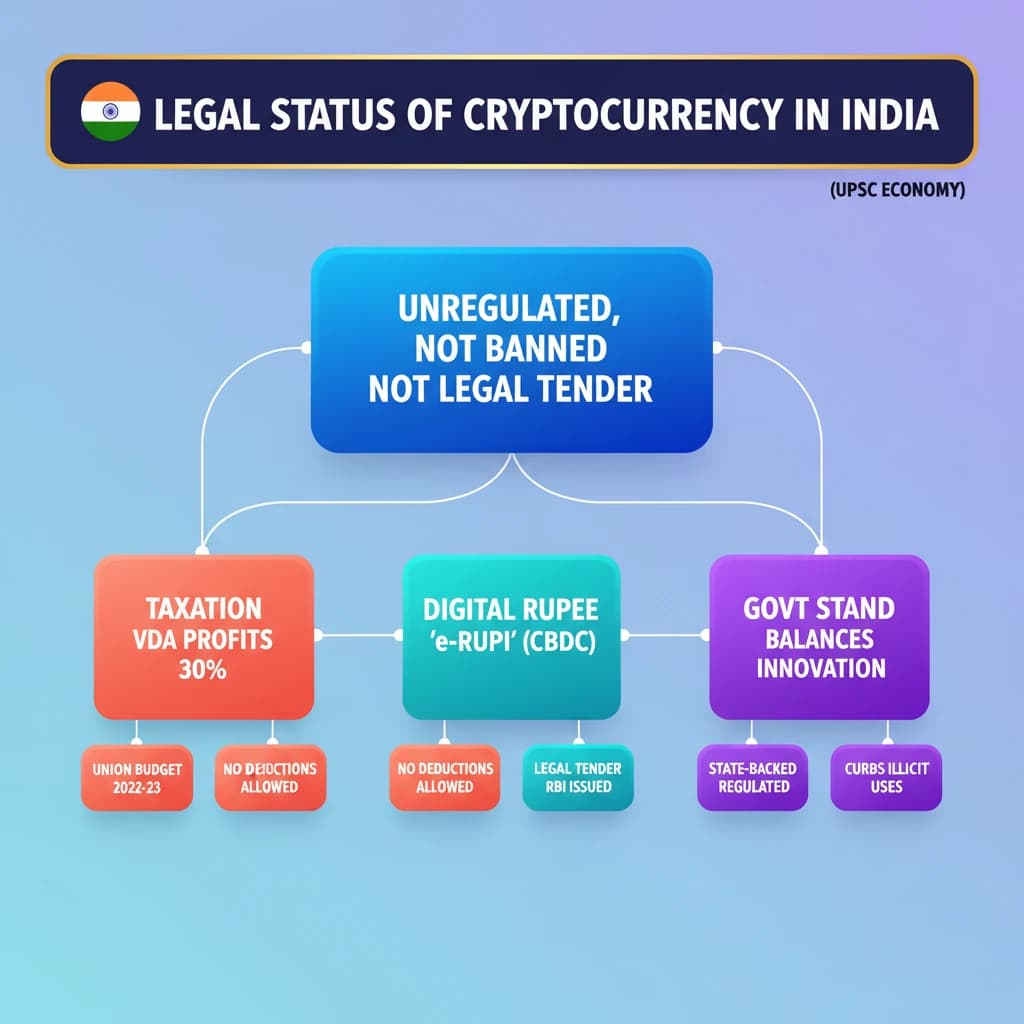
  • Cryptocurrency in India is unregulated but not banned; it is not legal tender.
  • Profits from Virtual Digital Assets (VDAs) are taxed at 30% since Union Budget 2022-23.
  • India has launched its own Central Bank Digital Currency (CBDC), the 'e-RUPI', which is legal tender.
  • CBDCs are state-backed and regulated, unlike decentralised private cryptocurrencies.
  • The government's approach balances innovation with financial stability and combating illicit uses.
What is Legal Status of Cryptocurrency in India?

What is Legal Status of Cryptocurrency in India?

Medium⏱️ 8 min read✓ 95% Verified
economy

📖 Introduction

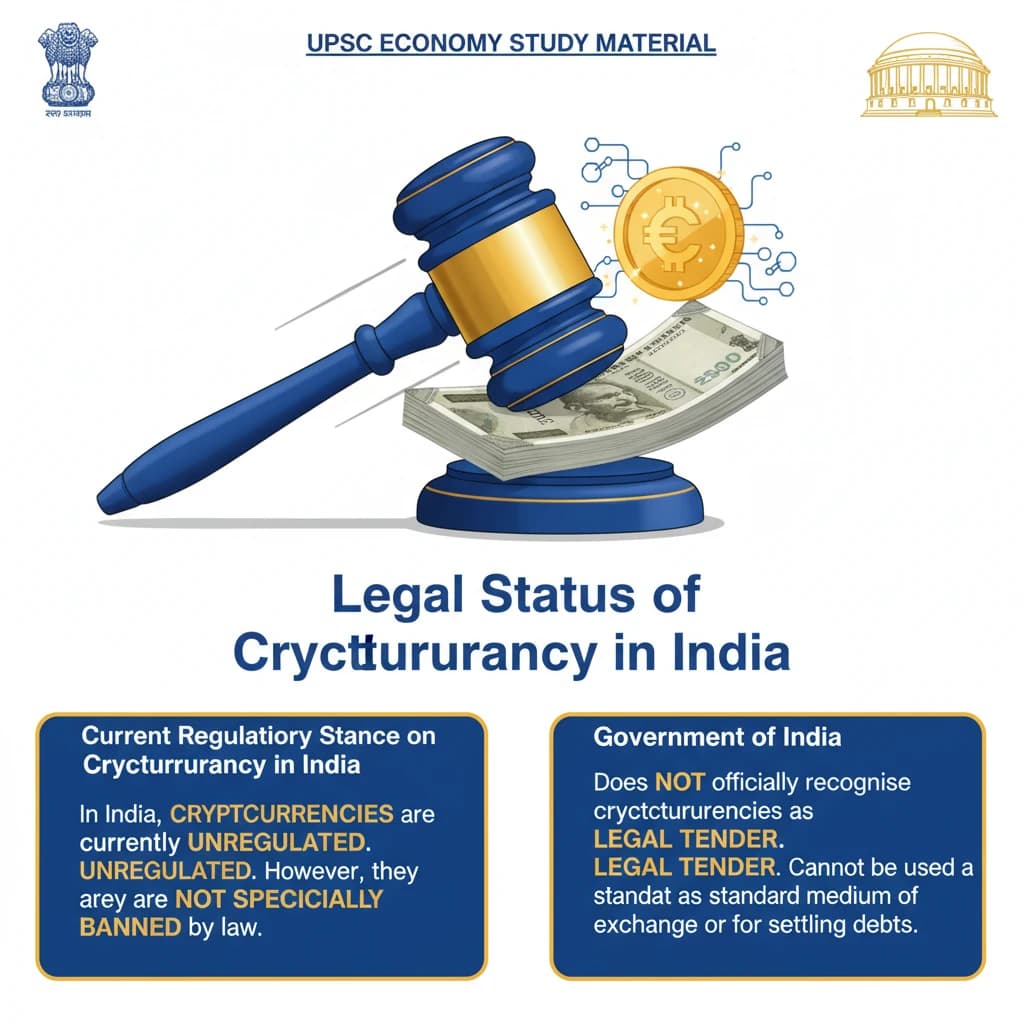
<h4>Current Regulatory Stance on Cryptocurrency in India</h4><p>In India, <strong>cryptocurrencies</strong> are currently <strong>unregulated</strong>. However, it is crucial to note that they are <strong>not specifically banned</strong> by law.</p><p>The <strong>Government of India</strong> does not officially recognise cryptocurrencies as <strong>legal tender</strong>. This means they cannot be used as a standard medium of exchange for goods and services or for settling debts.</p><div class='info-box'><p><strong>Legal Tender:</strong> A medium of payment recognised by law to be valid for meeting a financial obligation. In India, the <strong>Indian Rupee</strong> is the legal tender.</p></div><p>The government intends to address the use of cryptocurrencies in facilitating <strong>illegal activities</strong>, treating them as a payment method for such purposes.</p><h4>Taxation of Virtual Digital Assets (VDA)</h4><p>Despite the unregulated status, the <strong>Government of India</strong> introduced a significant taxation framework for <strong>virtual digital assets (VDA)</strong>, which includes cryptocurrencies, in the <strong>Union Budget 2022-23</strong>.</p><div class='info-box'><p><strong>Union Budget 2022-23:</strong> Announced that the transfer of any <strong>virtual currency/cryptocurrency asset</strong> will be subject to a <strong>30% tax deduction</strong>.</p></div><p>This taxation implies a form of indirect recognition for transaction purposes, even though they lack legal tender status.</p><div class='exam-tip-box'><p><strong>UPSC Insight:</strong> The introduction of taxation without explicit regulation highlights the government's cautious approach – aiming to generate revenue and track transactions while deliberating a comprehensive regulatory framework.</p></div><h4>Introduction of Central Bank Digital Currency (CBDC) - e-RUPI</h4><p>India has launched its own <strong>Central Bank Digital Currency (CBDC)</strong>, known as the <strong>Digital Rupee</strong> or <strong>‘e-RUPI’</strong>. This initiative is a collaborative effort by key financial and health authorities.</p><div class='info-box'><p><strong>Key Collaborators for e-RUPI:</strong></p><ul><li><strong>National Payments Corporation of India (NPCI)</strong></li><li><strong>Department of Financial Services (DFS)</strong></li><li><strong>National Health Authority (NHA)</strong></li><li><strong>Ministry of Health and Family Welfare (MoHFW)</strong></li><li>Partner banks</li></ul></div><p>The <strong>e-RUPI</strong> is a digital form of the paper currency, designed to be transacted using wallets backed by <strong>blockchain technology</strong>.</p><h4>Distinction between CBDC and Cryptocurrencies</h4><p>While the concept of <strong>CBDCs</strong> was inspired by innovations like <strong>Bitcoin</strong>, there are fundamental differences between them and decentralised virtual currencies or crypto assets.</p><div class='key-point-box'><p><strong>Key Differences:</strong></p><ul><li><strong>CBDCs</strong> are <strong>legal tenders</strong>, issued and backed by a <strong>central bank</strong> (like RBI in India).</li><li><strong>Cryptocurrencies</strong> (e.g., Bitcoin, Ethereum) operate in a <strong>regulatory vacuum</strong> and are <strong>not issued by the state</strong>.</li><li><strong>CBDCs</strong> are a digital form of <strong>fiat currency</strong>, enjoying sovereign backing.</li><li><strong>Cryptocurrencies</strong> lack the <strong>‘legal tender’ status</strong> and are decentralised.</li></ul></div><p>This distinction is critical for understanding India's approach, which seeks to leverage digital currency benefits while maintaining monetary control and stability.</p>
Concept Diagram

💡 Key Takeaways

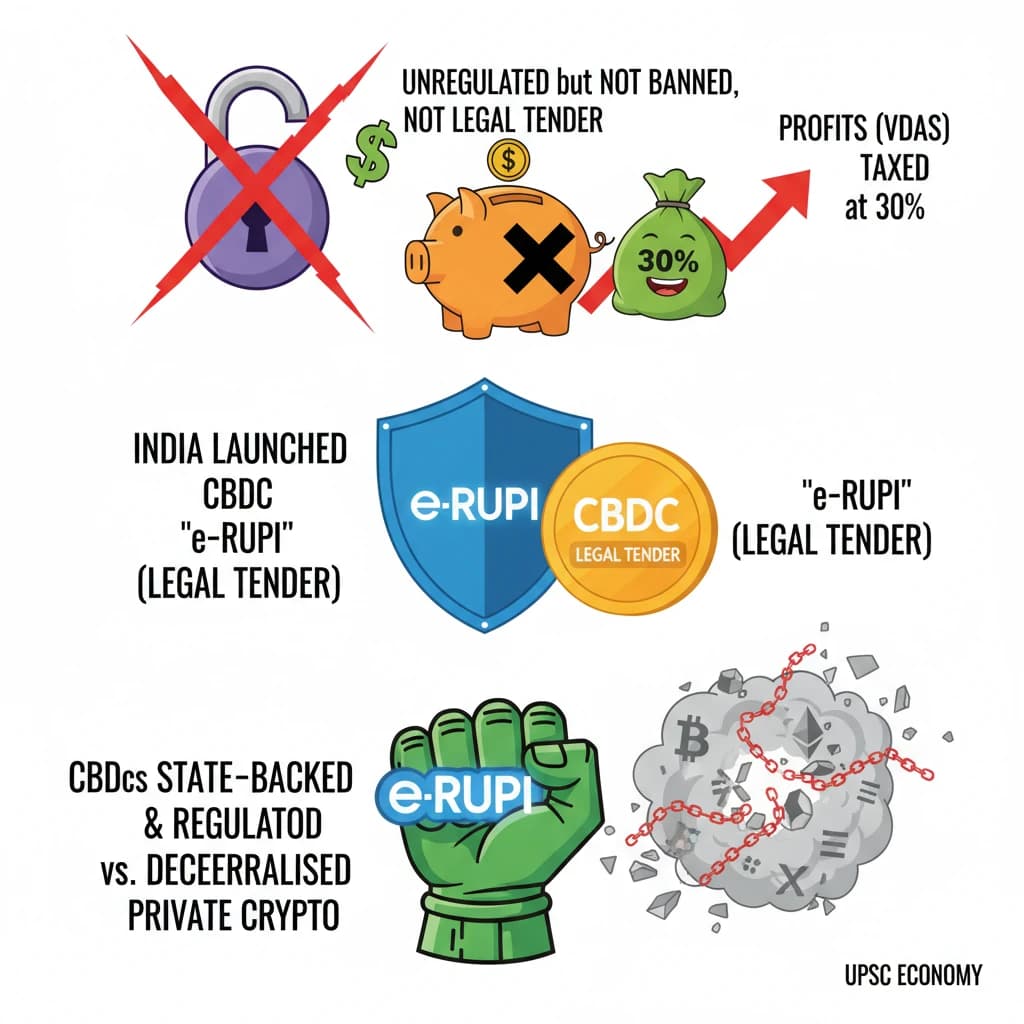
  • •Cryptocurrency in India is unregulated but not banned; it is not legal tender.
  • •Profits from Virtual Digital Assets (VDAs) are taxed at 30% since Union Budget 2022-23.
  • •India has launched its own Central Bank Digital Currency (CBDC), the 'e-RUPI', which is legal tender.
  • •CBDCs are state-backed and regulated, unlike decentralised private cryptocurrencies.
  • •The government's approach balances innovation with financial stability and combating illicit uses.

🧠 Memory Techniques
Memory Aid
95% Verified Content

📚 Reference Sources

•Union Budget 2022-23 documents
•Reserve Bank of India (RBI) publications on Central Bank Digital Currency (CBDC)
•Supreme Court of India rulings on cryptocurrency (2020)

Related Topics

Loading related topics...
Explore:Economy Topics·All Subjects·Daily Current Affairs·Editorial Analysis·Previous Year Questions·UPSC GPT