Loading page, please wait…
Vaidra Logo
Vaidra

Top 4 items + smart groups

UPSC GPT
New
Current Affairs
Daily Solutions
Daily Puzzle
Mains Evaluator

Version 2.0.0 • Built with ❤️ for UPSC aspirants

Loading...
Loading...
Loading...
Loading...
Loading...
Loading...
Loading...
Loading...
Loading...
Loading...
Loading...
Loading...
Loading...
Back
All Subjects

Topics

0 topics • 0 completed

Loading topics...
Loading...
Loading...
Loading...
Loading...
Loading...
Overall Progress0%

Central Trade Unions (CTUs) Demand for Labour Welfare - UPSC Economy

What is Central Trade Unions (CTUs) Demand for Labour Welfare in UPSC Economy?

Central Trade Unions (CTUs) Demand for Labour Welfare is a key topic under Economy for UPSC Civil Services Examination. Key points include: CTUs are national-level federations representing workers, engaging with the government on labour welfare.. Recent CTU demands include restoring the Old Pension Scheme, convening the ILC, and supporting the informal sector.. Government has agreed to further discussions on implementing the four Labour Codes.. Understanding this topic is essential for both UPSC Prelims and Mains preparation.

Why is Central Trade Unions (CTUs) Demand for Labour Welfare important for UPSC exam?

Central Trade Unions (CTUs) Demand for Labour Welfare is a Medium-level topic in UPSC Economy. It is tested in both Prelims (factual MCQs) and Mains (analytical answer writing). Previous year UPSC questions have frequently covered aspects of Central Trade Unions (CTUs) Demand for Labour Welfare, making it essential for comprehensive IAS preparation.

How to prepare Central Trade Unions (CTUs) Demand for Labour Welfare for UPSC?

To prepare Central Trade Unions (CTUs) Demand for Labour Welfare for UPSC: (1) Study the comprehensive notes covering all key concepts on Vaidra. (2) Practice previous year questions on this topic. (3) Connect it with current affairs using daily updates. (4) Revise using key takeaways and mind maps available for Economy. (5) Write practice answers linking Central Trade Unions (CTUs) Demand for Labour Welfare to related GS Paper topics.

Key takeaways of Central Trade Unions (CTUs) Demand for Labour Welfare for UPSC

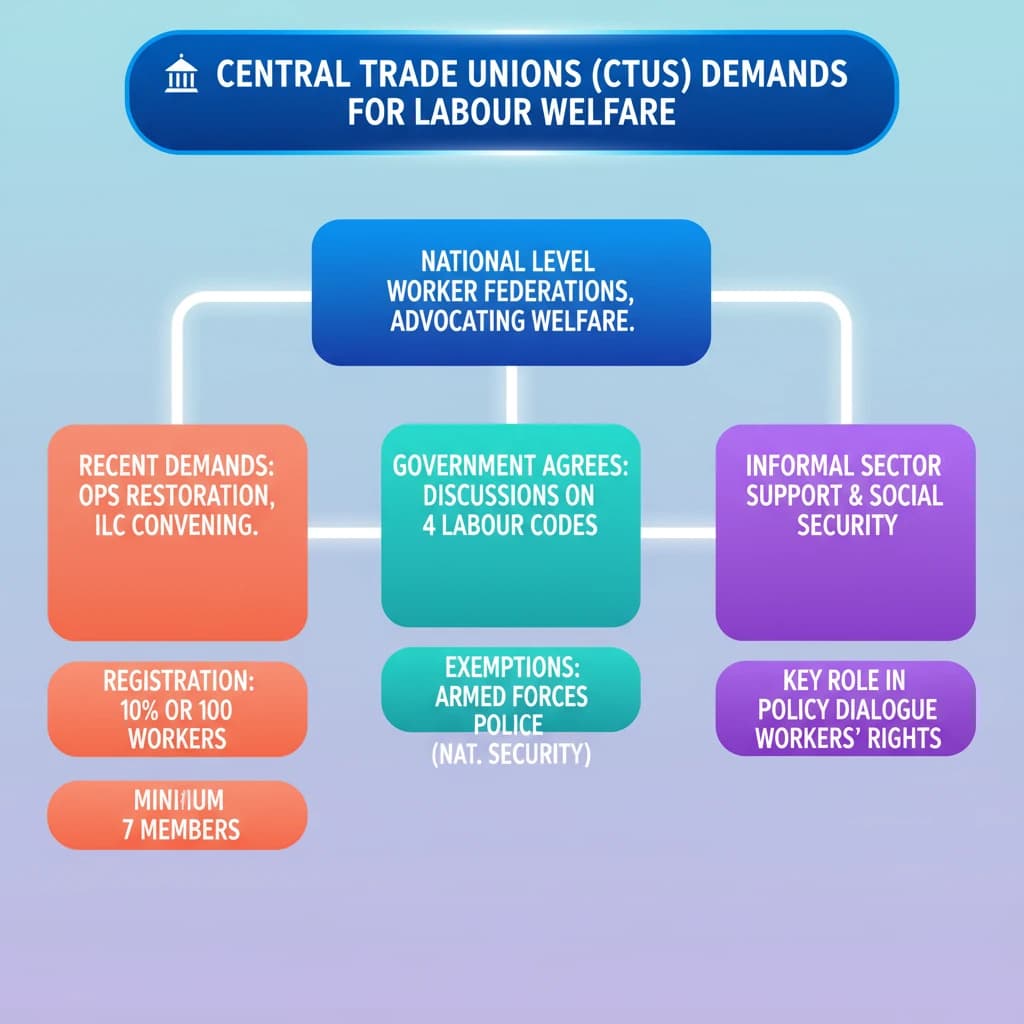
  • CTUs are national-level federations representing workers, engaging with the government on labour welfare.
  • Recent CTU demands include restoring the Old Pension Scheme, convening the ILC, and supporting the informal sector.
  • Government has agreed to further discussions on implementing the four Labour Codes.
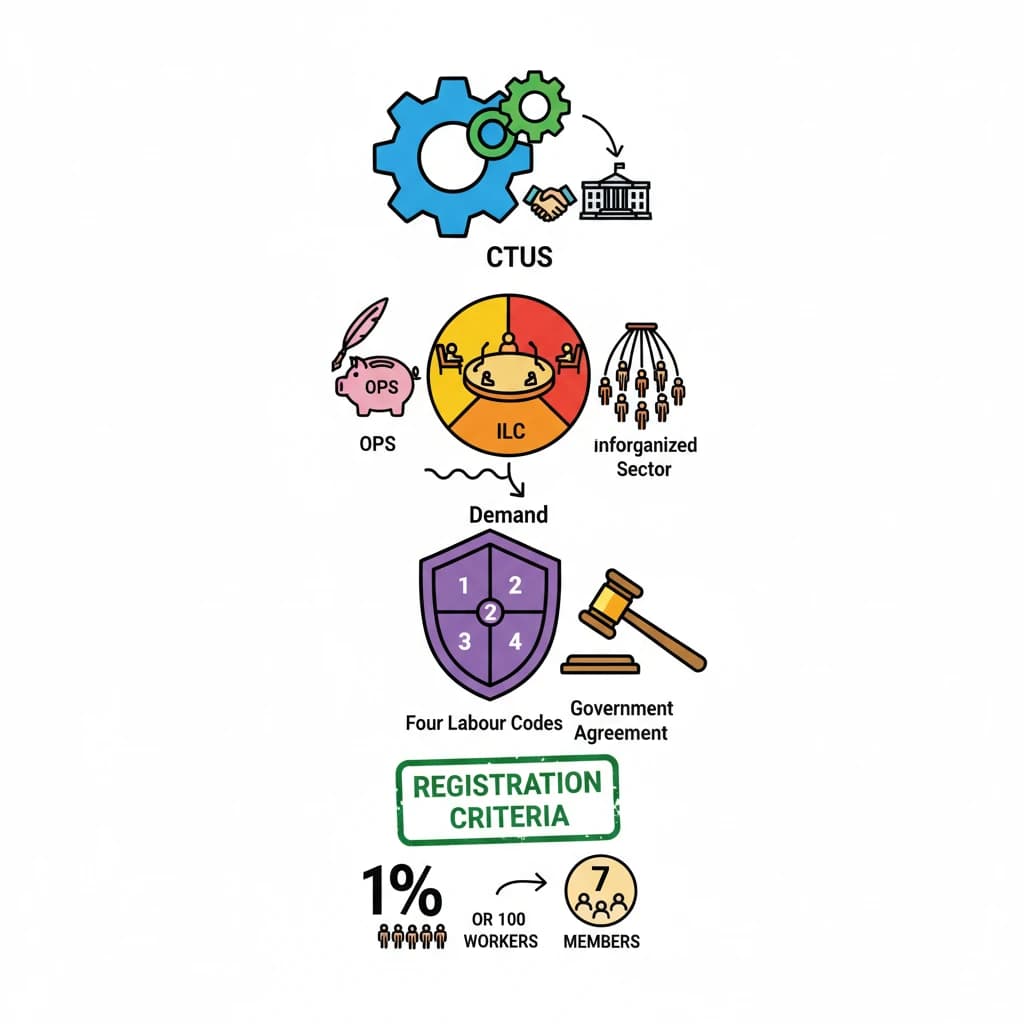
  • Trade unions require specific registration criteria: 10% or 100 workers (whichever is less) and 7 members.
  • Armed Forces and Police are legally exempt from forming trade unions due to national security and discipline considerations.
Central Trade Unions (CTUs) Demand for Labour Welfare

Central Trade Unions (CTUs) Demand for Labour Welfare

Medium⏱️ 6 min read✓ 95% Verified
economy

📖 Introduction

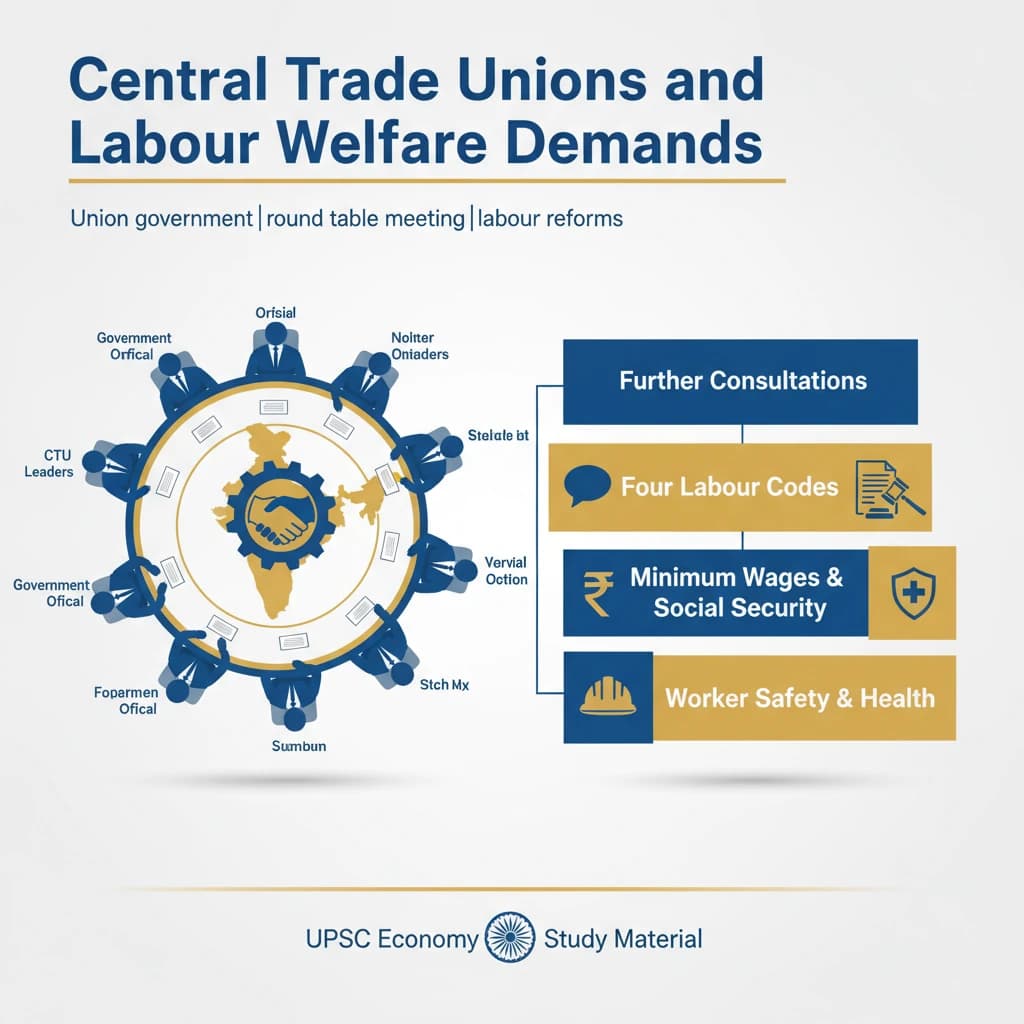
<h4>Central Trade Unions and Labour Welfare Demands</h4><p>The <strong>Union government</strong> recently convened a <strong>round table meeting</strong> with various <strong>Central Trade Unions (CTUs)</strong>. This meeting aimed to discuss critical issues concerning labour welfare and the future of labour reforms in India.</p><p>Following the discussions, the government has expressed its willingness to hold <strong>further consultations</strong> regarding the implementation of the <strong>four Labour Codes</strong>. This indicates an ongoing dialogue between the government and labour representatives.</p><div class='key-point-box'><p><strong>Key Demands by CTUs:</strong></p><ul><li><strong>Restoration of the Old Pension Scheme (OPS)</strong>: A major demand, reflecting concerns over post-retirement financial security for workers.</li><li><strong>Convening of the Indian Labour Conference (ILC)</strong>: CTUs urged for the regular and timely convening of this tripartite body for policy discussions.</li><li><strong>Increased Support for the Informal Sector</strong>: A call for greater governmental intervention and welfare measures for workers in the unorganized economy.</li></ul></div><h4>Trade Union Registration Provisions in India</h4><p>The formation and registration of trade unions in India are governed by specific legal provisions, ensuring their legitimacy and representativeness.</p><div class='info-box'><p><strong>Registration Criteria for a Trade Union:</strong></p><ul><li>A registered trade union must comprise at least <strong>10%</strong> of the workers or a minimum of <strong>100 workers</strong>, whichever number is less.</li><li>Additionally, it must have a minimum of <strong>7 members</strong> from the relevant establishment or industry to qualify for registration.</li></ul></div><h4>Organisations Exempted from Forming Trade Unions</h4><p>Certain critical organisations are explicitly exempted from forming trade unions. This provision is primarily aimed at ensuring their operational efficiency, discipline, and national security.</p><ul><li><strong>Armed Forces</strong>: Employees of the <strong>Indian Armed Forces</strong> (Army, Navy, and Air Force) are strictly prohibited from forming trade unions.</li><li>This restriction is enshrined in the <strong>Armed Forces Act, 1950</strong>, which outlines the conduct and discipline within the military.</li><li><strong>Police and Law Enforcement Agencies</strong>: The <strong>Police Forces (Restriction of Rights) Act, 1966</strong>, prohibits non-gazetted police employees, specifically those below the rank of inspector, from forming any kind of union or group.</li></ul><div class='exam-tip-box'><p><strong>UPSC Insight:</strong> Understanding the legal framework for trade unions, including both registration criteria and exemptions, is crucial for <strong>GS-II (Governance and Social Justice)</strong> and <strong>GS-III (Indian Economy)</strong>. Questions may focus on the balance between labour rights and national security/efficiency.</p></div>
Concept Diagram

💡 Key Takeaways

  • •CTUs are national-level federations representing workers, engaging with the government on labour welfare.
  • •Recent CTU demands include restoring the Old Pension Scheme, convening the ILC, and supporting the informal sector.
  • •Government has agreed to further discussions on implementing the four Labour Codes.
  • •Trade unions require specific registration criteria: 10% or 100 workers (whichever is less) and 7 members.
  • •Armed Forces and Police are legally exempt from forming trade unions due to national security and discipline considerations.

🧠 Memory Techniques
Memory Aid
95% Verified Content

📚 Reference Sources

•The Trade Unions Act, 1926 (implied by registration provisions)
•Armed Forces Act, 1950
•Police Forces (Restriction of Rights) Act, 1966
•Ministry of Labour & Employment, Government of India official releases (for CTU meetings and Labour Codes)

Related Topics

Loading related topics...
Explore:Economy Topics·All Subjects·Daily Current Affairs·Editorial Analysis·Previous Year Questions·UPSC GPT
Central Trade Unions (CTUs) Demand for Labour Welfare - UPSC Economy