Loading page, please wait…
Vaidra Logo
Vaidra

Top 4 items + smart groups

UPSC GPT
New
Current Affairs
Daily Solutions
Daily Puzzle
Mains Evaluator

Version 2.0.0 • Built with ❤️ for UPSC aspirants

Loading...
Loading...
Loading...
Loading...
Loading...
Loading...
Loading...
Loading...
Loading...
Loading...
Loading...
Loading...
Loading...
What are the Major Initiatives Taken to Enable Make in India? - UPSC Economy
Back
All Subjects

Topics

0 topics • 0 completed

Loading topics...
Loading...
Loading...
Loading...
Loading...
Loading...
Overall Progress0%

What are the Major Initiatives Taken to Enable Make in India? - UPSC Economy

What is What are the Major Initiatives Taken to Enable Make in India? in UPSC Economy?

What are the Major Initiatives Taken to Enable Make in India? is a key topic under Economy for UPSC Civil Services Examination. Key points include: Make in India aims to boost domestic manufacturing and attract investment.. PLI schemes incentivize production across 14 key sectors, boosting exports and jobs.. PM GatiShakti focuses on multimodal infrastructure for efficient logistics and economic growth.. Understanding this topic is essential for both UPSC Prelims and Mains preparation.

Why is What are the Major Initiatives Taken to Enable Make in India? important for UPSC exam?

What are the Major Initiatives Taken to Enable Make in India? is a Medium-level topic in UPSC Economy. It is tested in both Prelims (factual MCQs) and Mains (analytical answer writing). Previous year UPSC questions have frequently covered aspects of What are the Major Initiatives Taken to Enable Make in India?, making it essential for comprehensive IAS preparation.

How to prepare What are the Major Initiatives Taken to Enable Make in India? for UPSC?

To prepare What are the Major Initiatives Taken to Enable Make in India? for UPSC: (1) Study the comprehensive notes covering all key concepts on Vaidra. (2) Practice previous year questions on this topic. (3) Connect it with current affairs using daily updates. (4) Revise using key takeaways and mind maps available for Economy. (5) Write practice answers linking What are the Major Initiatives Taken to Enable Make in India? to related GS Paper topics.

Key takeaways of What are the Major Initiatives Taken to Enable Make in India? for UPSC

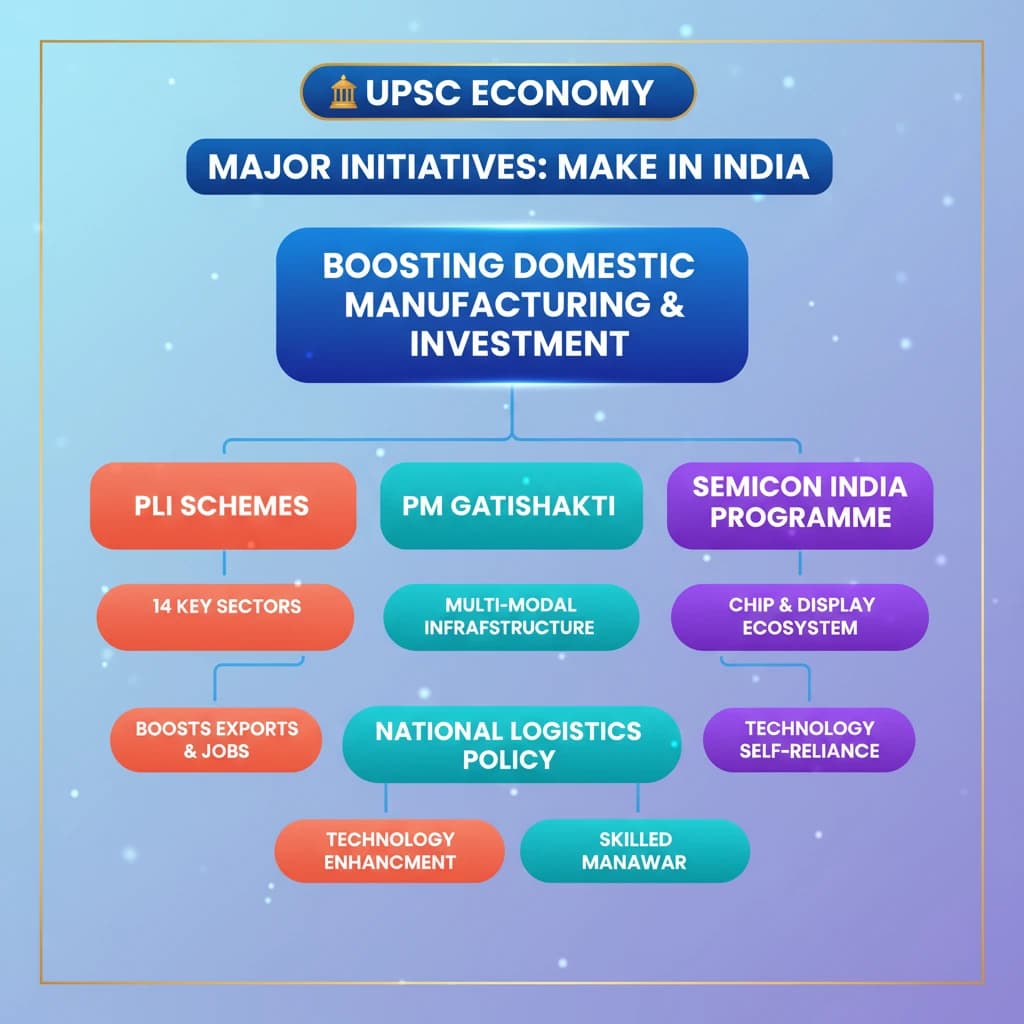
  • Make in India aims to boost domestic manufacturing and attract investment.
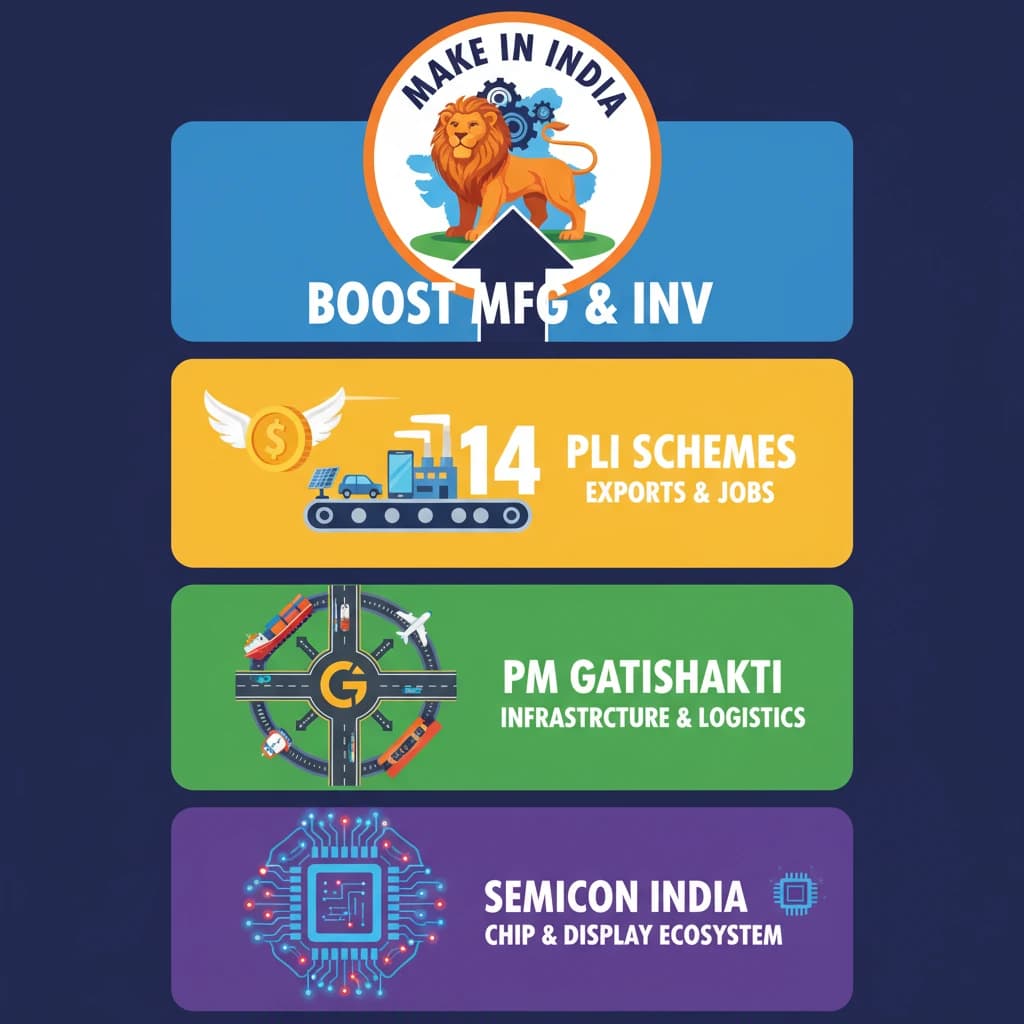
  • PLI schemes incentivize production across 14 key sectors, boosting exports and jobs.
  • PM GatiShakti focuses on multimodal infrastructure for efficient logistics and economic growth.
  • Semicon India Programme is critical for developing a sustainable semiconductor and display ecosystem.
  • National Logistics Policy enhances logistics efficiency through technology and skilled manpower.
  • These initiatives collectively drive job creation, economic resilience, and technological advancement for a self-reliant India.
What are the Major Initiatives Taken to Enable Make in India?

What are the Major Initiatives Taken to Enable Make in India?

Medium⏱️ 7 min read✓ 95% Verified
economy

📖 Introduction

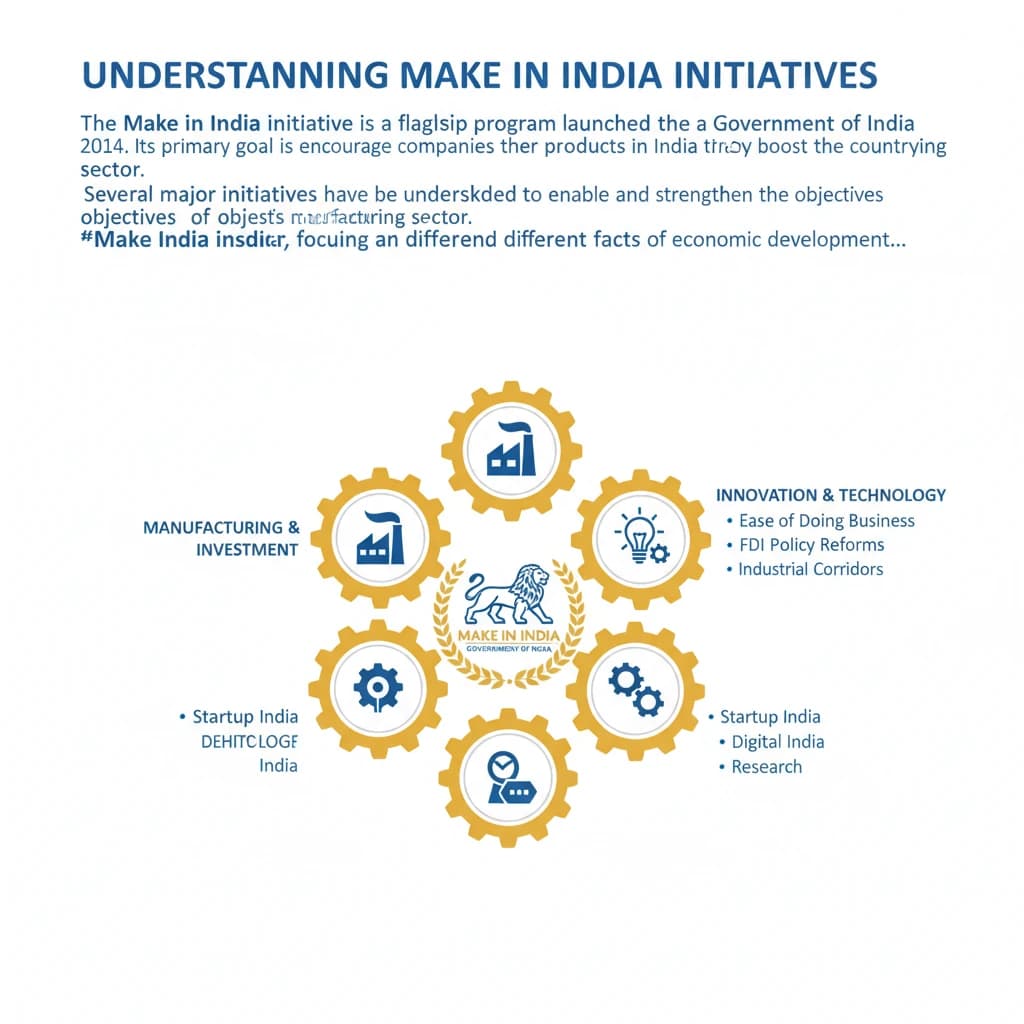
<h4>Understanding Make in India Initiatives</h4><p>The <strong>Make in India</strong> initiative is a flagship program launched by the Government of India in <strong>2014</strong>. Its primary goal is to encourage companies to manufacture their products in India and thereby boost the country's manufacturing sector.</p><p>Several major initiatives have been undertaken to enable and strengthen the objectives of <strong>Make in India</strong>, focusing on different facets of economic development and industrial growth.</p><h4>Production Linked Incentive (PLI) Schemes</h4><p>The <strong>Production Linked Incentive (PLI) Schemes</strong> are a crucial component designed to enhance domestic manufacturing capabilities. These schemes aim to boost both production and exports across various sectors.</p><p>The PLI framework covers <strong>14 key sectors</strong>, providing incentives on incremental sales from products manufactured in India. This encourages companies to expand their production base within the country.</p><div class='info-box'><p><strong>Progress as of July 2024:</strong></p><ul><li>Total investment attracted: <strong>Rs 1.23 lakh crore</strong></li><li>Jobs generated: Approximately <strong>8 lakh</strong></li></ul></div><div class='key-point-box'><p>The PLI schemes are instrumental in making Indian manufacturing globally competitive and reducing import dependence.</p></div><h4>PM GatiShakti National Master Plan</h4><p>The <strong>PM GatiShakti National Master Plan</strong> was launched with an ambitious vision to transform India's infrastructure landscape. Its core objective is to achieve a <strong>USD 5 trillion economy by 2025</strong>.</p><p>This initiative focuses on establishing comprehensive <strong>multimodal and last-mile connectivity infrastructure</strong>. Improved logistics are vital for reducing costs and enhancing the efficiency of the manufacturing sector.</p><div class='info-box'><p><strong>Seven Primary Engines of PM GatiShakti:</strong></p><ul><li><strong>Railways</strong></li><li><strong>Roads</strong></li><li><strong>Ports</strong></li><li><strong>Waterways</strong></li><li><strong>Airports</strong></li><li><strong>Mass Transport</strong></li><li><strong>Logistics Infrastructure</strong></li></ul></div><div class='exam-tip-box'><p>When discussing infrastructure development in UPSC answers, always mention <strong>PM GatiShakti</strong> and its multimodal approach for a comprehensive perspective.</p></div><h4>Semiconductor Ecosystem Development</h4><p>Recognizing the strategic importance of electronics manufacturing, the government approved the <strong>Semicon India Programme</strong> in <strong>2021</strong>. This program is a significant step towards building self-reliance in high-tech sectors.</p><p>The initiative aims to develop a sustainable <strong>semiconductor and display ecosystem</strong> within India. This includes attracting investments in fabrication units, design, and packaging facilities.</p><div class='key-point-box'><p>Developing a robust semiconductor ecosystem is crucial for India's digital economy and national security, directly supporting the high-tech manufacturing aspect of <strong>Make in India</strong>.</p></div><h4>National Logistics Policy (NLP)</h4><p>The <strong>National Logistics Policy (NLP)</strong> was introduced to address the challenges in India's logistics sector. An efficient logistics network is fundamental for cost-effective manufacturing and timely delivery of goods.</p><p>The policy focuses on enhancing the sector through a combination of advanced technology, improved processes, and the development of skilled manpower. This holistic approach aims to reduce logistics costs as a percentage of GDP.</p><div class='info-box'><p><strong>Key Pillars of NLP:</strong></p><ul><li>Integration of Digital Systems (IDS)</li><li>Unified Logistics Interface Platform (ULIP)</li><li>Ease of Logistics Services (E-Logs)</li><li>System Improvement Group (SIG)</li></ul></div>
Concept Diagram

💡 Key Takeaways

  • •Make in India aims to boost domestic manufacturing and attract investment.
  • •PLI schemes incentivize production across 14 key sectors, boosting exports and jobs.
  • •PM GatiShakti focuses on multimodal infrastructure for efficient logistics and economic growth.
  • •Semicon India Programme is critical for developing a sustainable semiconductor and display ecosystem.
  • •National Logistics Policy enhances logistics efficiency through technology and skilled manpower.
  • •These initiatives collectively drive job creation, economic resilience, and technological advancement for a self-reliant India.

🧠 Memory Techniques
Memory Aid
95% Verified Content

📚 Reference Sources

•Government of India official reports (e.g., Ministry of Commerce & Industry, NITI Aayog)

Related Topics

Loading related topics...
Explore:Economy Topics·All Subjects·Daily Current Affairs·Editorial Analysis·Previous Year Questions·UPSC GPT