Loading page, please wait…
Advance Pricing Agreements and Double Taxation Avoidance Agreement - UPSC Economy
What is Advance Pricing Agreements and Double Taxation Avoidance Agreement in UPSC Economy?
Advance Pricing Agreements and Double Taxation Avoidance Agreement is a key topic under Economy for UPSC Civil Services Examination. Key points include: APAs provide tax certainty for future international transactions, especially regarding transfer pricing.. DTAAs prevent income from being taxed twice by two different countries.. CBDT signed 125 APAs in FY 2023-24, indicating India's commitment to tax predictability.. Understanding this topic is essential for both UPSC Prelims and Mains preparation.
Why is Advance Pricing Agreements and Double Taxation Avoidance Agreement important for UPSC exam?
Advance Pricing Agreements and Double Taxation Avoidance Agreement is a Medium-level topic in UPSC Economy. It is tested in both Prelims (factual MCQs) and Mains (analytical answer writing). Previous year UPSC questions have frequently covered aspects of Advance Pricing Agreements and Double Taxation Avoidance Agreement, making it essential for comprehensive IAS preparation.
How to prepare Advance Pricing Agreements and Double Taxation Avoidance Agreement for UPSC?
To prepare Advance Pricing Agreements and Double Taxation Avoidance Agreement for UPSC: (1) Study the comprehensive notes covering all key concepts on Vaidra. (2) Practice previous year questions on this topic. (3) Connect it with current affairs using daily updates. (4) Revise using key takeaways and mind maps available for Economy. (5) Write practice answers linking Advance Pricing Agreements and Double Taxation Avoidance Agreement to related GS Paper topics.
Key takeaways of Advance Pricing Agreements and Double Taxation Avoidance Agreement for UPSC
- APAs provide tax certainty for future international transactions, especially regarding transfer pricing.
- DTAAs prevent income from being taxed twice by two different countries.
- CBDT signed 125 APAs in FY 2023-24, indicating India's commitment to tax predictability.
- India and Mauritius amended their DTAA to curb tax evasion, aligning with global BEPS efforts.
- Both APAs and DTAAs are vital for attracting FDI, improving ease of doing business, and combating illicit financial flows.
Advance Pricing Agreements and Double Taxation Avoidance Agreement
Medium⏱️ 6 min read
economy
📖 Introduction
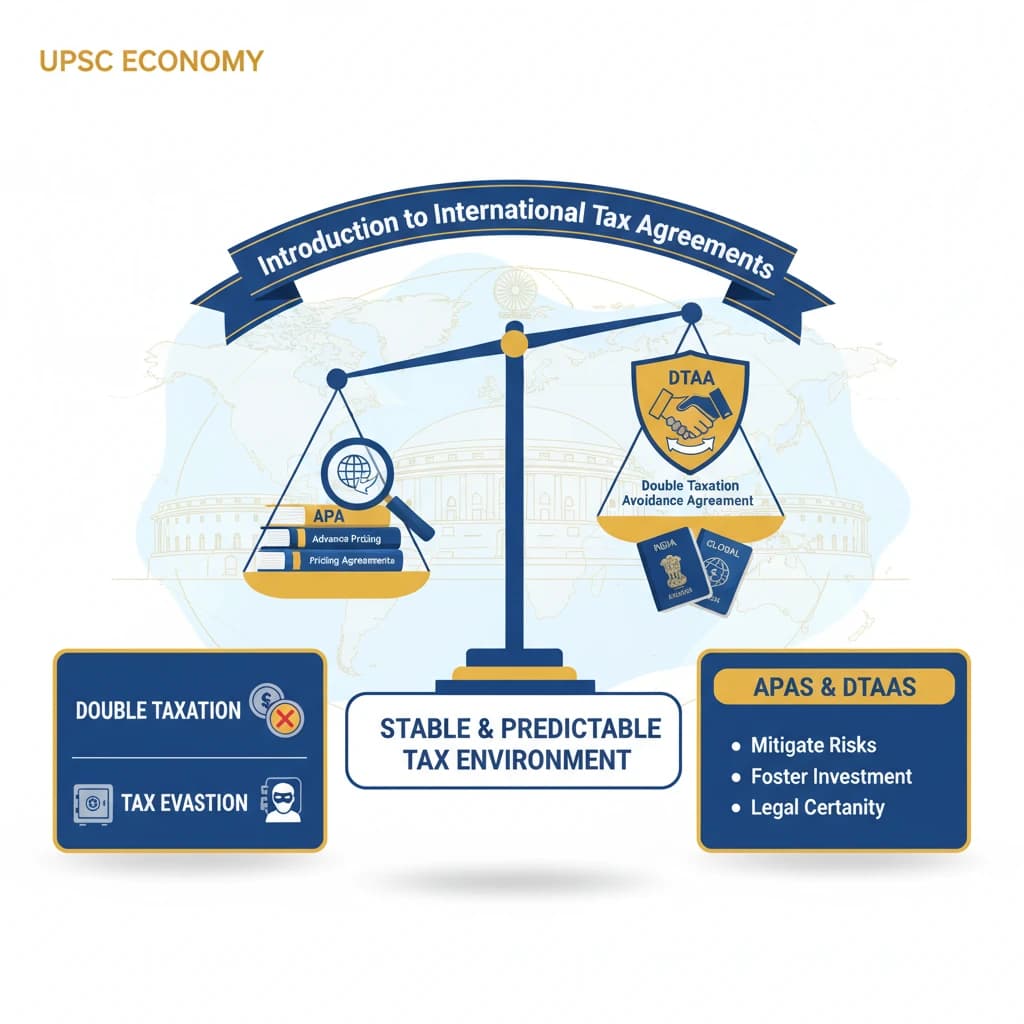
Introduction to International Tax Agreements
International taxation is a complex area, often leading to challenges like double taxation or opportunities for tax evasion. To address these, countries enter into various agreements, notably Advance Pricing Agreements (APAs) and Double Taxation Avoidance Agreements (DTAAs).
These mechanisms are crucial for fostering a stable and predictable tax environment, which in turn encourages cross-border trade and investment.
Advance Pricing Agreements (APAs)
An Advance Pricing Agreement (APA) is an agreement between a taxpayer and a tax authority. It determines the transfer pricing methodology for specified international transactions for a fixed period in advance.
The primary goal of an APA is to provide tax certainty to multinational corporations (MNCs) regarding their future transactions, thereby reducing litigation and compliance costs.
Recent Milestone: The Central Board of Direct Taxes (CBDT) in India signed a remarkable 125 Advance Pricing Agreements (APAs) during the fiscal year 2023-24. This achievement highlights India's commitment to tax certainty and ease of doing business.
Key Benefit of APAs: They offer predictability and transparency in transfer pricing matters, significantly mitigating potential disputes between taxpayers and tax authorities.
Double Taxation Avoidance Agreements (DTAAs)
A Double Taxation Avoidance Agreement (DTAA) is a tax treaty signed between two or more countries. Its main purpose is to prevent taxpayers from being taxed twice on the same income in two different countries.
DTAAs typically cover various types of income, including salaries, dividends, interest, royalties, and capital gains, specifying which country has the right to tax which income.
Recent Development: India and Mauritius have recently amended their Double Taxation Avoidance Agreement (DTAA). This amendment aims to curb tax evasion and ensure more equitable and fair taxation practices between the two nations.
UPSC Insight: Understanding the distinction between APAs (forward-looking, specific to transfer pricing) and DTAAs (broader, covering various income types to prevent double taxation) is crucial for both Prelims and Mains. Focus on their objectives and recent amendments.
💡 Key Takeaways
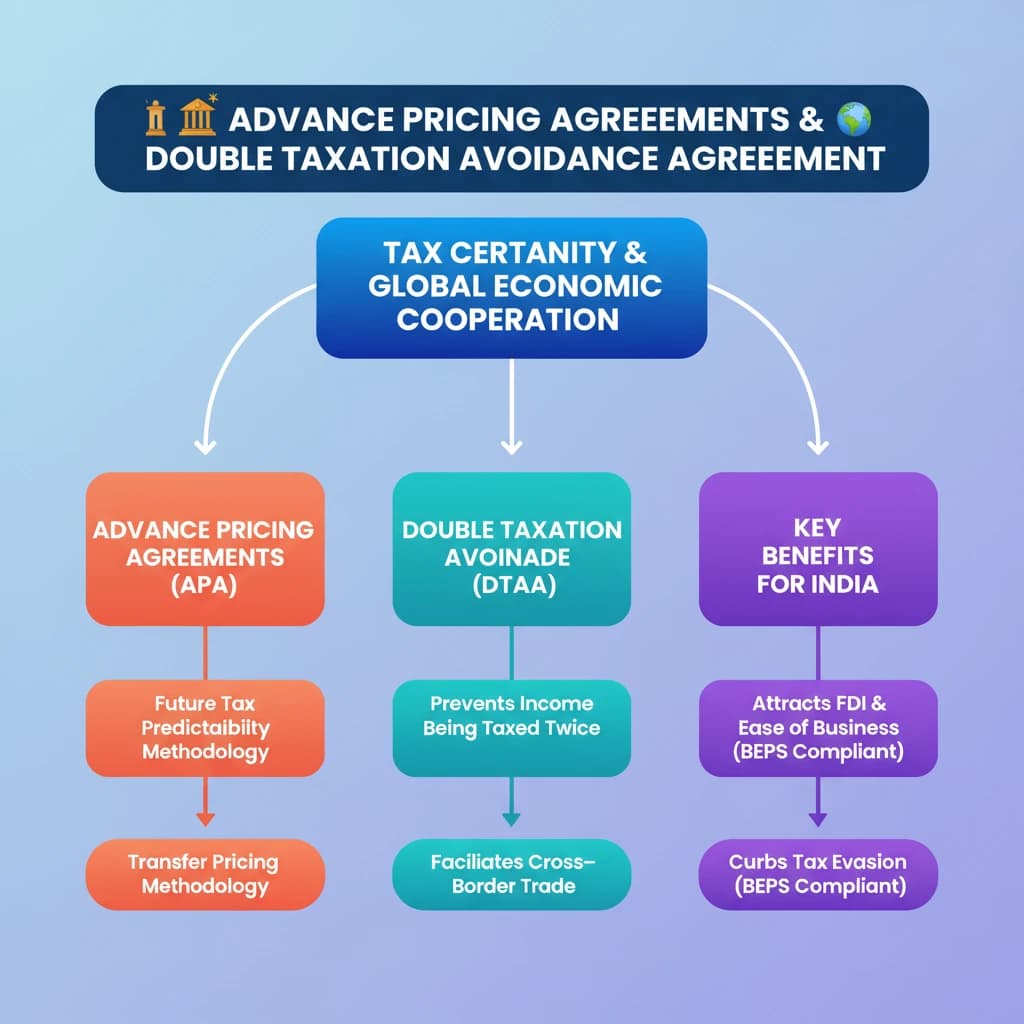
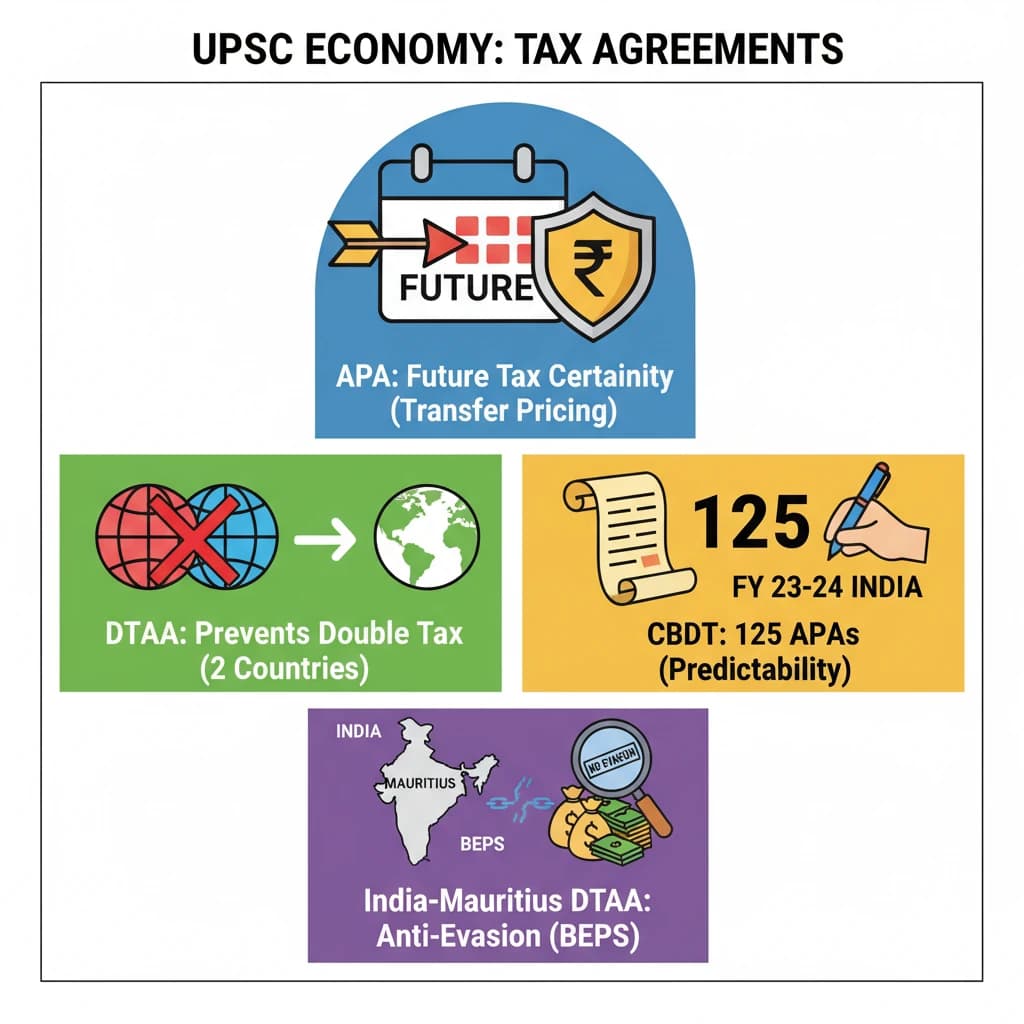
- •APAs provide tax certainty for future international transactions, especially regarding transfer pricing.
- •DTAAs prevent income from being taxed twice by two different countries.
- •CBDT signed 125 APAs in FY 2023-24, indicating India's commitment to tax predictability.
- •India and Mauritius amended their DTAA to curb tax evasion, aligning with global BEPS efforts.
- •Both APAs and DTAAs are vital for attracting FDI, improving ease of doing business, and combating illicit financial flows.
🧠 Memory Techniques
95% Verified Content
📚 Reference Sources
•Central Board of Direct Taxes (CBDT) Annual Reports/Press Releases
•Ministry of Finance, Government of India Publications
•OECD Model Tax Convention and BEPS Action Plans