Loading page, please wait…
Vaidra Logo
Vaidra

Top 4 items + smart groups

UPSC GPT
New
Current Affairs
Daily Solutions
Daily Puzzle
Mains Evaluator

Version 2.0.0 • Built with ❤️ for UPSC aspirants

Loading...
Loading...
Loading...
Loading...
Loading...
Loading...
Loading...
Loading...
Loading...
Loading...
Loading...
Loading...
Loading...
Back
All Subjects

Topics

0 topics • 0 completed

Loading topics...
Loading...
Loading...
Loading...
Loading...
Loading...
Overall Progress0%

Local Currency Trade between India-Indonesia - UPSC Economy

What is Local Currency Trade between India-Indonesia in UPSC Economy?

Local Currency Trade between India-Indonesia is a key topic under Economy for UPSC Civil Services Examination. Key points include: India and Indonesia signed an MoU for Local Currency Trade (LCT).. The framework promotes using Indian Rupee (INR) and Indonesian Rupiah (IDR) for cross-border transactions.. Aims to reduce reliance on the US Dollar and mitigate exchange rate risks.. Understanding this topic is essential for both UPSC Prelims and Mains preparation.

Why is Local Currency Trade between India-Indonesia important for UPSC exam?

Local Currency Trade between India-Indonesia is a Medium-level topic in UPSC Economy. It is tested in both Prelims (factual MCQs) and Mains (analytical answer writing). Previous year UPSC questions have frequently covered aspects of Local Currency Trade between India-Indonesia, making it essential for comprehensive IAS preparation.

How to prepare Local Currency Trade between India-Indonesia for UPSC?

To prepare Local Currency Trade between India-Indonesia for UPSC: (1) Study the comprehensive notes covering all key concepts on Vaidra. (2) Practice previous year questions on this topic. (3) Connect it with current affairs using daily updates. (4) Revise using key takeaways and mind maps available for Economy. (5) Write practice answers linking Local Currency Trade between India-Indonesia to related GS Paper topics.

Key takeaways of Local Currency Trade between India-Indonesia for UPSC

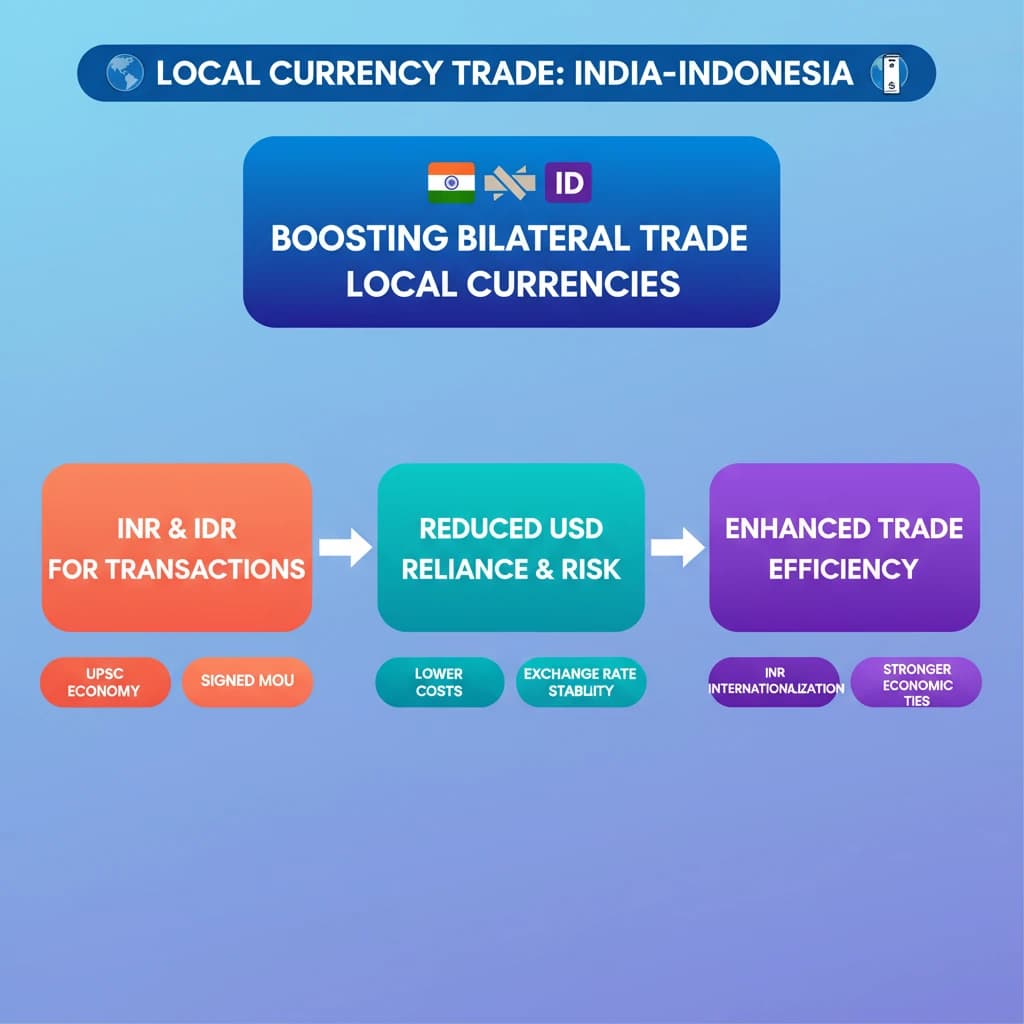
  • India and Indonesia signed an MoU for Local Currency Trade (LCT).
  • The framework promotes using Indian Rupee (INR) and Indonesian Rupiah (IDR) for cross-border transactions.
  • Aims to reduce reliance on the US Dollar and mitigate exchange rate risks.
  • Enhances bilateral trade efficiency and lowers transaction costs for businesses.
  • Supports the internationalization of the Indian Rupee and strengthens economic ties.
Local Currency Trade between India-Indonesia

Local Currency Trade between India-Indonesia

Medium⏱️ 5 min read✓ 95% Verified
economy

📖 Introduction

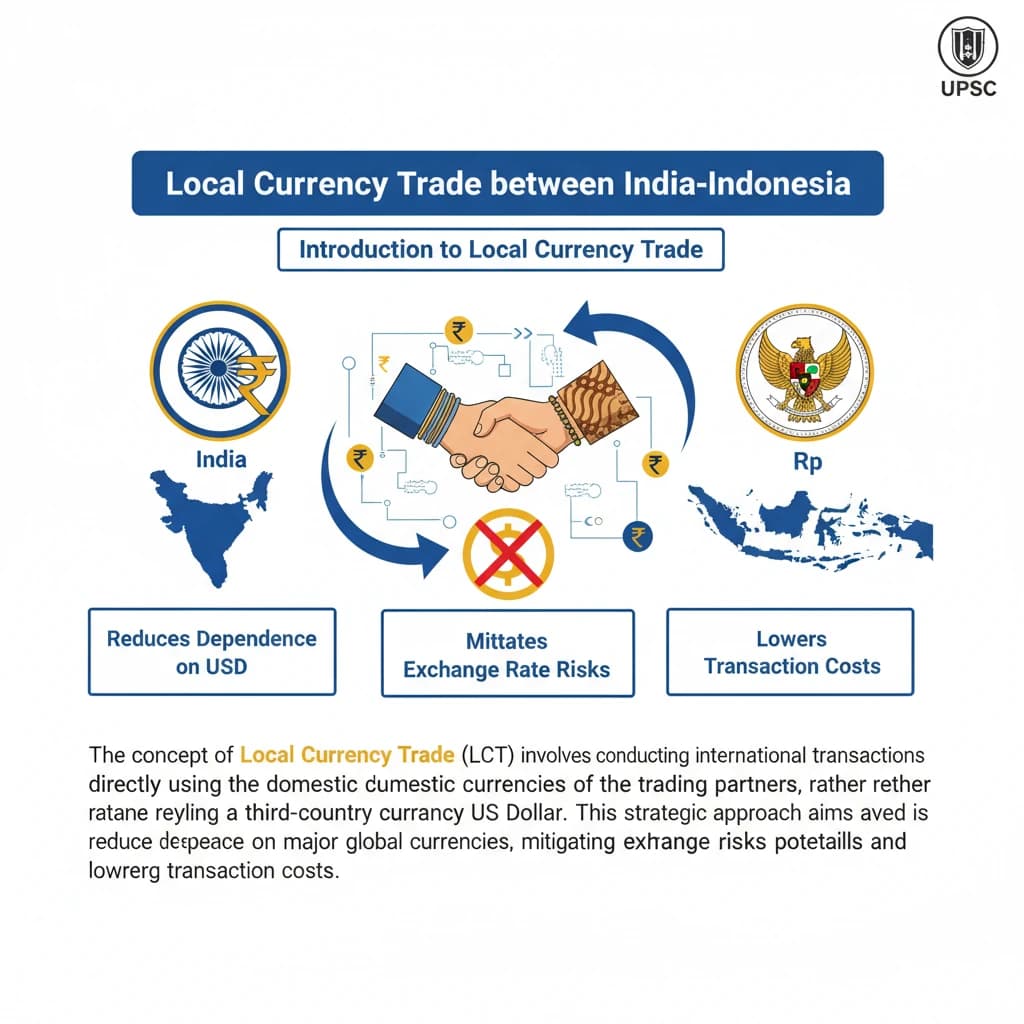
<h4>Introduction to Local Currency Trade</h4><p>The concept of <strong>Local Currency Trade (LCT)</strong> involves conducting international transactions directly using the domestic currencies of the trading partners, rather than relying on a third-country currency like the <strong>US Dollar</strong>.</p><p>This strategic approach aims to reduce dependence on major global currencies, thereby mitigating <strong>exchange rate risks</strong> and potentially lowering <strong>transaction costs</strong> for businesses engaged in cross-border commerce.</p><h4>India-Indonesia MoU for Local Currency Settlement</h4><p>The <strong>Reserve Bank of India (RBI)</strong> and <strong>Bank Indonesia (BI)</strong> have formally signed a significant agreement, a <strong>Memorandum of Understanding (MoU)</strong>.</p><p>This MoU establishes a robust framework specifically designed to facilitate and actively promote the use of their respective local currencies in bilateral trade and financial transactions.</p><div class='info-box'><p><strong>Key Currencies Involved:</strong></p><ul><li><strong>Indian Rupee (INR)</strong></li><li><strong>Indonesian Rupiah (IDR)</strong></li></ul></div><p>The primary objective of this newly established framework is to encourage the direct use of the <strong>INR</strong> and <strong>IDR</strong> for various <strong>cross-border transactions</strong> occurring between India and Indonesia.</p><div class='key-point-box'><p>This initiative represents a crucial step towards enhancing <strong>bilateral trade efficiency</strong> and strengthening <strong>economic ties</strong>, reducing the need for conversion into external currencies.</p></div><div class='exam-tip-box'><p>UPSC often focuses on India's efforts towards the <strong>internationalization of the Rupee</strong> and reducing <strong>dollar dependence</strong>. This MoU serves as a prime, current example for such topics.</p></div>
Concept Diagram

💡 Key Takeaways

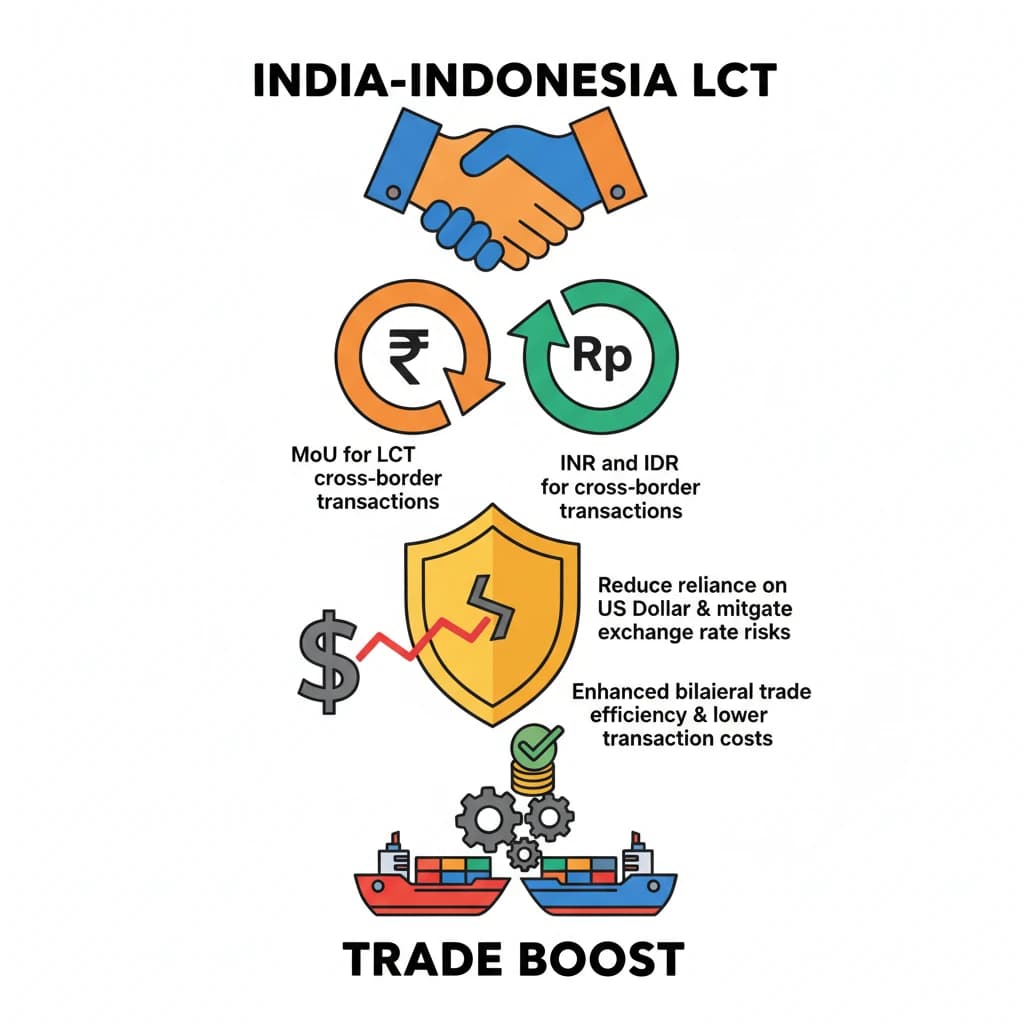
  • •India and Indonesia signed an MoU for Local Currency Trade (LCT).
  • •The framework promotes using Indian Rupee (INR) and Indonesian Rupiah (IDR) for cross-border transactions.
  • •Aims to reduce reliance on the US Dollar and mitigate exchange rate risks.
  • •Enhances bilateral trade efficiency and lowers transaction costs for businesses.
  • •Supports the internationalization of the Indian Rupee and strengthens economic ties.

🧠 Memory Techniques
Memory Aid
95% Verified Content

📚 Reference Sources

•Bank Indonesia (BI) Official Statements
•Ministry of External Affairs (MEA), Government of India
•Economic Survey of India

Related Topics

Loading related topics...
Explore:Economy Topics·All Subjects·Daily Current Affairs·Editorial Analysis·Previous Year Questions·UPSC GPT
Local Currency Trade between India-Indonesia - UPSC Economy