Loading page, please wait…
Vaidra Logo
Vaidra

Top 4 items + smart groups

UPSC GPT
New
Current Affairs
Daily Solutions
Daily Puzzle
Mains Evaluator

Version 2.0.0 • Built with ❤️ for UPSC aspirants

Loading...
Loading...
Loading...
Loading...
Loading...
Loading...
Loading...
Loading...
Loading...
Loading...
Loading...
Loading...
Loading...
What is Online Gaming? - UPSC Economy
Back
All Subjects

Topics

0 topics • 0 completed

Loading topics...
Loading...
Loading...
Loading...
Loading...
Loading...
Overall Progress0%

What is Online Gaming? - UPSC Economy

What is What is Online Gaming? in UPSC Economy?

What is Online Gaming? is a key topic under Economy for UPSC Civil Services Examination. Key points include: Online gaming involves playing video games over the Internet, enabling real-time interaction.. Games are classified as 'skill-based' (legal, e.g., Dream11) or 'chance-based' (illegal, e.g., Roulette).. India's large youth population and high smartphone penetration drive gaming industry growth.. Understanding this topic is essential for both UPSC Prelims and Mains preparation.

Why is What is Online Gaming? important for UPSC exam?

What is Online Gaming? is a Easy-level topic in UPSC Economy. It is tested in both Prelims (factual MCQs) and Mains (analytical answer writing). Previous year UPSC questions have frequently covered aspects of What is Online Gaming?, making it essential for comprehensive IAS preparation.

How to prepare What is Online Gaming? for UPSC?

To prepare What is Online Gaming? for UPSC: (1) Study the comprehensive notes covering all key concepts on Vaidra. (2) Practice previous year questions on this topic. (3) Connect it with current affairs using daily updates. (4) Revise using key takeaways and mind maps available for Economy. (5) Write practice answers linking What is Online Gaming? to related GS Paper topics.

Key takeaways of What is Online Gaming? for UPSC

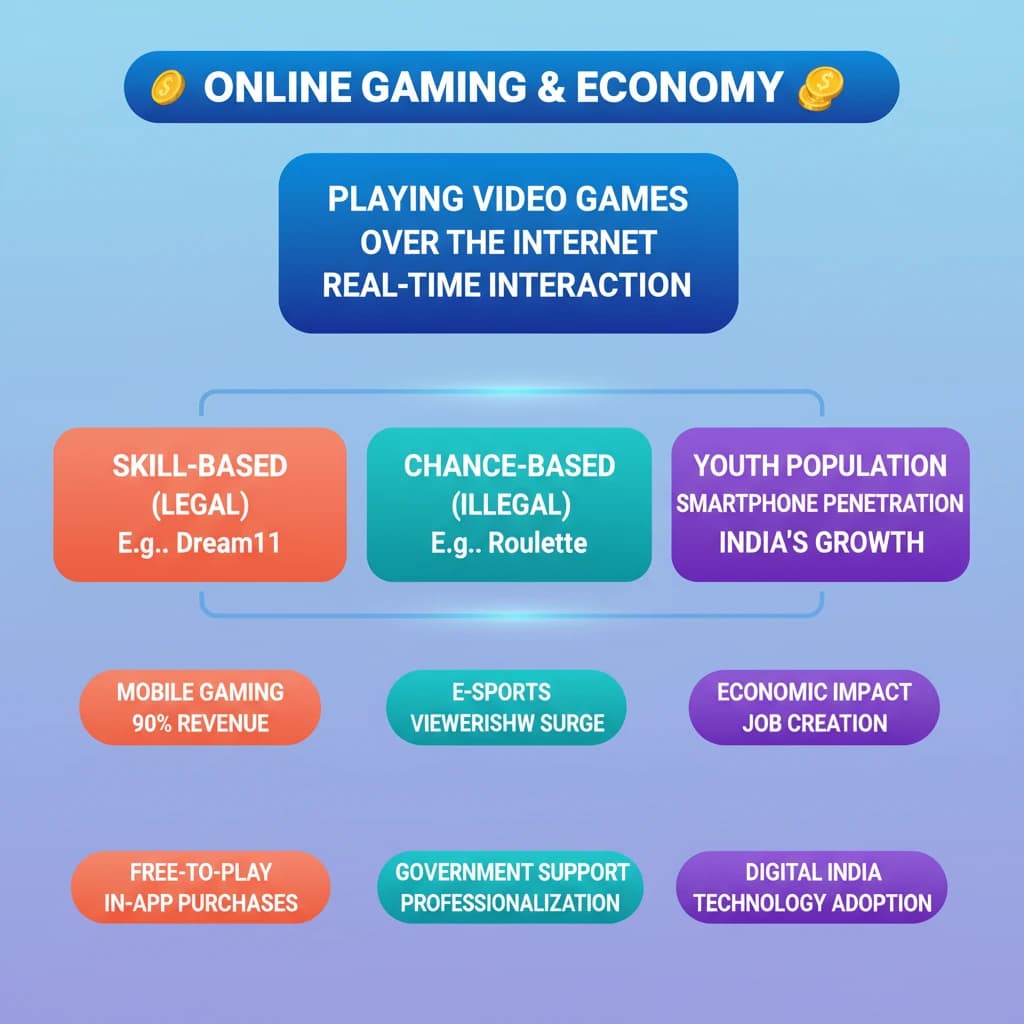
  • Online gaming involves playing video games over the Internet, enabling real-time interaction.
  • Games are classified as 'skill-based' (legal, e.g., Dream11) or 'chance-based' (illegal, e.g., Roulette).
  • India's large youth population and high smartphone penetration drive gaming industry growth.
  • Mobile gaming accounts for 90% of revenue, primarily from free-to-play and in-app purchases.
  • E-sports viewership is surging, with increasing government support and professionalization.
What is Online Gaming?

What is Online Gaming?

Easy⏱️ 4 min read✓ 95% Verified
economy

📖 Introduction

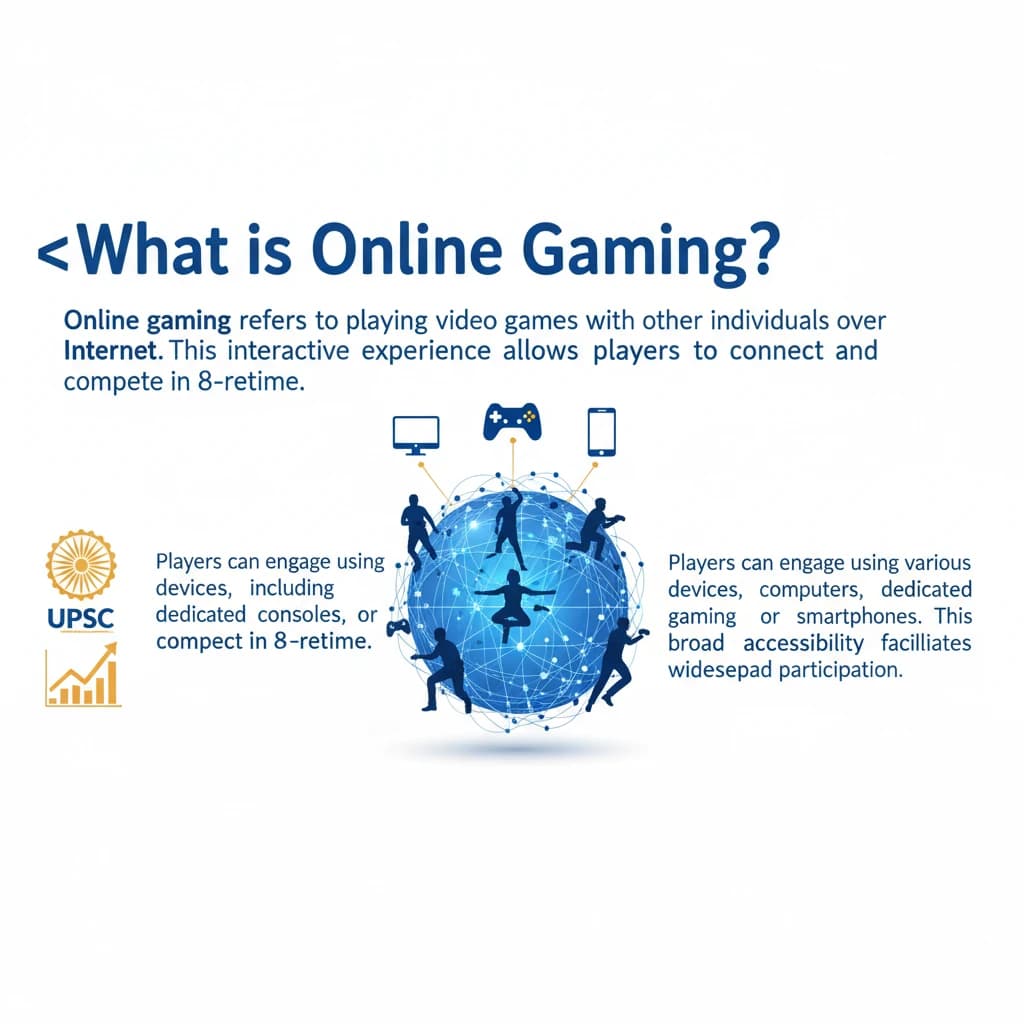
<h4>What is Online Gaming?</h4><p><strong>Online gaming</strong> refers to playing <strong>video games</strong> with other individuals over the <strong>Internet</strong>. This interactive experience allows players to connect and compete in real-time.</p><p>Players can engage using various devices, including <strong>computers</strong>, dedicated <strong>gaming consoles</strong>, or <strong>smartphones</strong>. This broad accessibility facilitates widespread participation.</p><p>The core characteristic of online gaming is its ability to enable <strong>real-time interaction</strong> and <strong>competition</strong> among participants, irrespective of their physical locations.</p><div class='info-box'><p><strong>Definition:</strong> <strong>Online gaming</strong> involves interactive digital entertainment played over a network, primarily the Internet, allowing multiplayer engagement.</p></div><h4>Classification of Online Games</h4><p>Online games in India are primarily classified based on the dominance of <strong>skill</strong> versus <strong>chance</strong> in determining the outcome. This distinction has significant legal implications.</p><h5>Skill-Based Games</h5><p>These games are considered <strong>legal in India</strong>. Their legality hinges on the premise that the outcome is predominantly determined by a player's <strong>skill</strong>, knowledge, or strategy, rather than random chance.</p><div class='info-box'><p><strong>Examples of Skill-Based Games:</strong> Platforms like <strong>Game 24x7</strong>, <strong>Dream11</strong>, and <strong>Mobile Premier League (MPL)</strong> are prominent examples where strategic thinking and player expertise are crucial.</p></div><h5>Games of Chance</h5><p>Conversely, games where the outcome is primarily influenced by <strong>random chance</strong> are generally deemed <strong>illegal</strong>. These games often attract players due to the potential for significant monetary rewards, rather than intellectual challenge.</p><div class='info-box'><p><strong>Example of a Game of Chance:</strong> <strong>Roulette</strong> is a classic illustration, where the result is almost entirely dependent on luck, making it illegal in most jurisdictions in India.</p></div><div class='key-point-box'><p><strong>Key Distinction:</strong> The legal status of an online game in India largely depends on whether <strong>skill</strong> or <strong>chance</strong> is the dominant factor in determining the game's outcome.</p></div><h4>Current Scenario of Online Gaming in India</h4><p>The Indian online gaming industry is experiencing rapid growth, driven by several demographic and technological factors.</p><h5>Youth Demographics</h5><p>India possesses a vast and youthful population. Over <strong>600 million people</strong> are under the age of <strong>35</strong>, constituting approximately <strong>45% of the total population</strong>. This demographic dividend fuels the demand for online entertainment.</p><h5>Smartphone Penetration</h5><p>The widespread adoption of smartphones has significantly boosted access to online gaming. <strong>Smartphone usage</strong> has reached an impressive <strong>75%</strong> across the country, making gaming readily available to a large segment of the population.</p><h5>Mobile Gaming Dominance</h5><p><strong>Mobile gaming</strong> is the powerhouse of the Indian online gaming market. It accounts for a staggering <strong>90% of the total gaming revenue</strong>. This revenue is primarily generated through <strong>free-to-play games</strong> and various <strong>in-app purchases</strong>.</p><h5>E-sports Growth</h5><p>The <strong>e-sports sector</strong> in India is witnessing exponential growth. Viewership has surged to over <strong>80 million</strong>, indicating a strong and engaged audience base.</p><div class='exam-tip-box'><p>The growth of <strong>e-sports</strong> is further bolstered by <strong>government backing</strong> and a rising number of professional gamers, signaling its potential as a recognized sport and industry.</p></div>
Concept Diagram

💡 Key Takeaways

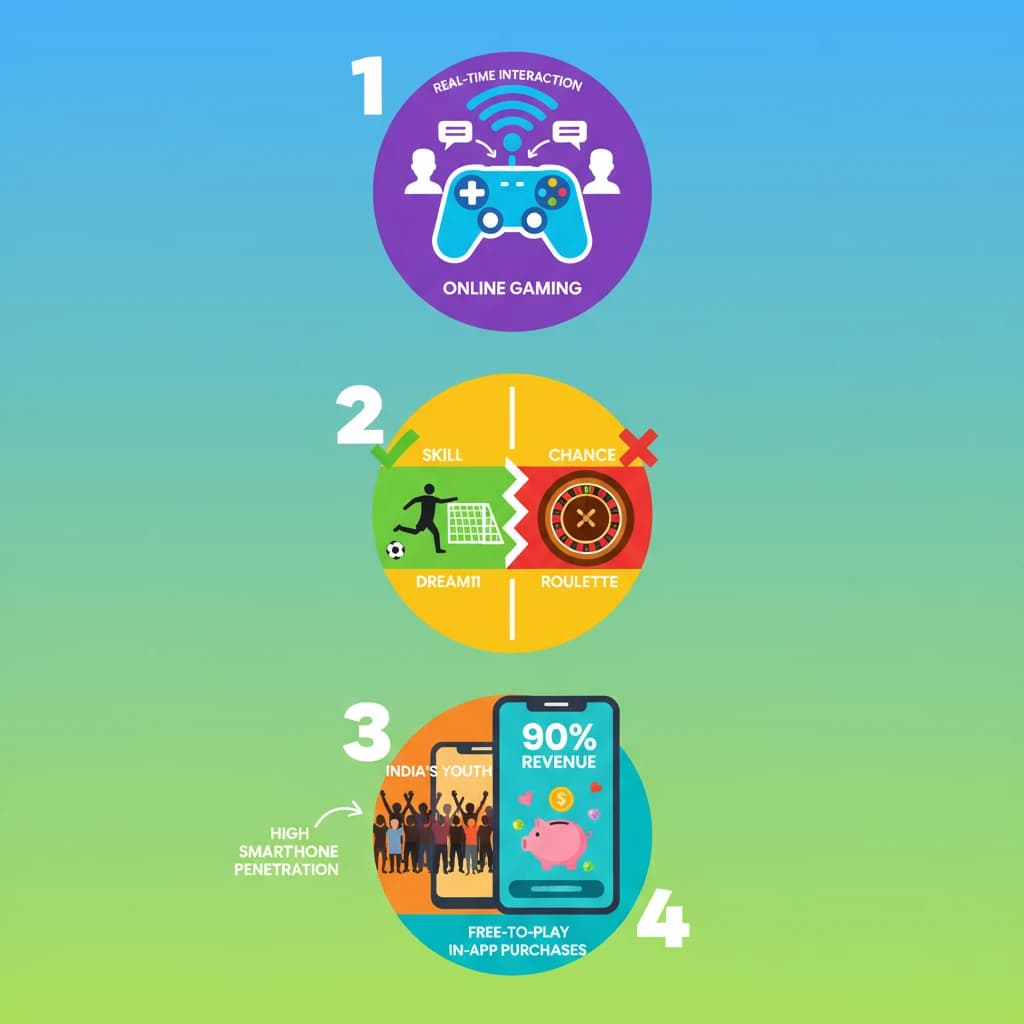
  • •Online gaming involves playing video games over the Internet, enabling real-time interaction.
  • •Games are classified as 'skill-based' (legal, e.g., Dream11) or 'chance-based' (illegal, e.g., Roulette).
  • •India's large youth population and high smartphone penetration drive gaming industry growth.
  • •Mobile gaming accounts for 90% of revenue, primarily from free-to-play and in-app purchases.
  • •E-sports viewership is surging, with increasing government support and professionalization.

🧠 Memory Techniques
Memory Aid
95% Verified Content

Related Topics

Loading related topics...
Explore:Economy Topics·All Subjects·Daily Current Affairs·Editorial Analysis·Previous Year Questions·UPSC GPT