Loading page, please wait…
Banking, Finance and Related Institutions - UPSC Economy
What is Banking, Finance and Related Institutions in UPSC Economy?
Banking, Finance and Related Institutions is a key topic under Economy for UPSC Civil Services Examination. Key points include: FIIs investing in Sovereign Green Bonds boosts green finance and global capital mobilization for India's environmental projects.. Sovereign Gold Bond Scheme aims to reduce physical gold demand, financialize savings, and offers tax benefits.. Strong regulatory bodies (RBI, SEBI, IRDAI) are crucial for financial stability and consumer protection.. Understanding this topic is essential for both UPSC Prelims and Mains preparation.
Why is Banking, Finance and Related Institutions important for UPSC exam?
Banking, Finance and Related Institutions is a Medium-level topic in UPSC Economy. It is tested in both Prelims (factual MCQs) and Mains (analytical answer writing). Previous year UPSC questions have frequently covered aspects of Banking, Finance and Related Institutions, making it essential for comprehensive IAS preparation.
How to prepare Banking, Finance and Related Institutions for UPSC?
To prepare Banking, Finance and Related Institutions for UPSC: (1) Study the comprehensive notes covering all key concepts on Vaidra. (2) Practice previous year questions on this topic. (3) Connect it with current affairs using daily updates. (4) Revise using key takeaways and mind maps available for Economy. (5) Write practice answers linking Banking, Finance and Related Institutions to related GS Paper topics.
Key takeaways of Banking, Finance and Related Institutions for UPSC
- FIIs investing in Sovereign Green Bonds boosts green finance and global capital mobilization for India's environmental projects.
- Sovereign Gold Bond Scheme aims to reduce physical gold demand, financialize savings, and offers tax benefits.
- Strong regulatory bodies (RBI, SEBI, IRDAI) are crucial for financial stability and consumer protection.
- D-SIBs (SBI, ICICI, HDFC) are 'too big to fail' banks requiring enhanced capital and supervision.
- India's taxation system (Direct, Indirect, Cess, Surcharges) faces challenges regarding fiscal federalism and transparency.
- Microfinance Institutions are vital for financial inclusion, empowering low-income groups, especially women.
- REER reflects trade competitiveness; its increase can make exports costlier and impact balance of payments.

Banking, Finance and Related Institutions
Medium⏱️ 15 min read
economy
📖 Introduction
FIIs to Invest in India’s Sovereign Green Bonds
The Indian government has permitted Foreign Institutional Investors (FIIs) to invest in Sovereign Green Bonds (SGrBs). This move aims to broaden the investor base for these specialized bonds.
Sovereign Green Bonds are financial instruments issued by governments to raise funds specifically for environmentally friendly projects. These projects can include renewable energy, sustainable transport, and pollution prevention.
Allowing FIIs to invest enhances the attractiveness of India's green finance market. It also helps in mobilizing global capital towards domestic environmental initiatives.
UPSC often asks about new financial instruments and their implications. Understand the difference between traditional bonds and Green Bonds, and the role of FIIs in capital markets (GS Paper III: Economy).
Sovereign Gold Bond Scheme (SGB)
The Sovereign Gold Bond (SGB) Scheme was launched by the Government of India in November 2015. Its primary objective is to reduce the demand for physical gold and shift household savings into financial instruments.
Key features of SGBs include: (1) Issued by the Reserve Bank of India (RBI) on behalf of the Government. (2) Denominated in grams of gold. (3) Offers a fixed interest rate (currently 2.50% per annum). (4) Capital gains are exempt from tax if held till maturity.
Investors buy SGBs in cash, and the redemption price is linked to the market price of gold at the time of maturity. This scheme provides an alternative to physical gold, offering benefits like storage safety and income generation.
- Tenor: 8 years, with an exit option from the 5th year.
- Minimum Investment: 1 gram of gold.
- Maximum Investment: 4 kg for individuals, 20 kg for trusts.
Strengthening Regulatory Bodies
A robust financial system relies heavily on strong and independent regulatory bodies. These institutions are crucial for maintaining stability, ensuring fair practices, and protecting consumer interests.
In India, bodies like the Reserve Bank of India (RBI), Securities and Exchange Board of India (SEBI), and Insurance Regulatory and Development Authority of India (IRDAI) play pivotal roles. Continuous efforts are made to enhance their powers and effectiveness.
Strengthening regulators involves: (1) Providing greater autonomy. (2) Enhancing technological capabilities. (3) Ensuring adequate human resources. (4) Implementing clear accountability frameworks.
Questions on the autonomy and effectiveness of regulatory bodies are common in UPSC Mains (GS Paper II & III). Discuss their challenges and recent reforms.
Insurance Sector in India
India's insurance sector is a vital component of its financial landscape, providing risk coverage and mobilizing long-term savings. It comprises both life and non-life (general) insurance segments.
The sector is regulated by the Insurance Regulatory and Development Authority of India (IRDAI). Recent reforms have aimed at increasing penetration, promoting innovation, and ensuring policyholder protection.
Key challenges for the Indian insurance sector include low penetration rates, especially in rural areas, and the need for greater awareness about insurance products. Digitalization offers significant opportunities for growth.
Be prepared to discuss the role of the insurance sector in financial inclusion and economic development. Understand the impact of foreign direct investment (FDI) limits and regulatory changes (GS Paper III).
Domestic Systemically Important Banks (D-SIBs)
Domestic Systemically Important Banks (D-SIBs) are banks whose distress or failure would cause significant disruption to the financial system and the wider economy. They are often referred to as "too big to fail."
The Reserve Bank of India (RBI) identifies D-SIBs annually. These banks are subjected to additional capital requirements and enhanced supervisory scrutiny to mitigate systemic risks.
The framework for D-SIBs was introduced by the RBI in 2014, based on the Basel Committee on Banking Supervision (BCBS) framework. It ensures that these critical banks maintain higher resilience.
Currently, State Bank of India (SBI), ICICI Bank, and HDFC Bank are identified as D-SIBs in India. Their continued stability is paramount for the overall financial health of the nation.
Need of Sovereign Wealth Fund for India
A Sovereign Wealth Fund (SWF) is a state-owned investment fund that invests in real and financial assets globally. These funds are typically created from balance of payments surpluses, official foreign currency operations, or revenues from natural resources.
For India, an SWF could serve multiple purposes, including long-term infrastructure financing, diversifying foreign exchange reserves, and providing a buffer against economic shocks. It could also invest in strategic domestic sectors.
Analyze the pros and cons of an SWF for India. Consider its potential impact on infrastructure development, foreign investment, and fiscal management (GS Paper III).
Many countries like Norway, Singapore, and UAE have successful SWFs. India currently has the National Investment and Infrastructure Fund (NIIF), which functions somewhat similarly but is not a traditional SWF.
India’s Taxation System
India's taxation system is a complex structure designed to fund public expenditure and achieve socio-economic objectives. It broadly consists of Direct Taxes and Indirect Taxes.
Direct taxes are levied on income and wealth, such as Income Tax and Corporate Tax. Indirect taxes are levied on goods and services, with the Goods and Services Tax (GST) being the most prominent.
Key principles of a good taxation system include: (1) Equity (fairness). (2) Efficiency (minimal distortion). (3) Simplicity (ease of compliance). (4) Revenue adequacy (sufficient funds for government).
Recent reforms, especially the implementation of GST in 2017, aimed to simplify the indirect tax regime, broaden the tax base, and reduce cascading effects.
Open Market Sale Scheme (Domestic) Policy
The Open Market Sale Scheme (OMSS) (Domestic) is a policy under which the Food Corporation of India (FCI) sells food grains, especially wheat and rice, in the open market. This is done to moderate open market prices, particularly during lean seasons.
The primary objective of OMSS is to ensure food security and control inflation by releasing buffer stocks. It helps in stabilizing prices for consumers and ensuring availability.
The sale of food grains under OMSS is usually conducted through e-auctions. This ensures transparency and provides a level playing field for various buyers, including flour millers and private traders.
Understand how OMSS acts as a tool for price stabilization and its implications for farmers, consumers, and government subsidies. Relate it to food security and inflation management (GS Paper III).
Concerns Over Cess and Surcharges in India
In India's taxation system, Cess and Surcharges are additional levies imposed on the basic tax liability. While they serve specific purposes, their increasing use has raised several concerns.
- Cess: Levied for a specific purpose (e.g., Swachh Bharat Cess, Health and Education Cess). The proceeds are typically earmarked for that purpose.
- Surcharge: An additional tax on the tax, usually levied on high-income earners or large corporations. It is not earmarked for specific purposes.
A major concern is that the proceeds from cess and surcharges are not part of the divisible pool of taxes that is shared with state governments. This reduces the fiscal autonomy of states and impacts federal fiscal relations.
Other concerns include: (1) Lack of transparency regarding the utilization of funds. (2) Erosion of tax base for states. (3) Complexity in the overall tax structure.
Decline In 10-Year Bond Yield
A bond yield represents the return an investor receives on a bond. The 10-year bond yield is a benchmark often used to gauge market sentiment and future interest rate expectations.
A decline in 10-year bond yield generally indicates that investors are willing to accept lower returns for holding government debt. This can happen due to increased demand for safe assets or expectations of lower inflation and economic growth.
Implications of a declining yield include: (1) Lower borrowing costs for the government and corporations. (2) Potential for lower interest rates on loans (e.g., home loans). (3) Can signal an economic slowdown or increased liquidity in the system.
Connect bond yields to monetary policy, inflation, and economic growth. Understand how global and domestic factors influence bond markets (GS Paper III).
Microfinance Institutions (MFIs)
Microfinance Institutions (MFIs) are organizations that provide financial services to low-income individuals or groups who traditionally lack access to conventional banking and related services. These services typically include small loans (microcredit), savings, and insurance.
MFIs play a crucial role in promoting financial inclusion, particularly in rural and underserved urban areas. They empower marginalized communities, especially women, by providing access to capital for income-generating activities.
The success of MFIs is often attributed to: (1) Group lending models (peer pressure for repayment). (2) Doorstep service delivery. (3) Focus on capacity building and financial literacy.
In India, MFIs are regulated by the Reserve Bank of India (RBI). They operate under various legal structures, including Non-Banking Financial Company-MFIs (NBFC-MFIs) and Self-Help Group (SHG)-Bank Linkage Programs.
Increasing Real Effective Exchange Rate (REER) in India
The Real Effective Exchange Rate (REER) is a measure of the value of a country's currency relative to a basket of other major currencies, adjusted for inflation. It reflects the country's competitiveness in international trade.
An increasing REER implies that a country's goods and services are becoming relatively more expensive compared to those of its trading partners. This can make exports less competitive and imports more attractive.
Factors contributing to an increasing REER can include: (1) Higher domestic inflation compared to trading partners. (2) Appreciation of the nominal exchange rate. (3) Strong capital inflows into the economy.
Analyze the impact of REER on India's balance of trade, export competitiveness, and overall economic policy. Distinguish it from Nominal Effective Exchange Rate (NEER) (GS Paper III).
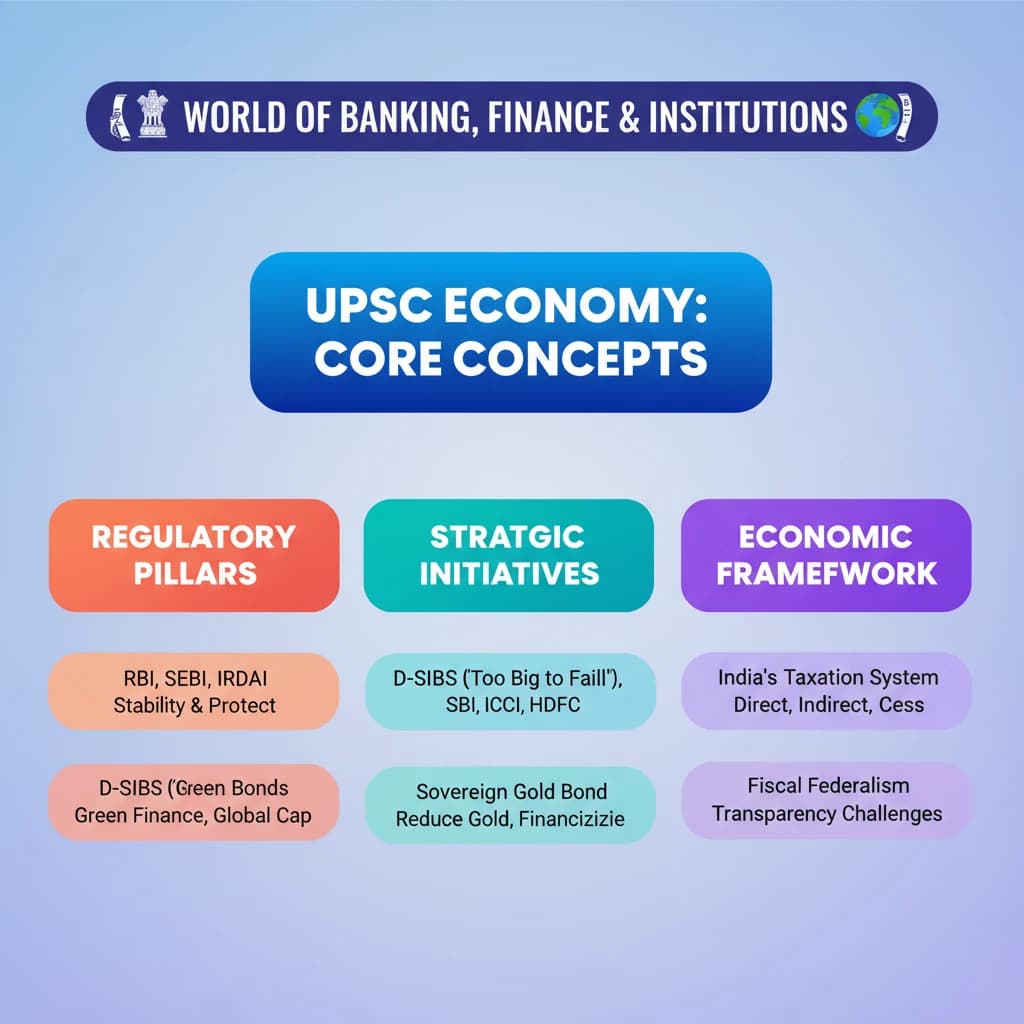
💡 Key Takeaways
- •FIIs investing in Sovereign Green Bonds boosts green finance and global capital mobilization for India's environmental projects.
- •Sovereign Gold Bond Scheme aims to reduce physical gold demand, financialize savings, and offers tax benefits.
- •Strong regulatory bodies (RBI, SEBI, IRDAI) are crucial for financial stability and consumer protection.
- •D-SIBs (SBI, ICICI, HDFC) are 'too big to fail' banks requiring enhanced capital and supervision.
- •India's taxation system (Direct, Indirect, Cess, Surcharges) faces challenges regarding fiscal federalism and transparency.
- •Microfinance Institutions are vital for financial inclusion, empowering low-income groups, especially women.
- •REER reflects trade competitiveness; its increase can make exports costlier and impact balance of payments.
🧠 Memory Techniques

95% Verified Content
📚 Reference Sources
•Ministry of Finance, Government of India Publications
•Drishti IAS Economy Summaries
•Economic Survey of India
•NITI Aayog Reports