Loading page, please wait…
Vaidra Logo
Vaidra

Top 4 items + smart groups

UPSC GPT
New
Current Affairs
Daily Solutions
Daily Puzzle
Mains Evaluator

Version 2.0.0 • Built with ❤️ for UPSC aspirants

Loading...
Loading...
Loading...
Loading...
Loading...
Loading...
Loading...
Loading...
Loading...
Loading...
Loading...
Loading...
Loading...
Back
All Subjects

Topics

0 topics • 0 completed

Loading topics...
Loading...
Loading...
Loading...
Loading...
Loading...
Overall Progress0%
What is a Currency Swap Agreement? - UPSC Economy

What is a Currency Swap Agreement? - UPSC Economy

What is What is a Currency Swap Agreement? in UPSC Economy?

What is a Currency Swap Agreement? is a key topic under Economy for UPSC Civil Services Examination. Key points include: A Currency Swap Agreement is a contract between two countries to exchange currencies with predetermined terms for liquidity.. Central banks and governments use swaps to meet short-term foreign exchange liquidity needs.. They help avoid Balance of Payments (BOP) crises by ensuring adequate foreign currency.. Understanding this topic is essential for both UPSC Prelims and Mains preparation.

Why is What is a Currency Swap Agreement? important for UPSC exam?

What is a Currency Swap Agreement? is a Medium-level topic in UPSC Economy. It is tested in both Prelims (factual MCQs) and Mains (analytical answer writing). Previous year UPSC questions have frequently covered aspects of What is a Currency Swap Agreement?, making it essential for comprehensive IAS preparation.

How to prepare What is a Currency Swap Agreement? for UPSC?

To prepare What is a Currency Swap Agreement? for UPSC: (1) Study the comprehensive notes covering all key concepts on Vaidra. (2) Practice previous year questions on this topic. (3) Connect it with current affairs using daily updates. (4) Revise using key takeaways and mind maps available for Economy. (5) Write practice answers linking What is a Currency Swap Agreement? to related GS Paper topics.

Key takeaways of What is a Currency Swap Agreement? for UPSC

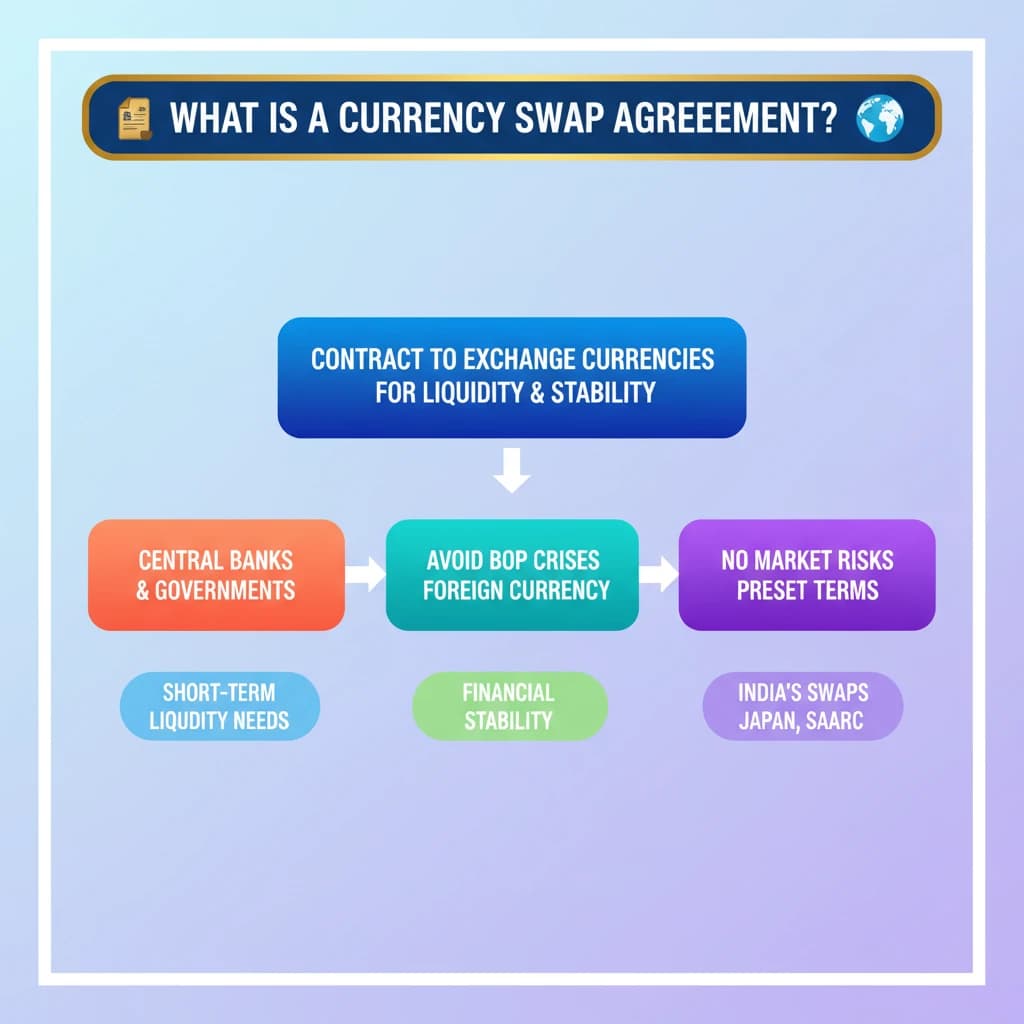
  • A Currency Swap Agreement is a contract between two countries to exchange currencies with predetermined terms for liquidity.
  • Central banks and governments use swaps to meet short-term foreign exchange liquidity needs.
  • They help avoid Balance of Payments (BOP) crises by ensuring adequate foreign currency.
  • Swap operations carry no exchange rate or other market risks as terms are set in advance.
  • India actively engages in currency swaps (e.g., with Japan, SAARC nations) to enhance financial stability and bilateral ties.
What is a Currency Swap Agreement?

What is a Currency Swap Agreement?

Medium⏱️ 8 min read✓ 98% Verified
economy

📖 Introduction

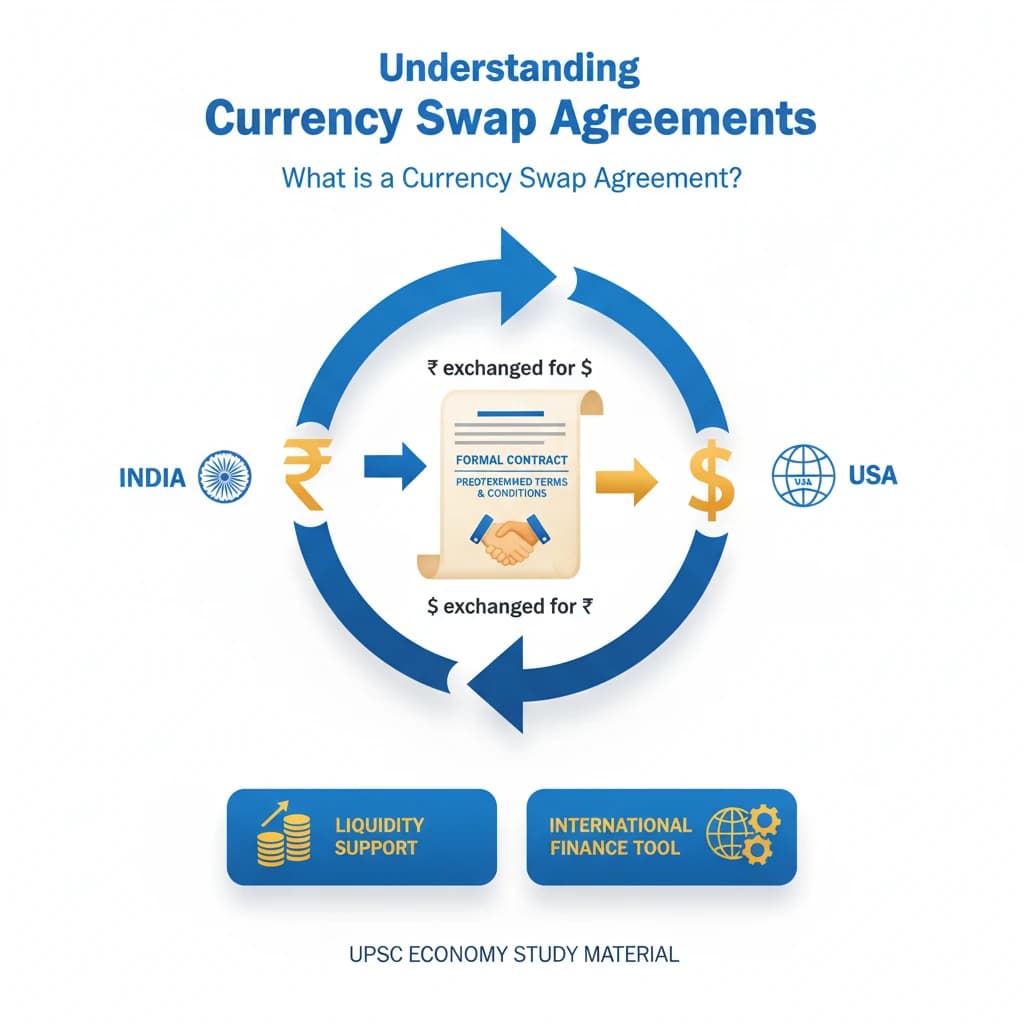
<h4>Understanding Currency Swap Agreements</h4><p>A <strong>Currency Swap Agreement</strong> is a formal <strong>contract</strong> between <strong>two countries</strong>. Its primary purpose is to facilitate the <strong>exchange of currencies</strong> under <strong>predetermined terms and conditions</strong>.</p><p>These agreements are crucial for providing immediate <strong>liquidity support</strong> to the participating nations. They serve as a vital tool in international finance.</p><div class='info-box'><p><strong>Definition:</strong> A <strong>Currency Swap Agreement</strong> is a bilateral contract for exchanging currencies between two countries, with all transaction terms (like exchange rate and tenor) set in advance.</p></div><h4>Primary Objectives of Currency Swaps</h4><p><strong>Central banks</strong> and <strong>Governments</strong> are the key entities that engage in these agreements with their <strong>foreign counterparts</strong>. They do so to address specific financial needs.</p><p>One main objective is to meet <strong>short-term foreign exchange liquidity requirements</strong>. This ensures a country has enough foreign currency to manage its immediate obligations.</p><ul><li><strong>Liquidity Support:</strong> To provide quick access to foreign currency for immediate needs.</li><li><strong>BOP Crisis Avoidance:</strong> To ensure <strong>adequate foreign currency</strong> and prevent a potential <strong>Balance of Payments (BOP) crisis</strong> until more permanent arrangements can be made.</li></ul><h4>Key Characteristics and Risk Mitigation</h4><p>A significant feature of <strong>currency swap operations</strong> is their inherent safety. They are designed to carry <strong>no exchange rate risk</strong> for the participating parties.</p><p>Furthermore, these agreements are structured to avoid <strong>other market risks</strong>. This stability is achieved because all <strong>transaction terms are set in advance</strong>, eliminating uncertainty.</p><div class='key-point-box'><p><strong>Risk-Free Nature:</strong> Due to <strong>predetermined terms</strong>, currency swaps largely eliminate <strong>exchange rate risk</strong> and <strong>market risks</strong> for the central banks or governments involved.</p></div><div class='exam-tip-box'><p><strong>UPSC Insight:</strong> Understanding <strong>currency swaps</strong> is vital for topics related to <strong>external sector management</strong>, <strong>financial stability</strong>, and the role of the <strong>Reserve Bank of India (RBI)</strong> in managing foreign exchange reserves. It often appears in <strong>GS Paper III (Economy)</strong>.</p></div>
Concept Diagram

💡 Key Takeaways

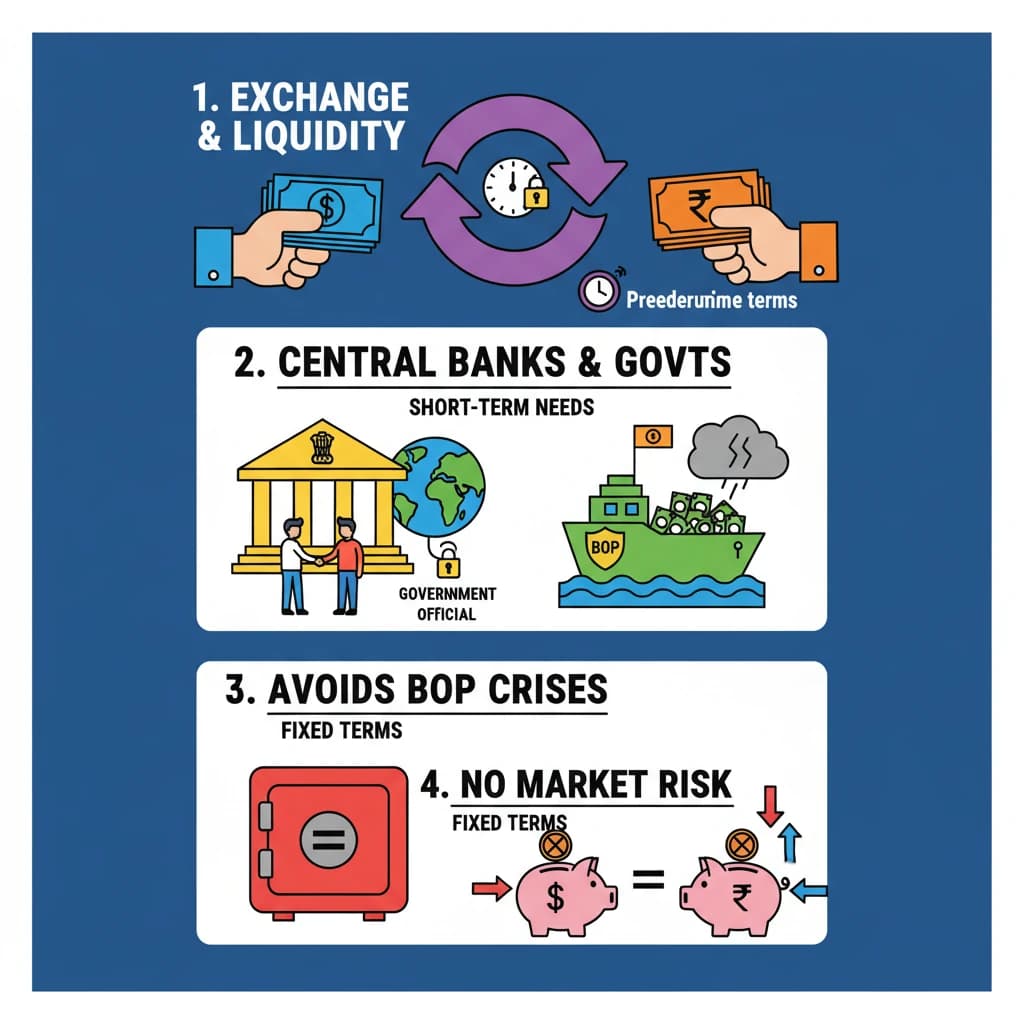
  • •A Currency Swap Agreement is a contract between two countries to exchange currencies with predetermined terms for liquidity.
  • •Central banks and governments use swaps to meet short-term foreign exchange liquidity needs.
  • •They help avoid Balance of Payments (BOP) crises by ensuring adequate foreign currency.
  • •Swap operations carry no exchange rate or other market risks as terms are set in advance.
  • •India actively engages in currency swaps (e.g., with Japan, SAARC nations) to enhance financial stability and bilateral ties.

🧠 Memory Techniques
Memory Aid
98% Verified Content

📚 Reference Sources

•Reserve Bank of India (RBI) publications on currency swap agreements
•Ministry of Finance, Government of India reports
•International Monetary Fund (IMF) articles on financial stability tools

Related Topics

Loading related topics...
Explore:Economy Topics·All Subjects·Daily Current Affairs·Editorial Analysis·Previous Year Questions·UPSC GPT