Loading page, please wait…
Vaidra Logo
Vaidra

Top 4 items + smart groups

UPSC GPT
New
Current Affairs
Daily Solutions
Daily Puzzle
Mains Evaluator

Version 2.0.0 • Built with ❤️ for UPSC aspirants

Loading...
Loading...
Loading...
Loading...
Loading...
Loading...
Loading...
Loading...
Loading...
Loading...
Loading...
Loading...
Loading...
Comparison of Ease of Doing Business and the B-READY Index - UPSC Economy

Comparison of Ease of Doing Business and the B-READY Index - UPSC Economy

What is Comparison of Ease of Doing Business and the B-READY Index in UPSC Economy?

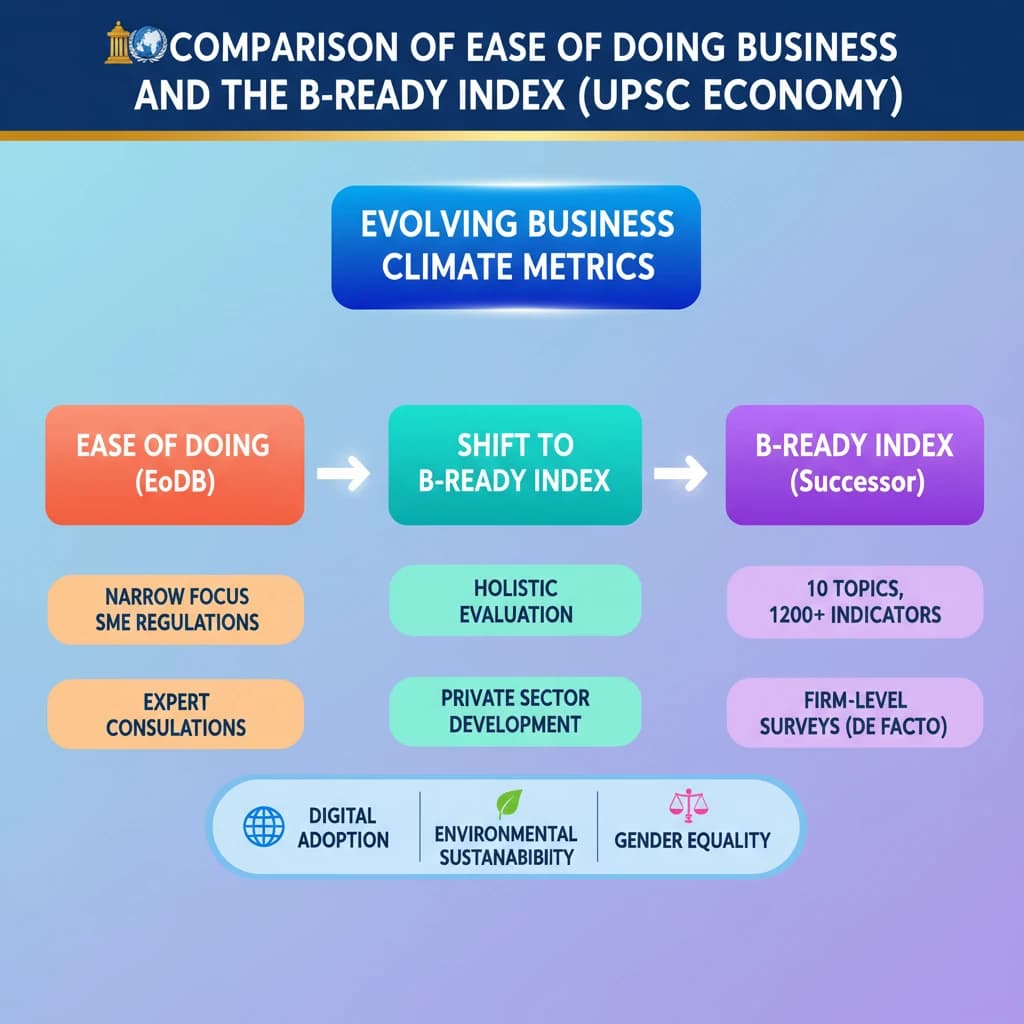
Comparison of Ease of Doing Business and the B-READY Index is a key topic under Economy for UPSC Civil Services Examination. Key points include: EoDB focused narrowly on regulatory burden for SMEs, using expert consultations.. B-READY is a comprehensive successor, evaluating private sector development holistically, including workers and consumers.. B-READY covers 10 topics, nearly 1,200 indicators, and includes firm-level surveys for de facto insights.. Understanding this topic is essential for both UPSC Prelims and Mains preparation.

Why is Comparison of Ease of Doing Business and the B-READY Index important for UPSC exam?

Comparison of Ease of Doing Business and the B-READY Index is a Medium-level topic in UPSC Economy. It is tested in both Prelims (factual MCQs) and Mains (analytical answer writing). Previous year UPSC questions have frequently covered aspects of Comparison of Ease of Doing Business and the B-READY Index, making it essential for comprehensive IAS preparation.

How to prepare Comparison of Ease of Doing Business and the B-READY Index for UPSC?

To prepare Comparison of Ease of Doing Business and the B-READY Index for UPSC: (1) Study the comprehensive notes covering all key concepts on Vaidra. (2) Practice previous year questions on this topic. (3) Connect it with current affairs using daily updates. (4) Revise using key takeaways and mind maps available for Economy. (5) Write practice answers linking Comparison of Ease of Doing Business and the B-READY Index to related GS Paper topics.

Key takeaways of Comparison of Ease of Doing Business and the B-READY Index for UPSC

  • EoDB focused narrowly on regulatory burden for SMEs, using expert consultations.
  • B-READY is a comprehensive successor, evaluating private sector development holistically, including workers and consumers.
  • B-READY covers 10 topics, nearly 1,200 indicators, and includes firm-level surveys for de facto insights.
  • It provides disaggregated scores, promoting targeted reforms over aggregate rankings.
  • Key cross-cutting themes in B-READY are digital adoption, environmental sustainability, and gender equality.
  • The shift reflects a global move towards more sustainable, inclusive, and transparent business environment assessments.
Comparison of Ease of Doing Business and the B-READY Index

Comparison of Ease of Doing Business and the B-READY Index

Medium⏱️ 10 min read✓ 98% Verified
economy

📖 Introduction

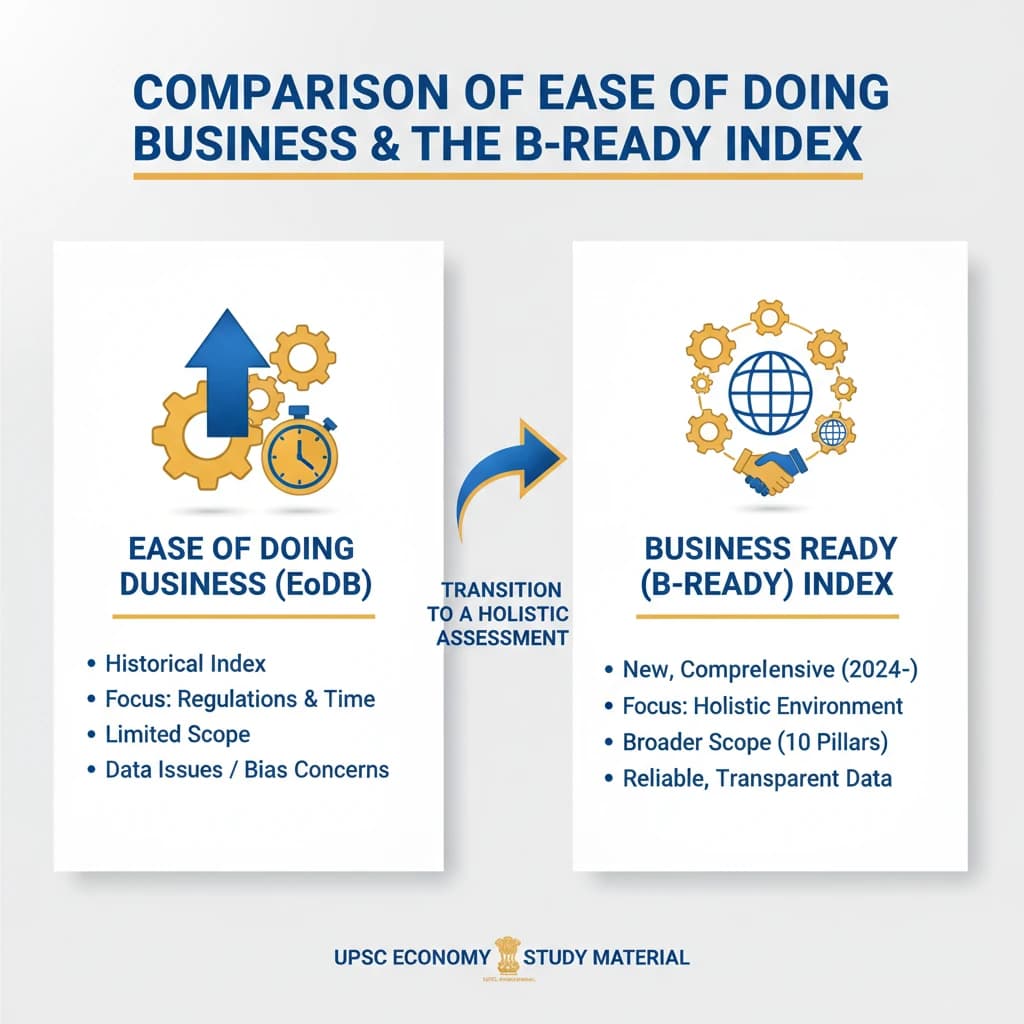
<h4>Introduction to Business Environment Indices</h4><p>Understanding the regulatory environment is crucial for both businesses and policymakers. Historically, the <strong>Ease of Doing Business (EoDB)</strong> report provided insights into this. However, it has been replaced by the more comprehensive <strong>Business Ready (B-READY) Index</strong>.</p><p>This transition marks a significant evolution in how global institutions assess the private sector landscape, moving towards a more holistic and nuanced evaluation.</p><div class='exam-tip-box'><p><strong>UPSC Insight:</strong> The shift from <strong>EoDB</strong> to <strong>B-READY</strong> is a critical development for Mains GS-III (Economy) and GS-II (Governance). Focus on the 'why' behind the change and the implications for India's policy reforms.</p></div><h4>Comparative Analysis: EoDB vs. B-READY Index</h4><p>The following table outlines the key differences between the defunct <strong>Ease of Doing Business (EoDB)</strong> report and the new <strong>B-READY Index</strong>, highlighting the evolution in assessment methodology and scope.</p><table class='info-table'><tr><th>Aspect</th><th>Ease of Doing Business (EoDB)</th><th>B-READY Index</th></tr><tr><td><strong>Objective</strong></td><td>Focused on evaluating the <strong>regulatory environment</strong> for <strong>Small and Medium-sized Enterprises (SMEs)</strong>.</td><td>Holistic evaluation of <strong>private sector development</strong>, including <strong>SMEs</strong>, <strong>workers</strong>, and <strong>consumers</strong>.</td></tr><tr><td><strong>Scope</strong></td><td>Primarily focused on <strong>regulatory burden</strong>.</td><td>Covers <strong>regulatory burden</strong>, <strong>quality of regulations</strong>, and <strong>public services</strong>.</td></tr><tr><td><strong>Topics Covered</strong></td><td>Limited to a few key topics like <strong>starting a business</strong>, <strong>getting credit</strong>, and <strong>paying taxes</strong>.</td><td>Comprehensive: Covers <strong>10 topics</strong> spanning a firm’s lifecycle, including <strong>business entry</strong>, <strong>utility services</strong>, <strong>labor</strong>, and <strong>market competition</strong>.</td></tr><tr><td><strong>Framework</strong></td><td>Focused mainly on <strong>ease of doing business</strong> for firms.</td><td>Includes <strong>firm flexibility</strong> (ease of business) and <strong>social benefits</strong> (impact on society).</td></tr></tr><tr><td><strong>Data Collection</strong></td><td>Relied on <strong>expert consultations</strong> and <strong>case studies</strong>.</td><td>Combines <strong>expert consultations</strong> and <strong>firm-level surveys</strong> for a balanced <strong>de jure</strong> and <strong>de facto</strong> perspective.</td></tr><tr><td><strong>Indicators Used</strong></td><td>Used around <strong>11 questionnaires</strong> covering a limited number of indicators.</td><td>Uses <strong>21 questionnaires</strong> and nearly <strong>1,200 indicators</strong> for detailed insights.</td></tr><tr><td><strong>Scoring and Ranking</strong></td><td>Produced <strong>aggregate rankings</strong> and scores, often criticized for <strong>oversimplification</strong>.</td><td>Provides <strong>disaggregated scores</strong> by topic and pillar, encouraging <strong>targeted reforms</strong> rather than overall rankings.</td></tr><tr><td><strong>Geographic Coverage</strong></td><td>Covered the main business city in <strong>191 economies</strong>.</td><td>Plans to expand to <strong>180 economies</strong> by <strong>2026</strong>, with a focus on <strong>national and local regulations</strong>.</td></tr><tr><td><strong>Public Services</strong></td><td>Limited attention to <strong>public services</strong>.</td><td>Explicitly evaluates <strong>public services</strong> and their <strong>operational efficiency</strong>.</td></tr><tr><td><strong>Cross-Cutting Themes</strong></td><td>Did not include specific themes.</td><td>Focuses on <strong>digital adoption</strong>, <strong>environmental sustainability</strong>, and <strong>gender equality</strong>.</td></tr><tr><td><strong>Use of Results</strong></td><td>Primarily for <strong>regulatory benchmarking</strong> and <strong>reform motivation</strong>.</td><td>Provides <strong>actionable insights</strong> for reforms, <strong>transparency</strong>, and <strong>data reproducibility</strong>.</td></tr><tr><td><strong>Methodology Updates</strong></td><td><strong>Static methodology</strong> with minor updates over time.</td><td><strong>Dynamic methodology</strong> that evolves based on feedback and lessons from rollouts.</td></tr></table><div class='key-point-box'><p><strong>Key Point:</strong> The <strong>B-READY Index</strong> represents a paradigm shift from simple 'ease' to a more comprehensive 'readiness' for sustainable and inclusive private sector development.</p></div>
Concept Diagram

💡 Key Takeaways

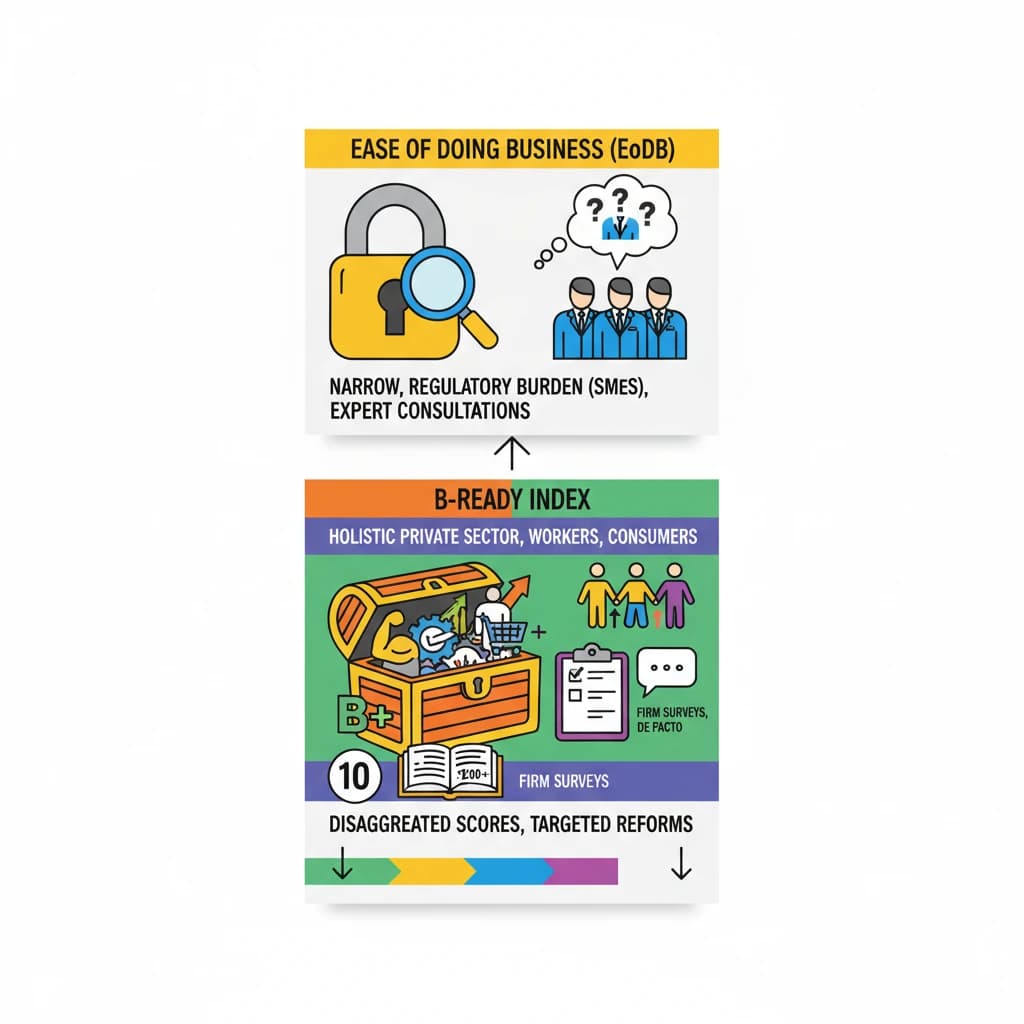
  • •EoDB focused narrowly on regulatory burden for SMEs, using expert consultations.
  • •B-READY is a comprehensive successor, evaluating private sector development holistically, including workers and consumers.
  • •B-READY covers 10 topics, nearly 1,200 indicators, and includes firm-level surveys for de facto insights.
  • •It provides disaggregated scores, promoting targeted reforms over aggregate rankings.
  • •Key cross-cutting themes in B-READY are digital adoption, environmental sustainability, and gender equality.
  • •The shift reflects a global move towards more sustainable, inclusive, and transparent business environment assessments.

🧠 Memory Techniques
Memory Aid
98% Verified Content

📚 Reference Sources

•World Bank Group: Doing Business reports (archived information)
•World Bank Group: Business Ready (B-READY) project official documentation and announcements

Related Topics

Loading related topics...
Explore:Economy Topics·All Subjects·Daily Current Affairs·Editorial Analysis·Previous Year Questions·UPSC GPT
Back
All Subjects

Topics

0 topics • 0 completed

Loading topics...
Loading...
Loading...
Loading...
Loading...
Loading...
Overall Progress0%