Loading page, please wait…
Vaidra Logo
Vaidra

Top 4 items + smart groups

UPSC GPT
New
Current Affairs
Daily Solutions
Daily Puzzle
Mains Evaluator

Version 2.0.0 • Built with ❤️ for UPSC aspirants

Loading...
Loading...
Loading...
Loading...
Loading...
Loading...
Loading...
Loading...
Loading...
Loading...
Loading...
Loading...
Loading...
Revised Currency Swap Framework for SAARC - UPSC Economy

Revised Currency Swap Framework for SAARC - UPSC Economy

What is Revised Currency Swap Framework for SAARC in UPSC Economy?

Revised Currency Swap Framework for SAARC is a key topic under Economy for UPSC Civil Services Examination. Key points include: RBI's Revised Currency Swap Framework provides a financial safety net for SAARC nations.. A currency swap is an exchange of principal/interest in different currencies to manage liquidity or risk.. The framework aims to address short-term foreign exchange liquidity and Balance of Payments (BoP) issues.. Understanding this topic is essential for both UPSC Prelims and Mains preparation.

Why is Revised Currency Swap Framework for SAARC important for UPSC exam?

Revised Currency Swap Framework for SAARC is a Medium-level topic in UPSC Economy. It is tested in both Prelims (factual MCQs) and Mains (analytical answer writing). Previous year UPSC questions have frequently covered aspects of Revised Currency Swap Framework for SAARC, making it essential for comprehensive IAS preparation.

How to prepare Revised Currency Swap Framework for SAARC for UPSC?

To prepare Revised Currency Swap Framework for SAARC for UPSC: (1) Study the comprehensive notes covering all key concepts on Vaidra. (2) Practice previous year questions on this topic. (3) Connect it with current affairs using daily updates. (4) Revise using key takeaways and mind maps available for Economy. (5) Write practice answers linking Revised Currency Swap Framework for SAARC to related GS Paper topics.

Key takeaways of Revised Currency Swap Framework for SAARC for UPSC

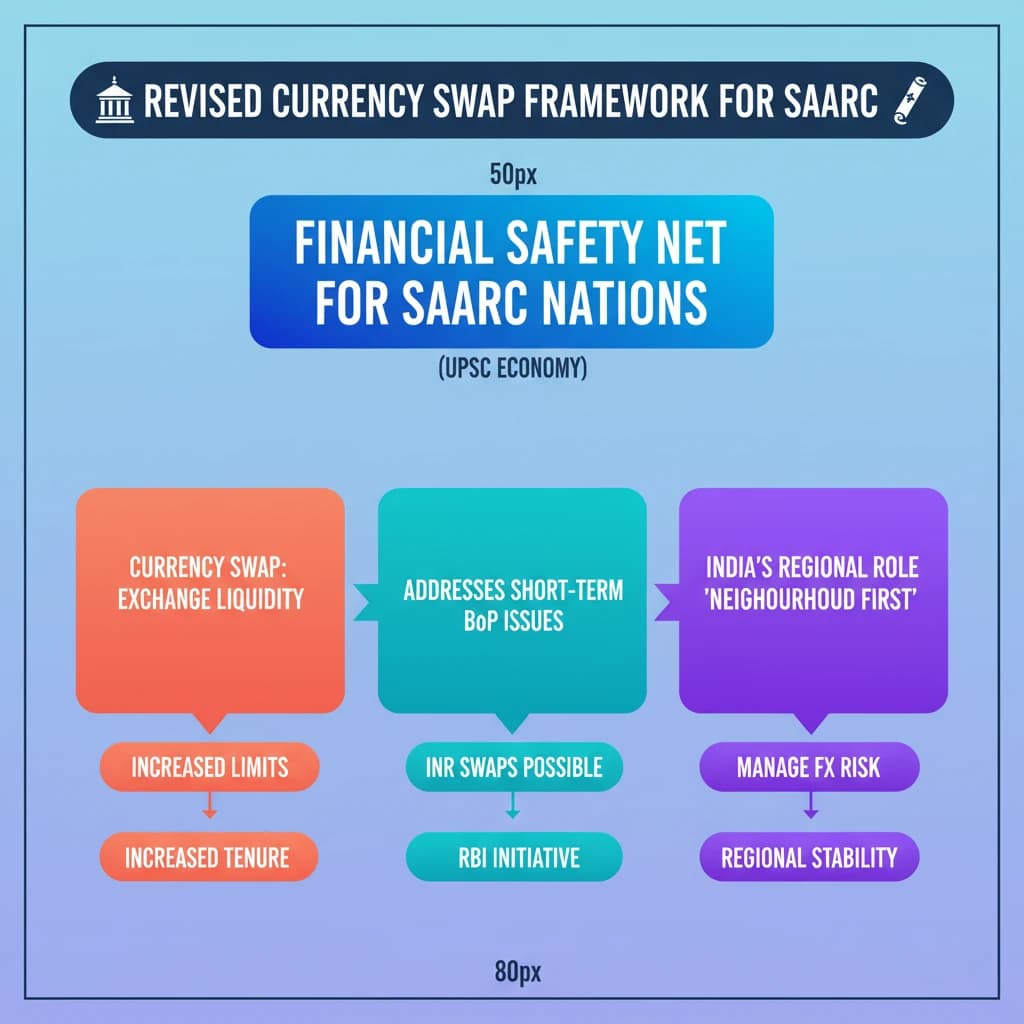
  • RBI's Revised Currency Swap Framework provides a financial safety net for SAARC nations.
  • A currency swap is an exchange of principal/interest in different currencies to manage liquidity or risk.
  • The framework aims to address short-term foreign exchange liquidity and Balance of Payments (BoP) issues.
  • It enhances India's role in regional economic stability and aligns with the 'Neighbourhood First' policy.
  • Key features include increased limits, longer tenure, and potential for INR swaps.
  • It helps SAARC countries reduce reliance on volatile international markets and manage currency volatility.
Revised Currency Swap Framework for SAARC

Revised Currency Swap Framework for SAARC

Medium⏱️ 8 min read✓ 95% Verified
economy

📖 Introduction

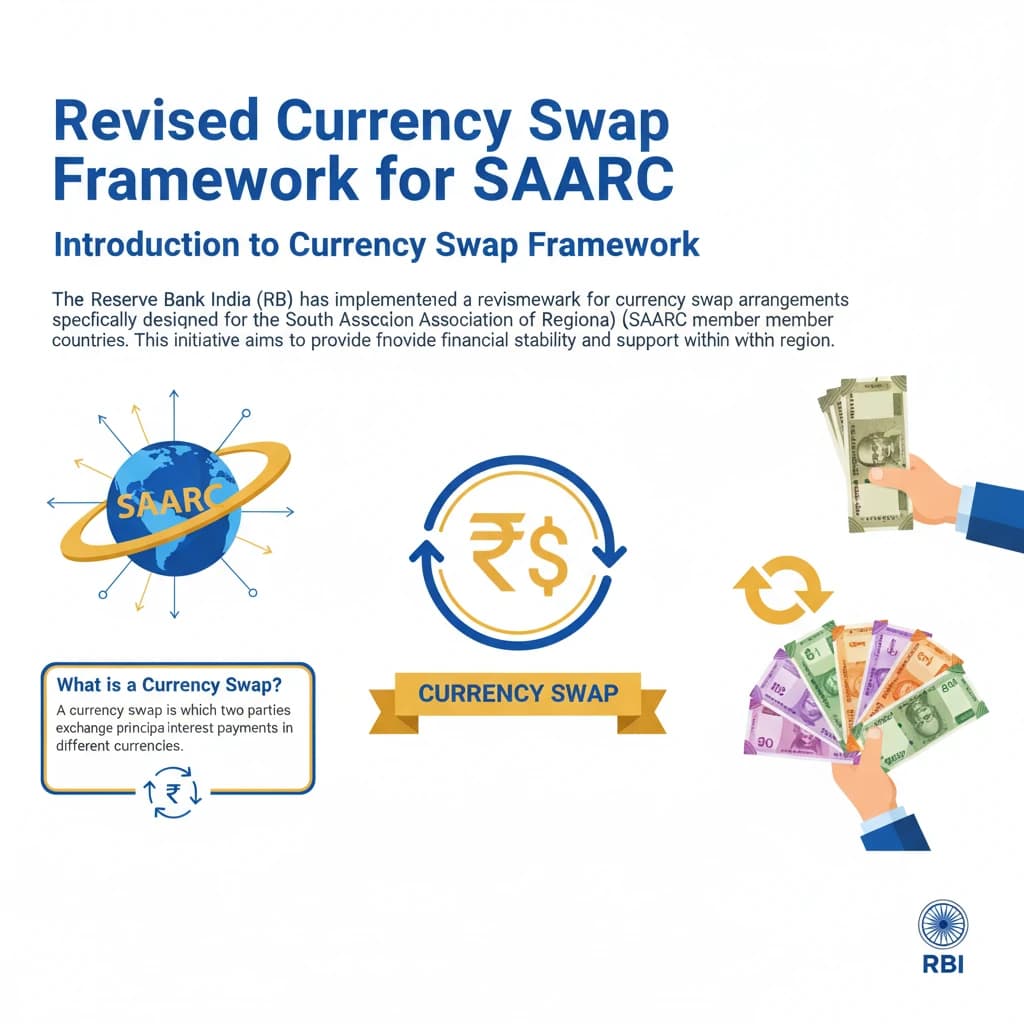
<h4>Introduction to Currency Swap Framework</h4><p>The <strong>Reserve Bank of India (RBI)</strong> has implemented a <strong>revised framework</strong> for <strong>currency swap arrangements</strong> specifically designed for the <strong>South Asian Association for Regional Cooperation (SAARC)</strong> member countries. This initiative aims to provide financial stability and support within the region.</p><div class='info-box'><p>A <strong>currency swap</strong> is a transaction in which two parties exchange an equivalent amount of money in different currencies. They agree to swap principal and/or interest payments over a specified period, typically to manage foreign exchange risk or obtain lower interest rates in foreign currency borrowing.</p></div><h4>Purpose of the SAARC Currency Swap Framework</h4><p>The primary objective of this framework is to offer a <strong>backstop line of funding</strong> to <strong>SAARC nations</strong>. This funding is crucial for meeting their short-term foreign exchange liquidity requirements, especially during times of balance of payments (BoP) crises or external shocks.</p><div class='key-point-box'><p>The framework acts as a <strong>safety net</strong>, allowing member countries to draw upon a pre-agreed amount of foreign currency from the <strong>RBI</strong>, thus preventing potential financial instability.</p></div><h4>Evolution and Revision of the Framework</h4><p>Initially, the <strong>RBI</strong> had established a <strong>SAARC Currency Swap Facility</strong> in <strong>2012</strong>. This facility was part of India's commitment to fostering regional economic cooperation and stability. Over time, economic conditions and regional needs evolved, necessitating a review.</p><p>The decision to put in place a <strong>revised framework</strong> reflects a proactive approach by the <strong>RBI</strong> to enhance the effectiveness and accessibility of the swap arrangements for its neighbours. This revision ensures the framework remains relevant and robust.</p><h4>Key Features of the Revised Framework</h4><p>The revised framework introduces several improvements to make the currency swap facility more attractive and beneficial for <strong>SAARC members</strong>. These enhancements include increased financial limits and more flexible terms.</p><ul><li><strong>Increased Limits:</strong> The total corpus of the swap facility has been substantially increased, allowing for larger drawdowns by eligible countries.</li><li><strong>Longer Tenure:</strong> The maximum period for which a swap can be availed has been extended, providing more flexibility for countries to manage their liquidity.</li><li><strong>Wider Currency Options:</strong> While primarily denominated in <strong>US Dollars</strong>, the framework may also allow for swaps in <strong>Indian Rupees (INR)</strong>, further promoting the use of local currencies in regional trade.</li><li><strong>Simplified Procedures:</strong> Efforts have been made to streamline the application and approval processes, making it easier for countries to access funds quickly when needed.</li></ul><div class='exam-tip-box'><p>For <strong>UPSC Mains GS-II (International Relations)</strong> and <strong>GS-III (Economy)</strong>, understanding the <strong>SAARC Currency Swap Framework</strong> is vital. It demonstrates India's role in regional economic diplomacy and its commitment to multilateral institutions. Focus on the 'why' (stability, liquidity) and 'how' (RBI's role, features).</p></div>
Concept Diagram

💡 Key Takeaways

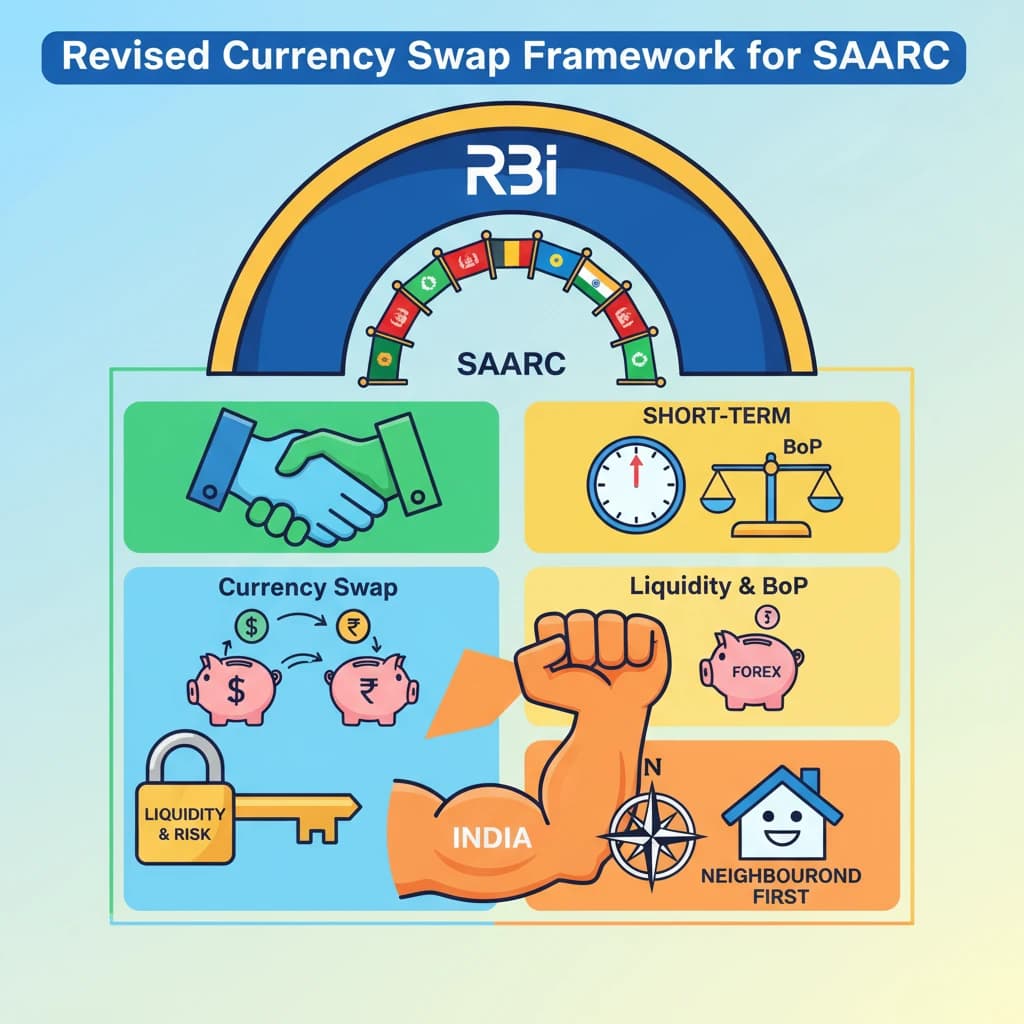
  • •RBI's Revised Currency Swap Framework provides a financial safety net for SAARC nations.
  • •A currency swap is an exchange of principal/interest in different currencies to manage liquidity or risk.
  • •The framework aims to address short-term foreign exchange liquidity and Balance of Payments (BoP) issues.
  • •It enhances India's role in regional economic stability and aligns with the 'Neighbourhood First' policy.
  • •Key features include increased limits, longer tenure, and potential for INR swaps.
  • •It helps SAARC countries reduce reliance on volatile international markets and manage currency volatility.

🧠 Memory Techniques
Memory Aid
95% Verified Content

📚 Reference Sources

•Economic Survey of India (various years)
•Financial news outlets (e.g., The Hindu, Livemint, Business Standard)
•Ministry of External Affairs (MEA) publications on SAARC and regional cooperation

Related Topics

Loading related topics...
Explore:Economy Topics·All Subjects·Daily Current Affairs·Editorial Analysis·Previous Year Questions·UPSC GPT
Back
All Subjects

Topics

0 topics • 0 completed

Loading topics...
Loading...
Loading...
Loading...
Loading...
Loading...
Overall Progress0%