Loading page, please wait…
Vaidra Logo
Vaidra

Top 4 items + smart groups

UPSC GPT
New
Current Affairs
Daily Solutions
Daily Puzzle
Mains Evaluator

Version 2.0.0 • Built with ❤️ for UPSC aspirants

Loading...
Loading...
Loading...
Loading...
Loading...
Loading...
Loading...
Loading...
Loading...
Loading...
Loading...
Loading...
Loading...
Back
All Subjects

Topics

0 topics • 0 completed

Loading topics...
Loading...
Loading...
Loading...
Loading...
Loading...
Overall Progress0%
Scheme of Special Assistance to States for Capital Investment - UPSC Economy

Scheme of Special Assistance to States for Capital Investment - UPSC Economy

What is Scheme of Special Assistance to States for Capital Investment in UPSC Economy?

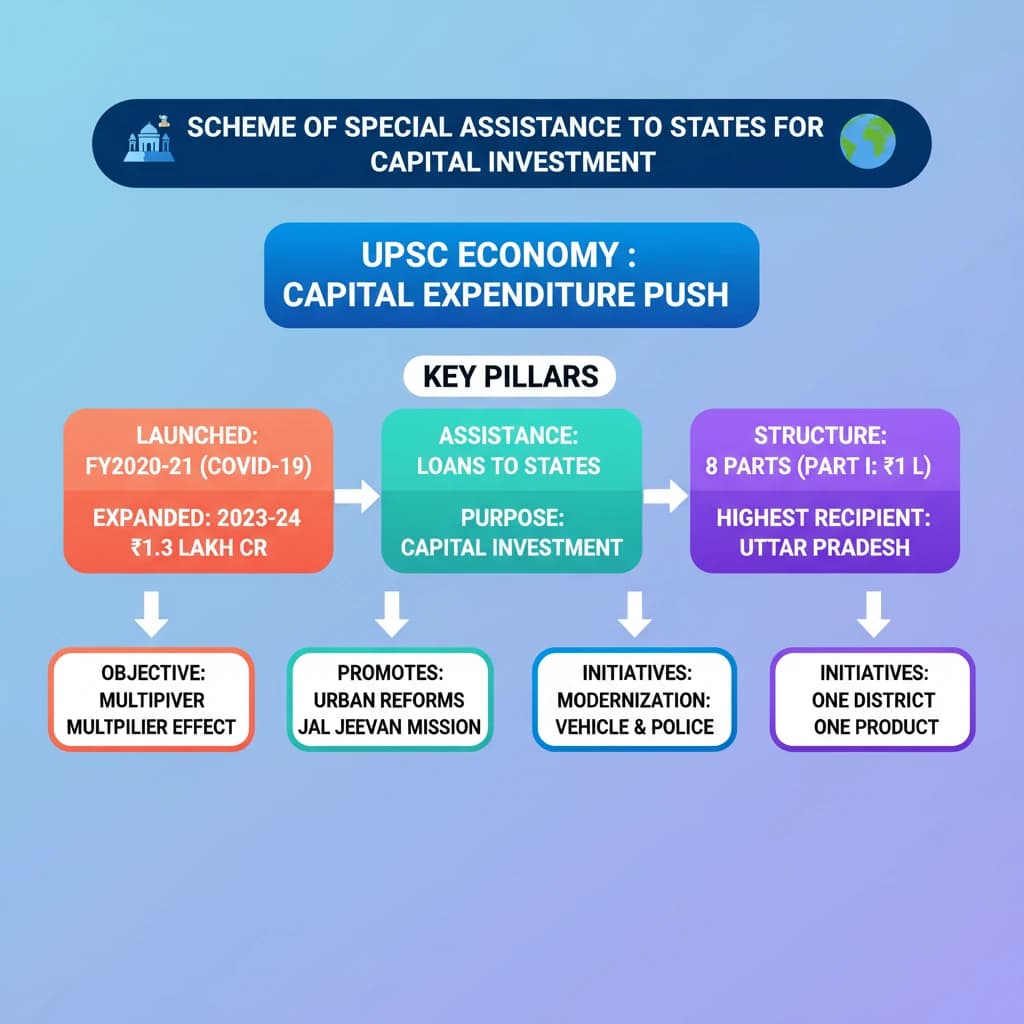
Scheme of Special Assistance to States for Capital Investment is a key topic under Economy for UPSC Civil Services Examination. Key points include: Launched in FY 2020-21 due to Covid-19, expanded in 2023-24 with Rs 1.3-lakh crore allocation.. Provides special assistance (loan) to states for capital investment; UP is the highest recipient.. Structured into eight parts; Part-I (Rs 1 lakh crore) is largest, others linked to reforms or sector-specific projects.. Understanding this topic is essential for both UPSC Prelims and Mains preparation.

Why is Scheme of Special Assistance to States for Capital Investment important for UPSC exam?

Scheme of Special Assistance to States for Capital Investment is a Medium-level topic in UPSC Economy. It is tested in both Prelims (factual MCQs) and Mains (analytical answer writing). Previous year UPSC questions have frequently covered aspects of Scheme of Special Assistance to States for Capital Investment, making it essential for comprehensive IAS preparation.

How to prepare Scheme of Special Assistance to States for Capital Investment for UPSC?

To prepare Scheme of Special Assistance to States for Capital Investment for UPSC: (1) Study the comprehensive notes covering all key concepts on Vaidra. (2) Practice previous year questions on this topic. (3) Connect it with current affairs using daily updates. (4) Revise using key takeaways and mind maps available for Economy. (5) Write practice answers linking Scheme of Special Assistance to States for Capital Investment to related GS Paper topics.

Key takeaways of Scheme of Special Assistance to States for Capital Investment for UPSC

  • Launched in FY 2020-21 due to Covid-19, expanded in 2023-24 with Rs 1.3-lakh crore allocation.
  • Provides special assistance (loan) to states for capital investment; UP is the highest recipient.
  • Structured into eight parts; Part-I (Rs 1 lakh crore) is largest, others linked to reforms or sector-specific projects.
  • Objectives: higher multiplier effect on economy, accelerate projects like Jal Jeevan Mission and PMGSY.
  • Promotes urban reforms, vehicle modernization, police housing, national integration, Make in India, and One District One Product.
Scheme of Special Assistance to States for Capital Investment

Scheme of Special Assistance to States for Capital Investment

Medium⏱️ 7 min read✓ 95% Verified
economy

📖 Introduction

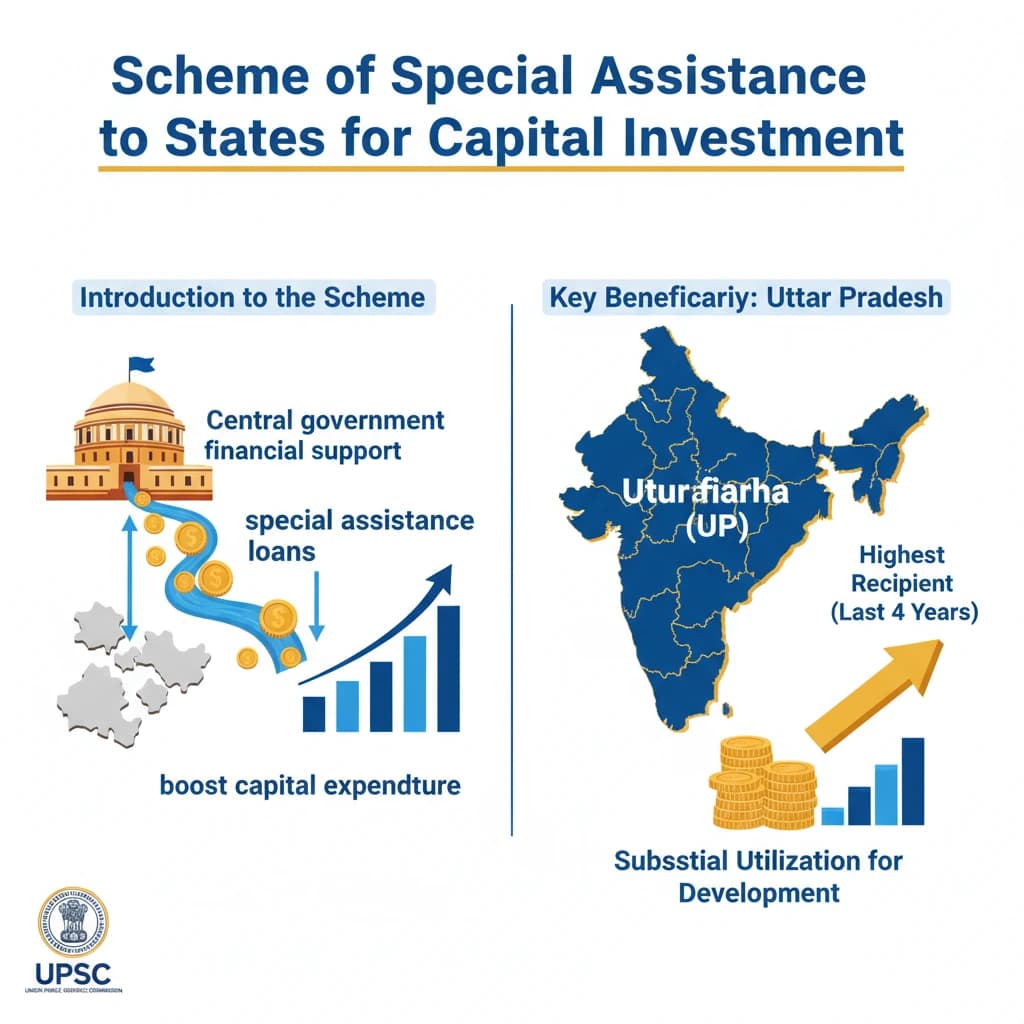
<h4>Introduction to the Scheme</h4><p>The <strong>Scheme of Special Assistance to States for Capital Investment</strong> is a significant initiative by the Central government. It provides financial support to states in the form of <strong>special assistance loans</strong> to boost capital expenditure.</p><p>Over the last four years, <strong>Uttar Pradesh (UP)</strong> has emerged as the highest recipient under this scheme, reflecting its substantial utilization of these funds for development.</p><div class='info-box'><p><strong>Total Allocation:</strong> Rs 1,67,518.6 crore (over four years)</p><p><strong>Highest Recipient:</strong> Uttar Pradesh (UP)</p></div><h4>About the Scheme of Special Assistance to States for Capital Investment</h4><p>This scheme was initially launched in <strong>FY 2020-21</strong>. Its inception was a direct response to the economic challenges posed by the <strong>Covid-19 Pandemic</strong>, aiming to stimulate economic activity through increased capital spending.</p><p>Recognizing its effectiveness, the scheme was expanded and continued as the <strong>‘Scheme for Special Assistance to States for Capital Investment 2023-24’</strong>. This expansion came with a substantial allocation, underscoring its importance in the national economic strategy.</p><div class='info-box'><p><strong>Launch Year:</strong> FY 2020-21</p><p><strong>Context:</strong> Post-Covid-19 Pandemic economic recovery</p><p><strong>Current Allocation (2023-24):</strong> Rs 1.3-lakh crore</p></div><h4>Structure and Parts of the Scheme</h4><p>The scheme is meticulously structured into <strong>eight distinct parts</strong>, each targeting specific areas of capital investment or linked to crucial reforms. This multi-pronged approach ensures comprehensive development.</p><p><strong>Part-I</strong> constitutes the largest component of the scheme, commanding an allocation of <strong>Rs 1 lakh crore</strong>. This significant portion is likely directed towards broad-based infrastructure development and capital projects.</p><div class='key-point-box'><p><strong>Key Principle:</strong> Other parts of the scheme are either linked to specific <strong>reforms</strong> or designed for <strong>sector-specific projects</strong>, promoting targeted development and policy changes.</p></div><ul><li><strong>Part-II:</strong> Focuses on initiatives related to environmental sustainability and modernization, specifically supporting the <strong>scrapping of old vehicles</strong> and the establishment of <strong>automated vehicle testing facilities</strong>.</li><li><strong>Part-III and IV:</strong> Provide crucial <strong>incentives to states</strong> for undertaking reforms in critical urban sectors, specifically <strong>urban planning</strong> and <strong>urban finance</strong>.</li><li><strong>Part-V:</strong> Addresses social infrastructure by providing funds aimed at <strong>increasing the housing stock for police personnel and their families</strong>, enhancing welfare and operational efficiency.</li><li><strong>Part-VI:</strong> Supports national strategic visions such as <strong>national integration</strong>, promoting indigenous manufacturing through <strong>Make in India</strong>, and fostering local economies via the <strong>One District One Product</strong> initiative.</li><li><strong>Part-VII:</strong> Allocates <strong>Rs. 5,000 crore</strong> as general financial assistance to states, providing flexibility for various capital expenditure needs.</li></ul><h4>Objectives and Economic Impact</h4><p>A primary objective of the scheme is to generate a <strong>higher multiplier effect on the economy</strong>. Capital investments are known to stimulate demand, create employment, and boost overall economic growth more effectively than revenue expenditure.</p><p>The scheme also specifically aims to accelerate the pace of projects in vital sectors. It achieves this by providing funds to states to meet their <strong>state share</strong> requirements for flagship national programs.</p><ul><li><strong>Key Sectors Supported:</strong> The scheme provides crucial financial backing for accelerated implementation of projects under the <strong>Jal Jeevan Mission</strong> and the <strong>Pradhan Mantri Gram Sadak Yojana</strong>.</li></ul><div class='exam-tip-box'><p><strong>UPSC Insight:</strong> Understand the <strong>fiscal federalism</strong> aspect of this scheme. It's an example of how the Centre incentivizes states for capital expenditure, which is crucial for long-term economic growth and infrastructure development. Relate it to the concept of <strong>'crowding in' private investment</strong>.</p></div>
Concept Diagram

💡 Key Takeaways

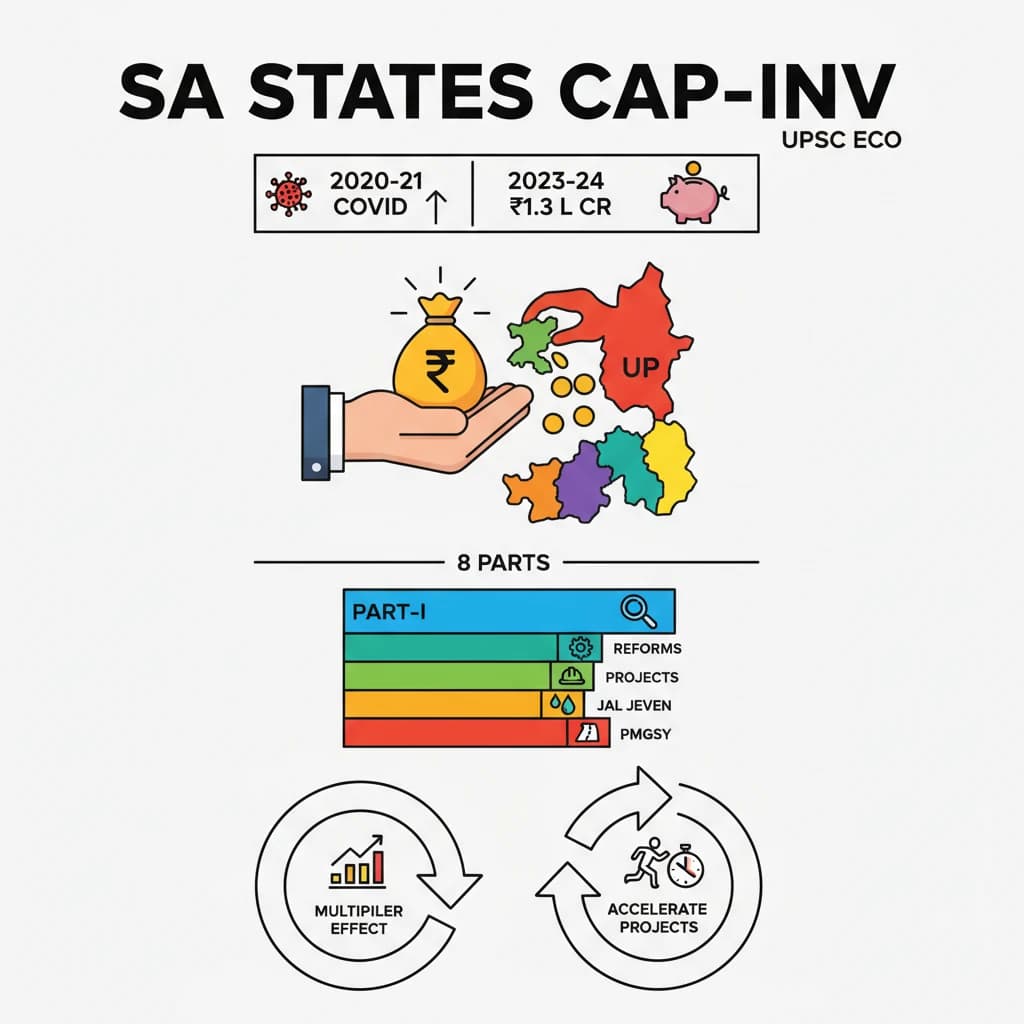
  • •Launched in FY 2020-21 due to Covid-19, expanded in 2023-24 with Rs 1.3-lakh crore allocation.
  • •Provides special assistance (loan) to states for capital investment; UP is the highest recipient.
  • •Structured into eight parts; Part-I (Rs 1 lakh crore) is largest, others linked to reforms or sector-specific projects.
  • •Objectives: higher multiplier effect on economy, accelerate projects like Jal Jeevan Mission and PMGSY.
  • •Promotes urban reforms, vehicle modernization, police housing, national integration, Make in India, and One District One Product.

🧠 Memory Techniques
Memory Aid
95% Verified Content

📚 Reference Sources

•Ministry of Finance, Government of India (for scheme details and allocations)
•Economic Survey of India (for context on capital expenditure and multiplier effect)

Related Topics

Loading related topics...
Explore:Economy Topics·All Subjects·Daily Current Affairs·Editorial Analysis·Previous Year Questions·UPSC GPT