Loading page, please wait…
Vaidra Logo
Vaidra

Top 4 items + smart groups

UPSC GPT
New
Current Affairs
Daily Solutions
Daily Puzzle
Mains Evaluator

Version 2.0.0 • Built with ❤️ for UPSC aspirants

Loading...
Loading...
Loading...
Loading...
Loading...
Loading...
Loading...
Loading...
Loading...
Loading...
Loading...
Loading...
Loading...
Back
All Subjects

Topics

0 topics • 0 completed

Loading topics...
Loading...
Loading...
Loading...
Loading...
Loading...
Overall Progress0%

PM GatiShakti: Key Pillars, Benefits & Integrated Planning - UPSC Economy

What is PM GatiShakti: Key Pillars, Benefits & Integrated Planning in UPSC Economy?

PM GatiShakti: Key Pillars, Benefits & Integrated Planning is a key topic under Economy for UPSC Civil Services Examination. Key points include: PM GatiShakti is a GIS-based digital platform for integrated infrastructure planning.. It has six pillars: Comprehensiveness, Prioritisation, Optimisation, Synchronisation, Analytical Capabilities, and Dynamic Monitoring.. Aims to break silos, reduce logistics costs, and accelerate project execution.. Understanding this topic is essential for both UPSC Prelims and Mains preparation.

Why is PM GatiShakti: Key Pillars, Benefits & Integrated Planning important for UPSC exam?

PM GatiShakti: Key Pillars, Benefits & Integrated Planning is a Medium-level topic in UPSC Economy. It is tested in both Prelims (factual MCQs) and Mains (analytical answer writing). Previous year UPSC questions have frequently covered aspects of PM GatiShakti: Key Pillars, Benefits & Integrated Planning, making it essential for comprehensive IAS preparation.

How to prepare PM GatiShakti: Key Pillars, Benefits & Integrated Planning for UPSC?

To prepare PM GatiShakti: Key Pillars, Benefits & Integrated Planning for UPSC: (1) Study the comprehensive notes covering all key concepts on Vaidra. (2) Practice previous year questions on this topic. (3) Connect it with current affairs using daily updates. (4) Revise using key takeaways and mind maps available for Economy. (5) Write practice answers linking PM GatiShakti: Key Pillars, Benefits & Integrated Planning to related GS Paper topics.

Key takeaways of PM GatiShakti: Key Pillars, Benefits & Integrated Planning for UPSC

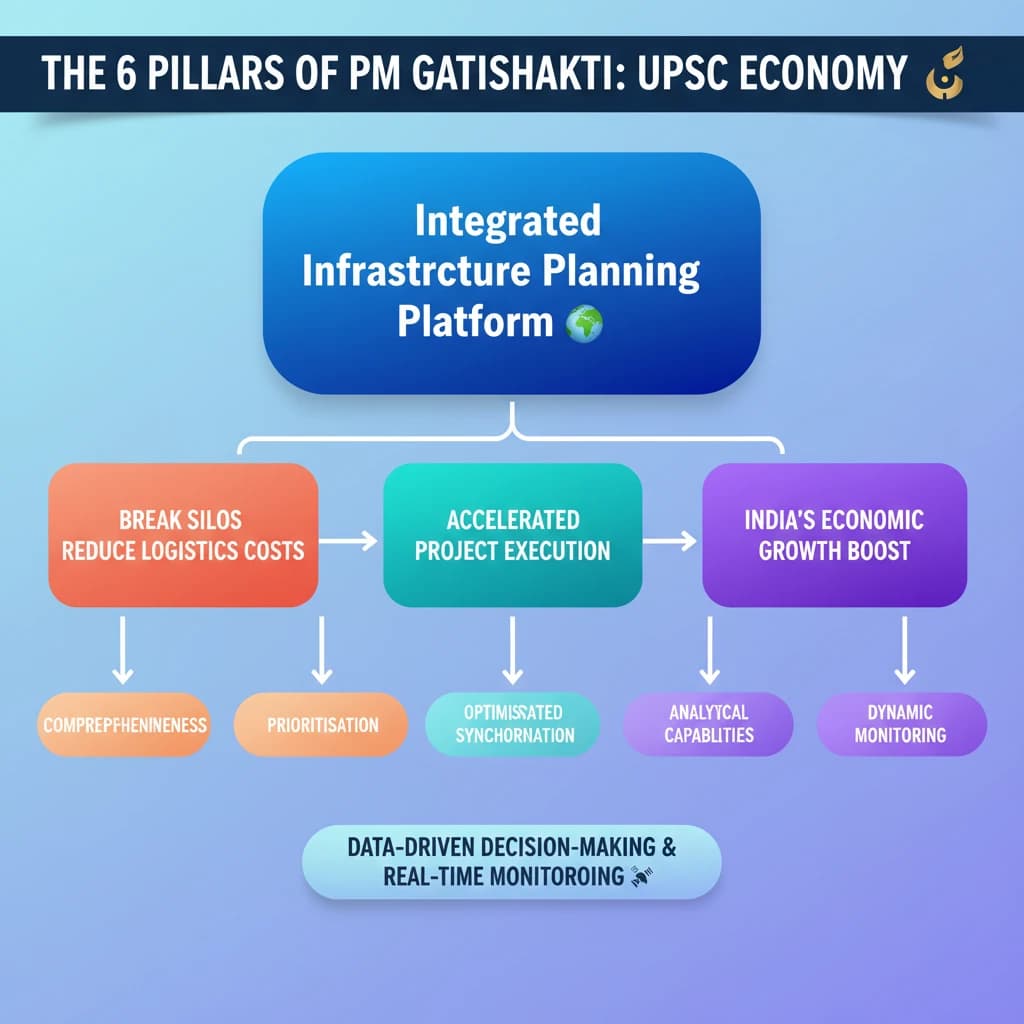
  • PM GatiShakti is a GIS-based digital platform for integrated infrastructure planning.
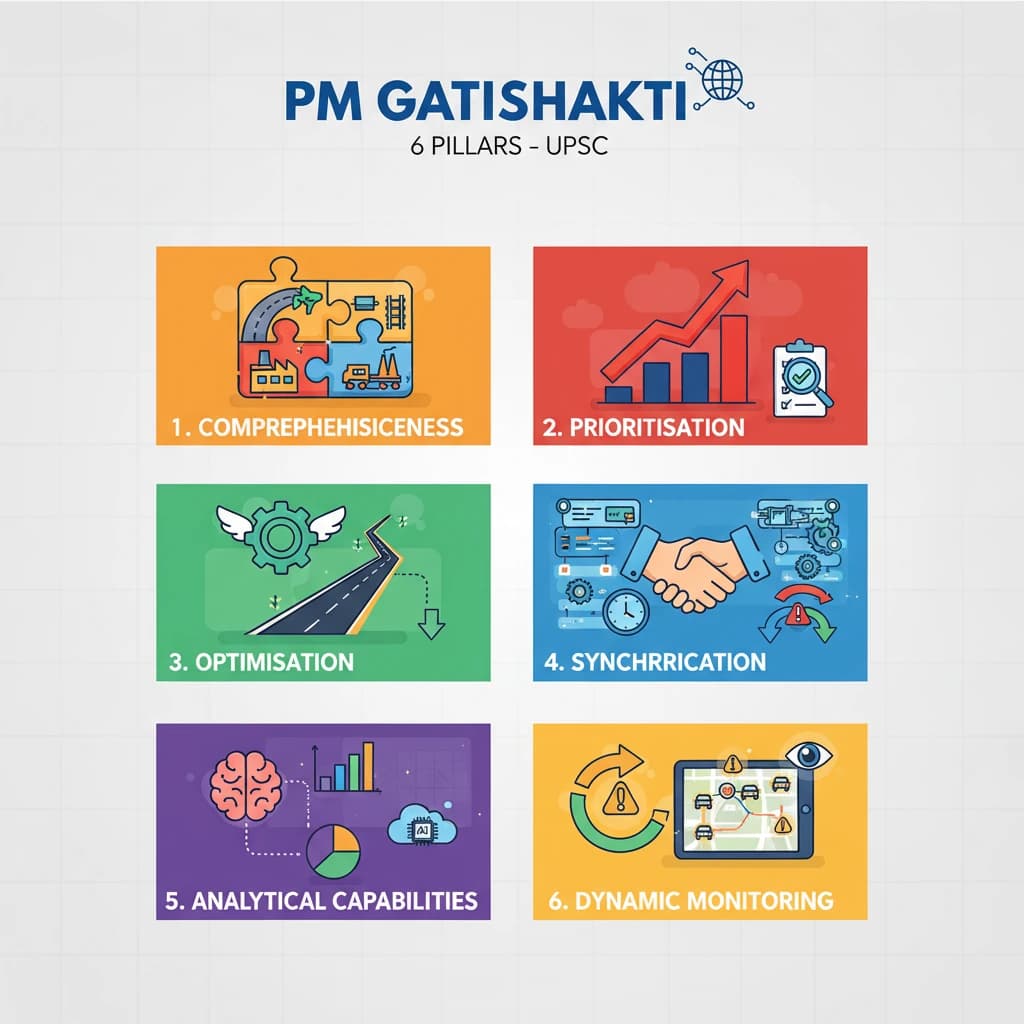
  • It has six pillars: Comprehensiveness, Prioritisation, Optimisation, Synchronisation, Analytical Capabilities, and Dynamic Monitoring.
  • Aims to break silos, reduce logistics costs, and accelerate project execution.
  • Crucial for India's economic growth, Make in India, and National Logistics Policy goals.
  • Leverages technology (GIS, satellite imagery) for data-driven decision-making and real-time monitoring.
PM GatiShakti: Key Pillars, Benefits & Integrated Planning

PM GatiShakti: Key Pillars, Benefits & Integrated Planning

Medium⏱️ 8 min read✓ 95% Verified
economy

📖 Introduction

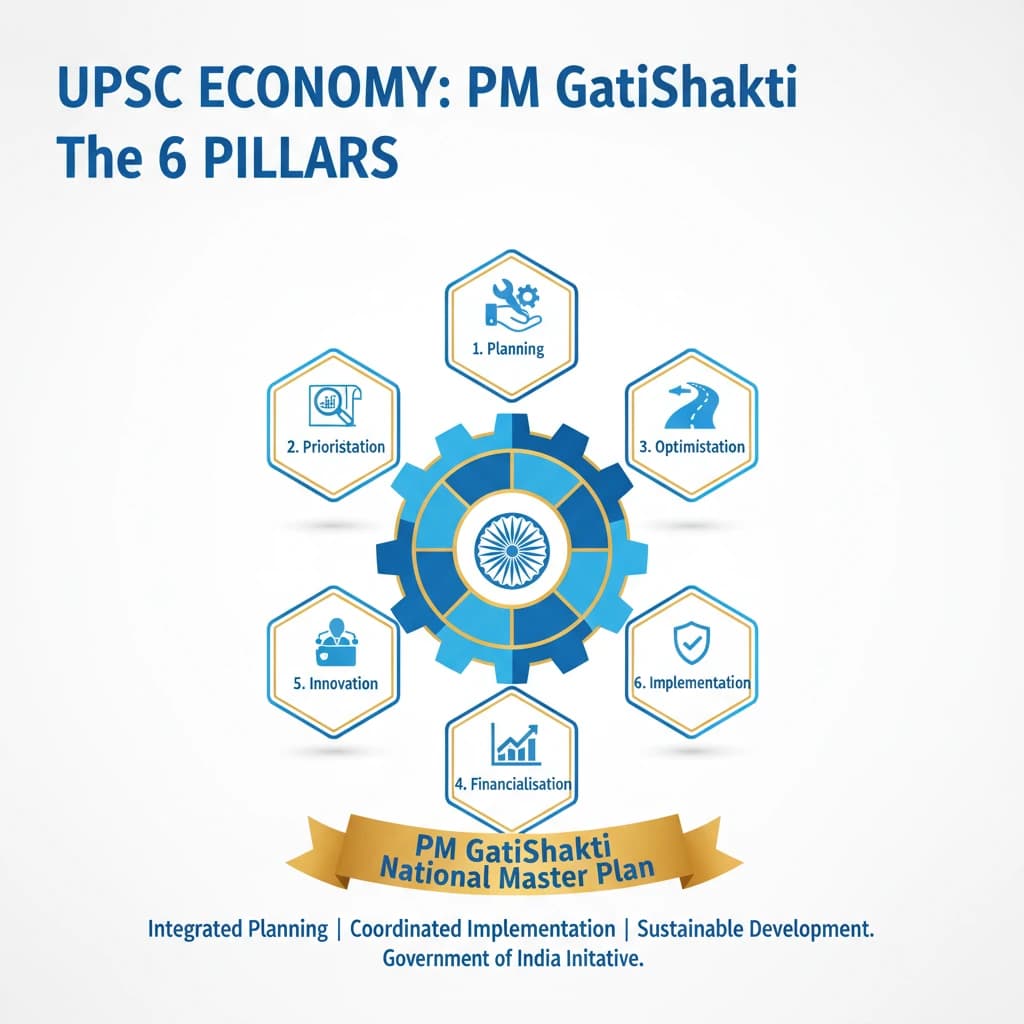
<h4>Understanding PM GatiShakti: The Six Pillars</h4><p>The <strong>PM GatiShakti National Master Plan</strong> is a transformative approach for economic growth and sustainable development. It aims to break departmental silos and bring various ministries together for integrated planning and coordinated implementation of infrastructure connectivity projects. At its core are <strong>six fundamental pillars</strong> that drive its effectiveness and impact.</p><div class='key-point-box'><p><strong>PM GatiShakti</strong> is a <strong>GIS-based digital platform</strong> for integrated infrastructure planning and execution across <strong>16 central ministries</strong>.</p></div><h4>1. Comprehensiveness</h4><p>The pillar of <strong>Comprehensiveness</strong> ensures a holistic view of infrastructure development. It integrates all existing and planned initiatives across various ministries onto a <strong>centralized portal</strong>.</p><p>This integration provides a single, unified platform for all stakeholders. It offers complete <strong>visibility into critical data</strong>, facilitating informed decision-making and efficient planning for future projects.</p><div class='info-box'><p><strong>Key Feature:</strong> A <strong>centralized digital portal</strong> acts as a single source of truth, showcasing all infrastructure projects from different ministries.</p></div><h4>2. Prioritisation</h4><p><strong>Prioritisation</strong> allows ministries to allocate resources effectively. By leveraging <strong>cross-sectoral interactions</strong>, projects can be ranked based on their strategic importance and national impact.</p><p>This pillar ensures that resources are directed towards projects that align with <strong>national priorities</strong>. It prevents duplication of efforts and maximizes the return on investment in infrastructure development.</p><h4>3. Optimisation</h4><p>The pillar of <strong>Optimisation</strong> focuses on efficiency and cost-effectiveness. It involves identifying <strong>key gaps in existing infrastructure</strong> and selecting the most efficient routes for transportation and logistics.</p><p>By optimizing routes and project execution, the plan aims to significantly <strong>reduce costs</strong> associated with infrastructure development. It also plays a crucial role in <strong>minimizing delays</strong>, ensuring timely project completion.</p><h4>4. Synchronisation</h4><p><strong>Synchronisation</strong> is critical for seamless project execution. It promotes robust <strong>coordination across ministries</strong> and departments involved in infrastructure projects.</p><p>This pillar ensures that all projects are aligned and work in harmony, preventing delays caused by departmental silos and uncoordinated efforts. It fosters a collaborative environment for national development.</p><h4>5. Analytical Capabilities</h4><p><strong>Analytical Capabilities</strong> are powered by advanced technology. The <strong>GIS-based platform</strong> incorporates over <strong>200 data layers</strong>, providing extensive spatial information.</p><p>These capabilities offer comprehensive <strong>spatial planning tools</strong>, enabling better decision-making and enhanced infrastructure visibility. This data-driven approach improves project design and implementation.</p><h4>6. Dynamic Monitoring</h4><p>The pillar of <strong>Dynamic Monitoring</strong> ensures real-time oversight of project progress. It utilizes advanced tools like <strong>satellite imagery</strong> to track developments on the ground.</p><p>This real-time tracking allows ministries to continuously monitor project schedules and make necessary adjustments promptly. It ensures projects remain on schedule and within their planned scope.</p><div class='exam-tip-box'><p>Understanding these <strong>six pillars</strong> is crucial for Mains answers (<strong>GS Paper III: Infrastructure</strong>). Focus on how each pillar contributes to integrated planning and efficient execution.</p></div>
Concept Diagram

💡 Key Takeaways

  • •PM GatiShakti is a GIS-based digital platform for integrated infrastructure planning.
  • •It has six pillars: Comprehensiveness, Prioritisation, Optimisation, Synchronisation, Analytical Capabilities, and Dynamic Monitoring.
  • •Aims to break silos, reduce logistics costs, and accelerate project execution.
  • •Crucial for India's economic growth, Make in India, and National Logistics Policy goals.
  • •Leverages technology (GIS, satellite imagery) for data-driven decision-making and real-time monitoring.

🧠 Memory Techniques
Memory Aid
95% Verified Content

📚 Reference Sources

•Press Information Bureau (PIB) releases on PM GatiShakti
•Ministry of Commerce & Industry, Government of India (PM GatiShakti website)

Related Topics

Loading related topics...
Explore:Economy Topics·All Subjects·Daily Current Affairs·Editorial Analysis·Previous Year Questions·UPSC GPT
PM GatiShakti: Key Pillars, Benefits & Integrated Planning - UPSC Economy