Loading page, please wait…
Vaidra Logo
Vaidra

Top 4 items + smart groups

UPSC GPT
New
Current Affairs
Daily Solutions
Daily Puzzle
Mains Evaluator

Version 2.0.0 • Built with ❤️ for UPSC aspirants

Loading...
Loading...
Loading...
Loading...
Loading...
Loading...
Loading...
Loading...
Loading...
Loading...
Loading...
Loading...
Loading...
Back
All Subjects

Topics

0 topics • 0 completed

Loading topics...
Loading...
Loading...
Loading...
Loading...
Loading...
Overall Progress0%
What is the Open Market Sale Scheme (Domestic) Policy? - UPSC Economy

What is the Open Market Sale Scheme (Domestic) Policy? - UPSC Economy

What is What is the Open Market Sale Scheme (Domestic) Policy? in UPSC Economy?

What is the Open Market Sale Scheme (Domestic) Policy? is a key topic under Economy for UPSC Civil Services Examination. Key points include: OMSS(D) is a government scheme for selling surplus food grains (wheat, rice) from FCI's central pool.. Its primary goals are to curb food inflation and stabilize market prices of essential food grains.. FCI conducts e-auctions for processors, millers, and traders, with specific quantity limits.. Understanding this topic is essential for both UPSC Prelims and Mains preparation.

Why is What is the Open Market Sale Scheme (Domestic) Policy? important for UPSC exam?

What is the Open Market Sale Scheme (Domestic) Policy? is a Medium-level topic in UPSC Economy. It is tested in both Prelims (factual MCQs) and Mains (analytical answer writing). Previous year UPSC questions have frequently covered aspects of What is the Open Market Sale Scheme (Domestic) Policy?, making it essential for comprehensive IAS preparation.

How to prepare What is the Open Market Sale Scheme (Domestic) Policy? for UPSC?

To prepare What is the Open Market Sale Scheme (Domestic) Policy? for UPSC: (1) Study the comprehensive notes covering all key concepts on Vaidra. (2) Practice previous year questions on this topic. (3) Connect it with current affairs using daily updates. (4) Revise using key takeaways and mind maps available for Economy. (5) Write practice answers linking What is the Open Market Sale Scheme (Domestic) Policy? to related GS Paper topics.

Key takeaways of What is the Open Market Sale Scheme (Domestic) Policy? for UPSC

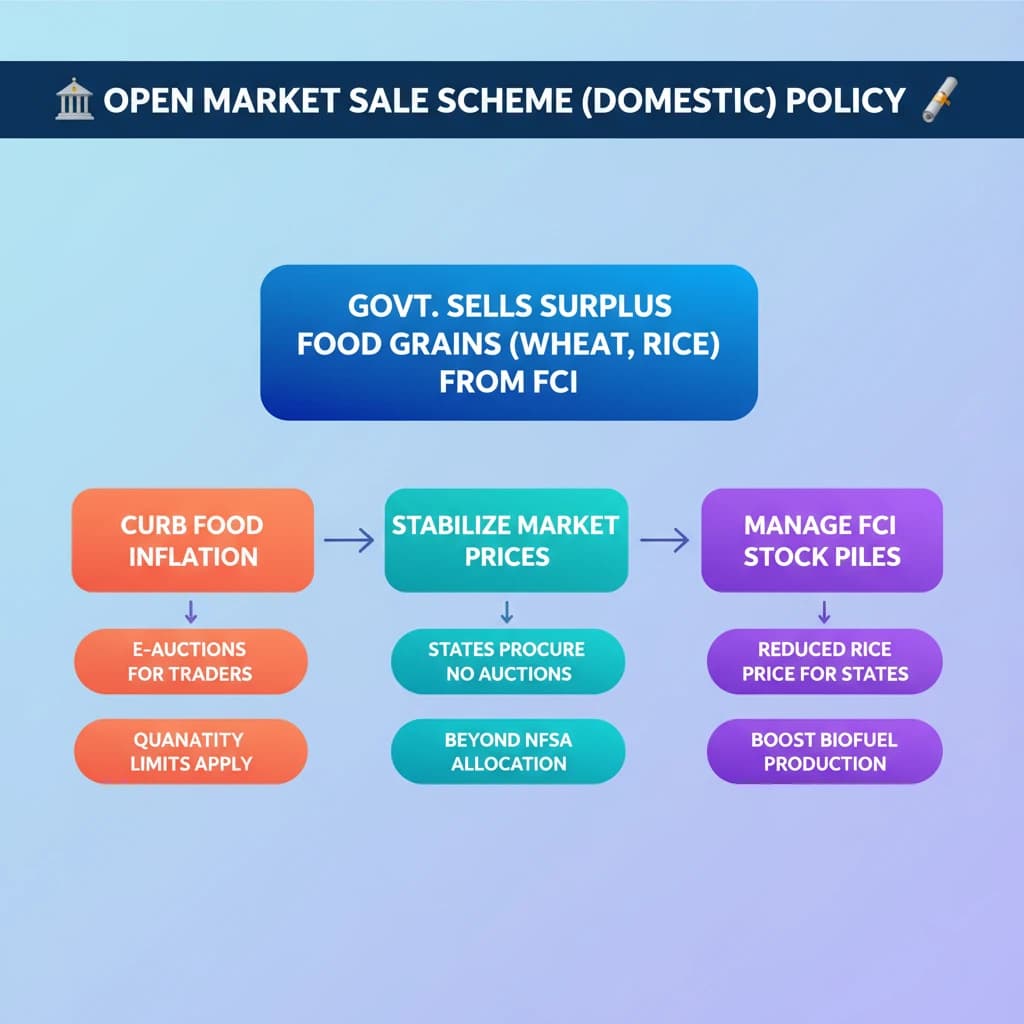
  • OMSS(D) is a government scheme for selling surplus food grains (wheat, rice) from FCI's central pool.
  • Its primary goals are to curb food inflation and stabilize market prices of essential food grains.
  • FCI conducts e-auctions for processors, millers, and traders, with specific quantity limits.
  • States can procure grains beyond NFSA allocation directly from OMSS without auctions.
  • Recent revisions include reduced rice prices for states and ethanol producers to boost sales and support biofuel production.
  • FCI, established in 1965, is crucial for NFSA, PDS, MSP operations, and market interventions like OMSS(D).
What is the Open Market Sale Scheme (Domestic) Policy?

What is the Open Market Sale Scheme (Domestic) Policy?

Medium⏱️ 7 min read✓ 98% Verified
economy

📖 Introduction

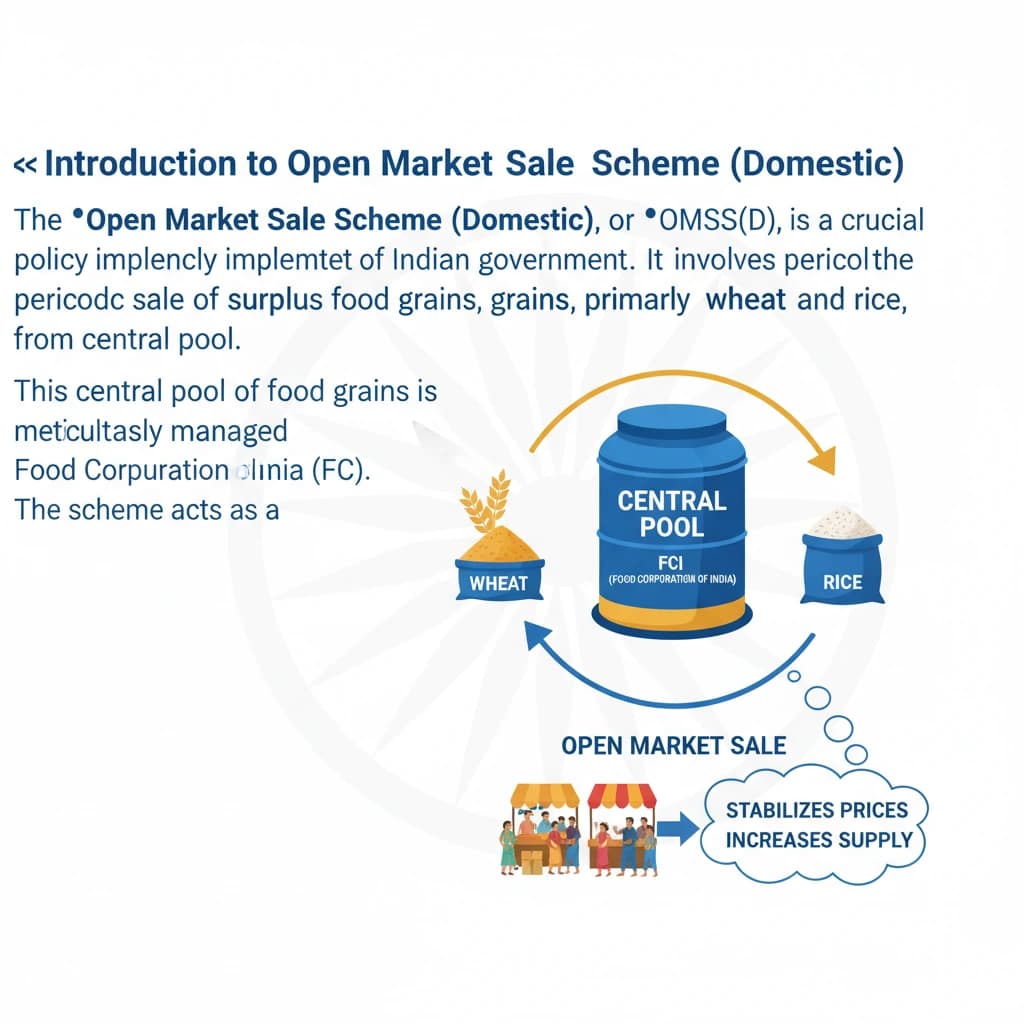
<h4>Introduction to Open Market Sale Scheme (Domestic)</h4><p>The <strong>Open Market Sale Scheme (Domestic)</strong>, or <strong>OMSS(D)</strong>, is a crucial policy implemented by the Indian government. It involves the periodic sale of <strong>surplus food grains</strong>, primarily <strong>wheat</strong> and <strong>rice</strong>, from the central pool.</p><p>This central pool of food grains is meticulously managed by the <strong>Food Corporation of India (FCI)</strong>. The scheme acts as a vital tool for market intervention.</p><div class='key-point-box'><p><strong>Key Objectives of OMSS(D):</strong><ul><li>To <strong>curb inflation</strong> by increasing market supply.</li><li>To <strong>stabilize food grain prices</strong>, ensuring affordability for consumers.</li><li>To meet the specific needs of the <strong>Targeted Public Distribution System (TPDS)</strong> and various <strong>Other Welfare Schemes</strong>.</li></ul></p></div><h4>Eligible Buyers and Procurement Process</h4><p>Under the OMSS(D), different types of buyers are eligible to procure food grains. The scheme distinguishes between buyers for wheat and rice.</p><div class='info-box'><p><strong>Eligible Buyers:</strong><ul><li><strong>Wheat:</strong> Primarily sold to <strong>Processors</strong>, <strong>Atta Chaklis</strong>, and <strong>Flour Millers</strong>. These entities convert wheat into flour for wider distribution.</li><li><strong>Rice:</strong> Typically sold to <strong>traders</strong>, who then distribute it further into the market.</li></ul></p></div><p>States also have the option to procure food grains through the OMSS(D). This procurement can be done <strong>beyond their National Food Security Act (NFSA), 2013 allocation</strong>. Importantly, states can do this <strong>without participating in the e-auctions</strong>, providing a direct channel for additional stock.</p><h4>Auction Process Details</h4><p>The primary method for bidders to procure food grains under OMSS(D) is through <strong>e-auctions</strong>. This ensures transparency and a competitive environment for sales.</p><div class='info-box'><p><strong>Auction Specifications:</strong><ul><li><strong>Wheat:</strong> Bidders can participate for a minimum quantity of <strong>10 metric tons (MT)</strong> and a maximum of <strong>100 MT</strong>.</li><li><strong>Rice:</strong> Bidders can participate for a minimum quantity of <strong>10 MT</strong> and a maximum of <strong>1000 MT</strong>.</li></ul></p></div><h4>Recent Revisions to OMSS(D)</h4><p>The Centre periodically revises the terms of the OMSS(D) to address evolving market conditions and policy objectives. A significant recent revision was made to the reserve price of rice.</p><div class='info-box'><p>The Centre reduced the reserve price of <strong>FCI rice</strong> under OMSS(D) by <strong>Rs 550</strong>. This brought the price down to <strong>Rs 2,250 per quintal</strong> for states and <strong>ethanol producers</strong>.</p></div><p>This revision aimed to achieve multiple goals: to <strong>boost sales</strong> of surplus rice, to <strong>support ethanol production</strong> (as rice can be used for ethanol), and to <strong>enhance overall food security</strong> by ensuring better availability and utilization of stocks.</p><h4>Role of Food Corporation of India (FCI)</h4><p>The <strong>Food Corporation of India (FCI)</strong> is the backbone of India's food security system and plays a central role in the OMSS(D).</p><div class='info-box'><p><strong>Establishment:</strong> The <strong>FCI</strong> is a <strong>statutory body</strong>. It was established under the <strong>Food Corporations Act, 1964</strong>, highlighting its legislative mandate and importance.</p></div><div class='key-point-box'><p><strong>Key Roles of FCI:</strong><ul><li><strong>National Food Security Act (NFSA):</strong> FCI is responsible for procuring grains to fulfill the requirements of the <strong>NFSA, 2013</strong>. It then distributes these grains at <strong>Central Issue Prices</strong> to economically vulnerable sections of society.</li><li><strong>Public Distribution System (PDS):</strong> FCI delivers food grains to State Governments and their agencies. These grains are then distributed through a network of <strong>Fair Price Shops</strong> across the country.</li><li><strong>Nutritional Security:</strong> Beyond basic food provision, FCI actively promotes <strong>nutritional security</strong>, for instance, through the distribution of <strong>fortified rice</strong>.</li><li><strong>Market Interventions:</strong> FCI plays a critical role in <strong>stabilizing food prices</strong> and <strong>mitigating inflation</strong>. This is achieved through strategic procurement and the implementation of schemes like the <strong>OMSS (Open Market Sale Scheme)</strong>.</li><li><strong>Farmer Welfare:</strong> FCI provides a crucial <strong>safety net for farmers</strong> by ensuring that they receive <strong>Minimum Support Prices (MSP)</strong> for their produce, thereby protecting them from market fluctuations.</li></ul></p></div><div class='exam-tip-box'><p><strong>UPSC Insight:</strong> Understanding the multifaceted role of <strong>FCI</strong>, especially its connection to <strong>NFSA</strong>, <strong>PDS</strong>, <strong>MSP</strong>, and <strong>OMSS</strong>, is vital for both Prelims and Mains. Questions often link these concepts to food security, agricultural policy, and inflation management.</p></div>
Concept Diagram

💡 Key Takeaways

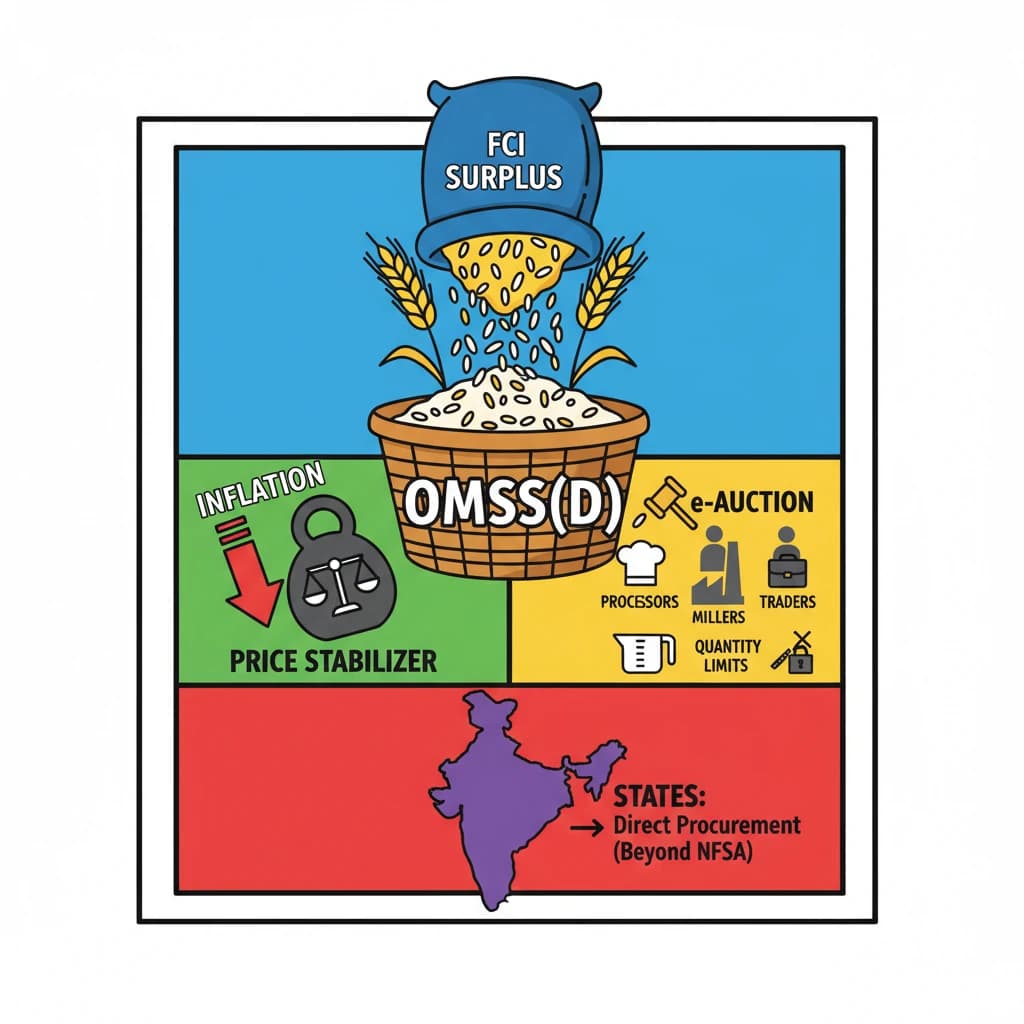
  • •OMSS(D) is a government scheme for selling surplus food grains (wheat, rice) from FCI's central pool.
  • •Its primary goals are to curb food inflation and stabilize market prices of essential food grains.
  • •FCI conducts e-auctions for processors, millers, and traders, with specific quantity limits.
  • •States can procure grains beyond NFSA allocation directly from OMSS without auctions.
  • •Recent revisions include reduced rice prices for states and ethanol producers to boost sales and support biofuel production.
  • •FCI, established in 1965, is crucial for NFSA, PDS, MSP operations, and market interventions like OMSS(D).

🧠 Memory Techniques
Memory Aid
98% Verified Content

📚 Reference Sources

•Food Corporation of India (FCI) Official Website
•Ministry of Consumer Affairs, Food & Public Distribution, Government of India
•Press Information Bureau (PIB) releases regarding OMSS(D) revisions

Related Topics

Loading related topics...
Explore:Economy Topics·All Subjects·Daily Current Affairs·Editorial Analysis·Previous Year Questions·UPSC GPT