Loading page, please wait…
Vaidra Logo
Vaidra

Top 4 items + smart groups

UPSC GPT
New
Current Affairs
Daily Solutions
Daily Puzzle
Mains Evaluator

Version 2.0.0 • Built with ❤️ for UPSC aspirants

Loading...
Loading...
Loading...
Loading...
Loading...
Loading...
Loading...
Loading...
Loading...
Loading...
Loading...
Loading...
Loading...
Back
All Subjects

Topics

0 topics • 0 completed

Loading topics...
Loading...
Loading...
Loading...
Loading...
Loading...
Overall Progress0%

Chennai-Vladivostok Maritime Corridor - UPSC Economy

What is Chennai-Vladivostok Maritime Corridor in UPSC Economy?

Chennai-Vladivostok Maritime Corridor is a key topic under Economy for UPSC Civil Services Examination. Key points include: The Chennai-Vladivostok Maritime Corridor links India's east coast (Chennai) with Russia's Far East (Vladivostok).. It significantly reduces transit distance (by ~3,000 nautical miles) and time (by ~16 days) compared to traditional routes.. Vladivostok is Russia's largest Pacific port, strategically located near the China-Russia border.. Understanding this topic is essential for both UPSC Prelims and Mains preparation.

Why is Chennai-Vladivostok Maritime Corridor important for UPSC exam?

Chennai-Vladivostok Maritime Corridor is a Medium-level topic in UPSC Economy. It is tested in both Prelims (factual MCQs) and Mains (analytical answer writing). Previous year UPSC questions have frequently covered aspects of Chennai-Vladivostok Maritime Corridor, making it essential for comprehensive IAS preparation.

How to prepare Chennai-Vladivostok Maritime Corridor for UPSC?

To prepare Chennai-Vladivostok Maritime Corridor for UPSC: (1) Study the comprehensive notes covering all key concepts on Vaidra. (2) Practice previous year questions on this topic. (3) Connect it with current affairs using daily updates. (4) Revise using key takeaways and mind maps available for Economy. (5) Write practice answers linking Chennai-Vladivostok Maritime Corridor to related GS Paper topics.

Key takeaways of Chennai-Vladivostok Maritime Corridor for UPSC

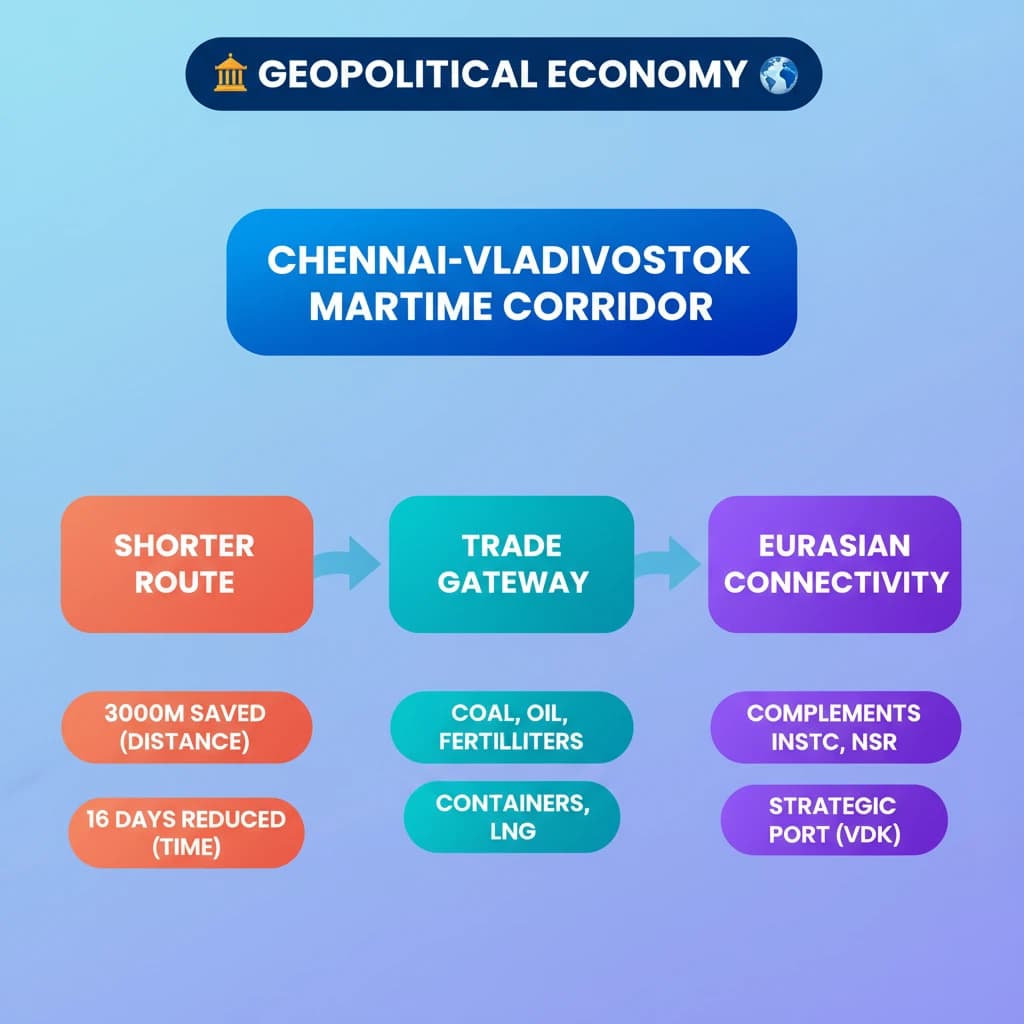
  • The Chennai-Vladivostok Maritime Corridor links India's east coast (Chennai) with Russia's Far East (Vladivostok).
  • It significantly reduces transit distance (by ~3,000 nautical miles) and time (by ~16 days) compared to traditional routes.
  • Vladivostok is Russia's largest Pacific port, strategically located near the China-Russia border.
  • The corridor has high potential for trade in coking coal, oil, fertilisers, containers, and LNG.
  • It complements other major connectivity initiatives like the Northern Sea Route and INSTC, enhancing Eurasian connectivity.
Chennai-Vladivostok Maritime Corridor

Chennai-Vladivostok Maritime Corridor

Medium⏱️ 8 min read✓ 95% Verified
economy

📖 Introduction

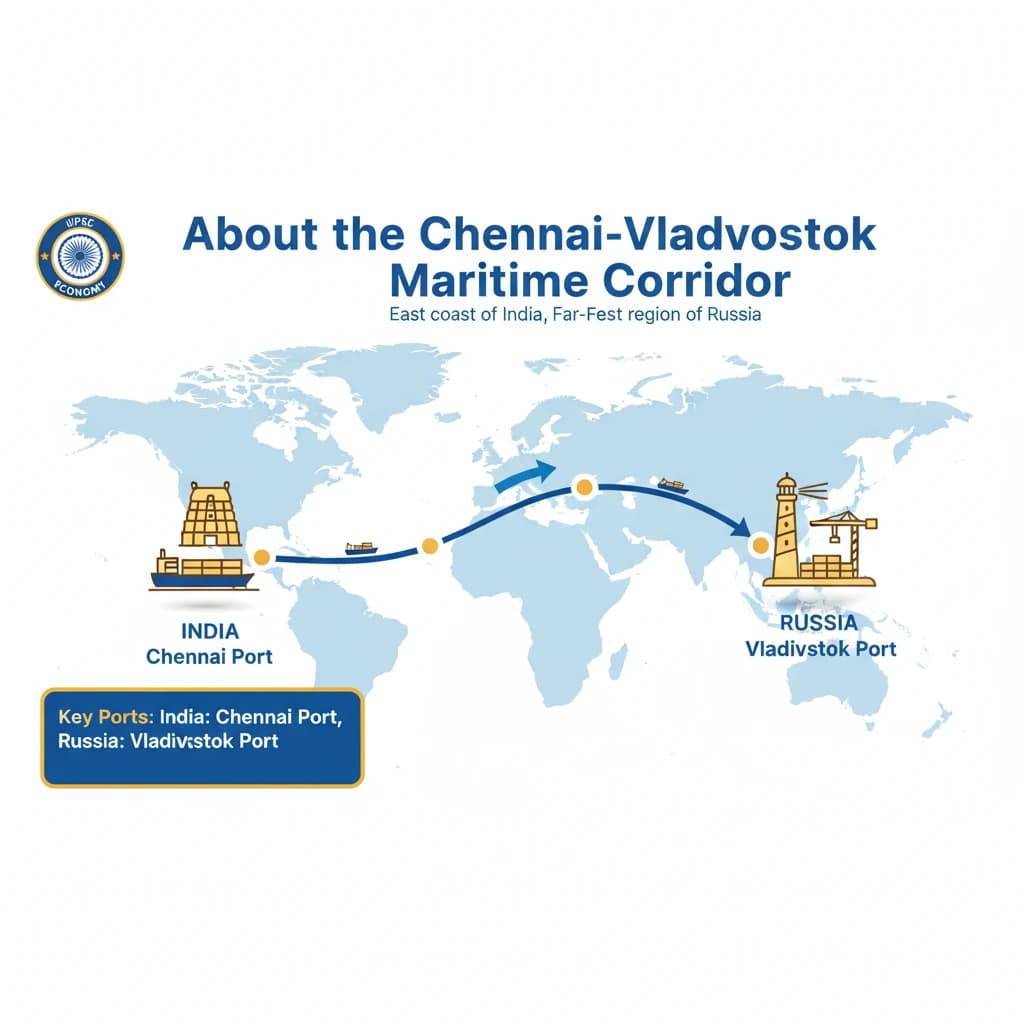
<h4>About the Chennai-Vladivostok Maritime Corridor</h4><p>The <strong>Chennai-Vladivostok Maritime Corridor</strong> is a crucial sea link. It connects the <strong>east coast of India</strong> with ports in the <strong>Far-East region of Russia</strong>. Specifically, it links the <strong>Chennai Port</strong> in India with the <strong>Vladivostok Port</strong> in Russia.</p><div class='info-box'><p><strong>Key Ports:</strong></p><ul><li><strong>India:</strong> Chennai Port</li><li><strong>Russia:</strong> Vladivostok Port</li></ul></div><h4>Distance and Time Reduction</h4><p>This new maritime route significantly reduces both the distance and time required for transport. The previous route, often via Europe, was much longer and more time-consuming.</p><div class='info-box'><p><strong>Route Efficiency:</strong></p><ul><li><strong>Distance Reduced:</strong> From <strong>8,675 nautical miles</strong> (via Europe) to approximately <strong>5,600 nautical miles</strong>.</li><li><strong>Time Reduced:</strong> From <strong>40 days</strong> to just <strong>24 days</strong>, a saving of up to <strong>16 days</strong>.</li></ul></div><h4>Strategic Importance of Vladivostok</h4><p><strong>Vladivostok</strong> holds immense strategic importance for Russia. It is the largest Russian port situated on the <strong>Pacific Coast</strong>, providing Russia with a vital gateway to the Asia-Pacific region.</p><p>Its geographical location further enhances its strategic value. <strong>Vladivostok</strong> is positioned approximately <strong>50 kilometers</strong> from the <strong>China-Russia border</strong>, making it a key logistical hub in the region.</p><h4>Trade Potential and Economic Opportunities</h4><p>A comprehensive feasibility study has highlighted significant potential for bilateral trade through this corridor. It aims to facilitate the exchange of various essential commodities between India and Russia.</p><div class='info-box'><p><strong>Potential Commodities for Trade:</strong></p><ul><li><strong>Coking coal</strong></li><li><strong>Oil</strong></li><li><strong>Fertilisers</strong></li><li><strong>Containers</strong></li><li><strong>Liquefied Natural Gas (LNG)</strong></li></ul></div><h4>Complementary Connectivity Initiatives</h4><p>The <strong>Chennai-Vladivostok Maritime Corridor</strong> is not an isolated initiative. It aligns strategically with other major connectivity projects aimed at enhancing trade and geopolitical influence.</p><p>This corridor complements the objectives of both the <strong>Northern Sea Route</strong> and the <strong>International North-South Transport Corridor (INSTC)</strong>, creating a multi-modal network for Eurasian connectivity.</p><div class='key-point-box'><p><strong>Overall Significance:</strong> The corridor enhances <strong>India's connectivity</strong> to Russia's Far East, diversifies trade routes, and strengthens strategic partnerships, particularly in energy and resources.</p></div>
Concept Diagram

💡 Key Takeaways

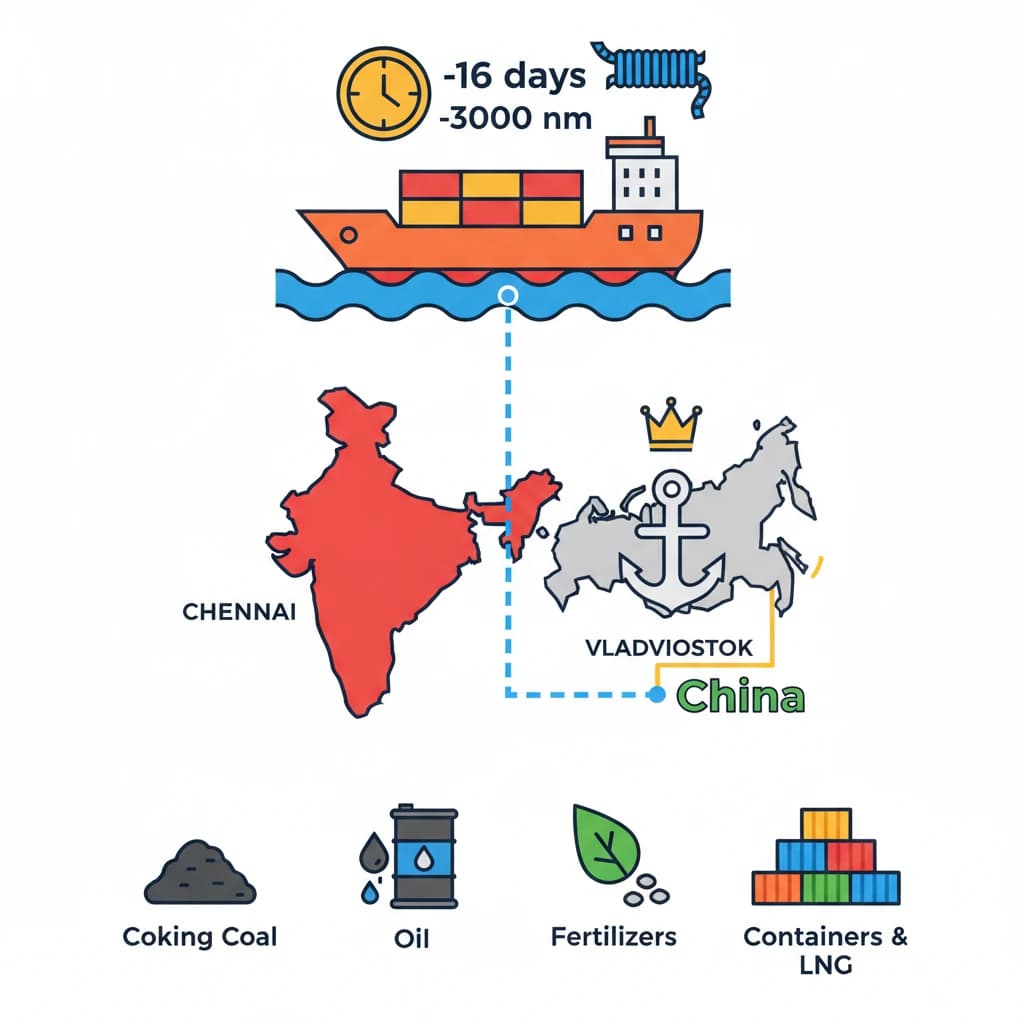
  • •The Chennai-Vladivostok Maritime Corridor links India's east coast (Chennai) with Russia's Far East (Vladivostok).
  • •It significantly reduces transit distance (by ~3,000 nautical miles) and time (by ~16 days) compared to traditional routes.
  • •Vladivostok is Russia's largest Pacific port, strategically located near the China-Russia border.
  • •The corridor has high potential for trade in coking coal, oil, fertilisers, containers, and LNG.
  • •It complements other major connectivity initiatives like the Northern Sea Route and INSTC, enhancing Eurasian connectivity.

🧠 Memory Techniques
Memory Aid
95% Verified Content

📚 Reference Sources

•Ministry of External Affairs (MEA) official statements (hypothetical)
•Press Information Bureau (PIB) releases (hypothetical)
•Reports from maritime industry analysts (hypothetical)

Related Topics

Loading related topics...
Explore:Economy Topics·All Subjects·Daily Current Affairs·Editorial Analysis·Previous Year Questions·UPSC GPT
Chennai-Vladivostok Maritime Corridor - UPSC Economy