Loading page, please wait…
Debt Sustainability and Exchange Rate Management - UPSC Economy
What is Debt Sustainability and Exchange Rate Management in UPSC Economy?
Debt Sustainability and Exchange Rate Management is a key topic under Economy for UPSC Civil Services Examination. Key points include: India's public debt-to-GDP ratio stood at 81% in 2022-23, with Central Government debt at 57.1% of GDP by March 2023.. High fiscal deficit, global events, and exchange rate fluctuations are key drivers of rising debt levels.. The FRBM Act, 2003, is India's primary legislation for fiscal discipline and public debt management.. Understanding this topic is essential for both UPSC Prelims and Mains preparation.
Why is Debt Sustainability and Exchange Rate Management important for UPSC exam?
Debt Sustainability and Exchange Rate Management is a Medium-level topic in UPSC Economy. It is tested in both Prelims (factual MCQs) and Mains (analytical answer writing). Previous year UPSC questions have frequently covered aspects of Debt Sustainability and Exchange Rate Management, making it essential for comprehensive IAS preparation.
How to prepare Debt Sustainability and Exchange Rate Management for UPSC?
To prepare Debt Sustainability and Exchange Rate Management for UPSC: (1) Study the comprehensive notes covering all key concepts on Vaidra. (2) Practice previous year questions on this topic. (3) Connect it with current affairs using daily updates. (4) Revise using key takeaways and mind maps available for Economy. (5) Write practice answers linking Debt Sustainability and Exchange Rate Management to related GS Paper topics.
Key takeaways of Debt Sustainability and Exchange Rate Management for UPSC
- India's public debt-to-GDP ratio stood at 81% in 2022-23, with Central Government debt at 57.1% of GDP by March 2023.
- High fiscal deficit, global events, and exchange rate fluctuations are key drivers of rising debt levels.
- The FRBM Act, 2003, is India's primary legislation for fiscal discipline and public debt management.
- Debt sustainability ensures a nation can meet its financial obligations without economic distress, while exchange rate management stabilizes currency value.
- The IMF's Article IV consultation provides an external assessment and recommendations for India's macroeconomic policies.
Debt Sustainability and Exchange Rate Management
Medium⏱️ 9 min read
economy
📖 Introduction
Introduction to Debt Sustainability and Exchange Rate Management
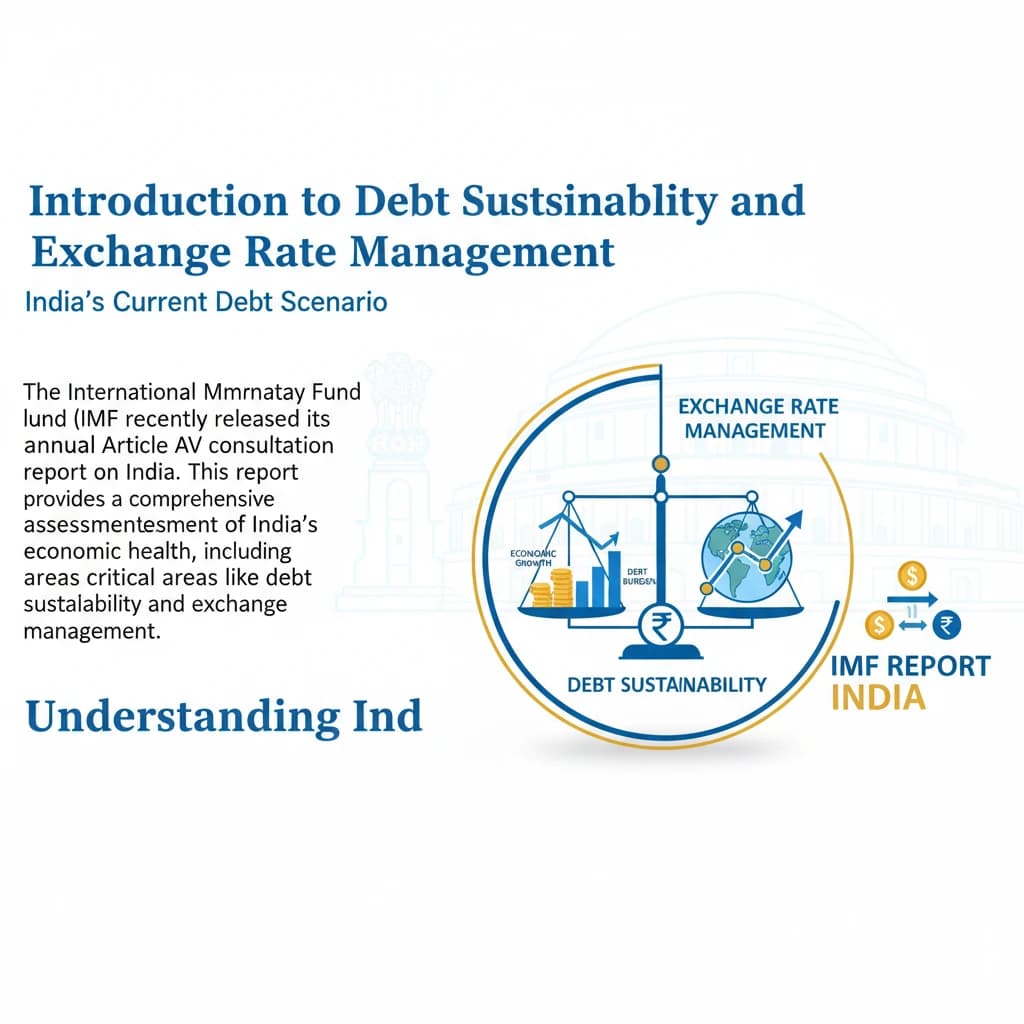
The International Monetary Fund (IMF) recently released its annual Article IV consultation report on India.
This report provides a comprehensive assessment of India's economic health, including critical areas like debt sustainability and exchange rate management.
India's Current Debt Scenario
Understanding India's debt landscape is crucial for evaluating its economic stability and future growth prospects.
Both the Central Government and State Governments contribute significantly to the overall public debt burden.
- Central Government's debt: Approximately ₹155.6 trillion by March 2023.
- This figure represented about 57.1% of India's GDP at that time.
- State Governments' debt: Accounted for roughly 28% of GDP.
- Overall Public Debt-to-GDP Ratio: Stood at 81% in 2022-23, as reported by the Finance Ministry.
Factors Contributing to India's Rising Debt Levels
Several interconnected factors contribute to the upward trend in India's public debt. These factors highlight both internal structural issues and external influences.
- High Fiscal Deficit: A persistent imbalance where government expenditure exceeds its revenue. This deficit is primarily financed through borrowing.
- High Expenditure Commitments: Significant spending on welfare schemes, infrastructure projects, subsidies, and defense can strain public finances.
- Slow Revenue Growth: Insufficient growth in tax and non-tax revenues limits the government's ability to fund its commitments without resorting to debt.
- Global Geopolitical Events: External shocks like wars, pandemics, or commodity price spikes can necessitate increased government spending or reduce revenue, leading to higher borrowing.
- Informal Economy and Tax Leakage: A large informal sector and issues like tax evasion can reduce the overall tax base, impacting revenue collection.
- Guarantees and Contingencies: Government guarantees to public sector undertakings or other entities can turn into actual liabilities if the guaranteed party defaults, adding to debt.
- Exchange Rate Fluctuations: A depreciation of the domestic currency can increase the local currency value of foreign currency denominated debt, making it more expensive to service.
Legislative Framework for Debt Management
To ensure fiscal discipline and manage debt sustainably, India has enacted specific legislation.
The primary legal framework is the Fiscal Responsibility and Budget Management Act, 2003 (FRBM Act).
This Act aims to introduce transparency and accountability in India's fiscal management and set targets for reducing fiscal deficit and public debt.
UPSC Insight: Understanding the provisions and amendments of the FRBM Act is crucial for Mains GS Paper III (Economy) questions on fiscal policy and public finance.
💡 Key Takeaways
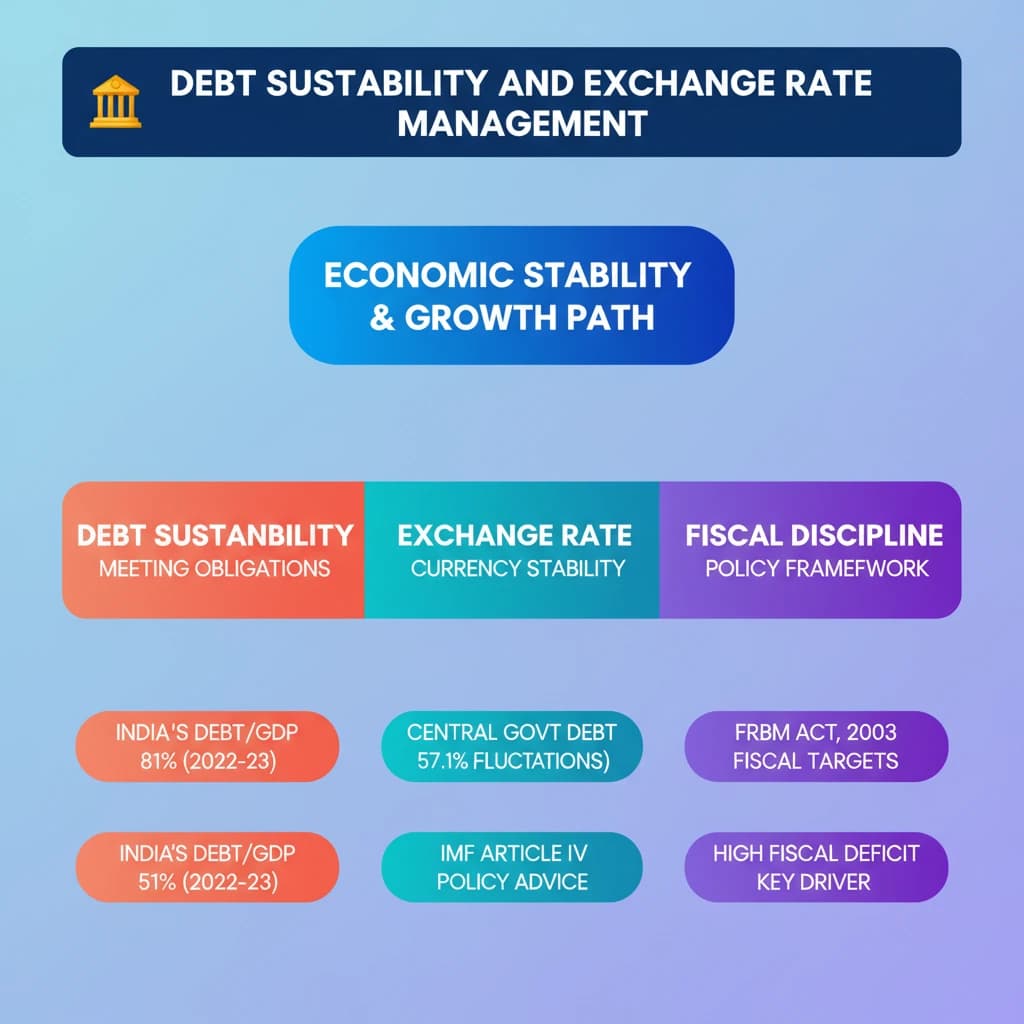
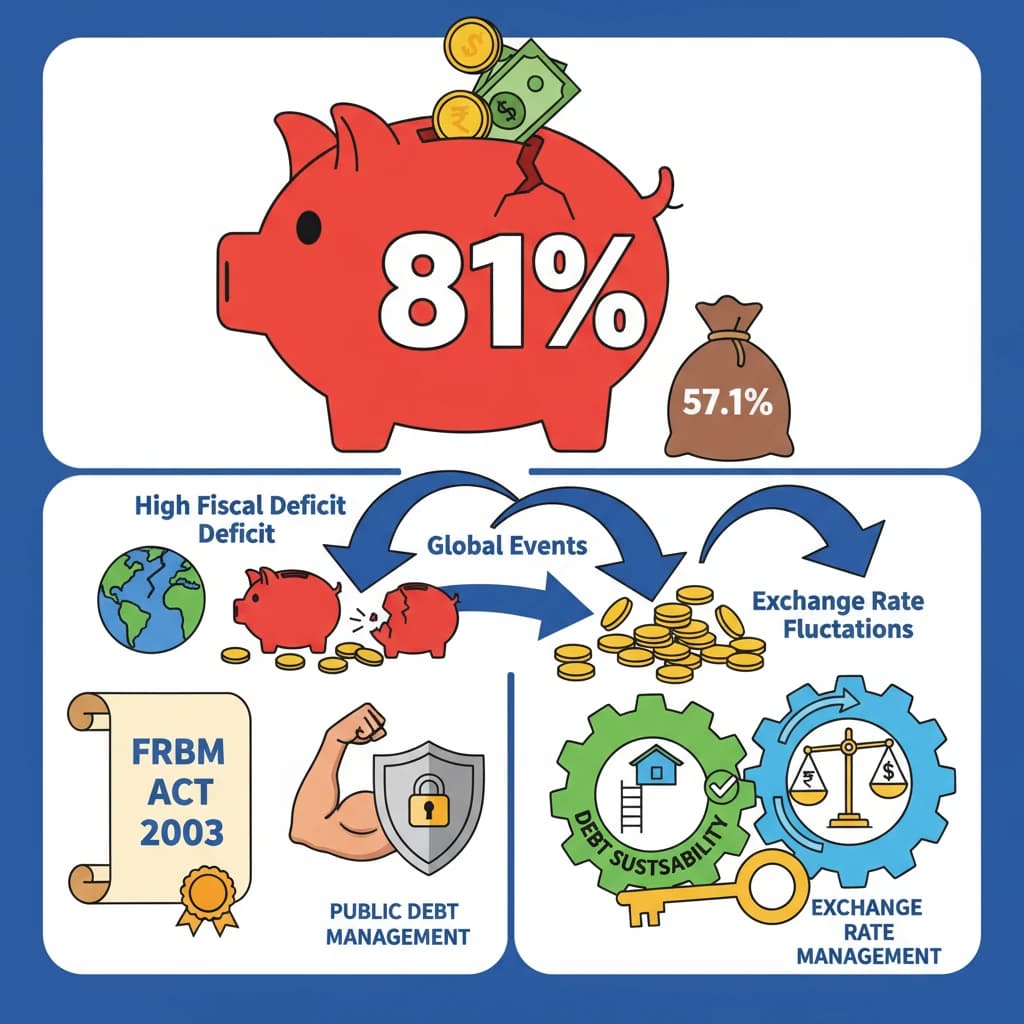
- •India's public debt-to-GDP ratio stood at 81% in 2022-23, with Central Government debt at 57.1% of GDP by March 2023.
- •High fiscal deficit, global events, and exchange rate fluctuations are key drivers of rising debt levels.
- •The FRBM Act, 2003, is India's primary legislation for fiscal discipline and public debt management.
- •Debt sustainability ensures a nation can meet its financial obligations without economic distress, while exchange rate management stabilizes currency value.
- •The IMF's Article IV consultation provides an external assessment and recommendations for India's macroeconomic policies.
🧠 Memory Techniques
95% Verified Content
📚 Reference Sources
•International Monetary Fund (IMF) Article IV Consultation Report on India
•Ministry of Finance, Government of India