Loading page, please wait…
Developments in India’s Maritime Sector - UPSC Economy
What is Developments in India’s Maritime Sector in UPSC Economy?
Developments in India’s Maritime Sector is a key topic under Economy for UPSC Civil Services Examination. Key points include: Sagarmanthan Dialogue highlights India's focus on maritime logistics, ports, and shipping.. Chennai-Vladivostok Eastern Maritime Corridor (CVEMC) operationalized in late 2023, connecting India to Far East Russia for strategic imports.. India-Middle East-Europe Economic Corridor (IMEC) announced at G20 2023, a multi-modal route connecting India, Middle East, and Europe.. Understanding this topic is essential for both UPSC Prelims and Mains preparation.
Why is Developments in India’s Maritime Sector important for UPSC exam?
Developments in India’s Maritime Sector is a Medium-level topic in UPSC Economy. It is tested in both Prelims (factual MCQs) and Mains (analytical answer writing). Previous year UPSC questions have frequently covered aspects of Developments in India’s Maritime Sector, making it essential for comprehensive IAS preparation.
How to prepare Developments in India’s Maritime Sector for UPSC?
To prepare Developments in India’s Maritime Sector for UPSC: (1) Study the comprehensive notes covering all key concepts on Vaidra. (2) Practice previous year questions on this topic. (3) Connect it with current affairs using daily updates. (4) Revise using key takeaways and mind maps available for Economy. (5) Write practice answers linking Developments in India’s Maritime Sector to related GS Paper topics.
Key takeaways of Developments in India’s Maritime Sector for UPSC
- Sagarmanthan Dialogue highlights India's focus on maritime logistics, ports, and shipping.
- Chennai-Vladivostok Eastern Maritime Corridor (CVEMC) operationalized in late 2023, connecting India to Far East Russia for strategic imports.
- India-Middle East-Europe Economic Corridor (IMEC) announced at G20 2023, a multi-modal route connecting India, Middle East, and Europe.
- These initiatives are crucial for India's economic growth, trade diversification, and geopolitical influence.
- India is leveraging its maritime position to enhance global connectivity and achieve strategic autonomy.
Developments in India’s Maritime Sector
Medium⏱️ 8 min read
economy
📖 Introduction
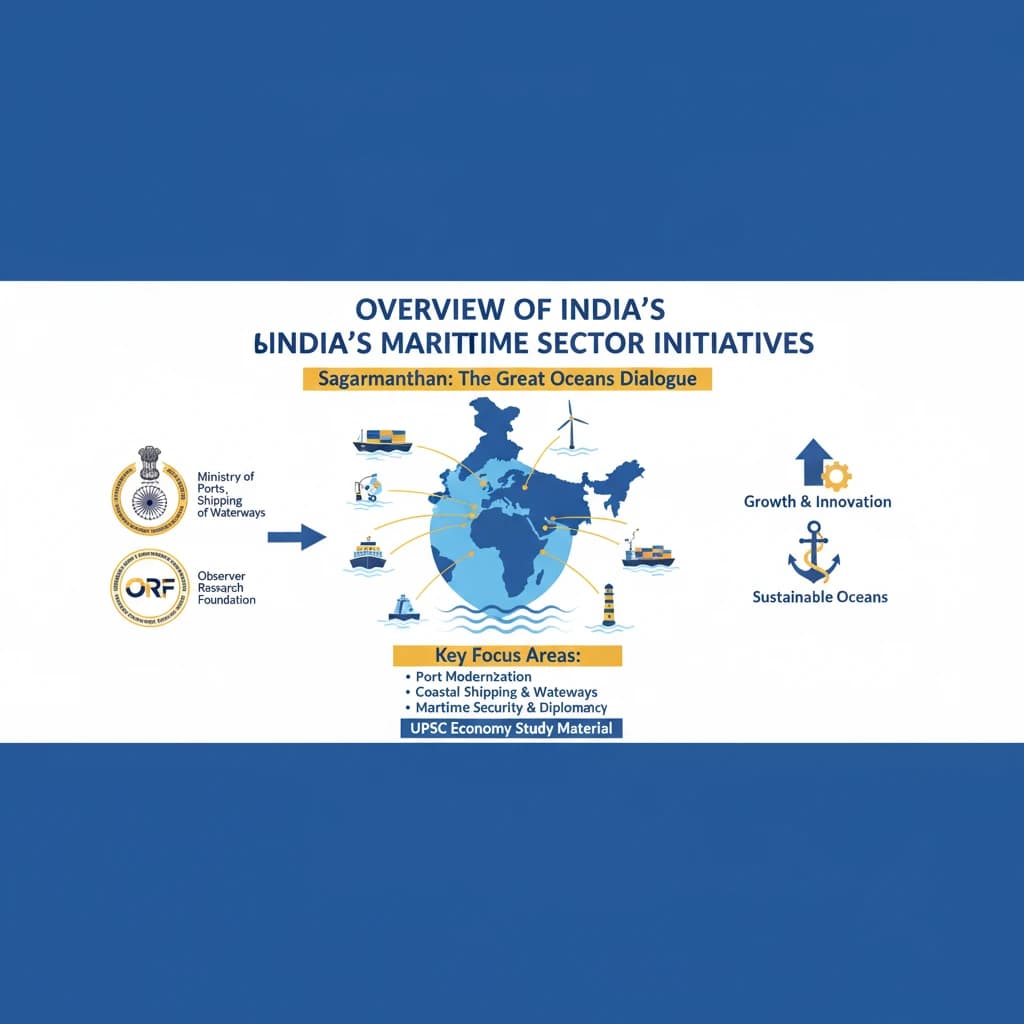
Overview of India's Maritime Sector Initiatives
The Ministry of Ports, Shipping and Waterways, in collaboration with the Observer Research Foundation (ORF), recently organized a significant event. This initiative was named Sagarmanthan: The Great Oceans Dialogue.
This inaugural dialogue aimed to highlight crucial developments within India's maritime sector. The discussions primarily focused on advancements in maritime logistics, ports, and shipping capabilities.
Sagarmanthan: The Great Oceans Dialogue serves as a platform to showcase India's strategic vision and progress in enhancing its maritime infrastructure and connectivity.
Chennai-Vladivostok Eastern Maritime Corridor (CVEMC)
The Chennai-Vladivostok Eastern Maritime Corridor (CVEMC) represents a pivotal development in India's efforts to diversify its trade routes. This corridor officially became operational towards the end of 2023.
The primary function of the CVEMC is to facilitate efficient cargo transport between India and Far East Russia. It significantly reduces transit times compared to traditional Western routes.
Key Imports Handled by CVEMC:
- Crude oil
- Coal
- Food products
- Machinery
Understanding the strategic importance of the CVEMC is crucial for UPSC Mains GS-II (International Relations) and GS-III (Economy). It connects India to the resource-rich Russian Far East, bolstering energy security and trade diversification.
India-Middle East-Europe Economic Corridor (IMEC)
The India-Middle East-Europe Economic Corridor (IMEC) was a landmark announcement made at the G20 New Delhi Summit 2023. This ambitious project aims to create a transformative economic pathway.
The IMEC spans an impressive distance of over 4,800 km. It is designed to connect India to various nations across the Middle East and Europe through a multi-modal transport network.
IMEC Connectivity:
- Asian Nations: India, UAE, Saudi Arabia, Jordan, Israel
- European Nations: Italy, France, Greece
The corridor utilizes both railway and sea routes to ensure comprehensive connectivity.
A key aspect of the IMEC's implementation involves strong bilateral and multilateral collaborations. India and Greece, for instance, are actively collaborating on this significant initiative, highlighting its strategic depth.
The IMEC is envisioned as a major infrastructure project that could reshape global trade routes, enhance regional economic integration, and offer an alternative to existing connectivity initiatives.
💡 Key Takeaways
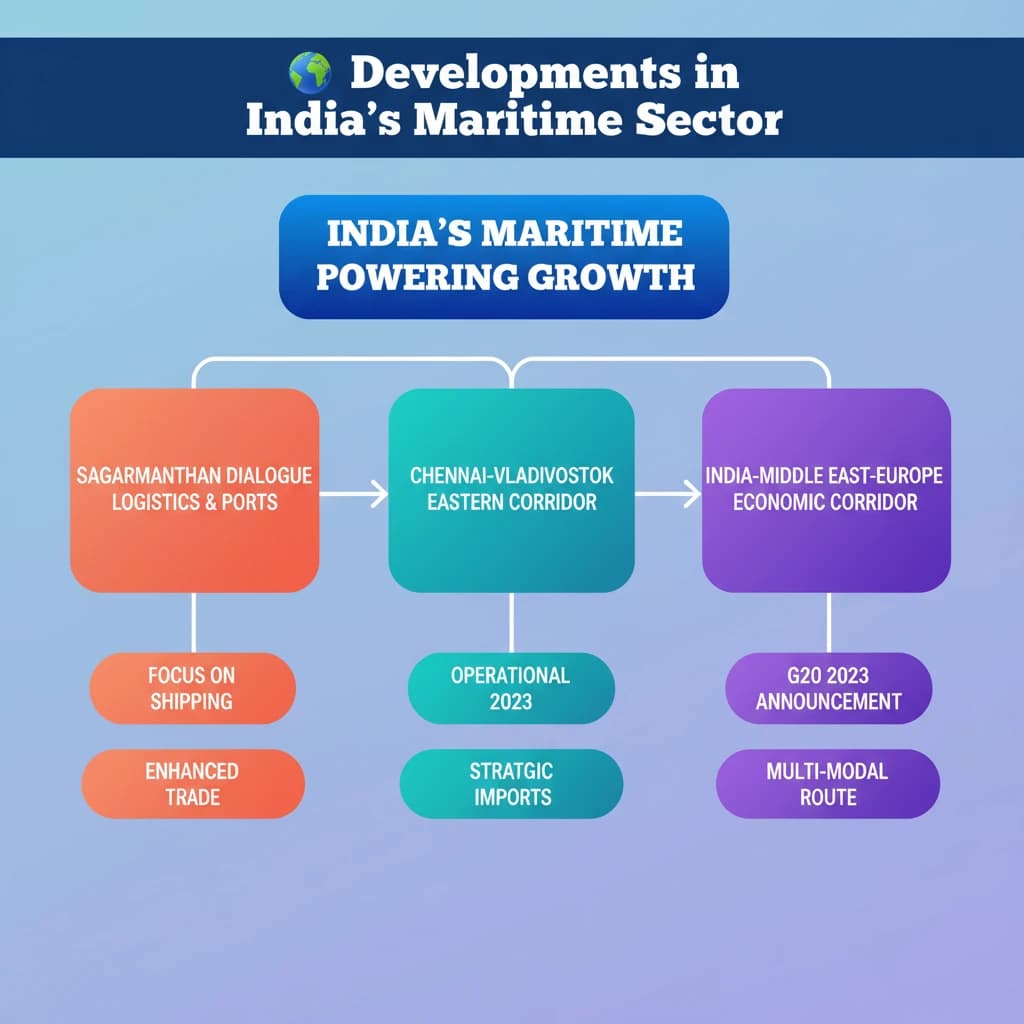
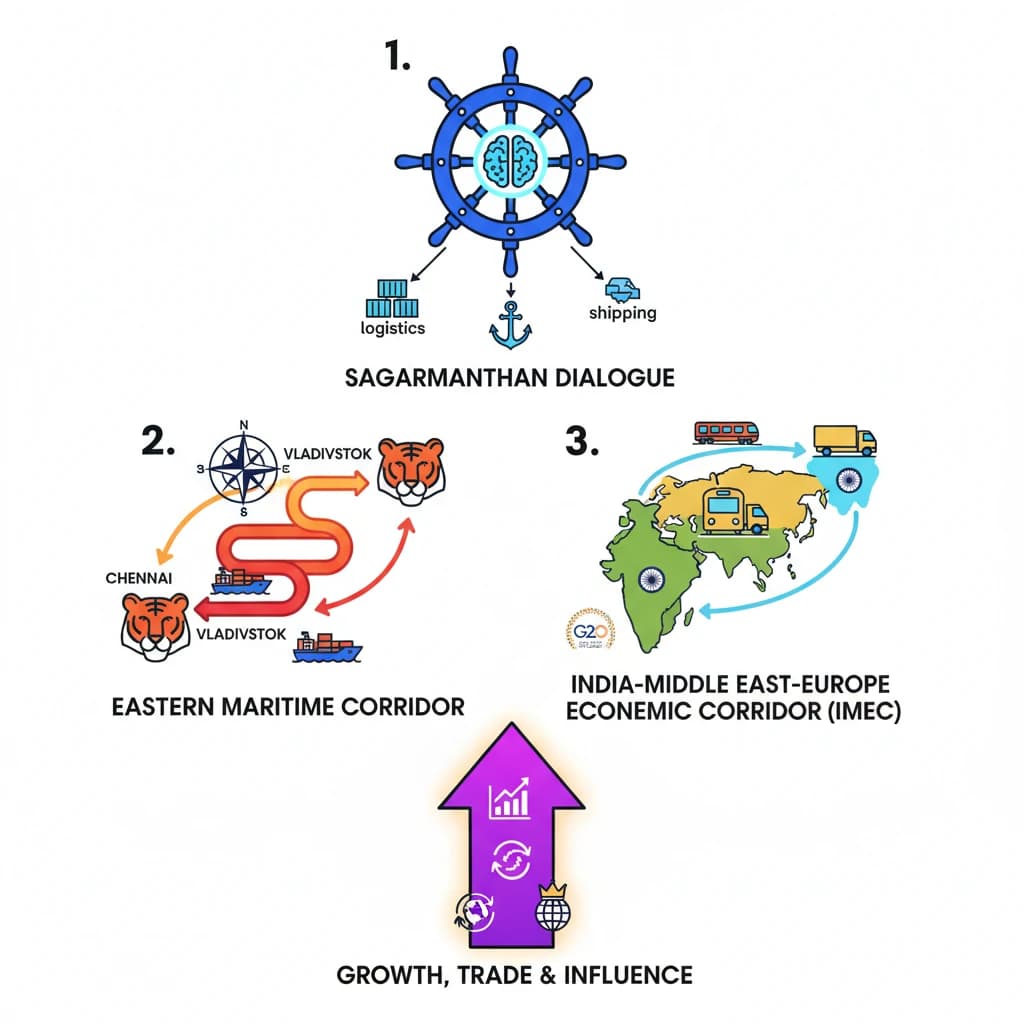
- •Sagarmanthan Dialogue highlights India's focus on maritime logistics, ports, and shipping.
- •Chennai-Vladivostok Eastern Maritime Corridor (CVEMC) operationalized in late 2023, connecting India to Far East Russia for strategic imports.
- •India-Middle East-Europe Economic Corridor (IMEC) announced at G20 2023, a multi-modal route connecting India, Middle East, and Europe.
- •These initiatives are crucial for India's economic growth, trade diversification, and geopolitical influence.
- •India is leveraging its maritime position to enhance global connectivity and achieve strategic autonomy.
🧠 Memory Techniques
95% Verified Content
📚 Reference Sources
•Observer Research Foundation (ORF) publications
•G20 New Delhi Summit 2023 official declarations and press releases
•Reputable news sources covering Indian economic and foreign policy developments