Loading page, please wait…
Digital Currency - UPSC Economy
What is Digital Currency in UPSC Economy?
Digital Currency is a key topic under Economy for UPSC Civil Services Examination. Key points include: CBDC is a legal tender digital currency issued and backed by a central bank, unlike private cryptocurrencies.. It is exchangeable one-to-one with fiat currency and aims to reduce costs and risks of physical cash.. Inspired by Bitcoin, but fundamentally different due to centralized issuance and legal tender status.. Understanding this topic is essential for both UPSC Prelims and Mains preparation.
Why is Digital Currency important for UPSC exam?
Digital Currency is a Medium-level topic in UPSC Economy. It is tested in both Prelims (factual MCQs) and Mains (analytical answer writing). Previous year UPSC questions have frequently covered aspects of Digital Currency, making it essential for comprehensive IAS preparation.
How to prepare Digital Currency for UPSC?
To prepare Digital Currency for UPSC: (1) Study the comprehensive notes covering all key concepts on Vaidra. (2) Practice previous year questions on this topic. (3) Connect it with current affairs using daily updates. (4) Revise using key takeaways and mind maps available for Economy. (5) Write practice answers linking Digital Currency to related GS Paper topics.
Key takeaways of Digital Currency for UPSC
- CBDC is a legal tender digital currency issued and backed by a central bank, unlike private cryptocurrencies.
- It is exchangeable one-to-one with fiat currency and aims to reduce costs and risks of physical cash.
- Inspired by Bitcoin, but fundamentally different due to centralized issuance and legal tender status.
- Bahamas (Sand Dollar), Nigeria (eNaira), and China (e-CNY) are pioneers in CBDC implementation.
- India's e-rupee is under development, with RBI emphasizing innovative features for a robust digital financial ecosystem.
Digital Currency
Medium⏱️ 5 min read
economy
📖 Introduction
Introduction to Digital Currency and CBDC
The concept of Digital Currency has gained significant traction globally. India's central bank, the Reserve Bank of India (RBI), is actively developing its own version, known as the Central Bank Digital Currency (CBDC) or e-rupee.
The Governor of the RBI has highlighted the innovative features being incorporated into India's CBDC, signaling a strategic move towards modernizing the country's financial infrastructure.
What is Central Bank Digital Currency (CBDC)?
A CBDC is essentially a legal tender that is issued by a central bank in a purely digital form. It represents the digital equivalent of a nation's fiat currency.
Definition: A Central Bank Digital Currency (CBDC) is a digital form of a country's fiat currency, issued and backed by its central bank.
Crucially, CBDCs are backed directly by the respective central bank. This backing provides inherent stability and fosters trust among users, a characteristic often lacking in private cryptocurrencies.
Key Feature: A CBDC is fully exchangeable one-to-one with the traditional fiat currency of that nation, maintaining its value and purchasing power.
Understanding Fiat Currency
The term fiat currency refers to a national currency that is not pegged to the price of a physical commodity. Unlike historical currencies backed by gold or silver, its value is derived from government decree and public trust.
Fiat Currency: A national currency not backed by a physical commodity like gold or silver. Its value is determined by government declaration and market demand.
Distinguishing CBDC from Cryptocurrencies
While the concept of CBDCs was indeed inspired by the emergence of Bitcoin and other digital assets, they are fundamentally different. CBDCs are distinct from decentralized virtual currencies and crypto assets.
The primary difference lies in their issuance and legal status. Private cryptocurrencies are not issued by the state and therefore lack the crucial status of 'legal tender', making them speculative assets rather than official currency.
Objectives of CBDC
The main objective behind the development and implementation of CBDCs is multi-faceted. It aims to enhance efficiency and security within the financial system.
Primary Goal: The core objective of CBDCs is to mitigate risks associated with and trim costs involved in handling physical currency, promoting a more streamlined digital economy.
💡 Key Takeaways
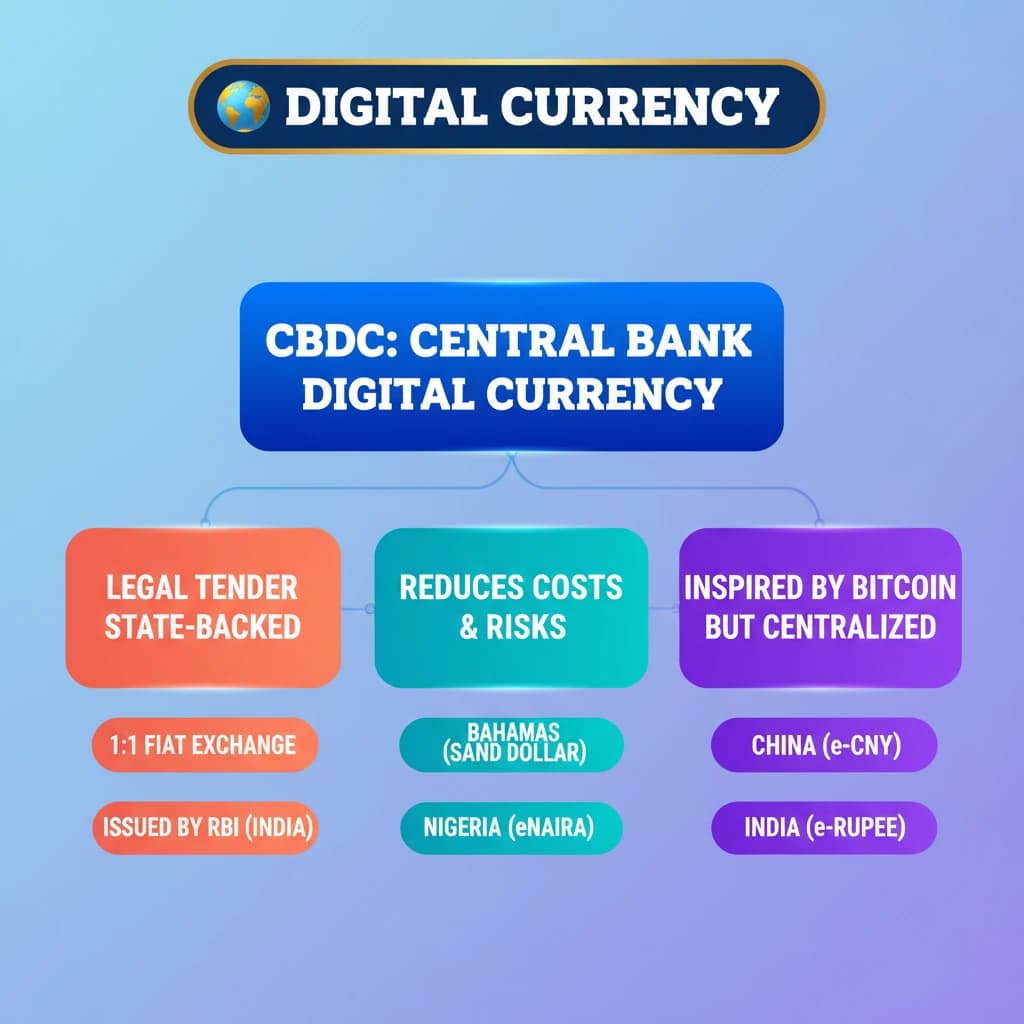
- •CBDC is a legal tender digital currency issued and backed by a central bank, unlike private cryptocurrencies.
- •It is exchangeable one-to-one with fiat currency and aims to reduce costs and risks of physical cash.
- •Inspired by Bitcoin, but fundamentally different due to centralized issuance and legal tender status.
- •Bahamas (Sand Dollar), Nigeria (eNaira), and China (e-CNY) are pioneers in CBDC implementation.
- •India's e-rupee is under development, with RBI emphasizing innovative features for a robust digital financial ecosystem.
🧠 Memory Techniques

95% Verified Content
📚 Reference Sources
•Reserve Bank of India (RBI) official statements and publications on CBDC
•Bank for International Settlements (BIS) reports on CBDCs