Loading page, please wait…
Vaidra Logo
Vaidra

Top 4 items + smart groups

UPSC GPT
New
Current Affairs
Daily Solutions
Daily Puzzle
Mains Evaluator

Version 2.0.0 • Built with ❤️ for UPSC aspirants

Loading...
Loading...
Loading...
Loading...
Loading...
Loading...
Loading...
Loading...
Loading...
Loading...
Loading...
Loading...
Loading...
Back
All Subjects

Topics

0 topics • 0 completed

Loading topics...
Loading...
Loading...
Loading...
Loading...
Loading...
Overall Progress0%

What is LNG and SSLNG? - UPSC Economy

What is What is LNG and SSLNG? in UPSC Economy?

What is LNG and SSLNG? is a key topic under Economy for UPSC Civil Services Examination. Key points include: LNG is natural gas cooled to -162°C for easier storage and transport.. It's a cleaner, more economical alternative to coal/oil, crucial for India's green energy transition.. Methane is the primary component (70-90%) of natural gas.. Understanding this topic is essential for both UPSC Prelims and Mains preparation.

Why is What is LNG and SSLNG? important for UPSC exam?

What is LNG and SSLNG? is a Medium-level topic in UPSC Economy. It is tested in both Prelims (factual MCQs) and Mains (analytical answer writing). Previous year UPSC questions have frequently covered aspects of What is LNG and SSLNG?, making it essential for comprehensive IAS preparation.

How to prepare What is LNG and SSLNG? for UPSC?

To prepare What is LNG and SSLNG? for UPSC: (1) Study the comprehensive notes covering all key concepts on Vaidra. (2) Practice previous year questions on this topic. (3) Connect it with current affairs using daily updates. (4) Revise using key takeaways and mind maps available for Economy. (5) Write practice answers linking What is LNG and SSLNG? to related GS Paper topics.

Key takeaways of What is LNG and SSLNG? for UPSC

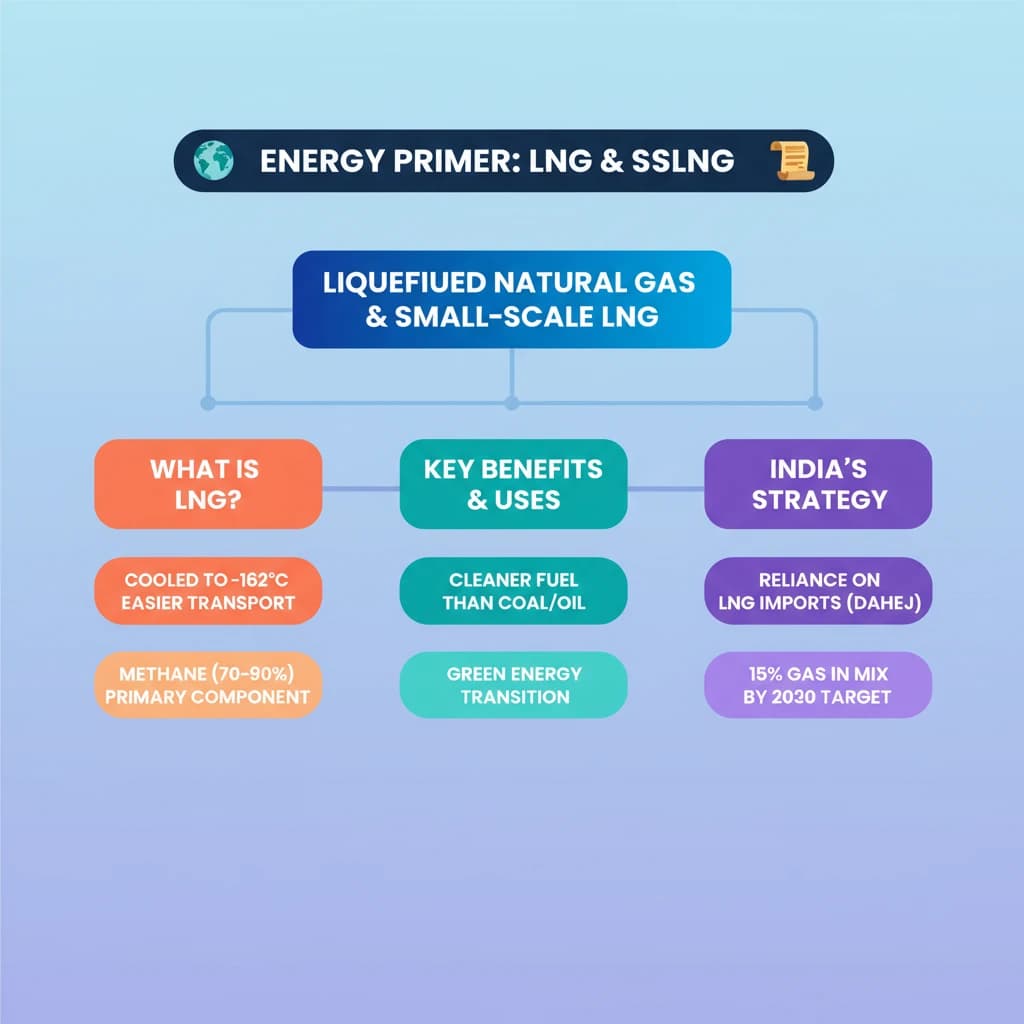
  • LNG is natural gas cooled to -162°C for easier storage and transport.
  • It's a cleaner, more economical alternative to coal/oil, crucial for India's green energy transition.
  • Methane is the primary component (70-90%) of natural gas.
  • India heavily relies on LNG imports, with terminals like Dahej being vital infrastructure.
  • The government aims to increase natural gas's share in India's energy mix to 15% by 2030.
What is LNG and SSLNG?

What is LNG and SSLNG?

Medium⏱️ 6 min read✓ 95% Verified
economy

📖 Introduction

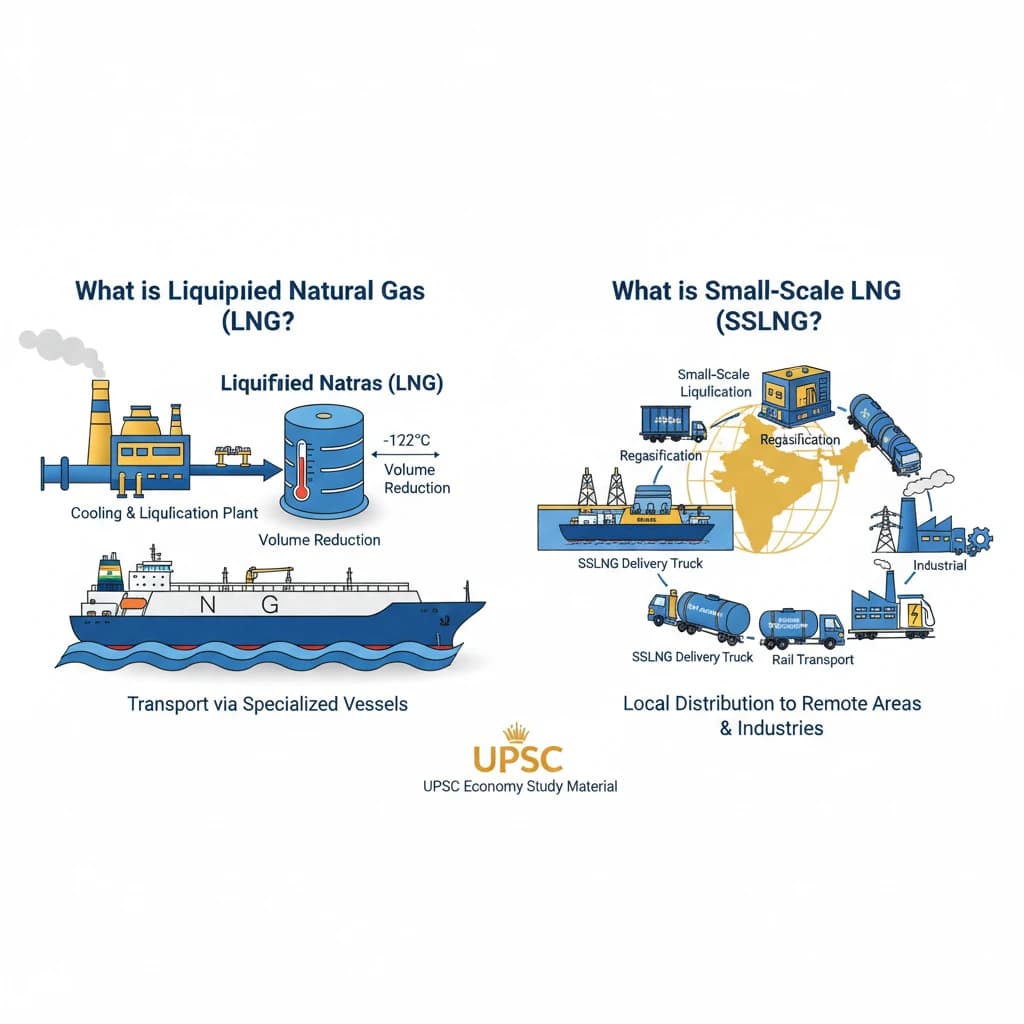
<h4>What is Liquefied Natural Gas (LNG)?</h4><p><strong>Liquefied natural gas (LNG)</strong> is a crucial form of <strong>natural gas</strong> that has been processed for efficient storage and transportation. This transformation involves cooling the gas to an extremely low temperature.</p><p>The primary purpose of converting <strong>natural gas</strong> into its liquid state is to significantly reduce its volume, making it more practical to move across vast distances, particularly via specialized vessels.</p><div class='info-box'><p><strong>Key Specification:</strong> <strong>LNG</strong> is created by cooling <strong>natural gas</strong> to approximately <strong>-260°F (-162°C)</strong>, at which point it becomes a liquid.</p></div><h4>Importance of Natural Gas in Energy Transition</h4><p><strong>Natural gas</strong> stands out as a cleaner and more economical alternative to conventional <strong>hydrocarbons</strong> such as <strong>coal and oil</strong>.</p><p>Its environmental benefits, including lower carbon emissions when burned, make it a pivotal fuel in India's strategic transition towards more sustainable and <strong>greener energy sources</strong>.</p><div class='key-point-box'><p><strong>Strategic Role:</strong> <strong>Natural gas</strong> is considered a bridge fuel in the global shift from high-carbon fossil fuels to renewable energy, offering a relatively cleaner option during this transition.</p></div><h4>Composition of Natural Gas</h4><p>The chemical makeup of <strong>natural gas</strong> is predominantly composed of a single hydrocarbon.</p><div class='info-box'><p><strong>Primary Component:</strong> <strong>Methane</strong> is the main constituent of <strong>natural gas</strong>, typically comprising <strong>70-90%</strong> of its total composition.</p></div><h4>Understanding Small-Scale LNG (SSLNG)</h4><p>While this content primarily details <strong>Liquefied Natural Gas (LNG)</strong> in its general form, the concept of <strong>Small-Scale LNG (SSLNG)</strong> is also relevant.</p><div class='info-box'><p><strong>SSLNG Definition:</strong> <strong>SSLNG</strong> generally refers to the production, storage, and distribution of <strong>LNG</strong> in smaller volumes, often tailored for specific regional demands, industrial uses, or as fuel for smaller vessels and vehicles. The detailed scope of <strong>SSLNG</strong> was not provided in the source material.</p></div><div class='exam-tip-box'><p><strong>UPSC Insight:</strong> Questions on <strong>LNG</strong> often revolve around India's energy security, environmental policies, and infrastructure development. Understanding the 'why' behind liquefaction and its role in the energy mix is crucial for Mains answers.</p></div>
Concept Diagram

💡 Key Takeaways

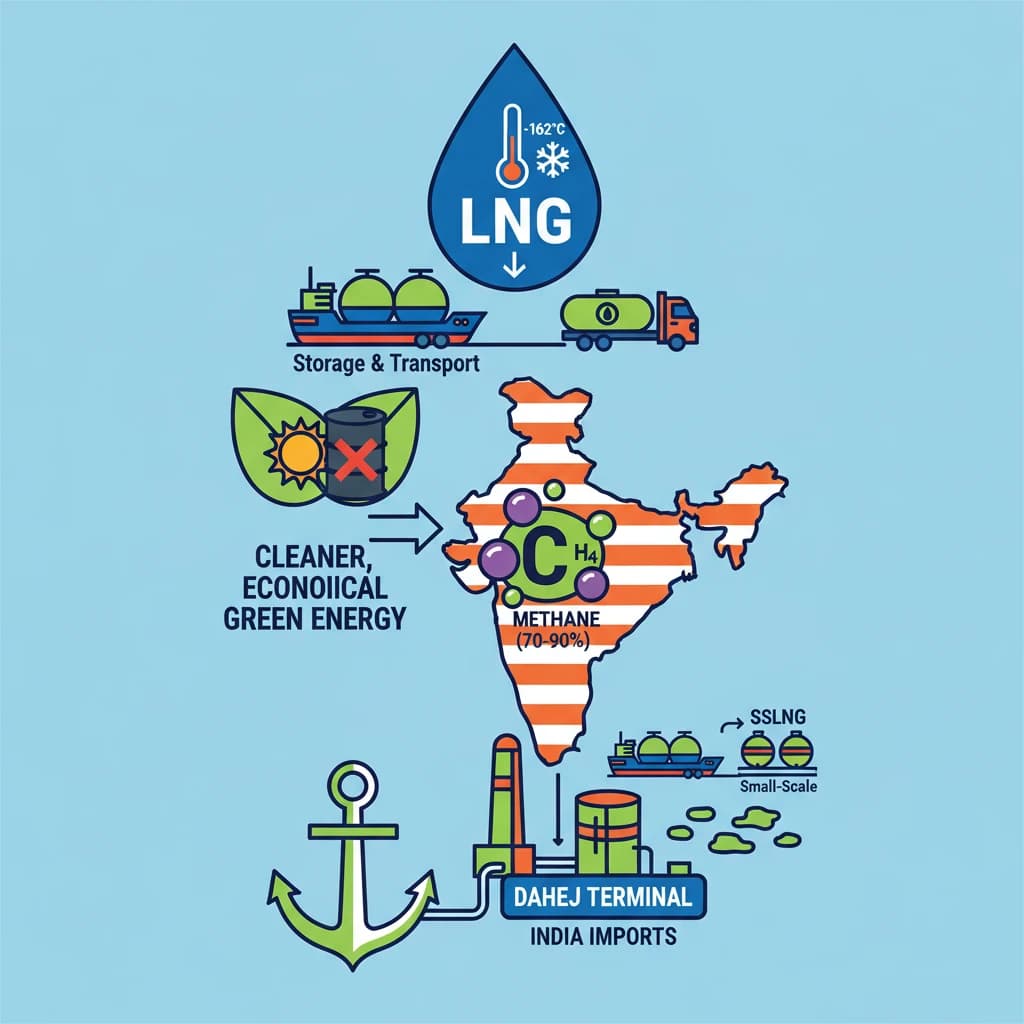
  • •LNG is natural gas cooled to -162°C for easier storage and transport.
  • •It's a cleaner, more economical alternative to coal/oil, crucial for India's green energy transition.
  • •Methane is the primary component (70-90%) of natural gas.
  • •India heavily relies on LNG imports, with terminals like Dahej being vital infrastructure.
  • •The government aims to increase natural gas's share in India's energy mix to 15% by 2030.

🧠 Memory Techniques
Memory Aid
95% Verified Content

📚 Reference Sources

•Ministry of Petroleum and Natural Gas, Government of India reports
•Petronet LNG Limited official website
•International Energy Agency (IEA) publications

Related Topics

Loading related topics...
Explore:Economy Topics·All Subjects·Daily Current Affairs·Editorial Analysis·Previous Year Questions·UPSC GPT
What is LNG and SSLNG? - UPSC Economy