Loading page, please wait…
Vaidra Logo
Vaidra

Top 4 items + smart groups

UPSC GPT
New
Current Affairs
Daily Solutions
Daily Puzzle
Mains Evaluator

Version 2.0.0 • Built with ❤️ for UPSC aspirants

Loading...
Loading...
Loading...
Loading...
Loading...
Loading...
Loading...
Loading...
Loading...
Loading...
Loading...
Loading...
Loading...
Financial Stability Board - UPSC Economy
Back
All Subjects

Topics

0 topics • 0 completed

Loading topics...
Loading...
Loading...
Loading...
Loading...
Loading...
Overall Progress0%

Financial Stability Board - UPSC Economy

What is Financial Stability Board in UPSC Economy?

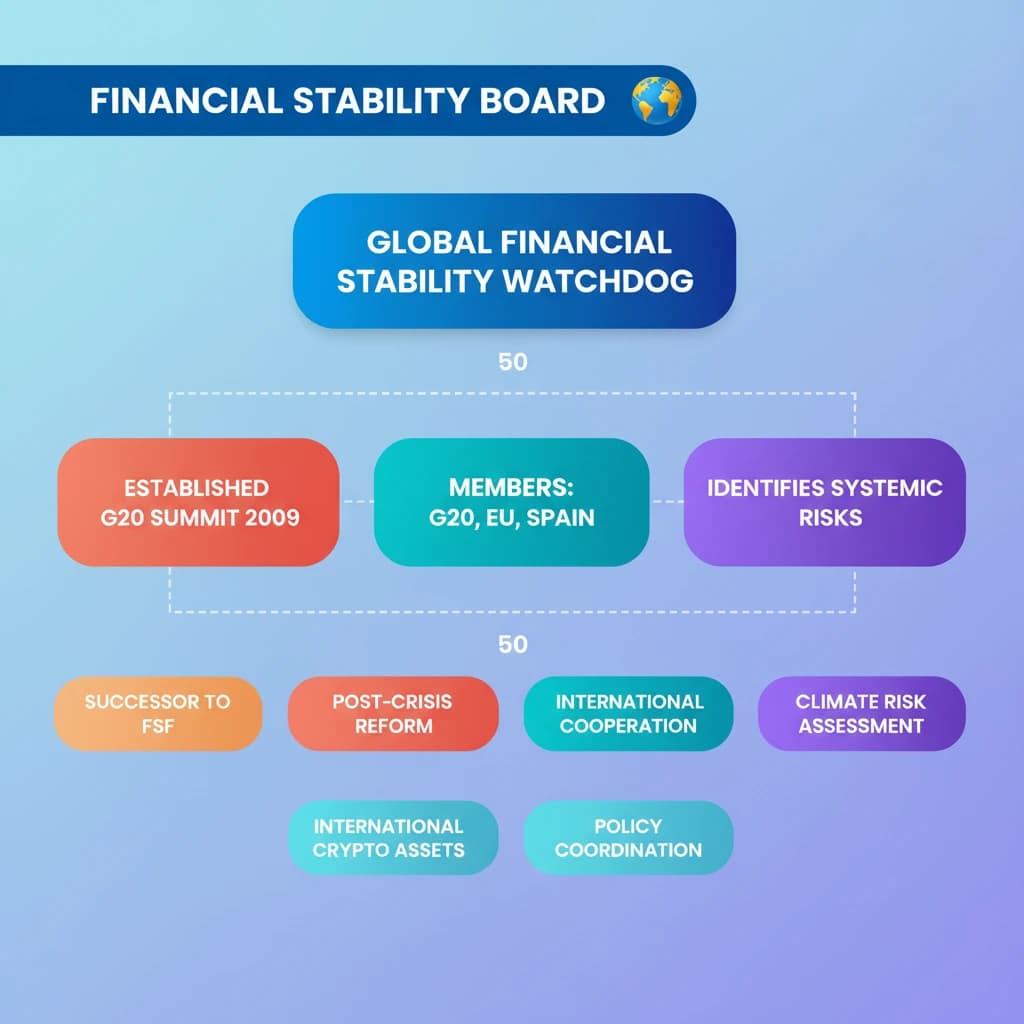
Financial Stability Board is a key topic under Economy for UPSC Civil Services Examination. Key points include: The Financial Stability Board (FSB) is an international body monitoring and recommending policies for global financial stability.. It was established in 2009 at the G20 Pittsburgh Summit, succeeding the Financial Stability Forum (FSF).. Its membership includes G20 countries, Spain, the European Commission, and former FSF members.. Understanding this topic is essential for both UPSC Prelims and Mains preparation.

Why is Financial Stability Board important for UPSC exam?

Financial Stability Board is a Medium-level topic in UPSC Economy. It is tested in both Prelims (factual MCQs) and Mains (analytical answer writing). Previous year UPSC questions have frequently covered aspects of Financial Stability Board, making it essential for comprehensive IAS preparation.

How to prepare Financial Stability Board for UPSC?

To prepare Financial Stability Board for UPSC: (1) Study the comprehensive notes covering all key concepts on Vaidra. (2) Practice previous year questions on this topic. (3) Connect it with current affairs using daily updates. (4) Revise using key takeaways and mind maps available for Economy. (5) Write practice answers linking Financial Stability Board to related GS Paper topics.

Key takeaways of Financial Stability Board for UPSC

  • The Financial Stability Board (FSB) is an international body monitoring and recommending policies for global financial stability.
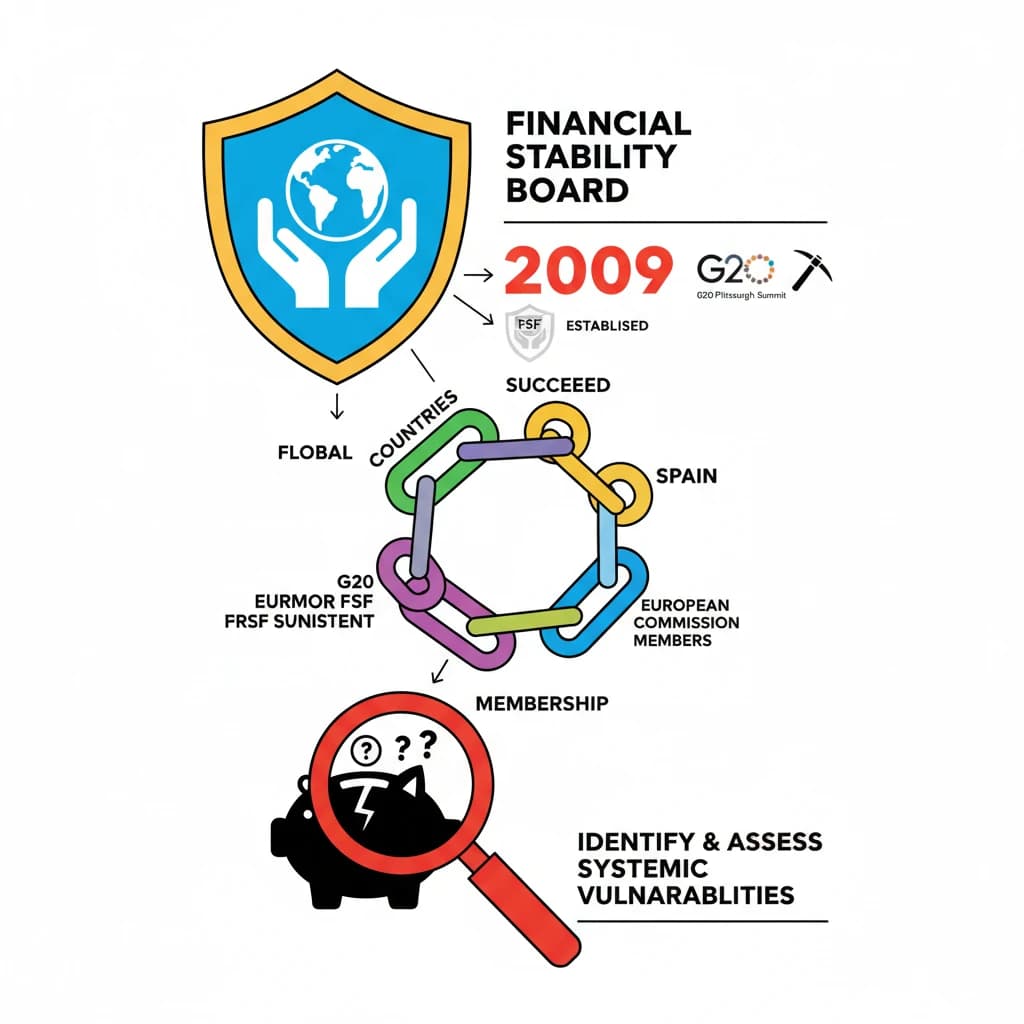
  • It was established in 2009 at the G20 Pittsburgh Summit, succeeding the Financial Stability Forum (FSF).
  • Its membership includes G20 countries, Spain, the European Commission, and former FSF members.
  • The FSB's core function is to identify and assess systemic vulnerabilities in the global financial system.
  • It plays a key role in coordinating international regulatory reforms and addressing emerging risks like shadow banking, climate risk, and crypto-assets.
Financial Stability Board

Financial Stability Board

Medium⏱️ 6 min read✓ 98% Verified
economy

📖 Introduction

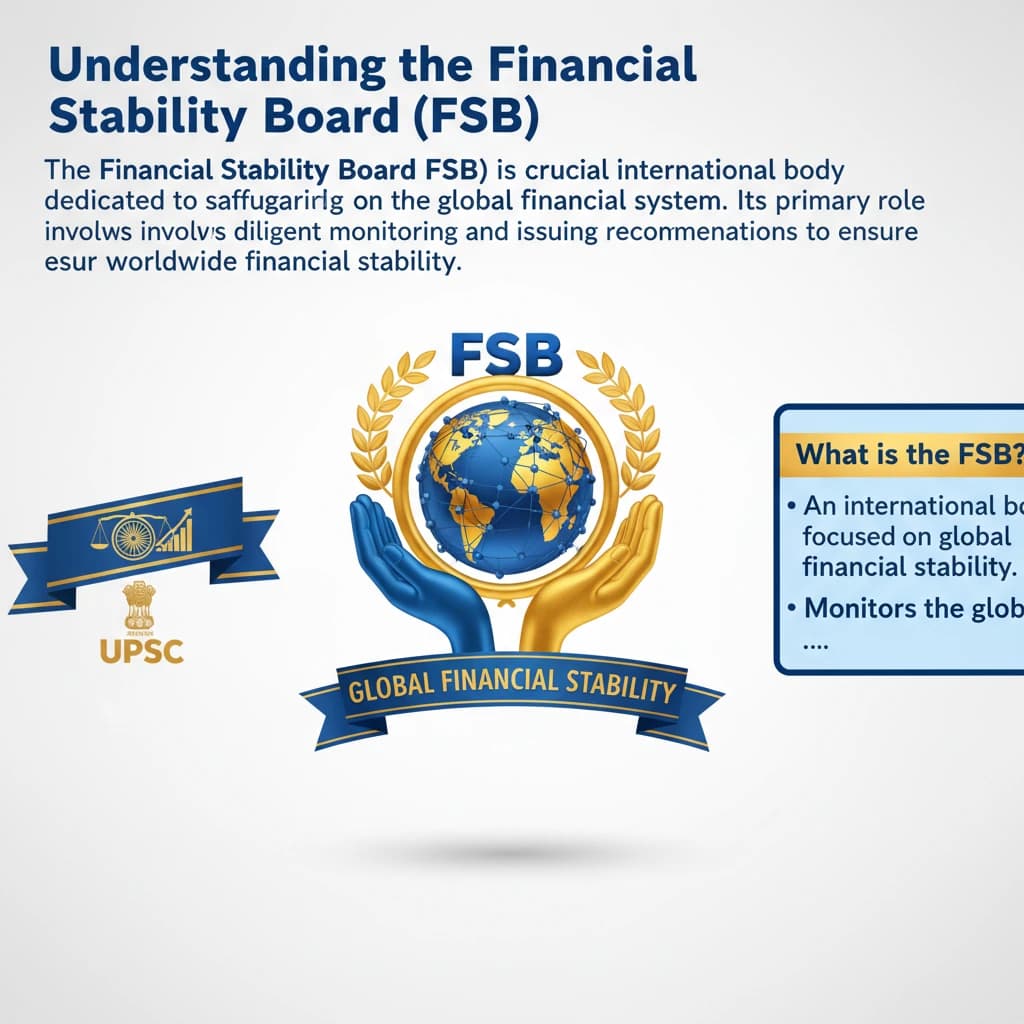
<h4>Understanding the Financial Stability Board (FSB)</h4><p>The <strong>Financial Stability Board (FSB)</strong> is a crucial international body dedicated to safeguarding the global financial system. Its primary role involves diligent monitoring and issuing recommendations to ensure worldwide financial stability.</p><div class='info-box'><p><strong>What is the FSB?</strong></p><ul><li>An <strong>international body</strong> focused on global financial stability.</li><li>Monitors the <strong>global financial system</strong> for vulnerabilities.</li><li>Makes <strong>recommendations</strong> to mitigate risks.</li></ul></div><h4>Establishment and Evolution</h4><p>The <strong>FSB</strong> was officially established in <strong>2009</strong>. This significant development occurred at the <strong>G20 Pittsburgh Summit</strong>, marking a pivotal moment in international financial governance.</p><p>It was created as the direct successor to the <strong>Financial Stability Forum (FSF)</strong>, an earlier body with similar objectives but a more limited scope and membership.</p><div class='key-point-box'><p><strong>Key Event:</strong> The <strong>2008 Global Financial Crisis</strong> highlighted the urgent need for a more robust and inclusive international body to address systemic risks, leading to the FSB's formation.</p></div><h4>Membership Structure</h4><p>The <strong>FSB's membership</strong> is broad and inclusive, reflecting its global mandate. It comprises a diverse group of countries and international organizations.</p><p>Its members include all <strong>G20 countries</strong>, along with <strong>Spain</strong> and the <strong>European Commission</strong>. This expanded membership significantly broadened the reach and influence compared to its predecessor.</p><div class='info-box'><p><strong>FSB Membership Includes:</strong></p><ul><li>All <strong>G20 countries</strong></li><li><strong>Spain</strong></li><li>The <strong>European Commission</strong></li><li>Members of the former <strong>Financial Stability Forum (FSF)</strong></li></ul></div><h4>Core Functions and Mandate</h4><p>A fundamental responsibility of the <strong>FSB</strong> is to actively identify and rigorously assess <strong>systemic vulnerabilities</strong> within the global financial system. This proactive approach aims to prevent future financial crises.</p><p>By identifying these risks, the <strong>FSB</strong> can then formulate and promote effective regulatory, supervisory, and other financial sector policies. These policies are designed to enhance financial stability.</p><div class='exam-tip-box'><p><strong>UPSC Insight:</strong> Understanding the <strong>FSB's role</strong> is vital for topics related to <strong>international economic institutions</strong> and <strong>global governance</strong> in <strong>GS Paper 2</strong> and <strong>GS Paper 3</strong>. Focus on its origin, mandate, and key functions.</p></div>
Concept Diagram

💡 Key Takeaways

  • •The Financial Stability Board (FSB) is an international body monitoring and recommending policies for global financial stability.
  • •It was established in 2009 at the G20 Pittsburgh Summit, succeeding the Financial Stability Forum (FSF).
  • •Its membership includes G20 countries, Spain, the European Commission, and former FSF members.
  • •The FSB's core function is to identify and assess systemic vulnerabilities in the global financial system.
  • •It plays a key role in coordinating international regulatory reforms and addressing emerging risks like shadow banking, climate risk, and crypto-assets.

🧠 Memory Techniques
Memory Aid
98% Verified Content

📚 Reference Sources

•Financial Stability Board (FSB) Official Website (for additional details and current initiatives)

Related Topics

Loading related topics...
Explore:Economy Topics·All Subjects·Daily Current Affairs·Editorial Analysis·Previous Year Questions·UPSC GPT