Loading page, please wait…
Vaidra Logo
Vaidra

Top 4 items + smart groups

UPSC GPT
New
Current Affairs
Daily Solutions
Daily Puzzle
Mains Evaluator

Version 2.0.0 • Built with ❤️ for UPSC aspirants

Loading...
Loading...
Loading...
Loading...
Loading...
Loading...
Loading...
Loading...
Loading...
Loading...
Loading...
Loading...
Loading...
Back
All Subjects

Topics

0 topics • 0 completed

Loading topics...
Loading...
Loading...
Loading...
Loading...
Loading...
Overall Progress0%

FIIs to Invest in India’s Sovereign Green Bonds - UPSC Economy

What is FIIs to Invest in India’s Sovereign Green Bonds in UPSC Economy?

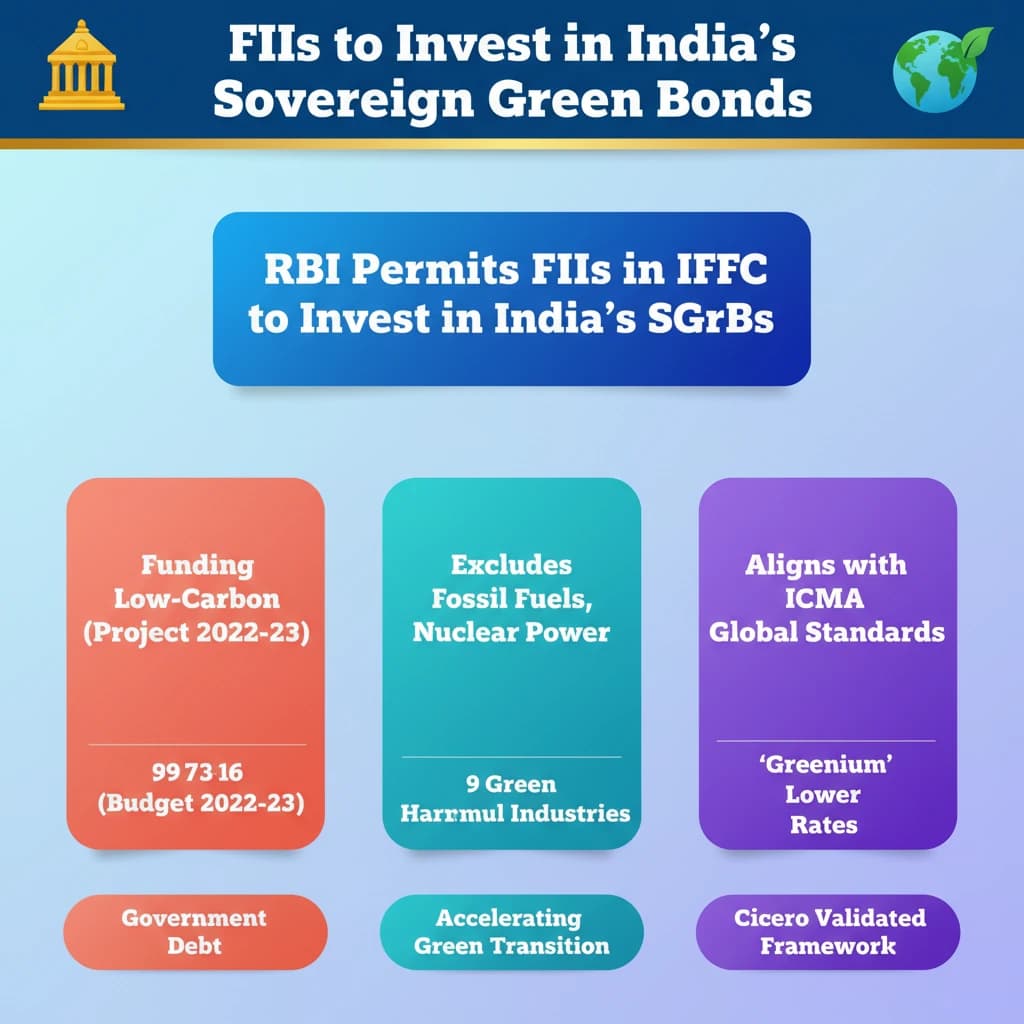
FIIs to Invest in India’s Sovereign Green Bonds is a key topic under Economy for UPSC Civil Services Examination. Key points include: RBI permits FIIs in IFSC to invest in India's Sovereign Green Bonds (SGrBs).. SGrBs are government debt issued for funding projects accelerating India's low-carbon economy transition, announced in Budget 2022-23.. Funds are exclusively earmarked for nine green categories, strictly excluding fossil fuel, nuclear power, and certain industries.. Understanding this topic is essential for both UPSC Prelims and Mains preparation.

Why is FIIs to Invest in India’s Sovereign Green Bonds important for UPSC exam?

FIIs to Invest in India’s Sovereign Green Bonds is a Medium-level topic in UPSC Economy. It is tested in both Prelims (factual MCQs) and Mains (analytical answer writing). Previous year UPSC questions have frequently covered aspects of FIIs to Invest in India’s Sovereign Green Bonds, making it essential for comprehensive IAS preparation.

How to prepare FIIs to Invest in India’s Sovereign Green Bonds for UPSC?

To prepare FIIs to Invest in India’s Sovereign Green Bonds for UPSC: (1) Study the comprehensive notes covering all key concepts on Vaidra. (2) Practice previous year questions on this topic. (3) Connect it with current affairs using daily updates. (4) Revise using key takeaways and mind maps available for Economy. (5) Write practice answers linking FIIs to Invest in India’s Sovereign Green Bonds to related GS Paper topics.

Key takeaways of FIIs to Invest in India’s Sovereign Green Bonds for UPSC

  • RBI permits FIIs in IFSC to invest in India's Sovereign Green Bonds (SGrBs).
  • SGrBs are government debt issued for funding projects accelerating India's low-carbon economy transition, announced in Budget 2022-23.
  • Funds are exclusively earmarked for nine green categories, strictly excluding fossil fuel, nuclear power, and certain industries.
  • 'Greenium' is the lower interest rate SGrBs offer compared to conventional Government Securities (G-Secs).
  • India's SGrB framework, validated by Norway-based Cicero, aligns with global green standards set by ICMA.
FIIs to Invest in India’s Sovereign Green Bonds

FIIs to Invest in India’s Sovereign Green Bonds

Medium⏱️ 7 min read✓ 95% Verified
economy

📖 Introduction

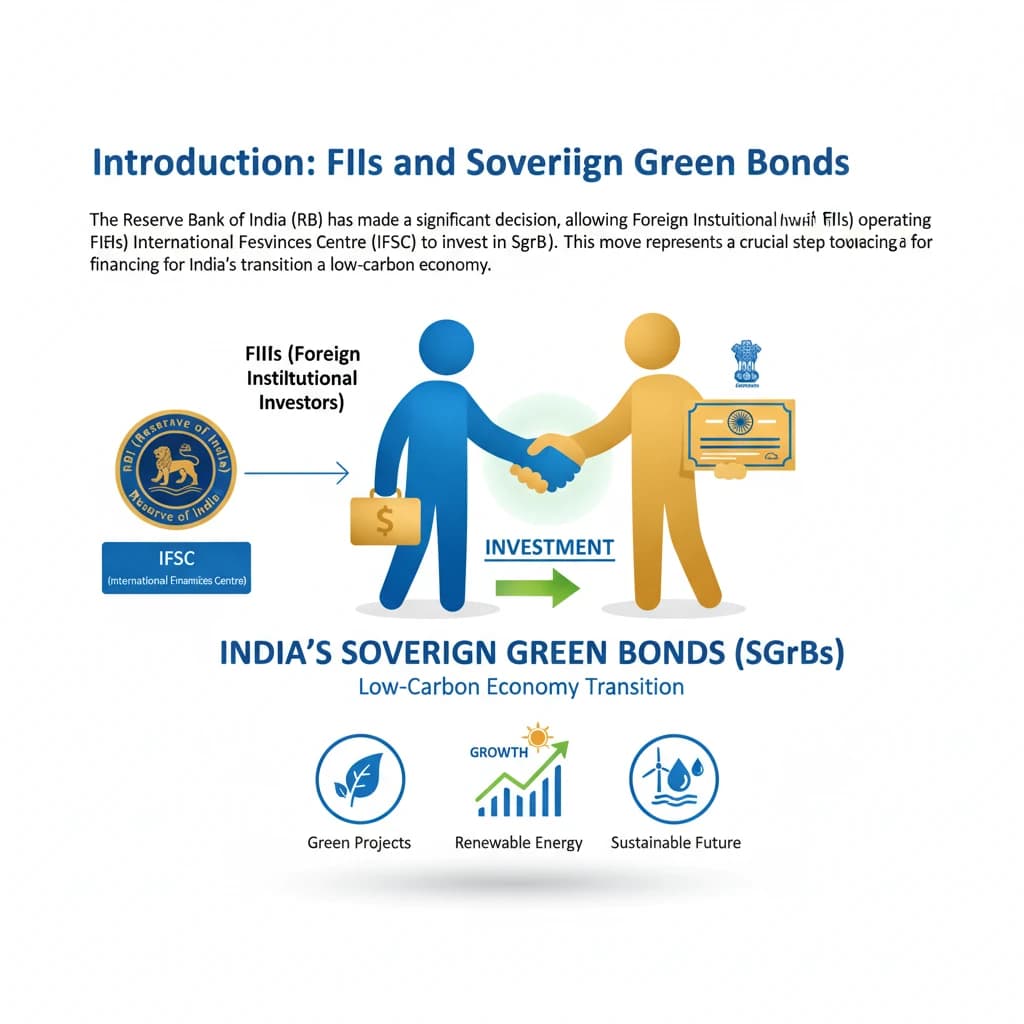
<h4>Introduction: FIIs and Sovereign Green Bonds</h4><p>The <strong>Reserve Bank of India (RBI)</strong> has made a significant decision, allowing <strong>Foreign Institutional Investors (FIIs)</strong> operating within the <strong>International Financial Services Centre (IFSC)</strong> to invest in <strong>India’s Sovereign Green Bonds (SGrBs)</strong>.</p><p>This move represents a crucial step towards securing financing for India's transition to a <strong>low-carbon economy</strong>.</p><div class='info-box'><p><strong>FIIs</strong> are <strong>institutional investors</strong> that invest in assets belonging to a different country than where their organizations are based.</p></div><div class='info-box'><p>The <strong>Securities and Exchange Board of India (SEBI)</strong> regulates <strong>FII investments</strong> in India, while the <strong>RBI</strong> is responsible for maintaining <strong>investment ceilings</strong> to manage FII participation.</p></div><h4>What are Sovereign Green Bonds (SGrBs)?</h4><p>The concept of <strong>Sovereign Green Bonds</strong> was first announced by the <strong>Finance Minister (FM)</strong> in the <strong>Union Budget 2022-23</strong>.</p><p><strong>SGrBs</strong> are a specific type of <strong>government debt</strong> designed to fund projects that accelerate India's transition to a <strong>low-carbon economy</strong>.</p><p>Funds raised through <strong>SGrBs</strong> are <strong>earmarked exclusively for green projects</strong>, ensuring high levels of <strong>transparency</strong> and <strong>accountability</strong> in their utilization.</p><p>These bonds typically offer <strong>lower interest rates</strong> compared to conventional <strong>Government Securities (G-Secs)</strong>, reflecting their alignment with broader <strong>sustainable development objectives</strong>.</p><p>Issuance of <strong>SGrBs</strong> mandates adherence to <strong>internationally recognised green standards</strong> and rigorous <strong>certification processes</strong> to ensure the credibility of the funded projects.</p><h4>Classification of SGrBs</h4><p><strong>Sovereign Green Bonds</strong> are classified under the <strong>Statutory Liquidity Ratio (SLR)</strong> framework.</p><div class='info-box'><p>The <strong>SLR</strong> is a <strong>liquidity rate</strong> stipulated by the <strong>RBI</strong> for <strong>financial institutions</strong>.</p></div><p><strong>Financial institutions</strong> are required to maintain a certain percentage of their deposits as <strong>SLR</strong> with themselves before they can lend to customers, which can impact the availability of funds for other purposes.</p><h4>Understanding 'Greenium'</h4><p><strong>SGrBs</strong> generally yield <strong>lower interest rates</strong> when compared to conventional <strong>G-Secs</strong>.</p><div class='info-box'><p>This difference in interest rates between <strong>Sovereign Green Bonds</strong> and traditional <strong>Government Securities</strong> is termed a <strong>greenium</strong>.</p></div><p>Globally, <strong>central banks</strong> and <strong>governments</strong> are actively encouraging the adoption of <strong>greeniums</strong> to support the transition towards a more <strong>environmentally sustainable future</strong>.</p><h4>India's Sovereign Green Bonds Framework</h4><p>The <strong>Finance Ministry</strong> released <strong>India’s first SGrB Framework</strong> in <strong>2022</strong>.</p><p>This comprehensive framework provides detailed guidelines on the specific types of projects that are eligible to receive funding through this class of bonds.</p><h4>Funding Projects under SGrBs</h4><p>Funds generated from <strong>SGrBs</strong> are specifically directed towards <strong>nine green project categories</strong>:</p><ul><li><strong>Renewable energy</strong> projects.</li><li>Initiatives promoting <strong>energy efficiency</strong>.</li><li>Development of <strong>clean transportation</strong> systems.</li><li>Projects focused on <strong>climate adaptation</strong>.</li><li>Strategies for <strong>sustainable water management</strong>.</li><li>Measures for <strong>pollution control</strong>.</li><li>Practices supporting <strong>sustainable land use</strong>.</li><li>Construction of <strong>green buildings</strong>.</li><li>Efforts in <strong>biodiversity conservation</strong>.</li></ul><h4>Excluded Projects</h4><p>To maintain the integrity and focus of <strong>green financing</strong>, certain types of projects are explicitly excluded from <strong>SGrB funding</strong>.</p><ul><li>Projects involving <strong>fossil fuel extraction</strong>.</li><li><strong>Nuclear power generation</strong> facilities.</li><li>Operations related to <strong>direct waste incineration</strong>.</li><li>Projects linked to the <strong>alcohol, weapons, tobacco, gaming, or palm oil industries</strong>.</li><li><strong>Renewable energy projects</strong> that utilize biomass sourced from <strong>protected areas</strong>.</li><li><strong>Landfill projects</strong>.</li><li><strong>Hydropower plants</strong> with a capacity larger than <strong>25 MW</strong>.</li></ul><h4>Credibility and Validation</h4><p>To enhance the credibility of its <strong>SGrB Framework</strong>, the <strong>Indian government</strong> sought independent validation.</p><p>This validation was provided by <strong>Cicero</strong>, a <strong>Norway-based validator</strong>.</p><div class='info-box'><p><strong>Cicero</strong> rated <strong>India’s framework</strong> as a <strong>“green medium”</strong> and assigned it a score of <strong>“good governance”</strong>.</p></div><p>This positive rating confirms the framework's strong alignment with the <strong>global green standards</strong> established by the <strong>International Capital Market Association (ICMA)</strong>.</p>
Concept Diagram

💡 Key Takeaways

  • •RBI permits FIIs in IFSC to invest in India's Sovereign Green Bonds (SGrBs).
  • •SGrBs are government debt issued for funding projects accelerating India's low-carbon economy transition, announced in Budget 2022-23.
  • •Funds are exclusively earmarked for nine green categories, strictly excluding fossil fuel, nuclear power, and certain industries.
  • •'Greenium' is the lower interest rate SGrBs offer compared to conventional Government Securities (G-Secs).
  • •India's SGrB framework, validated by Norway-based Cicero, aligns with global green standards set by ICMA.

🧠 Memory Techniques

Memory Aid
95% Verified Content

Related Topics

Loading related topics...
Explore:Economy Topics·All Subjects·Daily Current Affairs·Editorial Analysis·Previous Year Questions·UPSC GPT
FIIs to Invest in India’s Sovereign Green Bonds - UPSC Economy