Loading page, please wait…
Vaidra Logo
Vaidra

Top 4 items + smart groups

UPSC GPT
New
Current Affairs
Daily Solutions
Daily Puzzle
Mains Evaluator

Version 2.0.0 • Built with ❤️ for UPSC aspirants

Loading...
Loading...
Loading...
Loading...
Loading...
Loading...
Loading...
Loading...
Loading...
Loading...
Loading...
Loading...
Loading...
Back
All Subjects

Topics

0 topics • 0 completed

Loading topics...
Loading...
Loading...
Loading...
Loading...
Loading...
Overall Progress0%
Why Coal is Important for India’s Energy Security? - UPSC Economy

Why Coal is Important for India’s Energy Security? - UPSC Economy

What is Why Coal is Important for India’s Energy Security? in UPSC Economy?

Why Coal is Important for India’s Energy Security? is a key topic under Economy for UPSC Civil Services Examination. Key points include: India's large domestic coal reserves make it the most reliable and affordable energy source.. Significant past investments in coal plants create economic viability and 'stranded asset' concerns.. Insufficient global climate finance hinders India's rapid transition away from coal.. Understanding this topic is essential for both UPSC Prelims and Mains preparation.

Why is Why Coal is Important for India’s Energy Security? important for UPSC exam?

Why Coal is Important for India’s Energy Security? is a Medium-level topic in UPSC Economy. It is tested in both Prelims (factual MCQs) and Mains (analytical answer writing). Previous year UPSC questions have frequently covered aspects of Why Coal is Important for India’s Energy Security?, making it essential for comprehensive IAS preparation.

How to prepare Why Coal is Important for India’s Energy Security? for UPSC?

To prepare Why Coal is Important for India’s Energy Security? for UPSC: (1) Study the comprehensive notes covering all key concepts on Vaidra. (2) Practice previous year questions on this topic. (3) Connect it with current affairs using daily updates. (4) Revise using key takeaways and mind maps available for Economy. (5) Write practice answers linking Why Coal is Important for India’s Energy Security? to related GS Paper topics.

Key takeaways of Why Coal is Important for India’s Energy Security? for UPSC

  • India's large domestic coal reserves make it the most reliable and affordable energy source.
  • Significant past investments in coal plants create economic viability and 'stranded asset' concerns.
  • Insufficient global climate finance hinders India's rapid transition away from coal.
  • Renewable energy faces challenges like grid integration, storage, land availability, and critical mineral dependence.
  • Reliance on imported renewable technologies increases geopolitical vulnerabilities, while coal supports energy independence.
  • Historical energy transitions in developed nations were commercially driven, offering a pragmatic lesson for India.
Why Coal is Important for India’s Energy Security?

Why Coal is Important for India’s Energy Security?

Medium⏱️ 7 min read✓ 95% Verified
economy

📖 Introduction

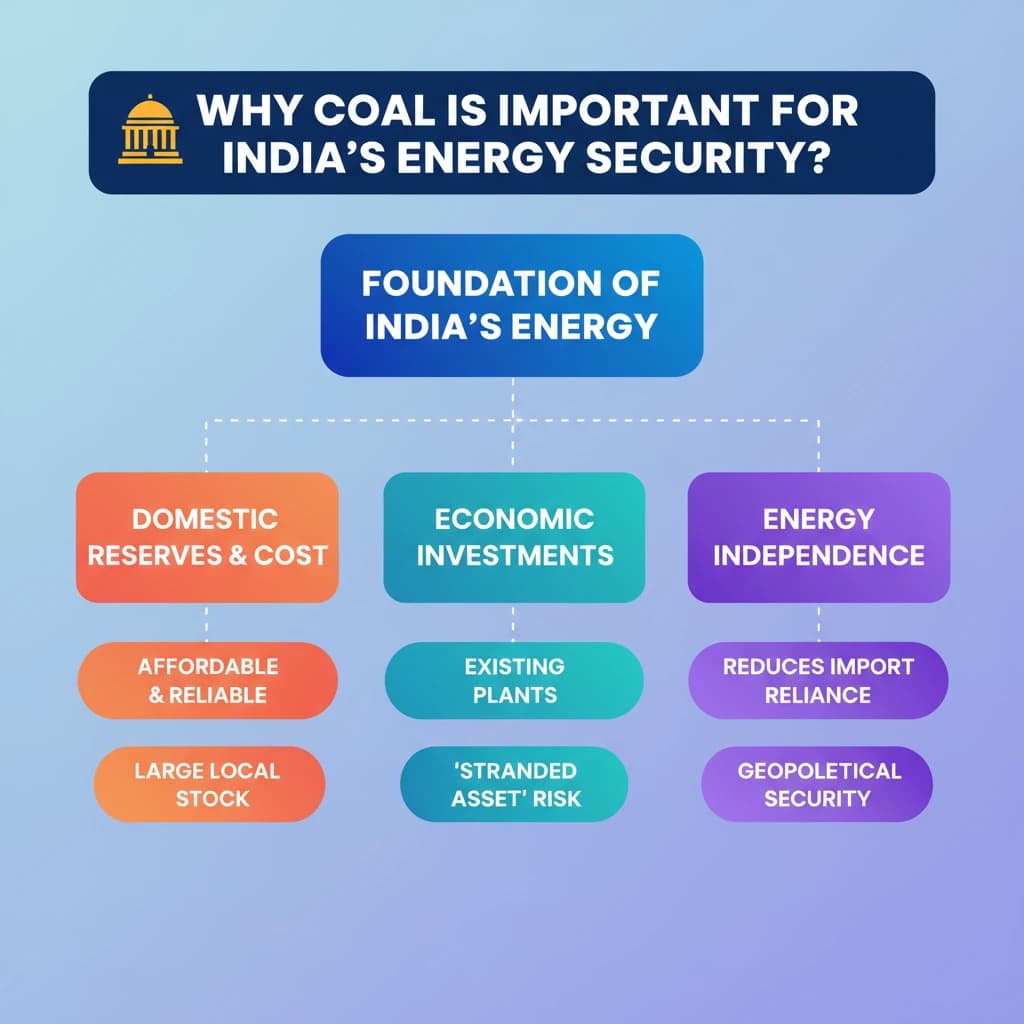
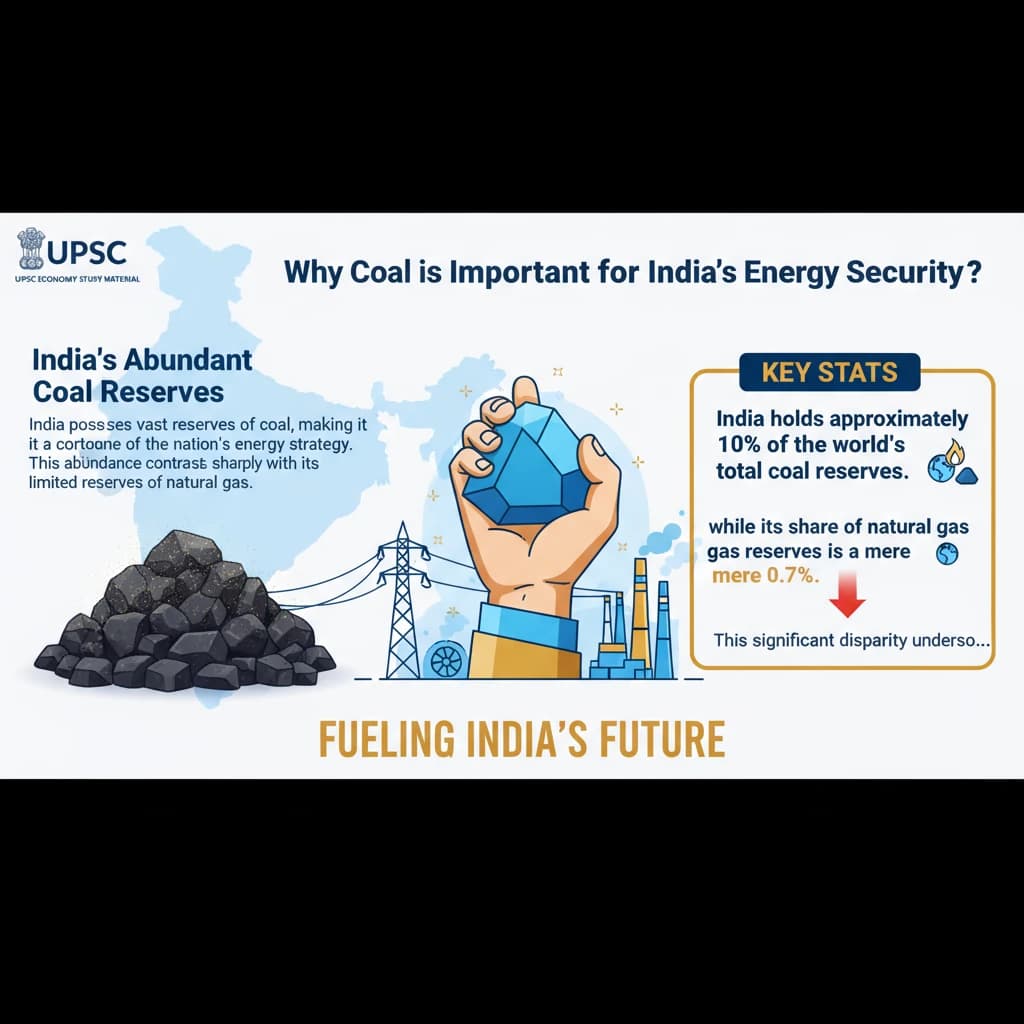
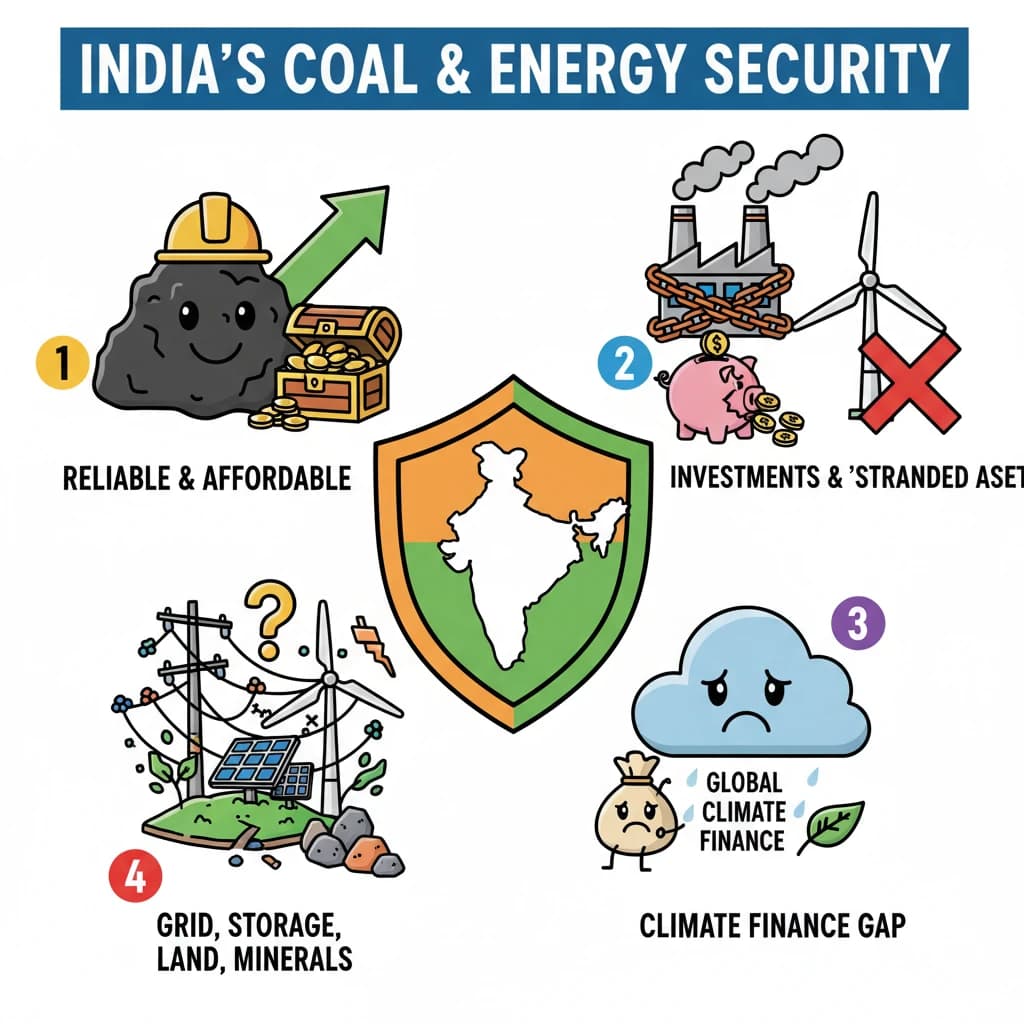
<h4>India's Abundant Coal Reserves</h4><p>India possesses vast reserves of <strong>coal</strong>, making it a cornerstone of the nation's energy strategy. This abundance contrasts sharply with its limited reserves of <strong>natural gas</strong>.</p><div class='info-box'><p>India holds approximately <strong>10%</strong> of the world’s total <strong>coal reserves</strong>, while its share of <strong>natural gas reserves</strong> is a mere <strong>0.7%</strong>. This significant disparity underscores coal's foundational role.</p></div><div class='key-point-box'><p>The sheer scale of domestic <strong>coal reserves</strong> positions it as India's most <strong>reliable</strong> and <strong>affordable energy source</strong>, crucial for meeting the country's growing power demands.</p></div><h4>Economic Viability and Stranded Assets</h4><p>Substantial <strong>investments</strong> have been channeled into <strong>coal-based power plants</strong>, particularly since the <strong>2010s</strong>. These investments represent significant capital outlay in the energy infrastructure.</p><p>Premature decommissioning of these plants would result in <strong>stranded investments</strong>, leading to substantial economic losses and <strong>underutilised assets</strong>. This presents a major economic dilemma for policymakers.</p><h4>Challenges in Climate Financing</h4><p>International commitments for <strong>climate finance</strong> often fall short of the actual requirements for developing nations like India to transition away from fossil fuels.</p><div class='info-box'><p>At <strong>UNFCCC COP 28</strong> in <strong>Baku, Azerbaijan</strong>, developed countries pledged only <strong>USD 300 billion</strong> in annual <strong>climate finance</strong>, significantly less than the estimated <strong>USD 1 trillion</strong> needed globally.</p></div><p>This shortfall may compel India to maintain its reliance on <strong>coal</strong> and potentially necessitate adjustments to its ambitious <strong>climate targets</strong>, balancing economic development with environmental goals.</p><h4>Limitations of Renewable Energy Sources</h4><p>While India is rapidly expanding its <strong>renewable energy</strong> capacity, sources like <strong>solar</strong> and <strong>wind</strong> power face several inherent challenges that hinder their complete dominance.</p><ul><li><strong>High investments</strong> are required for robust <strong>grid integration</strong> to handle variable power generation.</li><li>Significant challenges persist with <strong>battery storage</strong> solutions needed to manage the <strong>intermittency</strong> of renewable power.</li><li>There is <strong>limited land availability</strong> in densely populated regions for large-scale renewable installations.</li><li>India lacks abundance in many of the <strong>critical minerals</strong> essential for manufacturing advanced renewable technologies.</li></ul><h4>Geopolitical Risks and Energy Independence</h4><p>Many advanced <strong>renewable energy technologies</strong> and their components rely heavily on <strong>imported materials</strong> and specialized expertise from other nations.</p><p>This dependence increases India’s <strong>vulnerability</strong> to <strong>external geopolitical risks</strong>, supply chain disruptions, and price volatility, potentially compromising its <strong>energy independence</strong>.</p><div class='key-point-box'><p>Continued utilization of domestic <strong>coal reserves</strong> strengthens India's <strong>energy independence</strong>, reducing reliance on foreign imports and bolstering <strong>national security</strong> in the energy sector.</p></div><h4>Historical Energy Transitions: A Global Perspective</h4><p>A review of historical energy transitions in <strong>developed nations</strong> reveals a crucial insight. These transitions were primarily driven by evolving <strong>commercial interests</strong> and technological advancements.</p><div class='exam-tip-box'><p>Unlike current global efforts, past transitions were not solely motivated by a desire to limit <strong>emissions</strong>. This historical context offers a pragmatic lens through which to view India's own energy transition challenges for <strong>UPSC Mains GS-III</strong> answers.</p></div>
Concept Diagram

💡 Key Takeaways

  • •India's large domestic coal reserves make it the most reliable and affordable energy source.
  • •Significant past investments in coal plants create economic viability and 'stranded asset' concerns.
  • •Insufficient global climate finance hinders India's rapid transition away from coal.
  • •Renewable energy faces challenges like grid integration, storage, land availability, and critical mineral dependence.
  • •Reliance on imported renewable technologies increases geopolitical vulnerabilities, while coal supports energy independence.
  • •Historical energy transitions in developed nations were commercially driven, offering a pragmatic lesson for India.

🧠 Memory Techniques
Memory Aid
95% Verified Content

📚 Reference Sources

•NITI Aayog Energy Statistics
•International Energy Agency (IEA) Reports on India
•UNFCCC COP 28 Outcome Documents and Reports
•Economic Survey of India (various editions)

Related Topics

Loading related topics...
Explore:Economy Topics·All Subjects·Daily Current Affairs·Editorial Analysis·Previous Year Questions·UPSC GPT