Loading page, please wait…
Vaidra Logo
Vaidra

Top 4 items + smart groups

UPSC GPT
New
Current Affairs
Daily Solutions
Daily Puzzle
Mains Evaluator

Version 2.0.0 • Built with ❤️ for UPSC aspirants

Loading...
Loading...
Loading...
Loading...
Loading...
Loading...
Loading...
Loading...
Loading...
Loading...
Loading...
Loading...
Loading...
Back
All Subjects

Topics

0 topics • 0 completed

Loading topics...
Loading...
Loading...
Loading...
Loading...
Loading...
Overall Progress0%

Legislative Amendments: The Mines and Minerals (Development and Regulation) Act, 1957 - UPSC Economy

What is Legislative Amendments: The Mines and Minerals (Development and Regulation) Act, 1957 in UPSC Economy?

Legislative Amendments: The Mines and Minerals (Development and Regulation) Act, 1957 is a key topic under Economy for UPSC Civil Services Examination. Key points include: The MMDR Act, 1957, is India's core mining legislation.. Major amendments in 2023 aimed to streamline critical mineral exploration.. The amendments led to the auction of 24 strategic mineral blocks.. Understanding this topic is essential for both UPSC Prelims and Mains preparation.

Why is Legislative Amendments: The Mines and Minerals (Development and Regulation) Act, 1957 important for UPSC exam?

Legislative Amendments: The Mines and Minerals (Development and Regulation) Act, 1957 is a Medium-level topic in UPSC Economy. It is tested in both Prelims (factual MCQs) and Mains (analytical answer writing). Previous year UPSC questions have frequently covered aspects of Legislative Amendments: The Mines and Minerals (Development and Regulation) Act, 1957, making it essential for comprehensive IAS preparation.

How to prepare Legislative Amendments: The Mines and Minerals (Development and Regulation) Act, 1957 for UPSC?

To prepare Legislative Amendments: The Mines and Minerals (Development and Regulation) Act, 1957 for UPSC: (1) Study the comprehensive notes covering all key concepts on Vaidra. (2) Practice previous year questions on this topic. (3) Connect it with current affairs using daily updates. (4) Revise using key takeaways and mind maps available for Economy. (5) Write practice answers linking Legislative Amendments: The Mines and Minerals (Development and Regulation) Act, 1957 to related GS Paper topics.

Key takeaways of Legislative Amendments: The Mines and Minerals (Development and Regulation) Act, 1957 for UPSC

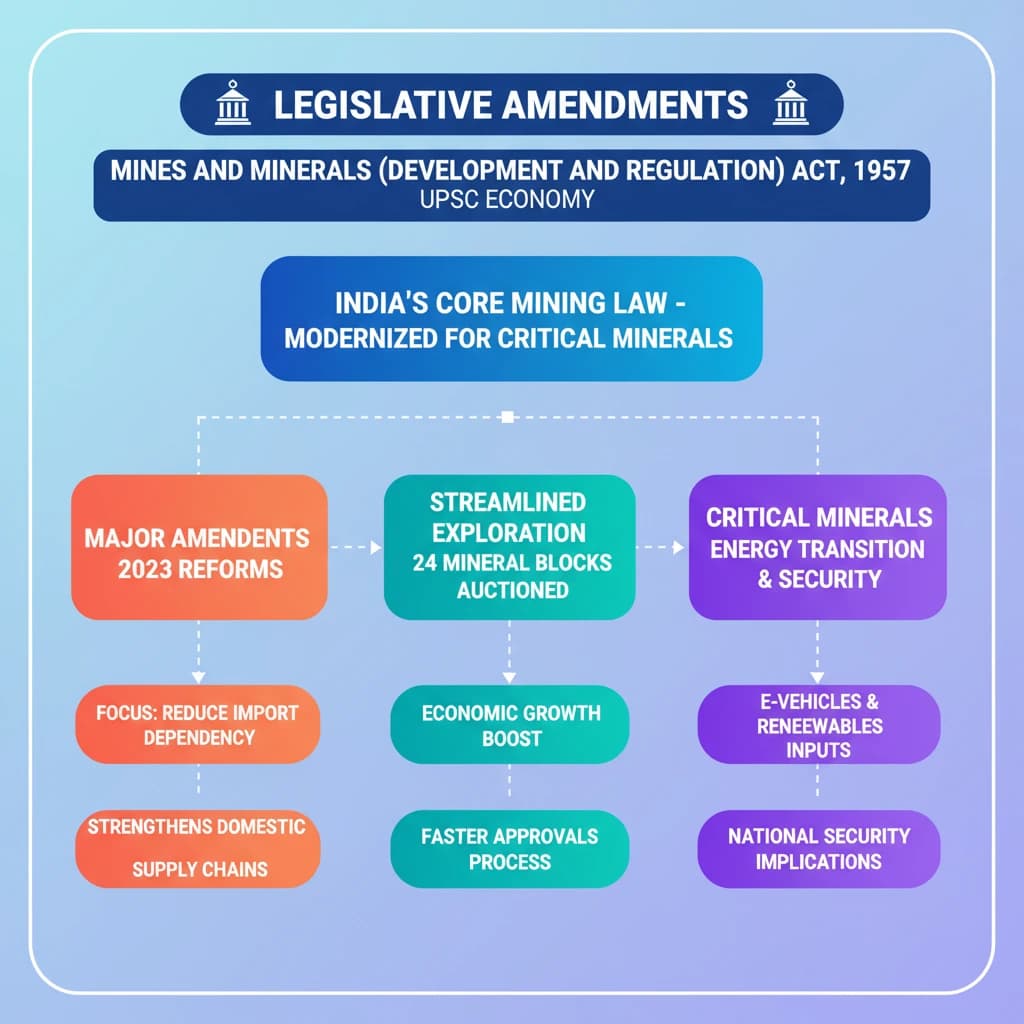
  • The MMDR Act, 1957, is India's core mining legislation.
  • Major amendments in 2023 aimed to streamline critical mineral exploration.
  • The amendments led to the auction of 24 strategic mineral blocks.
  • Focus on critical minerals is vital for India's energy transition, economic growth, and national security.
  • These reforms reduce import dependency and strengthen domestic supply chains for key industries.
Legislative Amendments: The Mines and Minerals (Development and Regulation) Act, 1957

Legislative Amendments: The Mines and Minerals (Development and Regulation) Act, 1957

Medium⏱️ 8 min read✓ 95% Verified
economy

📖 Introduction

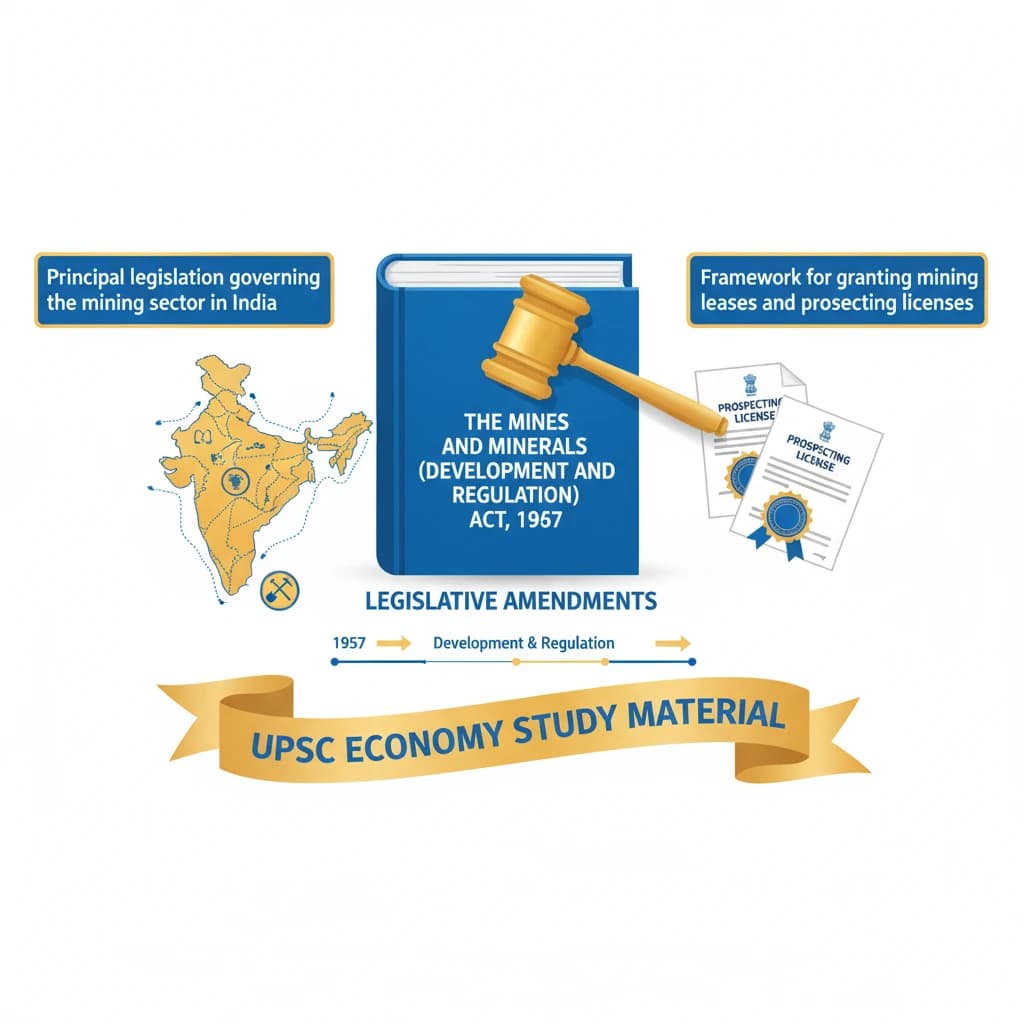
<h4>The Mines and Minerals (Development and Regulation) Act, 1957</h4><p>The <strong>Mines and Minerals (Development and Regulation) Act, 1957 (MMDR Act)</strong> is the principal legislation governing the mining sector in India. It aims to provide for the development and regulation of mines and minerals under the control of the Union.</p><p>This Act lays down the framework for granting <strong>mining leases</strong> and <strong>prospecting licenses</strong>, ensuring systematic development of mineral resources while safeguarding environmental and social concerns.</p><div class='info-box'><p><strong>Act Name:</strong> The Mines and Minerals (Development and Regulation) Act, 1957</p><p><strong>Primary Objective:</strong> Regulation of mines and mineral development in India.</p></div><h4>The 2023 Amendment and its Rationale</h4><p>In <strong>2023</strong>, significant legislative amendments were introduced to the <strong>MMDR Act, 1957</strong>. These changes were primarily aimed at boosting the exploration and extraction of <strong>critical minerals</strong> within the country.</p><p>The amendment seeks to <strong>streamline critical mineral exploration</strong> by simplifying processes and encouraging private sector participation. This move is crucial for India's strategic independence and economic growth.</p><div class='key-point-box'><p><strong>Critical Minerals:</strong> These are essential for modern technologies, economic development, and national security. They often have high supply chain risks due to geographical concentration of production.</p></div><h4>Impact: Auction of Strategic Mineral Blocks</h4><p>A direct outcome of the <strong>2023 amendments</strong> has been the facilitation of the <strong>auction of strategic mineral blocks</strong>. This initiative aims to unlock India's mineral potential and reduce reliance on imports.</p><p>Specifically, the amendments led to the auction of <strong>24 strategic mineral blocks</strong>. These blocks contain minerals vital for sectors like renewable energy, electric vehicles, and defence manufacturing.</p><div class='info-box'><p><strong>Outcome of Amendment:</strong> Auction of <strong>24 strategic mineral blocks</strong>.</p><p><strong>Purpose:</strong> Enhance domestic supply, reduce import dependency, and secure raw materials for future industries.</p></div><div class='exam-tip-box'><p><strong>UPSC Insight:</strong> Understand the distinction between 'critical' and 'strategic' minerals. The <strong>MMDR Act amendments</strong> are a key policy tool for India's energy transition and self-reliance goals. Questions can link to GS-3 (Economy, Infrastructure) and GS-2 (Governance, Policy).</p></div>
Concept Diagram

💡 Key Takeaways

  • •The MMDR Act, 1957, is India's core mining legislation.
  • •Major amendments in 2023 aimed to streamline critical mineral exploration.
  • •The amendments led to the auction of 24 strategic mineral blocks.
  • •Focus on critical minerals is vital for India's energy transition, economic growth, and national security.
  • •These reforms reduce import dependency and strengthen domestic supply chains for key industries.

🧠 Memory Techniques

Memory Aid
95% Verified Content

📚 Reference Sources

•Press Information Bureau (PIB) releases, Ministry of Mines, Government of India
•Annual Reports of the Ministry of Mines, Government of India

Related Topics

Loading related topics...
Explore:Economy Topics·All Subjects·Daily Current Affairs·Editorial Analysis·Previous Year Questions·UPSC GPT
Legislative Amendments: The Mines and Minerals (Development and Regulation) Act, 1957 - UPSC Economy