Loading page, please wait…
Vaidra Logo
Vaidra

Top 4 items + smart groups

UPSC GPT
New
Current Affairs
Daily Solutions
Daily Puzzle
Mains Evaluator

Version 2.0.0 • Built with ❤️ for UPSC aspirants

Loading...
Loading...
Loading...
Loading...
Loading...
Loading...
Loading...
Loading...
Loading...
Loading...
Loading...
Loading...
Loading...
Back
All Subjects

Topics

0 topics • 0 completed

Loading topics...
Loading...
Loading...
Loading...
Loading...
Loading...
Overall Progress0%

Status of India’s Renewable Energy - UPSC Economy

What is Status of India’s Renewable Energy in UPSC Economy?

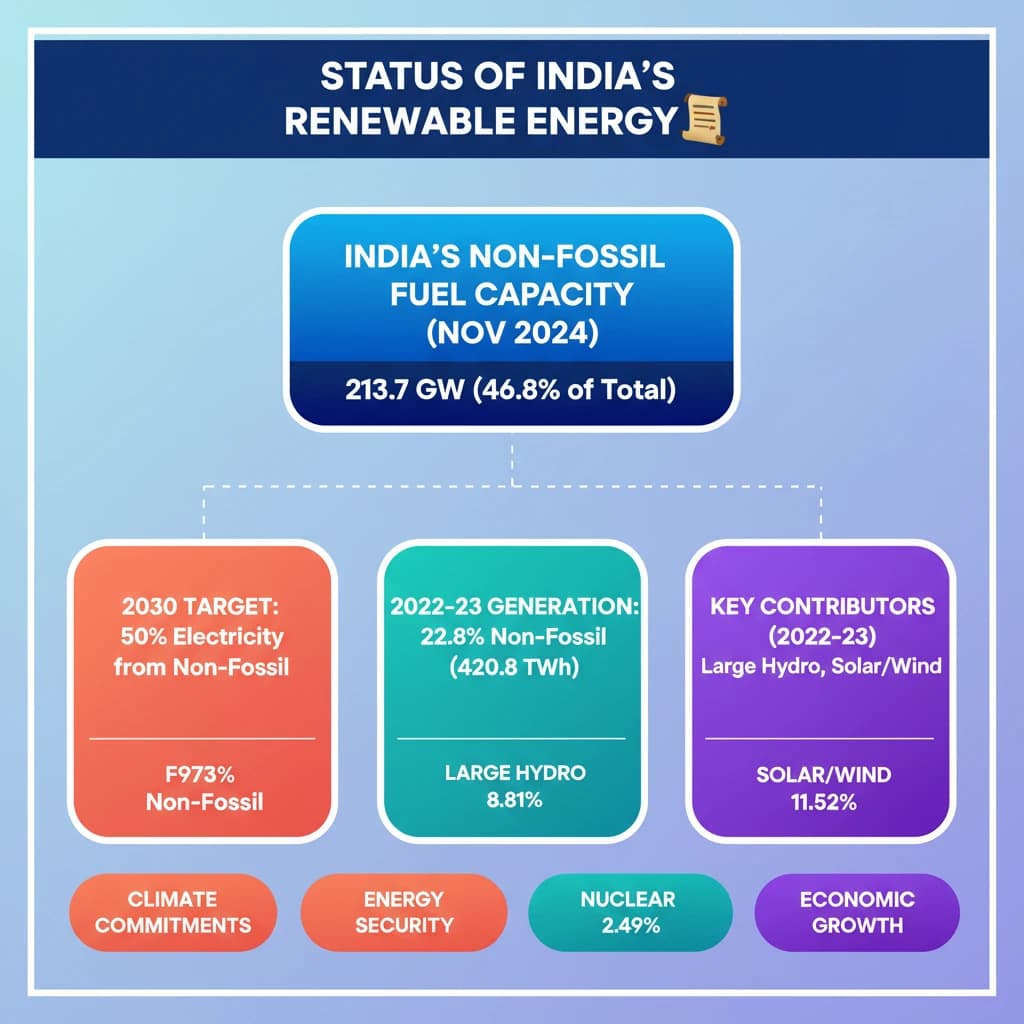
Status of India’s Renewable Energy is a key topic under Economy for UPSC Civil Services Examination. Key points include: As of November 2024, India's non-fossil fuel capacity is 213,701 MW, comprising 46.8% of total electricity capacity.. India aims for 50% of its electricity generation from non-fossil fuels by 2030.. In 2022-23, non-fossil fuels contributed 22.8% to total generation (420.8 thousand GWh).. Understanding this topic is essential for both UPSC Prelims and Mains preparation.

Why is Status of India’s Renewable Energy important for UPSC exam?

Status of India’s Renewable Energy is a Medium-level topic in UPSC Economy. It is tested in both Prelims (factual MCQs) and Mains (analytical answer writing). Previous year UPSC questions have frequently covered aspects of Status of India’s Renewable Energy, making it essential for comprehensive IAS preparation.

How to prepare Status of India’s Renewable Energy for UPSC?

To prepare Status of India’s Renewable Energy for UPSC: (1) Study the comprehensive notes covering all key concepts on Vaidra. (2) Practice previous year questions on this topic. (3) Connect it with current affairs using daily updates. (4) Revise using key takeaways and mind maps available for Economy. (5) Write practice answers linking Status of India’s Renewable Energy to related GS Paper topics.

Key takeaways of Status of India’s Renewable Energy for UPSC

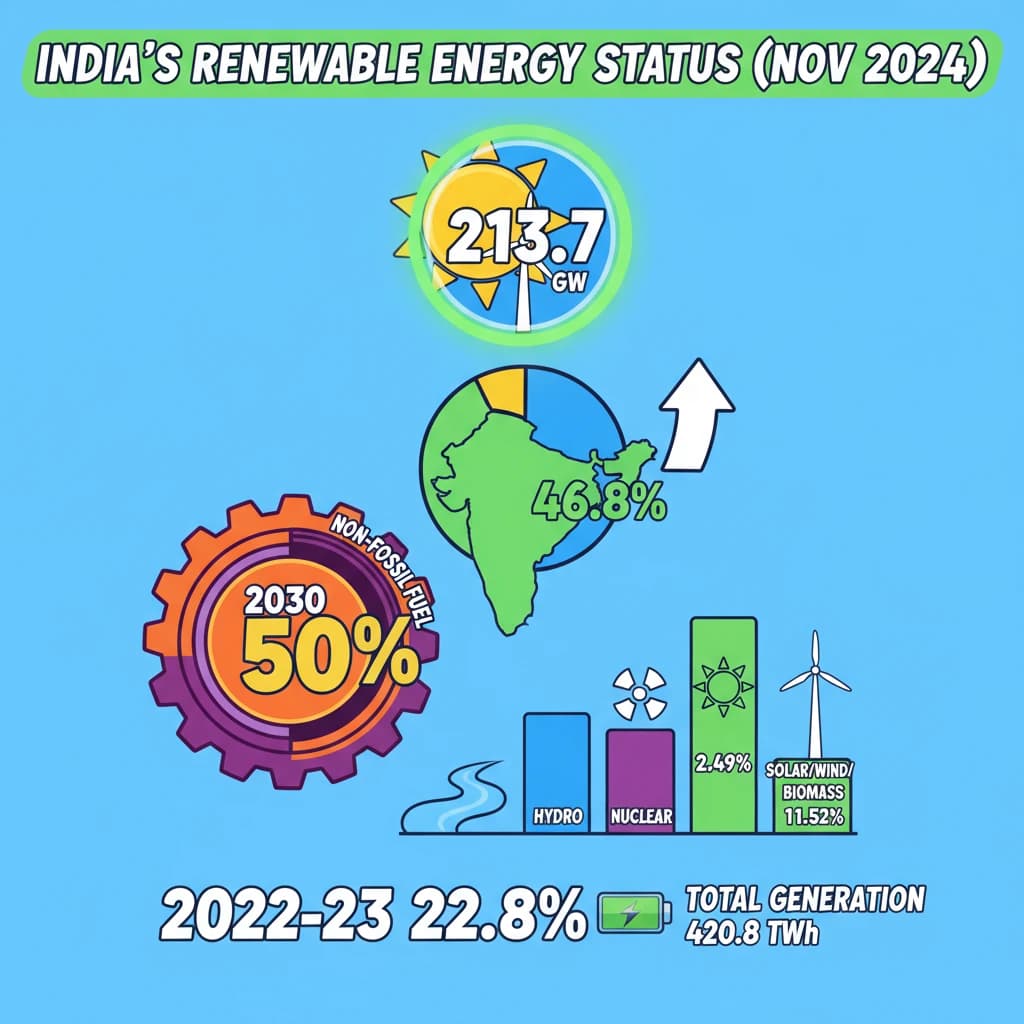
  • As of November 2024, India's non-fossil fuel capacity is 213,701 MW, comprising 46.8% of total electricity capacity.
  • India aims for 50% of its electricity generation from non-fossil fuels by 2030.
  • In 2022-23, non-fossil fuels contributed 22.8% to total generation (420.8 thousand GWh).
  • Large Hydro (8.81%), Nuclear (2.49%), and Solar/Wind/Biomass (11.52%) are key contributors to non-fossil fuel generation.
  • India's renewable energy push is crucial for climate commitments, energy security, and economic growth.
Status of India’s Renewable Energy

Status of India’s Renewable Energy

Medium⏱️ 8 min read✓ 95% Verified
economy

📖 Introduction

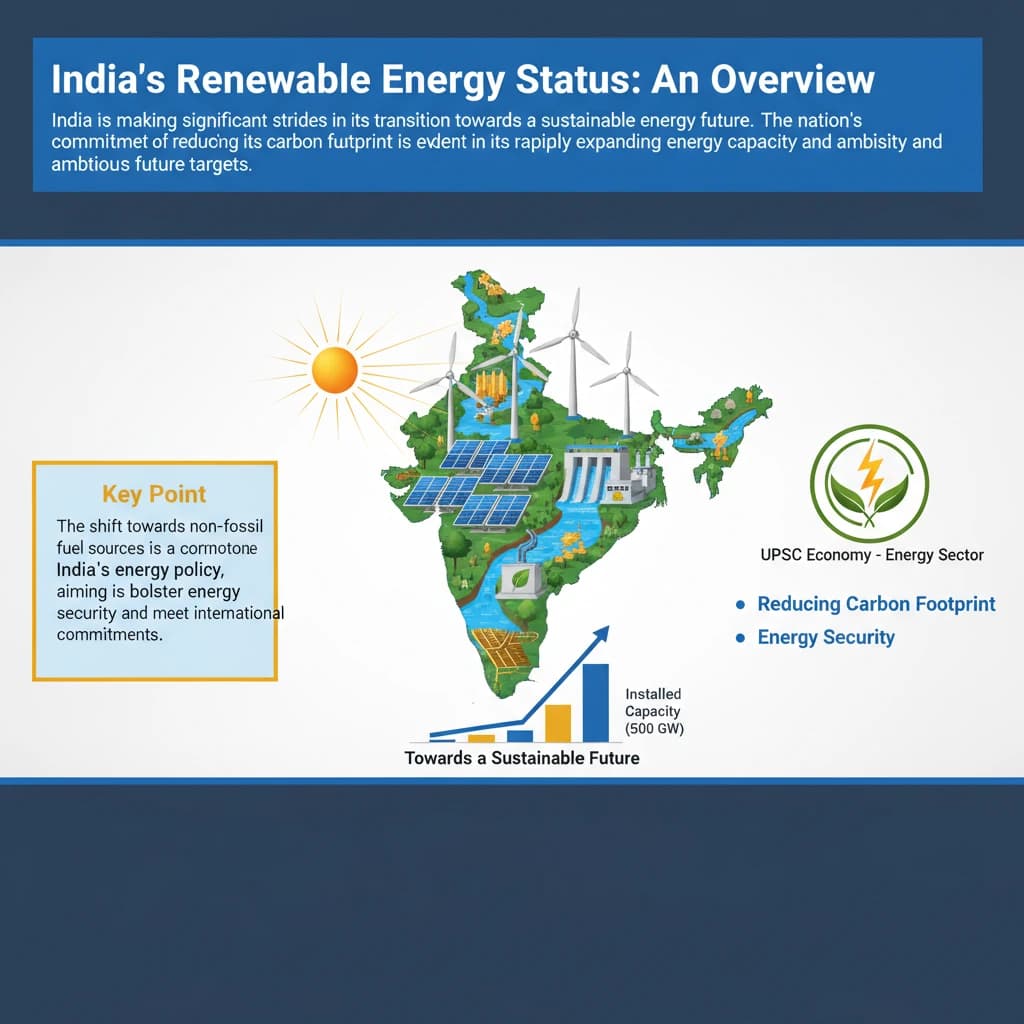
<h4>India's Renewable Energy Status: An Overview</h4><p>India is making significant strides in its transition towards a sustainable energy future. The nation's commitment to reducing its carbon footprint is evident in its rapidly expanding <strong>renewable energy capacity</strong> and ambitious future targets.</p><div class='key-point-box'><p>The shift towards <strong>non-fossil fuel sources</strong> is a cornerstone of India's energy policy, aiming to bolster energy security and meet international climate commitments.</p></div><h4>Current Installed Capacity from Non-Fossil Fuels</h4><p>As of <strong>November 2024</strong>, India's total installed electricity capacity from <strong>non-fossil fuel sources</strong> stands at an impressive <strong>213,701 MW</strong>. This represents a substantial portion of the country's overall power generation infrastructure.</p><div class='info-box'><p><strong>Key Data:</strong><ul><li><strong>Installed Non-Fossil Fuel Capacity:</strong> 213,701 MW</li><li><strong>Share of Total Electricity Capacity:</strong> 46.8%</li></ul></p></div><h4>Future Targets for Electricity Generation</h4><p>India has set an ambitious target to further increase its reliance on clean energy. The goal is to ensure that <strong>50% of its electricity generation</strong> originates from <strong>non-fossil fuel sources by 2030</strong>.</p><div class='exam-tip-box'><p>This target is crucial for understanding India's commitments under the <strong>Paris Agreement</strong> and its broader climate action strategy. UPSC often asks about such national targets and their implications.</p></div><h4>Progress in Non-Fossil Fuel Generation (2022-23)</h4><p>In the fiscal year <strong>2022-23</strong>, the contribution from <strong>non-fossil fuel sources</strong> to India's total electricity generation was significant. A total of <strong>420.8 thousand GWh</strong> was generated from these sources.</p><div class='info-box'><p><strong>Generation Share (2022-23):</strong><ul><li><strong>Total Non-Fossil Fuel Generation:</strong> 420.8 thousand GWh</li><li><strong>Contribution to Total Generation:</strong> 22.8%</li></ul></p></div><h4>Component-wise Contribution to Non-Fossil Fuel Generation</h4><p>The <strong>non-fossil fuel generation mix</strong> comprises various sources, each playing a vital role in India's energy landscape. <strong>Solar</strong>, <strong>Wind</strong>, and <strong>Biomass</strong> collectively form a significant portion, alongside <strong>Large Hydro</strong> and <strong>Nuclear Power</strong>.</p><div class='info-box'><p><strong>Breakdown of Non-Fossil Fuel Generation (2022-23):</strong><ul><li><strong>Large Hydro:</strong> 8.81%</li><li><strong>Nuclear:</strong> 2.49%</li><li><strong>Solar, Wind, Biomass (combined):</strong> 11.52%</li></ul></p></div>
Concept Diagram

💡 Key Takeaways

  • •As of November 2024, India's non-fossil fuel capacity is 213,701 MW, comprising 46.8% of total electricity capacity.
  • •India aims for 50% of its electricity generation from non-fossil fuels by 2030.
  • •In 2022-23, non-fossil fuels contributed 22.8% to total generation (420.8 thousand GWh).
  • •Large Hydro (8.81%), Nuclear (2.49%), and Solar/Wind/Biomass (11.52%) are key contributors to non-fossil fuel generation.
  • •India's renewable energy push is crucial for climate commitments, energy security, and economic growth.

🧠 Memory Techniques
Memory Aid
95% Verified Content

📚 Reference Sources

•Ministry of Power, Government of India (for installed capacity data)
•Ministry of New and Renewable Energy (MNRE), Government of India (for policy and generation data)

Related Topics

Loading related topics...
Explore:Economy Topics·All Subjects·Daily Current Affairs·Editorial Analysis·Previous Year Questions·UPSC GPT
Status of India’s Renewable Energy - UPSC Economy