Loading page, please wait…
Vaidra Logo
Vaidra

Top 4 items + smart groups

UPSC GPT
New
Current Affairs
Daily Solutions
Daily Puzzle
Mains Evaluator

Version 2.0.0 • Built with ❤️ for UPSC aspirants

Loading...
Loading...
Loading...
Loading...
Loading...
Loading...
Loading...
Loading...
Loading...
Loading...
Loading...
Loading...
Loading...
Back
All Subjects

Topics

0 topics • 0 completed

Loading topics...
Loading...
Loading...
Loading...
Loading...
Loading...
Overall Progress0%

Domestic Systemically Important Banks (D-SIBs) - UPSC Economy

What is Domestic Systemically Important Banks (D-SIBs) in UPSC Economy?

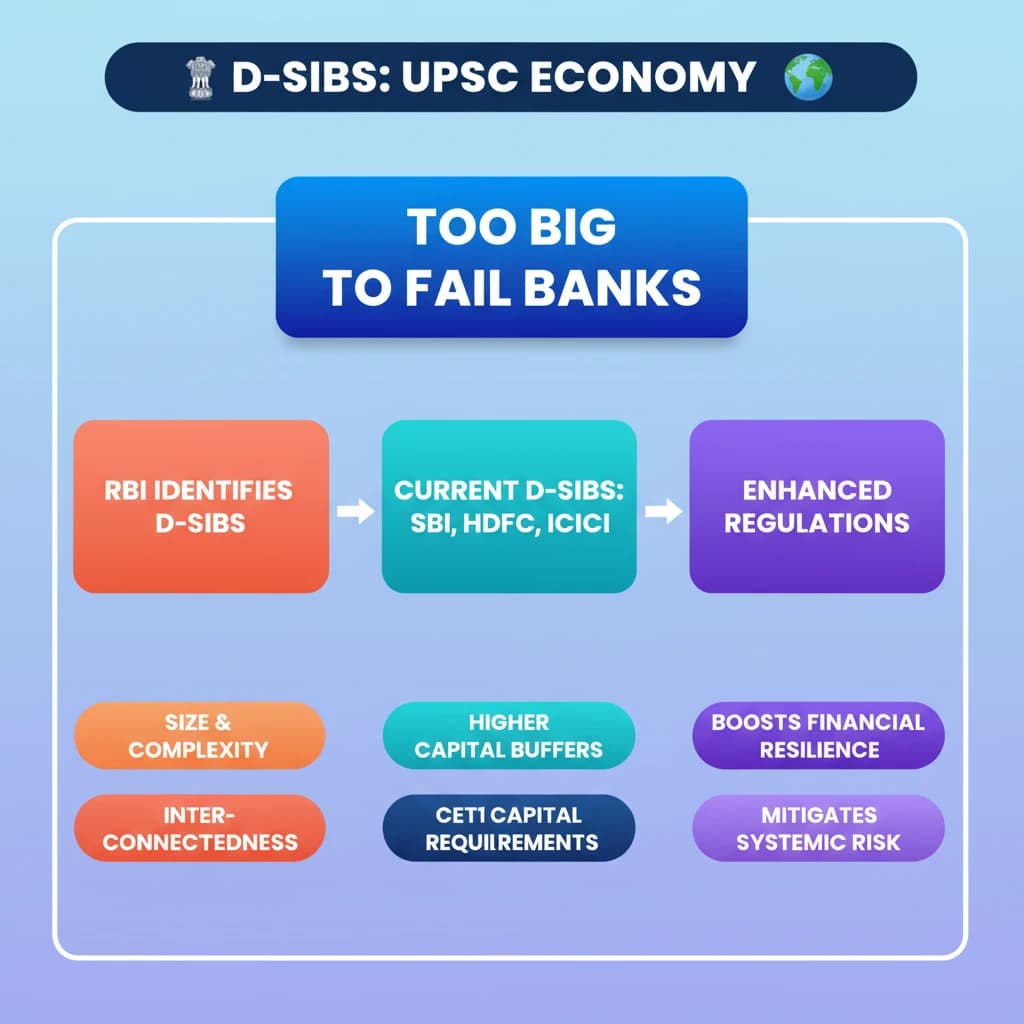
Domestic Systemically Important Banks (D-SIBs) is a key topic under Economy for UPSC Civil Services Examination. Key points include: D-SIBs are banks deemed "Too Big to Fail" (TBTF) due to their systemic importance.. RBI identifies D-SIBs based on size, complexity, and interconnectedness.. Currently, SBI, HDFC Bank, and ICICI Bank are identified as D-SIBs.. Understanding this topic is essential for both UPSC Prelims and Mains preparation.

Why is Domestic Systemically Important Banks (D-SIBs) important for UPSC exam?

Domestic Systemically Important Banks (D-SIBs) is a Medium-level topic in UPSC Economy. It is tested in both Prelims (factual MCQs) and Mains (analytical answer writing). Previous year UPSC questions have frequently covered aspects of Domestic Systemically Important Banks (D-SIBs), making it essential for comprehensive IAS preparation.

How to prepare Domestic Systemically Important Banks (D-SIBs) for UPSC?

To prepare Domestic Systemically Important Banks (D-SIBs) for UPSC: (1) Study the comprehensive notes covering all key concepts on Vaidra. (2) Practice previous year questions on this topic. (3) Connect it with current affairs using daily updates. (4) Revise using key takeaways and mind maps available for Economy. (5) Write practice answers linking Domestic Systemically Important Banks (D-SIBs) to related GS Paper topics.

Key takeaways of Domestic Systemically Important Banks (D-SIBs) for UPSC

  • D-SIBs are banks deemed "Too Big to Fail" (TBTF) due to their systemic importance.
  • RBI identifies D-SIBs based on size, complexity, and interconnectedness.
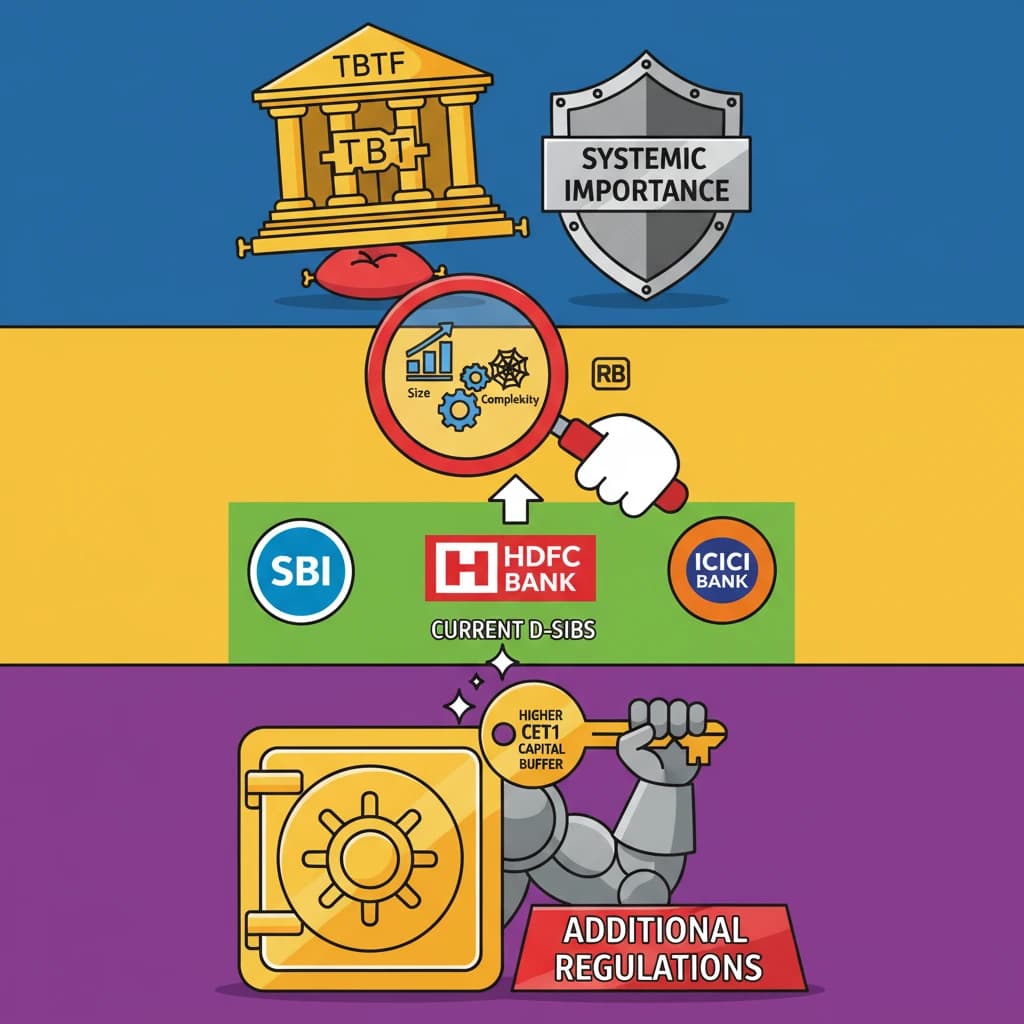
  • Currently, SBI, HDFC Bank, and ICICI Bank are identified as D-SIBs.
  • D-SIBs face additional regulatory requirements, including higher Common Equity Tier 1 (CET1) capital buffers.
  • The framework aims to enhance resilience and mitigate systemic risk, safeguarding financial stability.
Domestic Systemically Important Banks (D-SIBs)

Domestic Systemically Important Banks (D-SIBs)

Medium⏱️ 4 min read✓ 98% Verified
economy

📖 Introduction

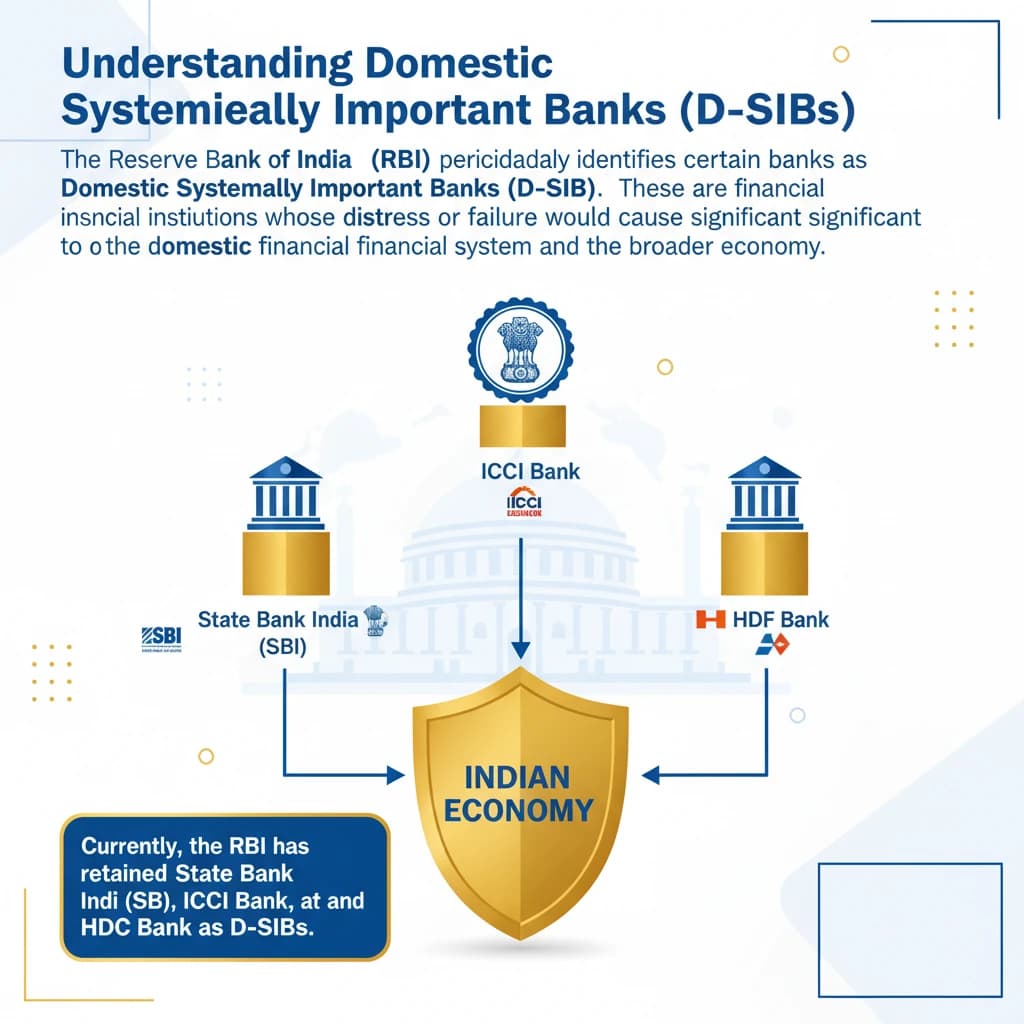
<h4>Understanding Domestic Systemically Important Banks (D-SIBs)</h4><p>The <strong>Reserve Bank of India (RBI)</strong> periodically identifies certain banks as <strong>Domestic Systemically Important Banks (D-SIBs)</strong>. These are financial institutions whose distress or failure would cause significant disruption to the domestic financial system and the broader economy.</p><div class='info-box'><p>Currently, the <strong>RBI</strong> has retained <strong>State Bank of India (SBI)</strong>, <strong>HDFC Bank</strong>, and <strong>ICICI Bank</strong> as <strong>D-SIBs</strong>, acknowledging their critical role in India's financial landscape.</p></div><h4>The "Too Big to Fail" (TBTF) Concept</h4><p><strong>D-SIBs</strong> are often referred to as <strong>"Too Big to Fail" (TBTF)</strong> banks. This classification stems from their immense <strong>size</strong>, intricate <strong>complexity</strong>, and deep <strong>interconnections</strong> within the financial system.</p><div class='key-point-box'><p>The failure of a <strong>D-SIB</strong> could trigger a widespread economic crisis, necessitating government intervention to prevent systemic collapse. Hence, they are subject to enhanced regulatory scrutiny.</p></div><h4>Importance and Enhanced Regulatory Measures</h4><p>Due to their systemic importance, <strong>D-SIBs</strong> are subjected to a stricter regulatory framework. These additional measures are designed to bolster their <strong>resilience</strong> and capacity to withstand severe financial shocks.</p><ul><li><strong>Additional Capital Buffers:</strong> Higher capital requirements ensure they have sufficient financial cushions.</li><li><strong>Stress Tests:</strong> Regular assessments evaluate their ability to cope with adverse economic scenarios.</li><li><strong>Recovery and Resolution Planning:</strong> Banks must have plans in place for orderly recovery from distress or resolution in case of failure, minimizing broader impact.</li></ul><h4>Additional Capital Requirement for D-SIBs</h4><p>A crucial regulatory measure for <strong>D-SIBs</strong> is the requirement to maintain an additional <strong>Common Equity Tier 1 (CET1)</strong> capital. This requirement varies based on the "bucket" in which a <strong>D-SIB</strong> is placed, reflecting its degree of systemic importance.</p><div class='info-box'><ul><li><strong>State Bank of India (SBI):</strong> Requires an additional <strong>0.80%</strong> <strong>CET1</strong>.</li><li><strong>HDFC Bank:</strong> Requires an additional <strong>0.40%</strong> <strong>CET1</strong>.</li><li><strong>ICICI Bank:</strong> Requires an additional <strong>0.20%</strong> <strong>CET1</strong>.</li></ul></div><div class='exam-tip-box'><p>Understanding the specific <strong>CET1</strong> requirements for each identified <strong>D-SIB</strong> can be important for objective-type questions in <strong>UPSC Prelims</strong>, especially regarding financial sector regulations.</p></div><h4>The D-SIB Identification Process by RBI</h4><p>The <strong>RBI</strong> employs a rigorous <strong>two-step process</strong> to identify <strong>D-SIBs</strong>, ensuring that only truly systemically important institutions are designated as such.</p><ol><li><strong>Sample Selection:</strong> The initial step involves identifying a sample of banks for assessment. Only banks whose <strong>assets exceed 2% of India's GDP</strong> are considered for this preliminary selection.</li><li><strong>Systemic Importance Assessment:</strong> For the selected banks, a comprehensive assessment is conducted. This involves calculating a <strong>composite score</strong> based on several key indicators.</li></ol><div class='info-box'><p>Key indicators for systemic importance include: <strong>lack of substitutability</strong> (how difficult it would be to replace their services), <strong>interconnectedness</strong> (their links with other financial institutions), <strong>size</strong>, and <strong>complexity</strong>.</p></div><p>Banks exceeding a predetermined <strong>threshold</strong> based on this composite score are then officially classified as <strong>Domestic Systemically Important Banks (D-SIBs)</strong>.</p>
Concept Diagram

💡 Key Takeaways

  • •D-SIBs are banks deemed "Too Big to Fail" (TBTF) due to their systemic importance.
  • •RBI identifies D-SIBs based on size, complexity, and interconnectedness.
  • •Currently, SBI, HDFC Bank, and ICICI Bank are identified as D-SIBs.
  • •D-SIBs face additional regulatory requirements, including higher Common Equity Tier 1 (CET1) capital buffers.
  • •The framework aims to enhance resilience and mitigate systemic risk, safeguarding financial stability.

🧠 Memory Techniques
Memory Aid
98% Verified Content

📚 Reference Sources

•Reserve Bank of India (RBI) official press releases and policy documents (implied by content)

Related Topics

Loading related topics...
Explore:Economy Topics·All Subjects·Daily Current Affairs·Editorial Analysis·Previous Year Questions·UPSC GPT
Domestic Systemically Important Banks (D-SIBs) - UPSC Economy