Loading page, please wait…
Employment, Skill Development and Innovation - UPSC Economy
What is Employment, Skill Development and Innovation in UPSC Economy?
Employment, Skill Development and Innovation is a key topic under Economy for UPSC Civil Services Examination. Key points include: Workforce formalisation is crucial for social security and economic development.. PLFS provides vital data on employment trends and unemployment rates.. India's innovation ecosystem is growing, reflected in record patent grants and GII ranking.. Understanding this topic is essential for both UPSC Prelims and Mains preparation.
Why is Employment, Skill Development and Innovation important for UPSC exam?
Employment, Skill Development and Innovation is a Medium-level topic in UPSC Economy. It is tested in both Prelims (factual MCQs) and Mains (analytical answer writing). Previous year UPSC questions have frequently covered aspects of Employment, Skill Development and Innovation, making it essential for comprehensive IAS preparation.
How to prepare Employment, Skill Development and Innovation for UPSC?
To prepare Employment, Skill Development and Innovation for UPSC: (1) Study the comprehensive notes covering all key concepts on Vaidra. (2) Practice previous year questions on this topic. (3) Connect it with current affairs using daily updates. (4) Revise using key takeaways and mind maps available for Economy. (5) Write practice answers linking Employment, Skill Development and Innovation to related GS Paper topics.
Key takeaways of Employment, Skill Development and Innovation for UPSC
- Workforce formalisation is crucial for social security and economic development.
- PLFS provides vital data on employment trends and unemployment rates.
- India's innovation ecosystem is growing, reflected in record patent grants and GII ranking.
- GI tags protect unique regional products and boost local economies.
- Government schemes like PMKVY and PMNAM are key to skill development and employability.
- PRAVAH Portal streamlines RBI regulatory approvals, enhancing ease of doing business.
Employment, Skill Development and Innovation
Medium⏱️ 15 min read
economy
📖 Introduction
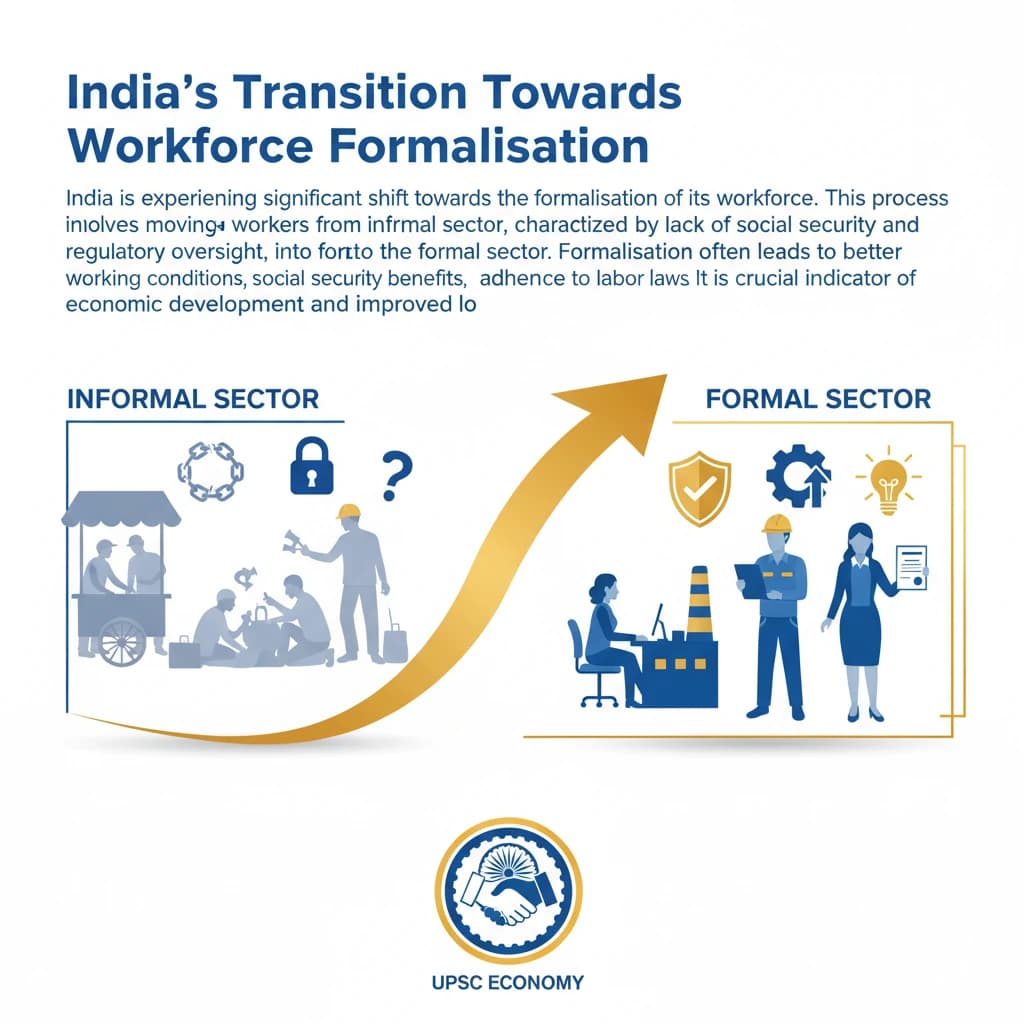
India's Transition Towards Workforce Formalisation
India is experiencing a significant shift towards the formalisation of its workforce. This process involves moving workers from the informal sector, characterized by lack of social security and regulatory oversight, into the formal sector.
Formalisation often leads to better working conditions, social security benefits, and adherence to labor laws. It is a crucial indicator of economic development and improved living standards for workers.
Key Drivers of Formalisation:
- Government initiatives promoting registration and compliance.
- Growth of organized industries and services.
- Increased awareness among workers about their rights.
Central Trade Unions (CTUs) Demand for Labour Welfare
Central Trade Unions (CTUs) play a vital role in advocating for the rights and welfare of workers in India. They represent a large segment of the organized and unorganized labor force.
CTUs consistently demand better working conditions, fair wages, social security, and protection against exploitation. Their collective bargaining power influences labor policy formulation.
Common Demands by CTUs:
- Implementation of a universal minimum wage.
- Strengthening of social security schemes like EPF and ESI.
- Protection of trade union rights and collective bargaining.
- Ensuring job security and preventing arbitrary retrenchment.
Periodic Labour Force Survey (PLFS) Report
The Periodic Labour Force Survey (PLFS) is a crucial survey conducted by the National Sample Survey Office (NSSO) under the Ministry of Statistics and Programme Implementation (MoSPI).
It provides estimates of key employment and unemployment indicators in India. These indicators include the Labour Force Participation Rate (LFPR), Worker Population Ratio (WPR), and Unemployment Rate (UR).
Purpose of PLFS:
- To estimate employment and unemployment indicators in both usual status and current weekly status.
- To assess the labor force dynamics in both rural and urban areas.
- To provide data for policy formulation related to employment and skill development.
India Grants Record Patents
India has witnessed a significant increase in the number of patents granted, indicating a growing focus on innovation and research and development (R&D) within the country.
A patent grants exclusive rights to an inventor for a limited period, preventing others from making, using, or selling the invention without permission. This incentivizes innovation.
UPSC Relevance: Record patent grants reflect India's progress in its innovation ecosystem, a key aspect of economic growth and global competitiveness (GS Paper III - Economy, Science & Technology).
India’s Geographical Indication Landscape
A Geographical Indication (GI) tag is a sign used on products that have a specific geographical origin and possess qualities or a reputation that are due to that origin. India's GI landscape is expanding.
GI tags protect the unique identity of products, prevent misuse of names, and promote the economic prosperity of producers in a specific region. Examples include Darjeeling Tea and Kanchipuram Silk.
Benefits of GI Tags:
- Confers legal protection to GI products in India.
- Prevents unauthorized use of a registered GI by others.
- Promotes the economic prosperity of the producers of GI goods.
- Helps in export promotion and international recognition.
PM Internship Scheme
The Prime Minister's National Apprenticeship Mela (PMNAM), often referred to as a PM Internship Scheme, is an initiative aimed at boosting apprenticeship opportunities in India.
The scheme connects aspiring individuals with companies seeking to onboard apprentices, providing practical training and enhancing employability. It focuses on skill development and industry readiness.
Objectives of PMNAM:
- To provide on-the-job training to youth.
- To bridge the gap between academic learning and industry requirements.
- To enhance the employability of the Indian workforce.
- To promote a culture of apprenticeship across various sectors.
Global Innovation Index 2024
The Global Innovation Index (GII) is an annual ranking of countries by their capacity for, and success in, innovation. It is published by the World Intellectual Property Organization (WIPO).
India's performance in the GII is closely watched as it reflects the country's innovation ecosystem, including R&D investment, intellectual property, and technological output.
UPSC Insight: India's consistent improvement in GII rankings can be cited in answers related to economic reforms, 'Make in India', and boosting indigenous innovation (GS Paper III).
PRAVAH Portal
The PRAVAH Portal (Platform for Regulatory Application, Vetting and Authorisation) is an initiative launched by the Reserve Bank of India (RBI).
Its primary objective is to streamline and expedite the application and approval processes for various regulatory clearances and authorizations required from the RBI. This enhances ease of doing business.
Key Features of PRAVAH Portal:
- Online application submission for various licenses and authorizations.
- Transparency in the application tracking process.
- Reduced processing time for regulatory approvals.
- A single platform for all RBI regulatory clearances.
💡 Key Takeaways
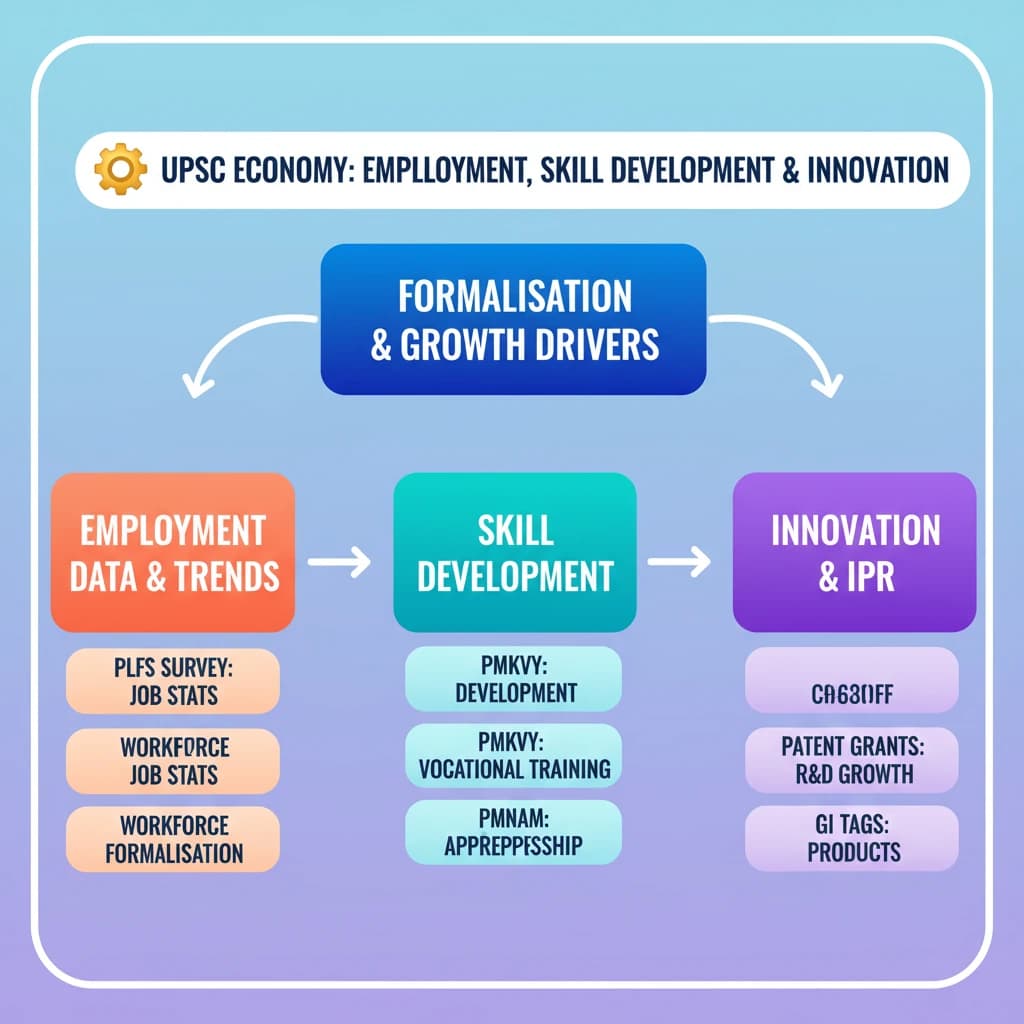
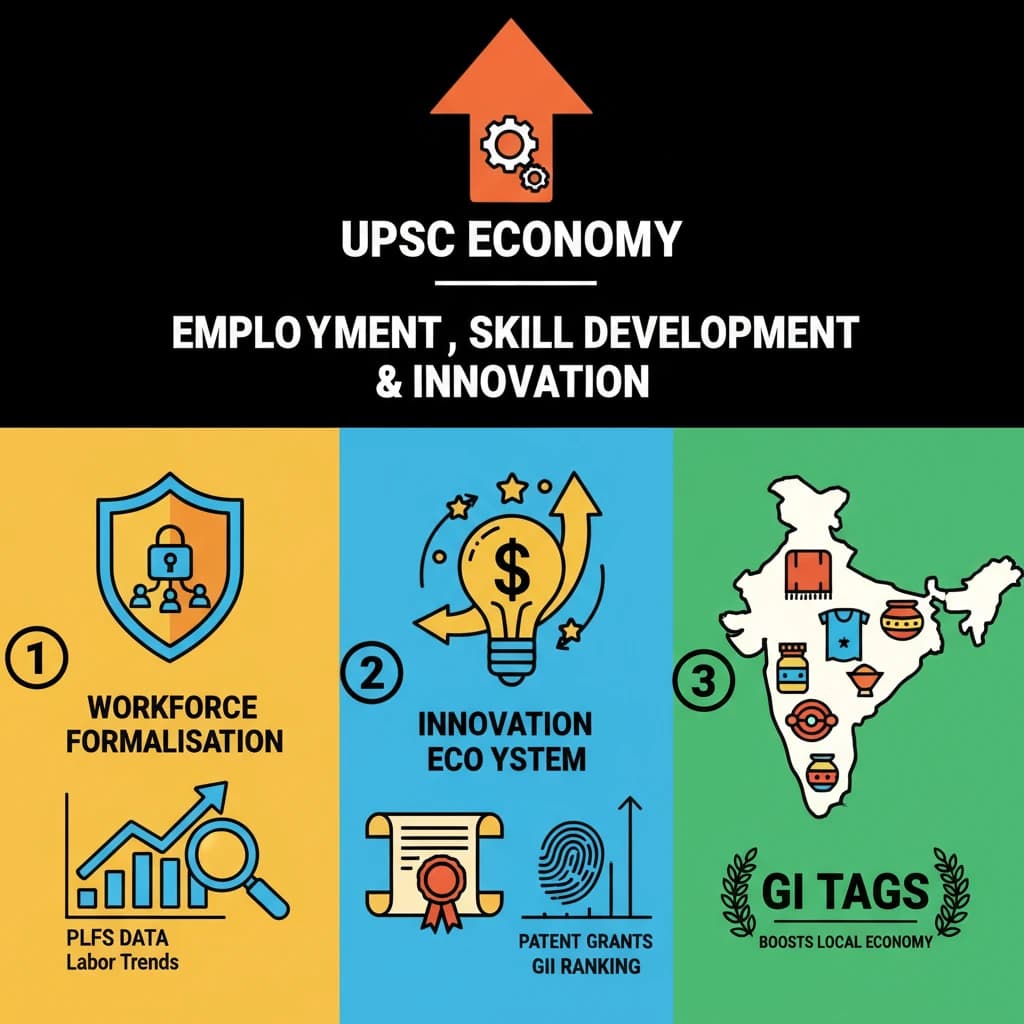
- •Workforce formalisation is crucial for social security and economic development.
- •PLFS provides vital data on employment trends and unemployment rates.
- •India's innovation ecosystem is growing, reflected in record patent grants and GII ranking.
- •GI tags protect unique regional products and boost local economies.
- •Government schemes like PMKVY and PMNAM are key to skill development and employability.
- •PRAVAH Portal streamlines RBI regulatory approvals, enhancing ease of doing business.
🧠 Memory Techniques
95% Verified Content
📚 Reference Sources
•Ministry of Statistics and Programme Implementation (MoSPI) - PLFS Reports
•World Intellectual Property Organization (WIPO) - Global Innovation Index Reports
•Controller General of Patents, Designs & Trade Marks (CGPDTM) - Annual Reports
•Ministry of Skill Development and Entrepreneurship (MSDE) - PMKVY Guidelines
•Reserve Bank of India (RBI) - Press Releases and Notifications on PRAVAH Portal