Loading page, please wait…
Vaidra Logo
Vaidra

Top 4 items + smart groups

UPSC GPT
New
Current Affairs
Daily Solutions
Daily Puzzle
Mains Evaluator

Version 2.0.0 • Built with ❤️ for UPSC aspirants

Loading...
Loading...
Loading...
Loading...
Loading...
Loading...
Loading...
Loading...
Loading...
Loading...
Loading...
Loading...
Loading...

Reasons for Revising the Base Year - UPSC Economy

What is Reasons for Revising the Base Year in UPSC Economy?

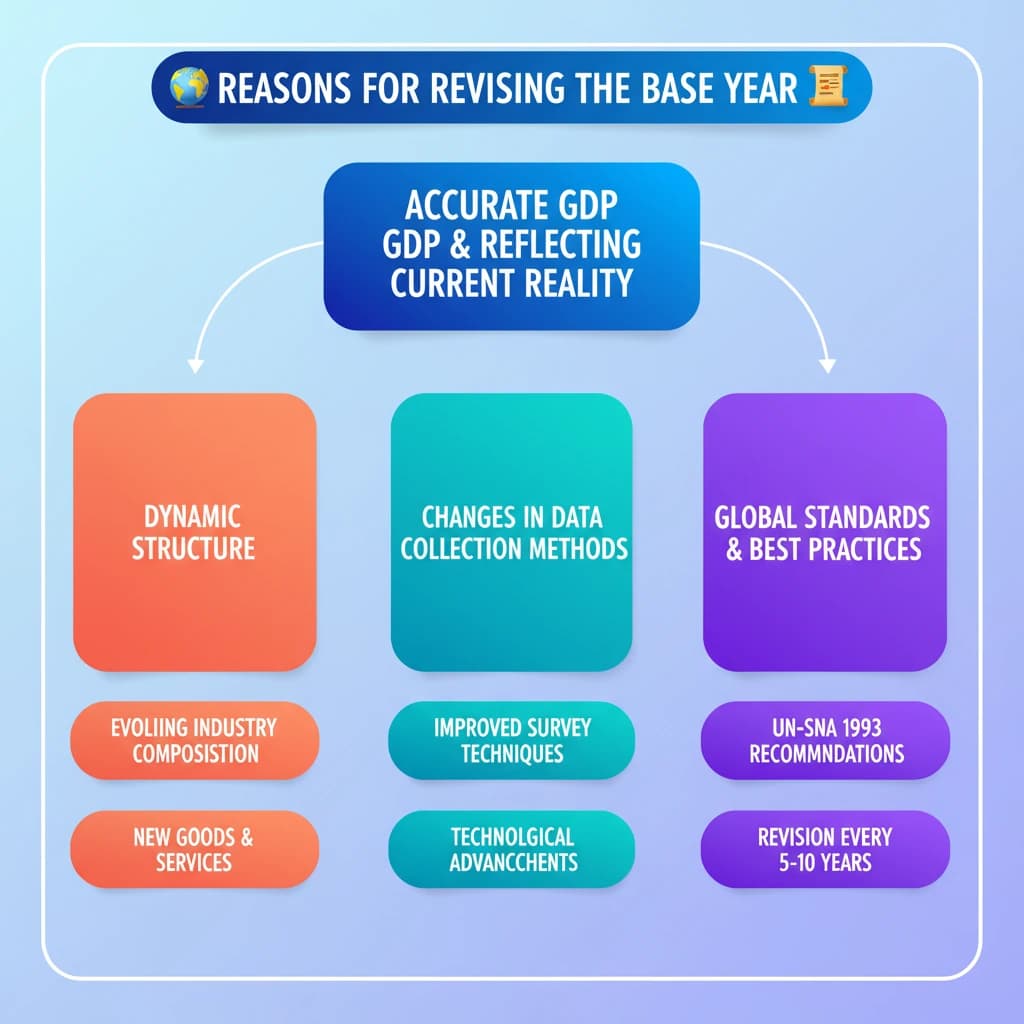
Reasons for Revising the Base Year is a key topic under Economy for UPSC Civil Services Examination. Key points include: Base year revision is essential for accurate GDP calculation and reflects current economic reality.. Indicators, economic structure, and data methods are dynamic, necessitating periodic updates.. Revisions impact a wide range of economic indicators, including public expenditure and debt.. Understanding this topic is essential for both UPSC Prelims and Mains preparation.

Why is Reasons for Revising the Base Year important for UPSC exam?

Reasons for Revising the Base Year is a Medium-level topic in UPSC Economy. It is tested in both Prelims (factual MCQs) and Mains (analytical answer writing). Previous year UPSC questions have frequently covered aspects of Reasons for Revising the Base Year, making it essential for comprehensive IAS preparation.

How to prepare Reasons for Revising the Base Year for UPSC?

To prepare Reasons for Revising the Base Year for UPSC: (1) Study the comprehensive notes covering all key concepts on Vaidra. (2) Practice previous year questions on this topic. (3) Connect it with current affairs using daily updates. (4) Revise using key takeaways and mind maps available for Economy. (5) Write practice answers linking Reasons for Revising the Base Year to related GS Paper topics.

Key takeaways of Reasons for Revising the Base Year for UPSC

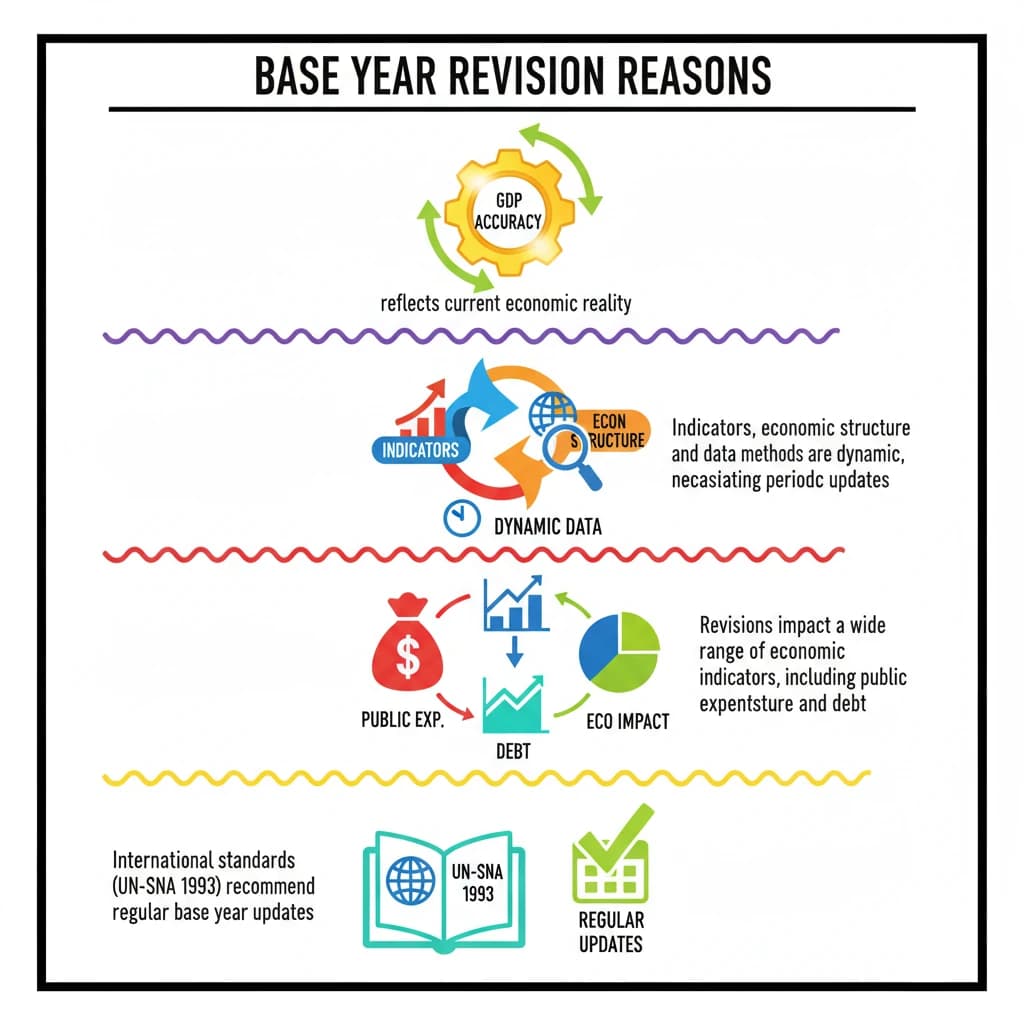
  • Base year revision is essential for accurate GDP calculation and reflects current economic reality.
  • Indicators, economic structure, and data methods are dynamic, necessitating periodic updates.
  • Revisions impact a wide range of economic indicators, including public expenditure and debt.
  • International standards (UN-SNA 1993) recommend regular base year updates.
  • Ideally, base years should be revised every 5-10 years to ensure data relevance.
  • India has revised its base year seven times, most recently from FY 2005 to FY 2012.
Reasons for Revising the Base Year

Reasons for Revising the Base Year

Medium⏱️ 7 min read✓ 98% Verified
economy

📖 Introduction

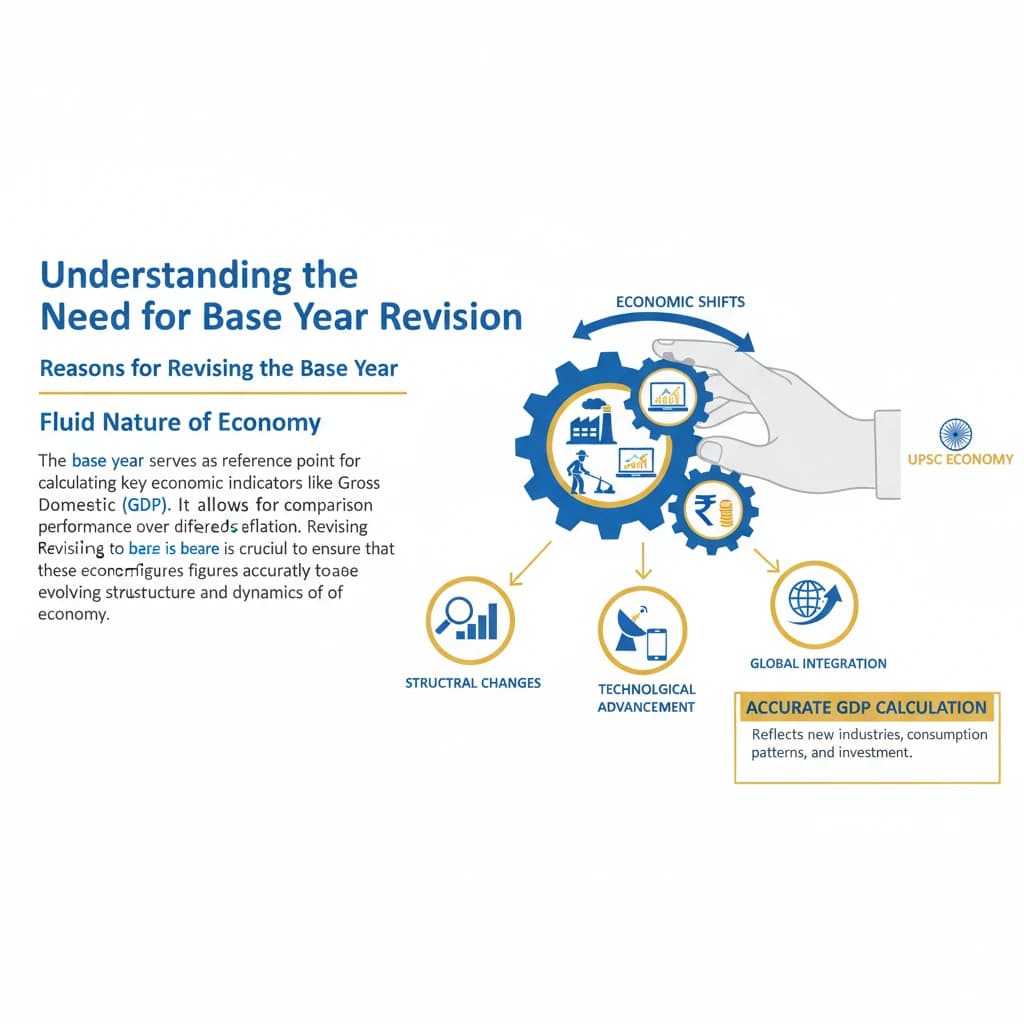
<h4>Understanding the Need for Base Year Revision</h4><p>The <strong>base year</strong> serves as a reference point for calculating key economic indicators like <strong>Gross Domestic Product (GDP)</strong>. It allows for the comparison of economic performance over different periods, adjusting for inflation.</p><p>Revising the <strong>base year</strong> is crucial to ensure that these economic figures accurately represent the evolving structure and dynamics of an economy.</p><h4>Fluid Nature of Economic Indicators</h4><p>The <strong>indicators</strong> used for computing <strong>GDP</strong> are inherently dynamic. They constantly change due to shifts in various economic factors.</p><p>These shifts include changes in <strong>consumer behaviour</strong>, the overall <strong>economic structure</strong>, and the <strong>composition of commodities</strong> produced and consumed within the economy.</p><p>Furthermore, <strong>data compilation methods</strong> evolve over time. This necessitates the incorporation of new <strong>classification systems</strong> and updated <strong>data sources</strong> to maintain accuracy.</p><div class='key-point-box'><p><strong>Key Point:</strong> Regular revisions ensure that the reported <strong>GDP figures</strong> truly reflect the <strong>current economic reality</strong> and are not skewed by outdated parameters.</p></div><h4>Impact on Broader Economic Indicators</h4><p>When new <strong>data sets</strong> are incorporated through <strong>base year revisions</strong>, it can lead to significant adjustments in overall <strong>GDP levels</strong>. This is a direct consequence of updated methodologies and data.</p><p>These changes have a profound <strong>ripple effect</strong> across a wide array of other crucial <strong>economic indicators</strong>. This includes trends in <strong>public expenditure</strong>, patterns of <strong>taxation</strong>, and the overall level of <strong>public sector debt</strong>.</p><h4>International Standard Practice</h4><div class='info-box'><p>The <strong>United Nations-System of National Accounts 1993 (UN-SNA 1993)</strong>, an internationally recognized framework, mandates countries to revise their computation practices periodically. This ensures global consistency and comparability of economic data.</p></div><h4>Recommended Frequency of Revisions</h4><p>Ideally, the <strong>base year</strong> for national accounts should be revised every <strong>5 to 10 years</strong>. This timeframe is considered optimal for keeping economic statistics relevant.</p><div class='key-point-box'><p><strong>Key Point:</strong> This regular revision schedule helps in aligning <strong>national accounts</strong> with the <strong>latest available data</strong> and reflecting structural changes promptly.</p></div><h4>History of Base Year Revisions in India</h4><p>India's journey with <strong>national income estimates</strong> began with their first publication in <strong>1956</strong>. At that time, the designated <strong>base year</strong> was <strong>FY 1949</strong>.</p><p>Since then, India has undertaken a total of <strong>seven revisions</strong> to its <strong>base year</strong>, demonstrating a commitment to updating its economic statistics.</p><div class='info-box'><p><strong>Recent Revision:</strong> The <strong>most recent revision</strong> saw the <strong>base year</strong> changed from <strong>FY 2005</strong> to <strong>FY 2012</strong>. This significant update aimed to capture recent structural changes in the Indian economy.</p></div>
Concept Diagram

💡 Key Takeaways

  • •Base year revision is essential for accurate GDP calculation and reflects current economic reality.
  • •Indicators, economic structure, and data methods are dynamic, necessitating periodic updates.
  • •Revisions impact a wide range of economic indicators, including public expenditure and debt.
  • •International standards (UN-SNA 1993) recommend regular base year updates.
  • •Ideally, base years should be revised every 5-10 years to ensure data relevance.
  • •India has revised its base year seven times, most recently from FY 2005 to FY 2012.

🧠 Memory Techniques
Memory Aid
98% Verified Content

📚 Reference Sources

•Ministry of Statistics and Programme Implementation (MOSPI) publications on National Accounts Statistics
•United Nations System of National Accounts (UN-SNA) guidelines

Related Topics

Loading related topics...
Explore:Economy Topics·All Subjects·Daily Current Affairs·Editorial Analysis·Previous Year Questions·UPSC GPT
Back
All Subjects

Topics

0 topics • 0 completed

Loading topics...
Loading...
Loading...
Loading...
Loading...
Loading...
Overall Progress0%
Reasons for Revising the Base Year - UPSC Economy