Loading page, please wait…
Vaidra Logo
Vaidra

Top 4 items + smart groups

UPSC GPT
New
Current Affairs
Daily Solutions
Daily Puzzle
Mains Evaluator

Version 2.0.0 • Built with ❤️ for UPSC aspirants

Loading...
Loading...
Loading...
Loading...
Loading...
Loading...
Loading...
Loading...
Loading...
Loading...
Loading...
Loading...
Loading...
Back
All Subjects

Topics

0 topics • 0 completed

Loading topics...
Loading...
Loading...
Loading...
Loading...
Loading...
Overall Progress0%

Central Bank Digital Currency - UPSC Economy

What is Central Bank Digital Currency in UPSC Economy?

Central Bank Digital Currency is a key topic under Economy for UPSC Civil Services Examination. Key points include: CBDC is a digital legal tender issued by a central bank, backed by fiat currency.. It differs from private cryptocurrencies by being state-issued and having legal tender status.. Key objectives include mitigating risks and reducing costs of physical currency.. Understanding this topic is essential for both UPSC Prelims and Mains preparation.

Why is Central Bank Digital Currency important for UPSC exam?

Central Bank Digital Currency is a Easy-level topic in UPSC Economy. It is tested in both Prelims (factual MCQs) and Mains (analytical answer writing). Previous year UPSC questions have frequently covered aspects of Central Bank Digital Currency, making it essential for comprehensive IAS preparation.

How to prepare Central Bank Digital Currency for UPSC?

To prepare Central Bank Digital Currency for UPSC: (1) Study the comprehensive notes covering all key concepts on Vaidra. (2) Practice previous year questions on this topic. (3) Connect it with current affairs using daily updates. (4) Revise using key takeaways and mind maps available for Economy. (5) Write practice answers linking Central Bank Digital Currency to related GS Paper topics.

Key takeaways of Central Bank Digital Currency for UPSC

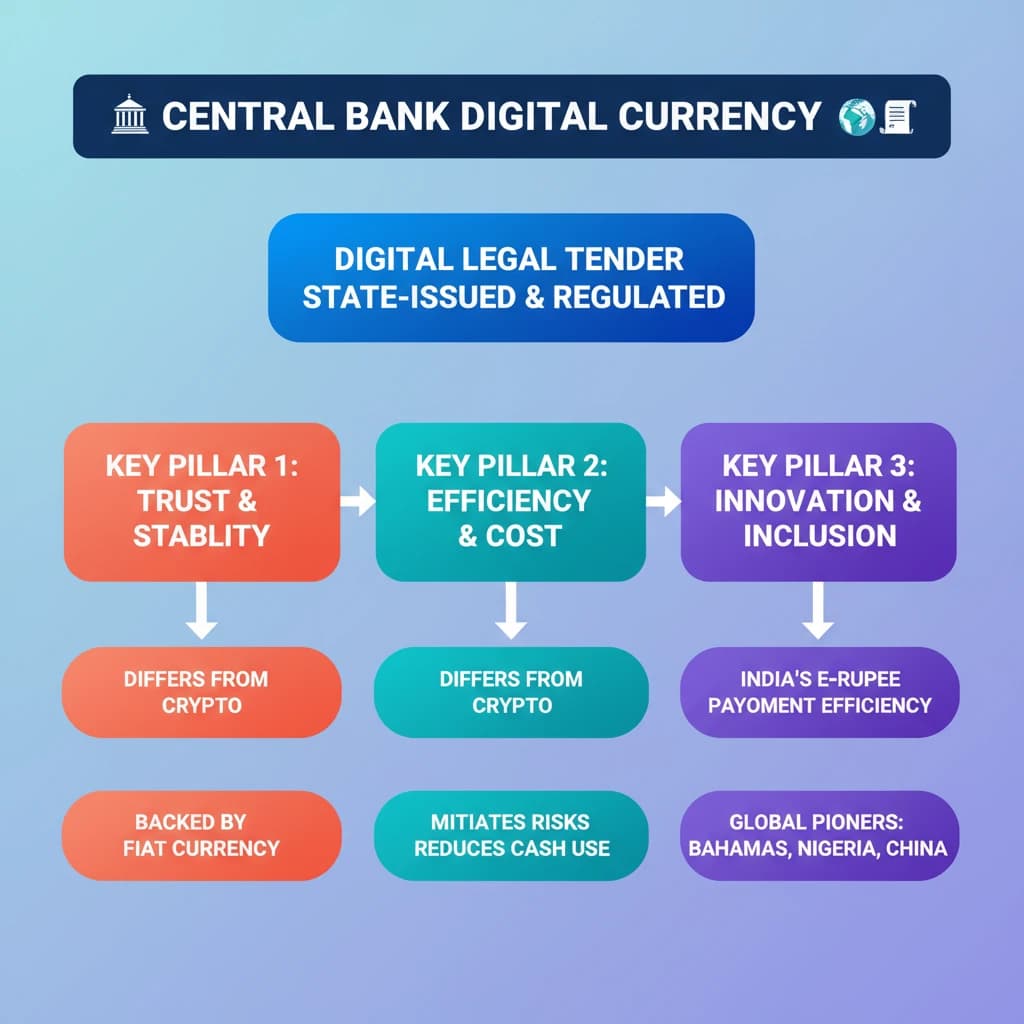
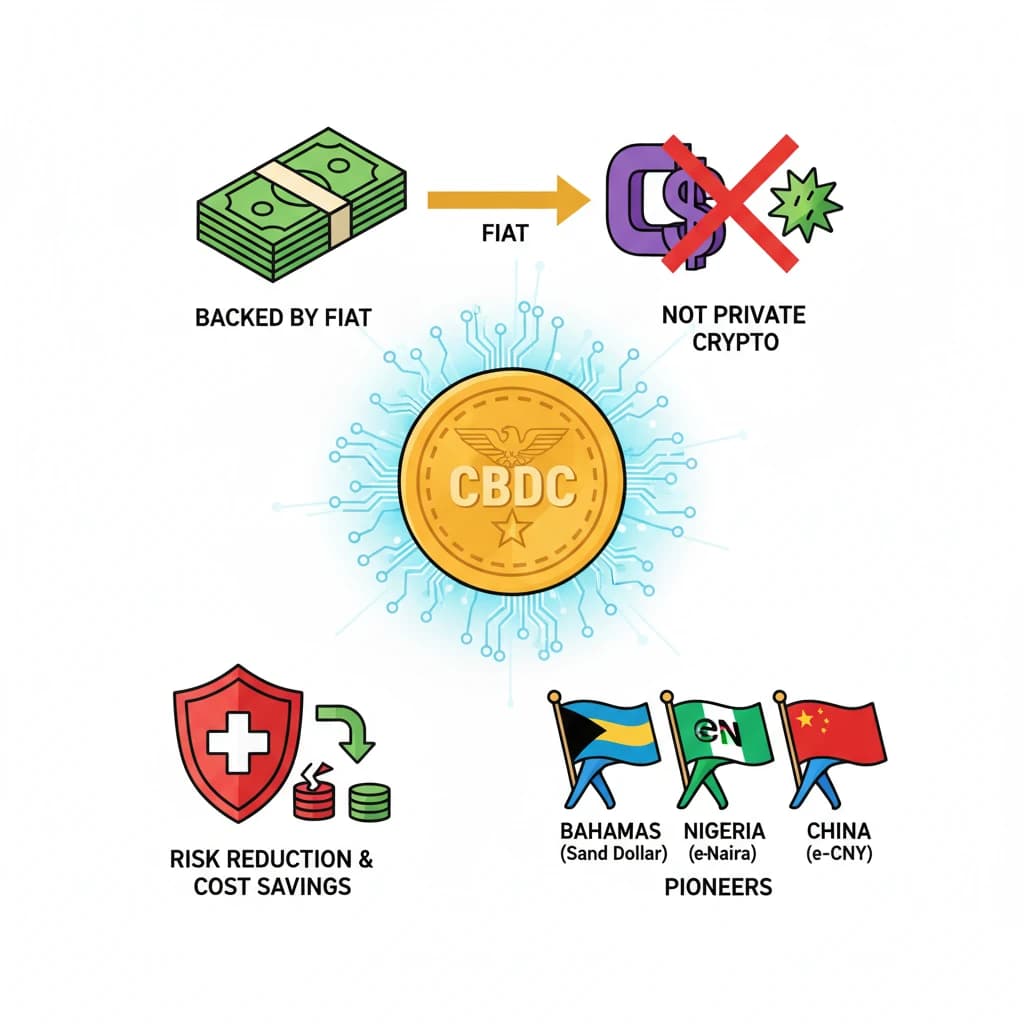
  • CBDC is a digital legal tender issued by a central bank, backed by fiat currency.
  • It differs from private cryptocurrencies by being state-issued and having legal tender status.
  • Key objectives include mitigating risks and reducing costs of physical currency.
  • Bahamas (Sand Dollar), Nigeria (eNaira), and China (e-CNY) are pioneers in CBDC adoption.
  • India's e-rupee aims for innovation, financial inclusion, and payment efficiency.
Central Bank Digital Currency

Central Bank Digital Currency

Easy⏱️ 7 min read✓ 98% Verified
economy

📖 Introduction

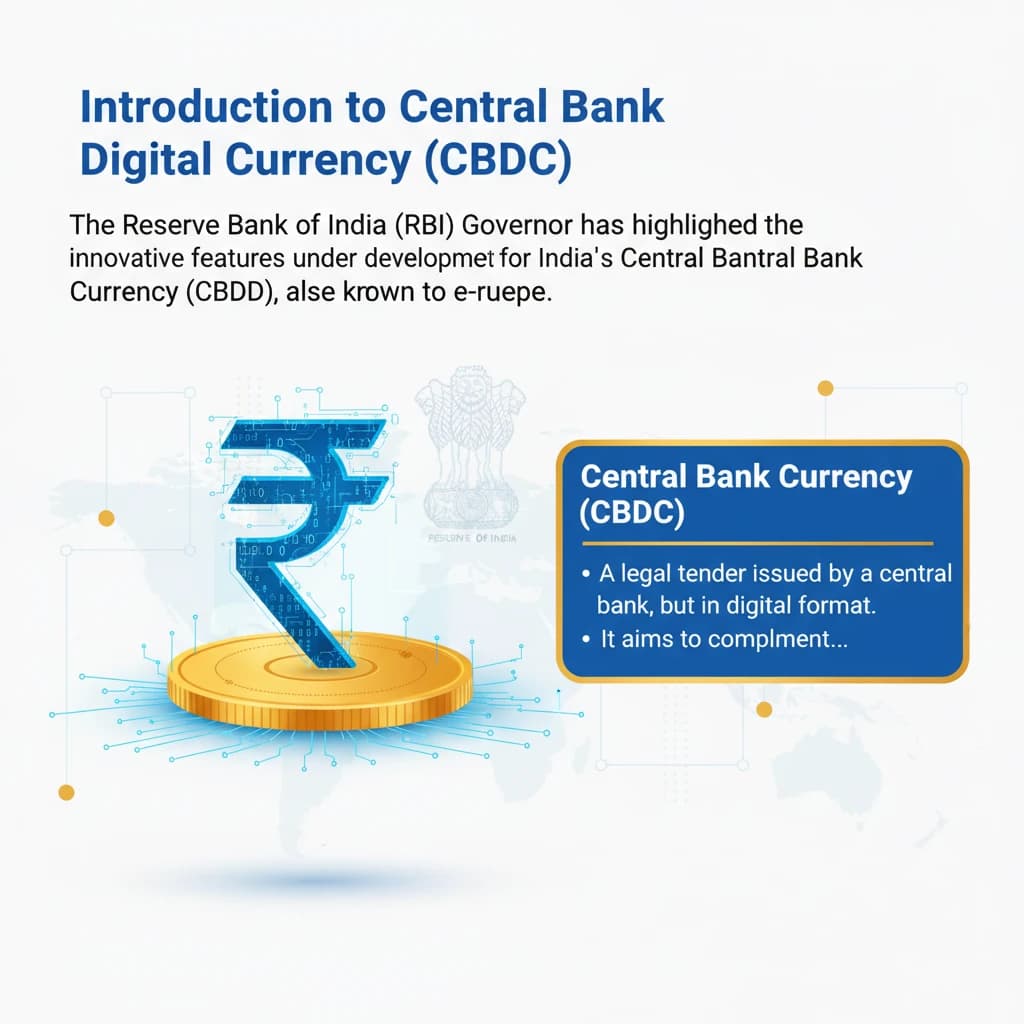
<h4>Introduction to Central Bank Digital Currency (CBDC)</h4><p>The <strong>Reserve Bank of India (RBI)</strong> Governor has highlighted the innovative features under development for <strong>India's Central Bank Digital Currency (CBDC)</strong>, also known as the <strong>e-rupee</strong>.</p><div class='key-point-box'><p>A <strong>Central Bank Digital Currency (CBDC)</strong> represents a <strong>legal tender</strong> issued by a <strong>central bank</strong>, but in a digital format. It aims to offer the benefits of digital payments while retaining the stability and trust associated with traditional <strong>fiat currency</strong>.</p></div><h4>What is a Central Bank Digital Currency (CBDC)?</h4><div class='info-box'><p>A <strong>CBDC</strong> is essentially a <strong>legal tender</strong> issued by a <strong>central bank</strong> in a digital form. It is distinct from private cryptocurrencies due to its backing by the central bank, which ensures its stability and public trust.</p></div><p>It functions identically to a <strong>fiat currency</strong> and is fully exchangeable on a one-to-one basis with its physical counterpart. This means one <strong>e-rupee</strong> would be equivalent to one physical <strong>Indian Rupee</strong>.</p><div class='info-box'><p>A <strong>fiat currency</strong> is defined as a national currency that is not pegged to the price of a physical commodity, such as <strong>gold</strong> or <strong>silver</strong>. Its value is derived from government decree and public trust.</p></div><p>While the concept of <strong>CBDCs</strong> was inspired by the emergence of cryptocurrencies like <strong>Bitcoin</strong>, they differ significantly. <strong>CBDCs</strong> are issued by the state and possess <strong>legal tender</strong> status, unlike decentralized virtual currencies and crypto assets.</p><h4>Objectives of CBDC</h4><p>The primary objective behind the introduction of <strong>CBDCs</strong> is multifaceted, focusing on efficiency and risk mitigation within the financial system.</p><ul><li>To <strong>mitigate risks</strong> associated with the handling and management of physical currency.</li><li>To <strong>trim costs</strong> involved in the printing, storage, distribution, and security of banknotes and coins.</li><li>To enhance the efficiency and security of payment systems.</li></ul><h4>Global Trends in CBDC Adoption</h4><p>Several countries have already taken significant steps towards launching or piloting their own <strong>CBDCs</strong>, showcasing a global shift towards digital sovereign currencies.</p><div class='info-box'><ul><li><strong>Bahamas</strong>: The first economy globally to launch a nationwide <strong>CBDC</strong>, named <strong>Sand Dollar</strong>, in <strong>2020</strong>.</li><li><strong>Nigeria</strong>: Rolled out its own digital currency, the <strong>eNaira</strong>, also in <strong>2020</strong>.</li><li><strong>China</strong>: Became the world's first major economy to pilot a digital currency, the <strong>e-CNY</strong>, in <strong>April 2020</strong>.</li></ul></div><div class='exam-tip-box'><p>For <strong>UPSC Prelims</strong>, remember the first countries to launch/pilot <strong>CBDCs</strong> and their respective names. The year <strong>2020</strong> is a significant common factor for early adoption.</p></div>
Concept Diagram

💡 Key Takeaways

  • •CBDC is a digital legal tender issued by a central bank, backed by fiat currency.
  • •It differs from private cryptocurrencies by being state-issued and having legal tender status.
  • •Key objectives include mitigating risks and reducing costs of physical currency.
  • •Bahamas (Sand Dollar), Nigeria (eNaira), and China (e-CNY) are pioneers in CBDC adoption.
  • •India's e-rupee aims for innovation, financial inclusion, and payment efficiency.

🧠 Memory Techniques
Memory Aid
98% Verified Content

Related Topics

Loading related topics...
Explore:Economy Topics·All Subjects·Daily Current Affairs·Editorial Analysis·Previous Year Questions·UPSC GPT
Central Bank Digital Currency - UPSC Economy