Loading page, please wait…
Vaidra Logo
Vaidra

Top 4 items + smart groups

UPSC GPT
New
Current Affairs
Daily Solutions
Daily Puzzle
Mains Evaluator

Version 2.0.0 • Built with ❤️ for UPSC aspirants

Loading...
Loading...
Loading...
Loading...
Loading...
Loading...
Loading...
Loading...
Loading...
Loading...
Loading...
Loading...
Loading...
Back
All Subjects

Topics

0 topics • 0 completed

Loading topics...
Loading...
Loading...
Loading...
Loading...
Loading...
Overall Progress0%

India’s Balance of Payments (BOP) - UPSC Economy

What is India’s Balance of Payments (BOP) in UPSC Economy?

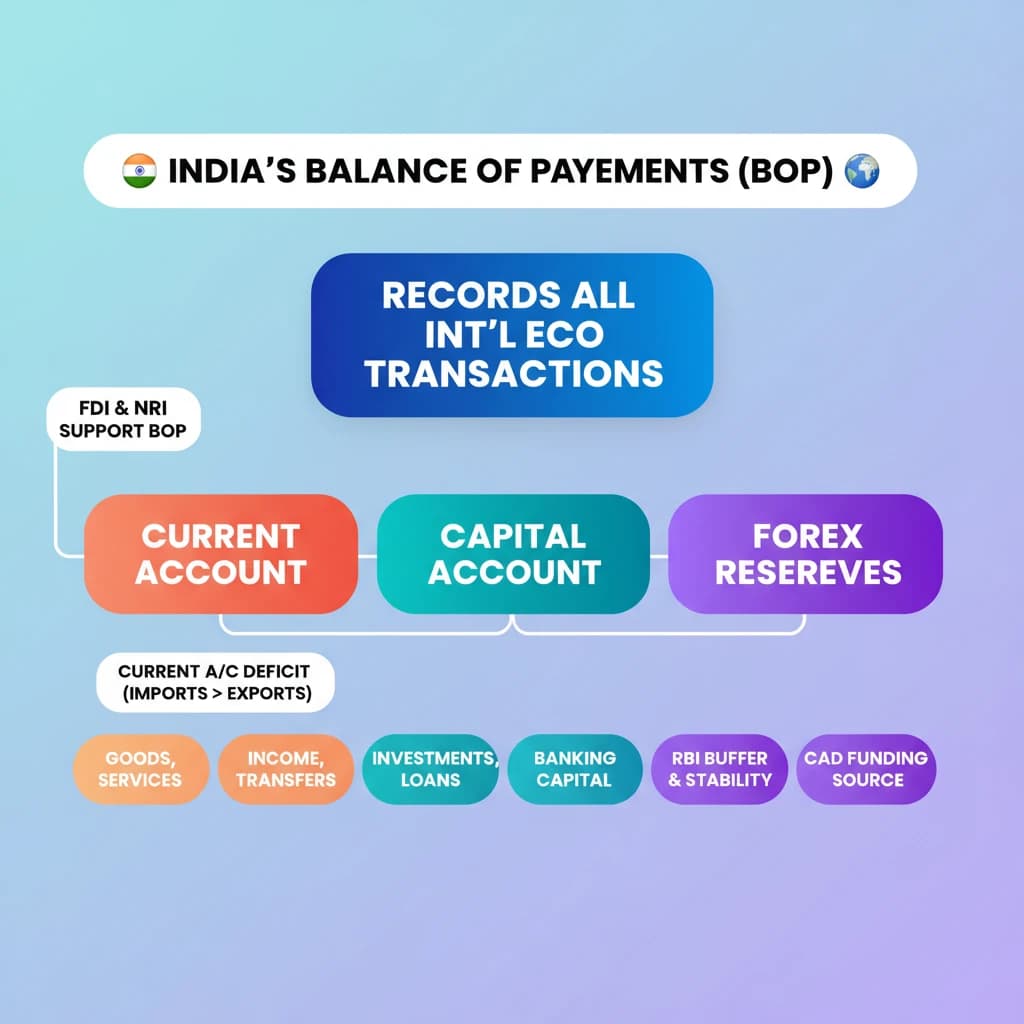
India’s Balance of Payments (BOP) is a key topic under Economy for UPSC Civil Services Examination. Key points include: <strong>Balance of Payments (BOP)</strong> records all international economic transactions of a country.. The two main components are the <strong>Current Account</strong> (goods, services, income, transfers) and <strong>Capital Account</strong> (investments, loans, banking capital).. A <strong>Current Account Deficit (CAD)</strong> occurs when imports and outflows exceed exports and inflows in the current account.. Understanding this topic is essential for both UPSC Prelims and Mains preparation.

Why is India’s Balance of Payments (BOP) important for UPSC exam?

India’s Balance of Payments (BOP) is a Medium-level topic in UPSC Economy. It is tested in both Prelims (factual MCQs) and Mains (analytical answer writing). Previous year UPSC questions have frequently covered aspects of India’s Balance of Payments (BOP), making it essential for comprehensive IAS preparation.

How to prepare India’s Balance of Payments (BOP) for UPSC?

To prepare India’s Balance of Payments (BOP) for UPSC: (1) Study the comprehensive notes covering all key concepts on Vaidra. (2) Practice previous year questions on this topic. (3) Connect it with current affairs using daily updates. (4) Revise using key takeaways and mind maps available for Economy. (5) Write practice answers linking India’s Balance of Payments (BOP) to related GS Paper topics.

Key takeaways of India’s Balance of Payments (BOP) for UPSC

  • <strong>Balance of Payments (BOP)</strong> records all international economic transactions of a country.
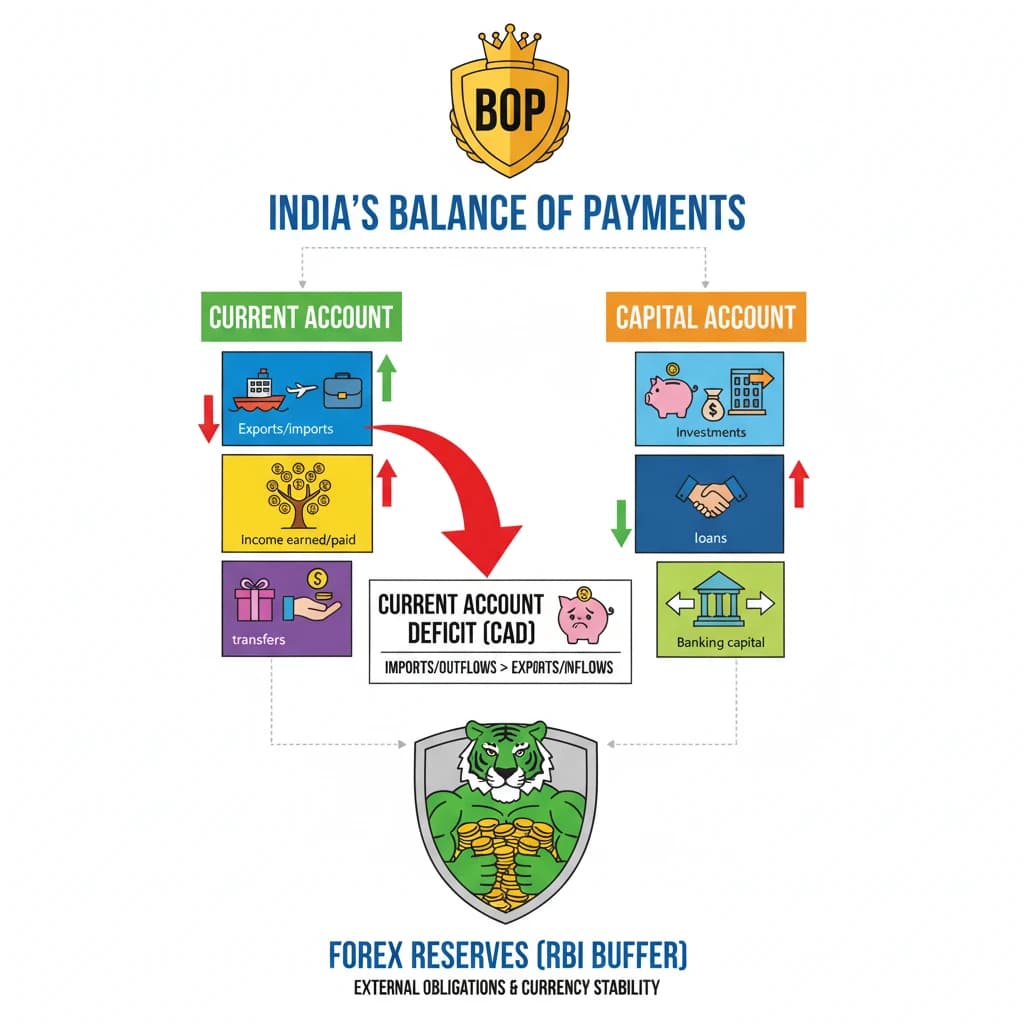
  • The two main components are the <strong>Current Account</strong> (goods, services, income, transfers) and <strong>Capital Account</strong> (investments, loans, banking capital).
  • A <strong>Current Account Deficit (CAD)</strong> occurs when imports and outflows exceed exports and inflows in the current account.
  • <strong>Forex Reserves</strong> held by the RBI act as a crucial buffer for external obligations and currency stability.
  • <strong>FDI</strong> and <strong>NRI remittances</strong> are significant sources of capital and current account inflows, respectively, supporting India's BOP.
India’s Balance of Payments (BOP)

India’s Balance of Payments (BOP)

Medium⏱️ 10 min read✓ 95% Verified
economy

📖 Introduction

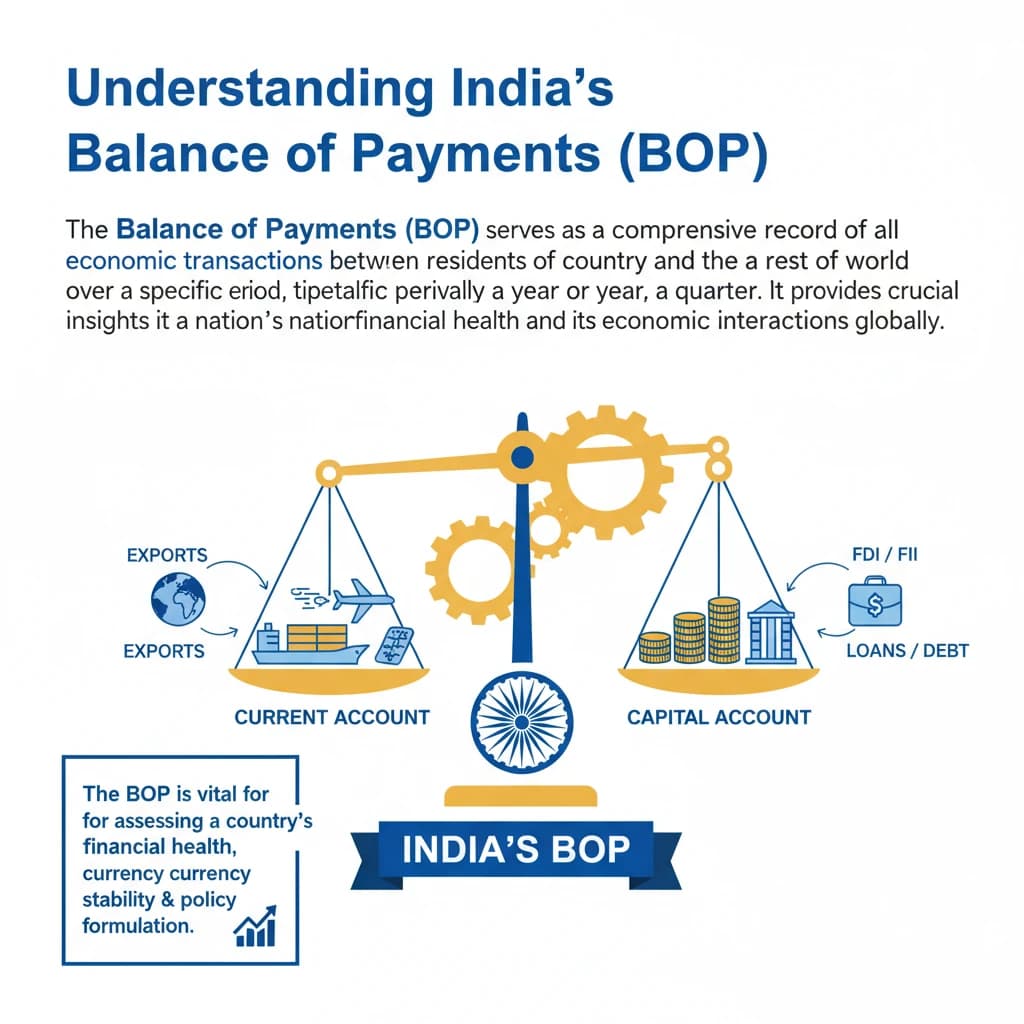
<h4>Understanding India's Balance of Payments (BOP)</h4><p>The <strong>Balance of Payments (BOP)</strong> serves as a comprehensive record of all <strong>economic transactions</strong> between residents of a country and the rest of the world over a specific period, typically a year or a quarter. It provides crucial insights into a nation's financial health and its economic interactions globally.</p><div class='key-point-box'><p>The <strong>BOP</strong> is vital for assessing a country's <strong>economic stability</strong>. It reflects the relative demand for its domestic currency against foreign currencies, directly influencing <strong>exchange rates</strong> and international trade dynamics.</p></div><h4>Recent Trends: India's Current Account Deficit (CAD)</h4><p>According to recent <strong>Reserve Bank of India (RBI) data</strong>, India's <strong>Current Account Deficit (CAD)</strong> experienced a marginal widening. In <strong>Q1 of 2025</strong>, the CAD stood at <strong>USD 9.7 billion</strong>, representing <strong>1.1% of GDP</strong>. This figure is a key indicator reflecting the overall status of India's <strong>Balance of Payments</strong>.</p><div class='info-box'><p>A <strong>Current Account Deficit (CAD)</strong> arises when the total value of <strong>goods and services imported</strong> by a country, along with <strong>net transfers and factor income outflows</strong>, exceeds the total value of its <strong>exports of goods and services</strong> and inflows.</p></div><h4>Key Constituents of BOP: Current Account</h4><p>The <strong>Balance of Payments (BOP)</strong> is primarily divided into two major components: the <strong>Current Account</strong> and the <strong>Capital Account</strong>. The <strong>Current Account</strong> records transactions that do not lead to a change in the country's assets or liabilities.</p><ul><li><strong>Merchandise Trade:</strong> This component covers the physical <strong>exports and imports of goods</strong>. The balance of merchandise trade, often referred to as the <strong>Balance of Trade</strong>, indicates whether a country is a net exporter or importer of physical goods. A deficit here suggests higher imports than exports.</li><li><strong>Invisibles:</strong> This broad category includes three sub-components:<ul><li><strong>Services:</strong> Encompasses trade in non-physical items like <strong>banking, insurance, IT services, tourism, and transport</strong>. India is often a net exporter in IT and related services.</li><li><strong>Factor Income:</strong> Refers to income generated from factors of production. This includes <strong>interest</strong> earned on foreign investments, <strong>compensation of employees</strong> working abroad (e.g., remittances from Indian workers), and <strong>dividends</strong> from investments in foreign assets.</li><li><strong>Transfers:</strong> These are one-way transactions, meaning they do not involve any quid pro quo. Examples include <strong>gifts, grants</strong> received or given, and crucial <strong>remittances</strong> sent by non-resident Indians (NRIs) to their families in India.</li></ul></li></ul><h4>Key Constituents of BOP: Capital Account</h4><p>The <strong>Capital Account</strong> reflects the net change in a nation's <strong>assets and liabilities</strong> over a specific period. It records all international transactions that involve the acquisition or disposal of financial assets and liabilities.</p><ul><li><strong>Foreign Investment:</strong> This is a significant driver of capital flows, reflecting investments that are essential for economic growth and stability. It includes:<ul><li><strong>Foreign Direct Investment (FDI):</strong> Long-term investments in physical assets and controlling stakes in domestic companies.</li><li><strong>Foreign Portfolio Investment (FPI):</strong> Short-term, liquid investments in stocks, bonds, and other financial assets.</li></ul></li><li><strong>Loans:</strong> This category covers various forms of international borrowing and lending, such as <strong>External Commercial Borrowings (ECBs)</strong> by Indian companies from foreign sources.</li><li><strong>Banking Capital:</strong> Includes transactions related to the banking sector, prominently featuring <strong>Non-Resident Indian (NRI) deposits</strong> held in Indian banks, which are a crucial source of foreign currency.</li></ul><div class='exam-tip-box'><p>For <strong>UPSC Mains (GS Paper III - Economy)</strong>, understanding the components of <strong>Current Account</strong> and <strong>Capital Account</strong> is crucial. Be prepared to analyze how different global events (e.g., oil price hikes, global recessions, interest rate changes) impact specific sub-components and the overall <strong>BOP</strong>.</p></div><h4>India's Forex Reserves: A Vital Cushion</h4><p><strong>Indian forex reserves</strong> are essential assets held by the <strong>Reserve Bank of India (RBI)</strong> primarily in foreign currencies. They act as a critical financial buffer for the nation.</p><div class='info-box'><p>These reserves ensure <strong>liquidity</strong> to meet external obligations, such as import payments and debt servicing. They also play a pivotal role in <strong>stabilizing the nation's currency</strong> (the Rupee) and the broader economy by allowing the RBI to intervene in the foreign exchange market.</p></div><p>The primary components of India's <strong>Forex Reserves</strong> include:</p><ul><li><strong>Foreign Currencies:</strong> Predominantly strong currencies such as the <strong>US Dollar, Euro, and British Pound</strong>. These provide the necessary liquidity for international trade and financial transactions.</li><li>Other components, though not detailed in the source, typically include <strong>Gold, Special Drawing Rights (SDRs)</strong>, and <strong>Reserve Tranche Position (RTP)</strong> with the IMF.</li></ul>
Concept Diagram

💡 Key Takeaways

  • •<strong>Balance of Payments (BOP)</strong> records all international economic transactions of a country.
  • •The two main components are the <strong>Current Account</strong> (goods, services, income, transfers) and <strong>Capital Account</strong> (investments, loans, banking capital).
  • •A <strong>Current Account Deficit (CAD)</strong> occurs when imports and outflows exceed exports and inflows in the current account.
  • •<strong>Forex Reserves</strong> held by the RBI act as a crucial buffer for external obligations and currency stability.
  • •<strong>FDI</strong> and <strong>NRI remittances</strong> are significant sources of capital and current account inflows, respectively, supporting India's BOP.

🧠 Memory Techniques
Memory Aid
95% Verified Content

📚 Reference Sources

•Economic Survey of India (Ministry of Finance)
•International Monetary Fund (IMF) Reports on India
•Drishti IAS Economy Notes (provided source)

Related Topics

Loading related topics...
Explore:Economy Topics·All Subjects·Daily Current Affairs·Editorial Analysis·Previous Year Questions·UPSC GPT
India’s Balance of Payments (BOP) - UPSC Economy