Loading page, please wait…
Vaidra Logo
Vaidra

Top 4 items + smart groups

UPSC GPT
New
Current Affairs
Daily Solutions
Daily Puzzle
Mains Evaluator

Version 2.0.0 • Built with ❤️ for UPSC aspirants

Loading...
Loading...
Loading...
Loading...
Loading...
Loading...
Loading...
Loading...
Loading...
Loading...
Loading...
Loading...
Loading...
Back
All Subjects

Topics

0 topics • 0 completed

Loading topics...
Loading...
Loading...
Loading...
Loading...
Loading...
Overall Progress0%

National Bank for Agriculture and Rural Development (NABARD) - UPSC Economy

What is National Bank for Agriculture and Rural Development (NABARD) in UPSC Economy?

National Bank for Agriculture and Rural Development (NABARD) is a key topic under Economy for UPSC Civil Services Examination. Key points include: NABARD is India's apex development bank for agriculture and rural development, established in 1982.. It provides refinance, promotes rural infrastructure (RIDF), and supervises rural credit institutions.. Key functions include credit, development, and supervision, aimed at strengthening rural economy.. Understanding this topic is essential for both UPSC Prelims and Mains preparation.

Why is National Bank for Agriculture and Rural Development (NABARD) important for UPSC exam?

National Bank for Agriculture and Rural Development (NABARD) is a Medium-level topic in UPSC Economy. It is tested in both Prelims (factual MCQs) and Mains (analytical answer writing). Previous year UPSC questions have frequently covered aspects of National Bank for Agriculture and Rural Development (NABARD), making it essential for comprehensive IAS preparation.

How to prepare National Bank for Agriculture and Rural Development (NABARD) for UPSC?

To prepare National Bank for Agriculture and Rural Development (NABARD) for UPSC: (1) Study the comprehensive notes covering all key concepts on Vaidra. (2) Practice previous year questions on this topic. (3) Connect it with current affairs using daily updates. (4) Revise using key takeaways and mind maps available for Economy. (5) Write practice answers linking National Bank for Agriculture and Rural Development (NABARD) to related GS Paper topics.

Key takeaways of National Bank for Agriculture and Rural Development (NABARD) for UPSC

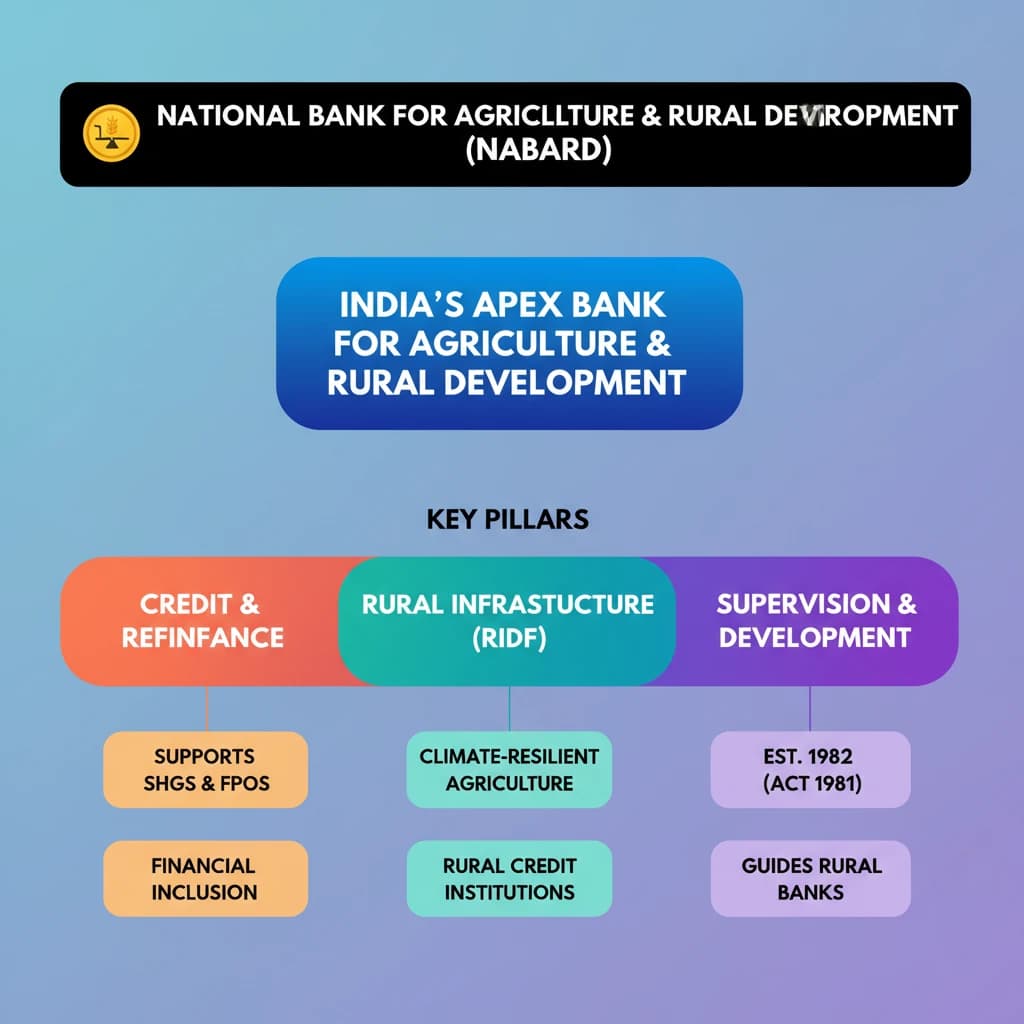
  • NABARD is India's apex development bank for agriculture and rural development, established in 1982.
  • It provides refinance, promotes rural infrastructure (RIDF), and supervises rural credit institutions.
  • Key functions include credit, development, and supervision, aimed at strengthening rural economy.
  • NHB, SIDBI, and NaBFID are other specialized DFIs for housing, MSMEs, and infrastructure respectively.
  • NABARD plays a vital role in financial inclusion, supporting SHGs, FPOs, and climate-resilient agriculture.
National Bank for Agriculture and Rural Development (NABARD)

National Bank for Agriculture and Rural Development (NABARD)

Medium⏱️ 8 min read✓ 98% Verified
economy

📖 Introduction

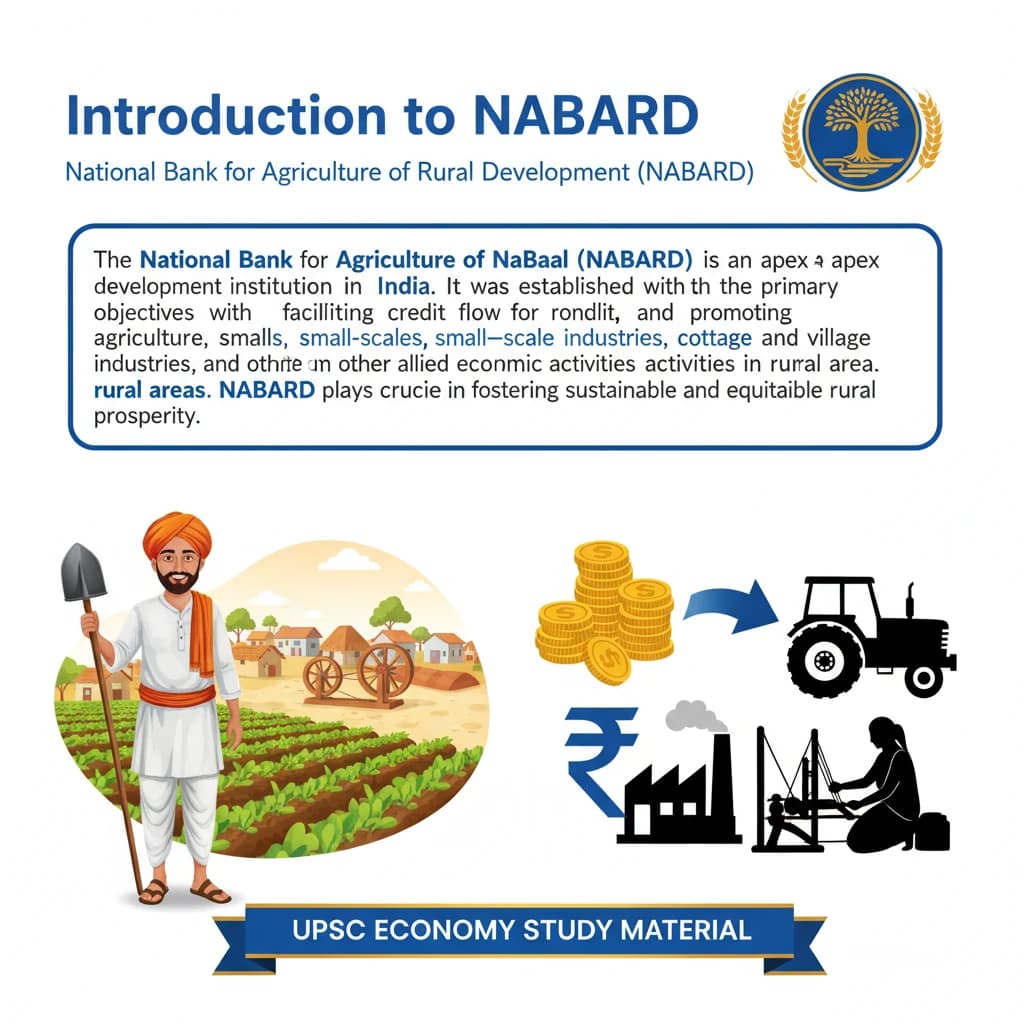
<h4>Introduction to NABARD</h4><p>The <strong>National Bank for Agriculture and Rural Development (NABARD)</strong> is an apex development financial institution in India. It was established with the primary objective of facilitating credit flow for promoting and developing agriculture, small-scale industries, cottage and village industries, handicrafts, and other allied economic activities in rural areas. NABARD plays a crucial role in fostering sustainable and equitable rural prosperity.</p><div class='key-point-box'><p><strong>Key Role:</strong> NABARD serves as an <strong>apex regulatory body</strong> for overall regulation and licensing of regional rural banks and cooperative banks in India.</p></div><h4>Genesis and Mandate</h4><p>NABARD was established on <strong>July 12, 1982</strong>, based on the recommendations of the <strong>B. Sivaraman Committee (Committee to Review the Arrangements for Institutional Credit for Agriculture and Rural Development - CRAFICARD)</strong>. It took over the agricultural credit functions of the <strong>Reserve Bank of India (RBI)</strong> and the refinance functions of the erstwhile <strong>Agricultural Refinance and Development Corporation (ARDC)</strong> and the <strong>Rural Planning and Credit Cell (RPCC)</strong> of RBI.</p><div class='info-box'><p><strong>Establishment Details:</strong><ul><li><strong>Date of Establishment:</strong> July 12, 1982</li><li><strong>Act:</strong> National Bank for Agriculture and Rural Development Act, 1981</li><li><strong>Initial Capital:</strong> ₹100 crore (fully subscribed by Government of India and RBI)</li><li><strong>Current Ownership:</strong> Wholly owned by the <strong>Government of India</strong> since 2017.</li></ul></p></div><h4>Core Functions of NABARD</h4><p>NABARD performs a wide range of functions, broadly categorized into three areas: <strong>Credit Functions</strong>, <strong>Developmental Functions</strong>, and <strong>Supervisory Functions</strong>. These functions are aimed at strengthening the rural credit delivery system and promoting integrated rural development.</p><ul><li><strong>Refinance Facilities:</strong> Provides refinance to various financial institutions that extend credit for agriculture and rural development. This ensures liquidity for these institutions.</li><li><strong>Rural Infrastructure Development:</strong> Manages funds like the <strong>Rural Infrastructure Development Fund (RIDF)</strong> to finance infrastructure projects in rural areas.</li><li><strong>Institutional Development:</strong> Works towards strengthening the rural credit institutions, including cooperative banks and Regional Rural Banks (RRBs), through training, capacity building, and policy formulation.</li><li><strong>Supervision:</strong> Exercises supervisory powers over cooperative banks and RRBs to ensure their sound functioning and adherence to prudential norms.</li><li><strong>Research and Development:</strong> Undertakes research and studies related to agriculture and rural development to inform policy and strategy.</li></ul><h4>Other Specialized Financial Institutions in India</h4><p>Apart from NABARD, India has several other specialized financial institutions, each catering to specific sectors or developmental needs. These institutions play a crucial role in the country's economic development by providing targeted financial support and regulatory oversight.</p><div class='info-box'><p><strong>National Housing Bank (NHB):</strong> An apex financial institution for housing. It was established in <strong>1988</strong> under the <strong>National Housing Bank Act, 1987</strong>, to promote a sound, healthy, viable, and efficient housing finance system in the country and to regulate the activities of housing finance companies.</p></div><div class='info-box'><p><strong>Small Industries Development Bank of India (SIDBI):</strong> Established in <strong>1990</strong> under an Act of the Indian Parliament, SIDBI is the principal financial institution for the promotion, financing, and development of the <strong>Micro, Small and Medium Enterprises (MSME)</strong> sector. It also coordinates the functions of institutions engaged in similar activities.</p></div><div class='info-box'><p><strong>National Bank for Financing Infrastructure and Development (NaBFID):</strong> Constituted in <strong>2021</strong> under the <strong>NaBFID Act, 2021</strong>, as a Development Financial Institution (DFI). Its primary objective is to finance infrastructure projects, both greenfield and brownfield, and to catalyze investment in the infrastructure sector in India.</p></div><div class='exam-tip-box'><p><strong>UPSC Relevance:</strong> Understanding the roles of <strong>NABARD, NHB, SIDBI, and NaBFID</strong> is vital for <strong>GS Paper III (Indian Economy)</strong>. Questions often relate to their mandates, functions, and impact on specific sectors like agriculture, housing, MSMEs, and infrastructure. Differentiate their specific areas of focus.</p></div>
Concept Diagram

💡 Key Takeaways

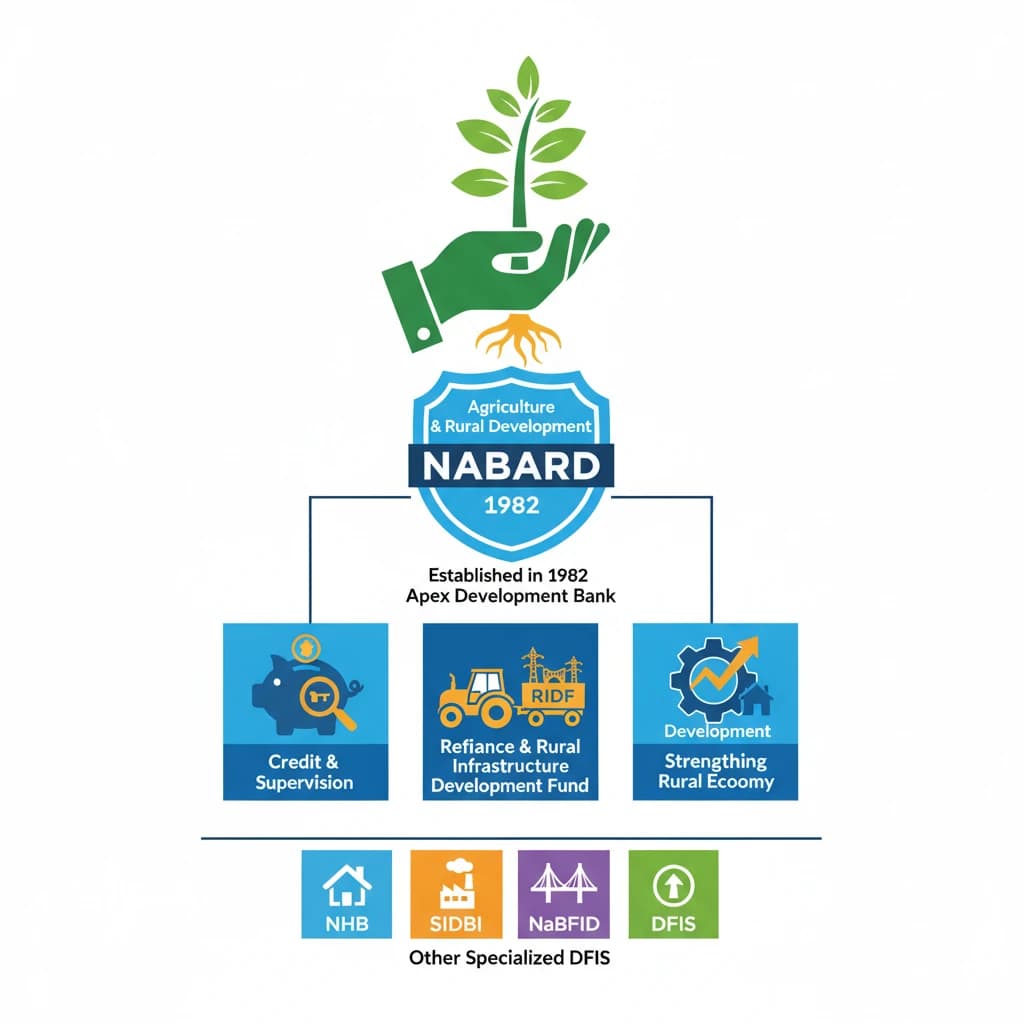
  • •NABARD is India's apex development bank for agriculture and rural development, established in 1982.
  • •It provides refinance, promotes rural infrastructure (RIDF), and supervises rural credit institutions.
  • •Key functions include credit, development, and supervision, aimed at strengthening rural economy.
  • •NHB, SIDBI, and NaBFID are other specialized DFIs for housing, MSMEs, and infrastructure respectively.
  • •NABARD plays a vital role in financial inclusion, supporting SHGs, FPOs, and climate-resilient agriculture.

🧠 Memory Techniques
Memory Aid
98% Verified Content

📚 Reference Sources

•Reserve Bank of India (RBI) Publications
•Economic Survey of India
•Ministry of Finance, Government of India Documents

Related Topics

Loading related topics...
Explore:Economy Topics·All Subjects·Daily Current Affairs·Editorial Analysis·Previous Year Questions·UPSC GPT
National Bank for Agriculture and Rural Development (NABARD) - UPSC Economy