📖 Introduction
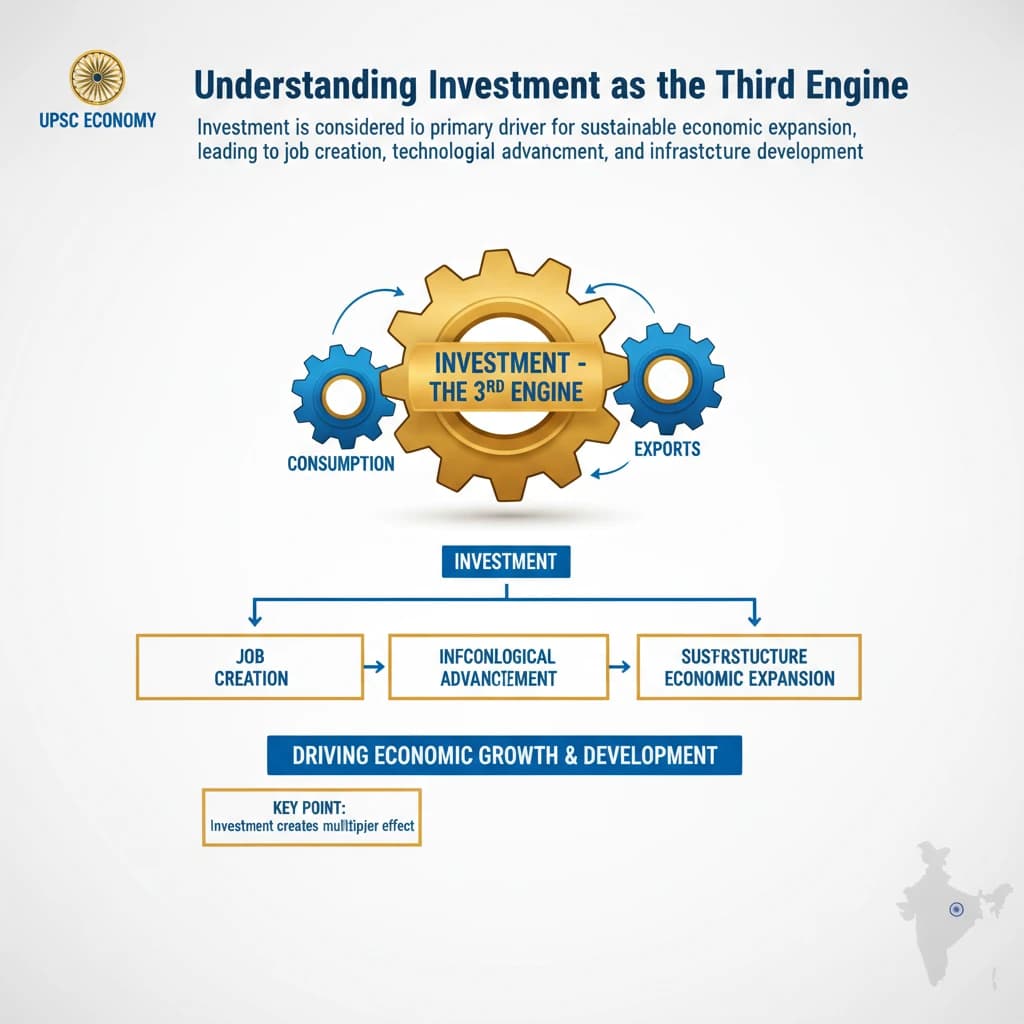
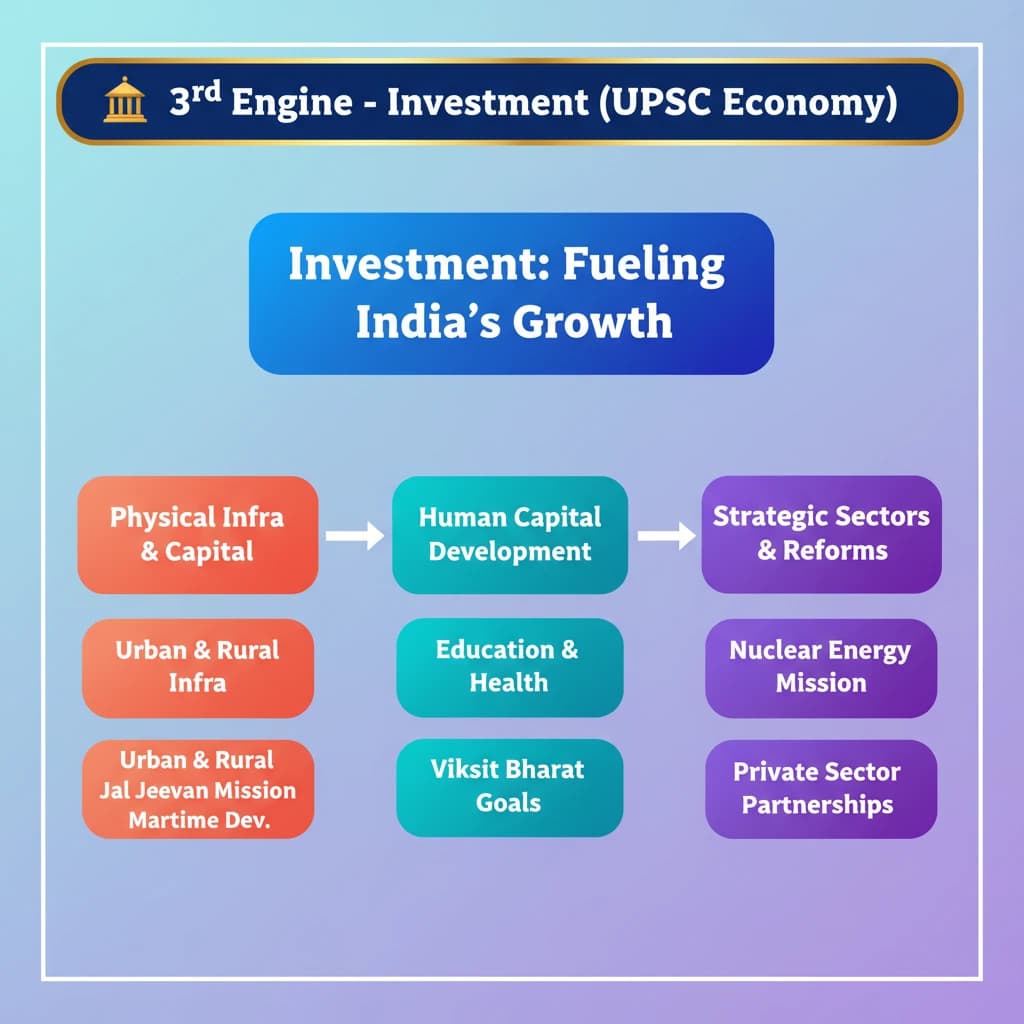
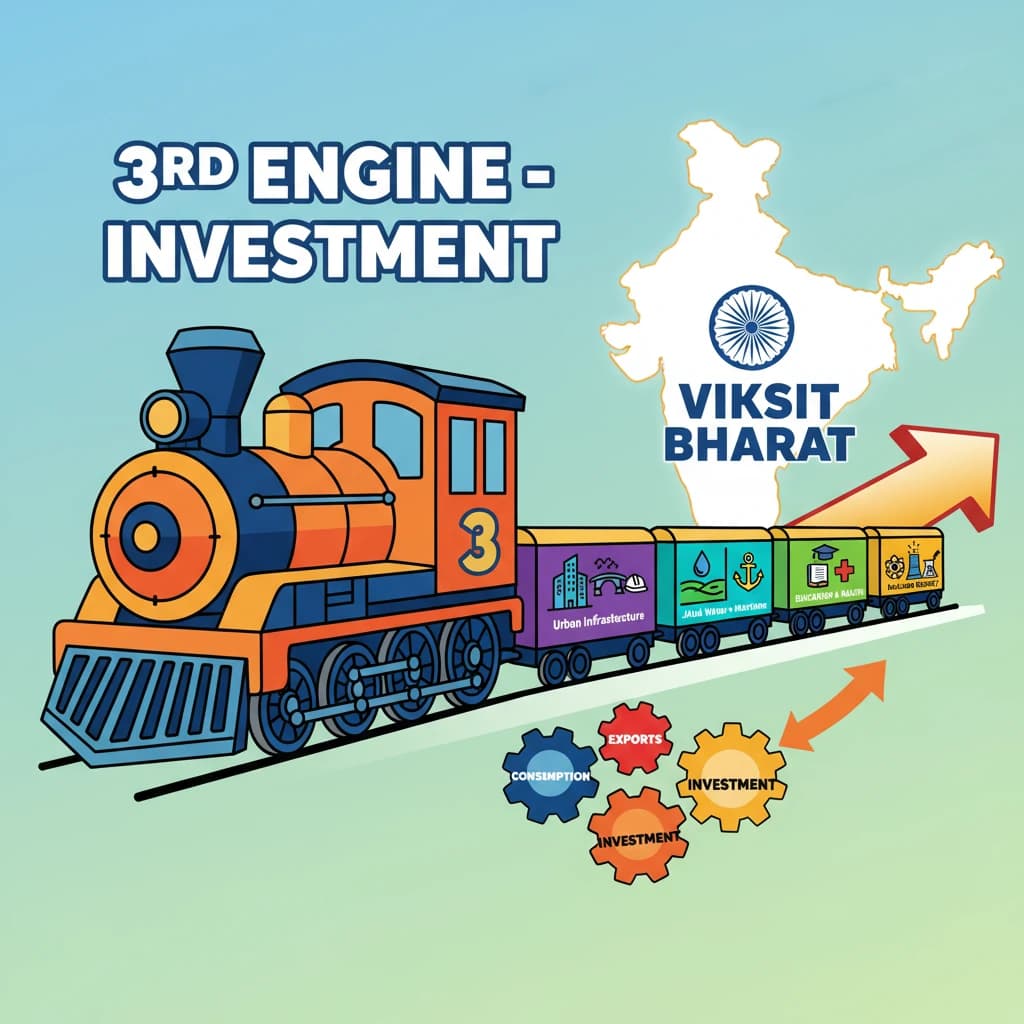
<h4>Understanding Investment as the Third Engine</h4><p>The concept of <strong>Investment as the 3rd Engine</strong> highlights its crucial role in driving economic growth and development, alongside consumption and exports. The government's focus on boosting investment aims to create a multiplier effect across various sectors.</p><div class='key-point-box'><p><strong>Investment</strong> is considered a primary driver for sustainable economic expansion, leading to job creation, technological advancement, and enhanced productivity.</p></div><h4>Urban Challenge Fund</h4><p>The <strong>Urban Challenge Fund</strong> is a significant initiative designed to bolster urban development. An allocation of <strong>₹1 lakh crore</strong> has been made to support cities across India.</p><div class='info-box'><p><strong>Key Focus Areas:</strong></p><ul><li><strong>Cities as Growth Hubs:</strong> Promoting urban centers as engines of economic activity.</li><li><strong>Creative Redevelopment of Cities:</strong> Encouraging innovative approaches to urban planning and infrastructure.</li><li><strong>Water and Sanitation:</strong> Improving essential services for urban populations.</li></ul></div><p>For the fiscal year <strong>2025-26</strong>, a specific allocation of <strong>₹10,000 crore</strong> has been earmarked for this fund, demonstrating a phased approach to investment.</p><h4>Jal Jeevan Mission (JJM)</h4><p>The <strong>Jal Jeevan Mission (JJM)</strong> is a flagship program focused on providing safe and adequate drinking water through individual household tap connections in rural India. Its budget outlay has been substantially enhanced.</p><div class='info-box'><p><strong>Mission Details:</strong></p><ul><li><strong>Total Budget Outlay:</strong> Enhanced to <strong>₹67,000 Crore</strong>.</li><li><strong>Extension:</strong> Mission extended till <strong>2028</strong> to achieve its universal coverage goals.</li><li><strong>Objective:</strong> Ensuring <strong>universal piped water coverage</strong>, with increased funding specifically for rural water projects.</li></ul></div><p>Currently, the mission has benefited <strong>15 crore households</strong>, which represents approximately <strong>80% of India’s rural population</strong>, significantly improving access to potable water.</p><h4>Maritime Development Fund (MDF)</h4><p>The <strong>Maritime Development Fund (MDF)</strong> is established to provide long-term financing for critical infrastructure within the maritime sector. This includes shipbuilding, port development, and other related facilities.</p><div class='info-box'><p><strong>Fund Structure:</strong></p><ul><li><strong>Total Fund Size:</strong> <strong>₹25,000 crore</strong>.</li><li><strong>Government Contribution:</strong> The government contributes <strong>49%</strong> of the total fund.</li><li><strong>Purpose:</strong> Supports long-term financing for <strong>shipbuilding</strong>, <strong>ports</strong>, and broader <strong>maritime infrastructure</strong> development.</li></ul></div><p>This fund is crucial for enhancing India's maritime capabilities and boosting trade logistics.</p><h4>Expansion of IITs</h4><p>To strengthen India's technical education landscape, there are plans for the <strong>Expansion of IITs</strong>. This initiative aims to increase the capacity of these premier institutions.</p><div class='info-box'><p><strong>Capacity Enhancement:</strong></p><ul><li>Provision for <strong>additional infrastructure</strong> to accommodate <strong>6,500 more students</strong>.</li><li>This expansion is vital for boosting India’s overall <strong>technical education capacity</strong> and producing a skilled workforce.</li></ul></div><h4>PM Research Fellowship</h4><p>The <strong>PM Research Fellowship</strong> scheme is designed to promote advanced research and innovation within India's top educational institutions. It provides support to promising researchers.</p><div class='info-box'><p><strong>Fellowship Details:</strong></p><ul><li><strong>Number of Fellowships:</strong> <strong>10,000 fellowships</strong>.</li><li><strong>Institutions:</strong> Offered for advanced research in <strong>IITs</strong> and <strong>IISc</strong> (Indian Institute of Science).</li></ul></div><p>This initiative aims to foster a strong research ecosystem and encourage cutting-edge scientific work.</p><h4>Day Care Cancer Centers</h4><p>To improve accessibility to affordable cancer treatment, <strong>Day Care Cancer Centers</strong> are being established across the country. This is a significant step in healthcare infrastructure.</p><div class='info-box'><p><strong>Rollout Plan:</strong></p><ul><li>To be set up in <strong>all district hospitals</strong> within the next <strong>3 years</strong>.</li><li><strong>Initial Phase (2025-26):</strong> <strong>200 Centres</strong> will become operational.</li></ul></div><p>These centers will ensure that affordable cancer treatment is more readily available, especially in non-metro areas.</p><h4>Bharatiya Bhasha Pustak Scheme</h4><p>The <strong>Bharatiya Bhasha Pustak Scheme</strong> focuses on enhancing educational accessibility through digital resources. It aims to bridge language barriers in learning.</p><div class='info-box'><p><strong>Scheme Objective:</strong></p><ul><li>Provides <strong>digital Indian language books</strong>.</li><li>Enhances accessibility for both <strong>school and higher education</strong>, making learning resources available in regional languages.</li></ul></div><h4>Nuclear Energy Mission for Viksit Bharat</h4><p>India is committed to expanding its nuclear energy capabilities with the launch of the <strong>Nuclear Energy Mission for Viksit Bharat</strong>. This mission focuses on advanced reactor technologies.</p><div class='info-box'><p><strong>Mission Components:</strong></p><ul><li><strong>Outlay:</strong> A substantial <strong>₹20,000 crore</strong> allocation.</li><li><strong>Focus:</strong> Development of <strong>Small Modular Reactors (SMRs)</strong>.</li><li><strong>Target:</strong> At least <strong>5 indigenously developed SMRs</strong> to be operational by <strong>2033</strong>.</li></ul></div><p>To facilitate this, amendments to the <strong>Atomic Energy Act</strong> and the <strong>Civil Liability for Nuclear Damage Act</strong> will be undertaken. These amendments aim to foster active partnership with the <strong>private sector</strong> in nuclear energy development.</p><h4>UDAN - Regional Connectivity Scheme</h4><p>The <strong>UDAN (Ude Desh ka Aam Nagrik) - Regional Connectivity Scheme</strong> is being revised to further enhance air travel accessibility across India. It focuses on connecting underserved regions.</p><div class='info-box'><p><strong>Revised Scheme Goals:</strong></p><ul><li><strong>New Destinations:</strong> Will enhance regional connectivity to <strong>120 new destinations</strong>.</li><li><strong>Passenger Target:</strong> Aims to carry <strong>4 crore passengers</strong> over the next <strong>five years</strong>.</li></ul></div><p>This scheme is pivotal for boosting tourism, trade, and economic activity in smaller towns and cities.</p>