Loading page, please wait…
Features of the SGrB - UPSC Economy
What is Features of the SGrB in UPSC Economy?
Features of the SGrB is a key topic under Economy for UPSC Civil Services Examination. Key points include: Sovereign Green Bonds (SGrB) fund eco-friendly projects, issued via Uniform Price Auction, eligible for Repo and SLR, and tradable.. SGrB proceeds are managed by the Ministry of Finance and audited by CAG, strengthening Indian currency by attracting green investors.. Sovereign Gold Bonds (SGB) scheme (Nov 2015) aims to reduce physical gold demand by offering gold-denominated government securities.. Understanding this topic is essential for both UPSC Prelims and Mains preparation.
Why is Features of the SGrB important for UPSC exam?
Features of the SGrB is a Medium-level topic in UPSC Economy. It is tested in both Prelims (factual MCQs) and Mains (analytical answer writing). Previous year UPSC questions have frequently covered aspects of Features of the SGrB, making it essential for comprehensive IAS preparation.
How to prepare Features of the SGrB for UPSC?
To prepare Features of the SGrB for UPSC: (1) Study the comprehensive notes covering all key concepts on Vaidra. (2) Practice previous year questions on this topic. (3) Connect it with current affairs using daily updates. (4) Revise using key takeaways and mind maps available for Economy. (5) Write practice answers linking Features of the SGrB to related GS Paper topics.
Key takeaways of Features of the SGrB for UPSC
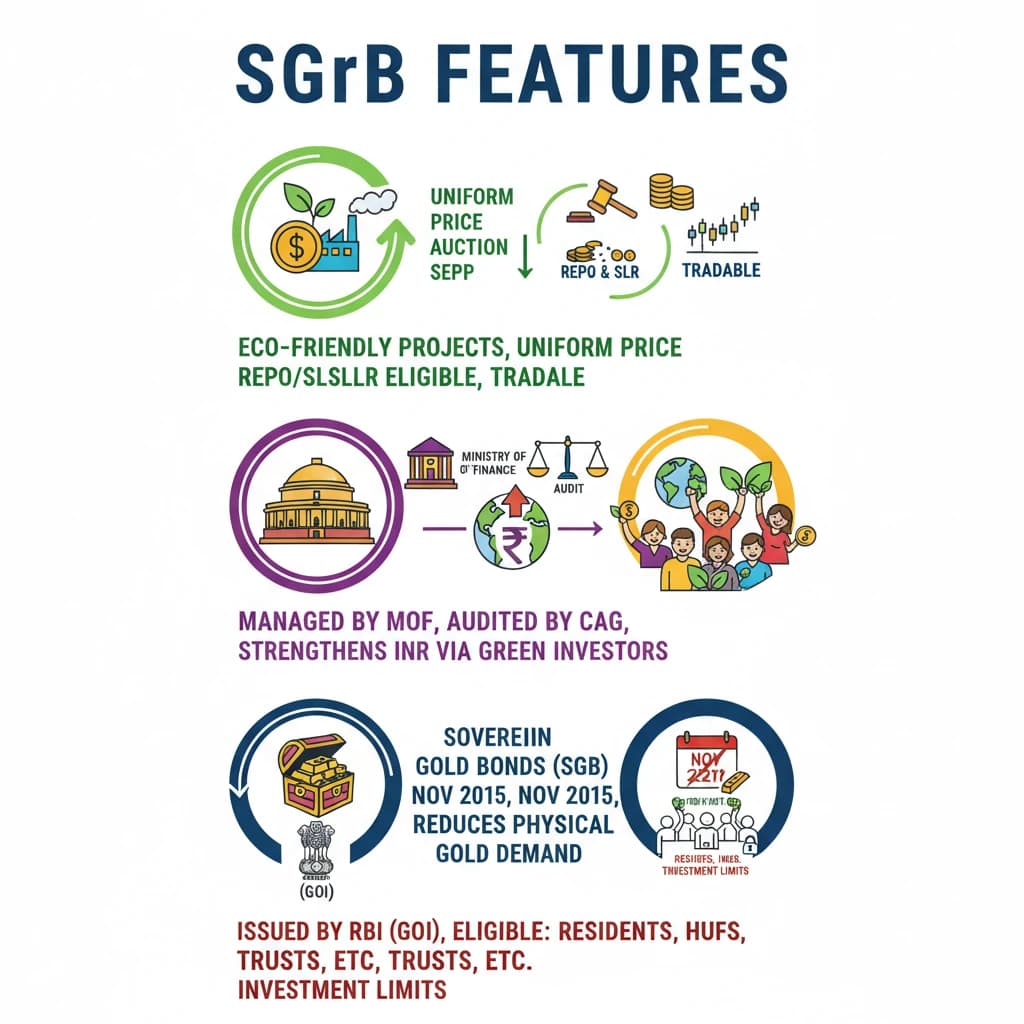
- Sovereign Green Bonds (SGrB) fund eco-friendly projects, issued via Uniform Price Auction, eligible for Repo and SLR, and tradable.
- SGrB proceeds are managed by the Ministry of Finance and audited by CAG, strengthening Indian currency by attracting green investors.
- Sovereign Gold Bonds (SGB) scheme (Nov 2015) aims to reduce physical gold demand by offering gold-denominated government securities.
- SGBs are issued by RBI on behalf of the Government of India, available to resident individuals, HUFs, trusts, etc., with specific investment limits.
- India is the second-largest gold consumer; recent Budget 2024-25 reduced gold import duty from 15% to 6%, impacting SGB's future.
Features of the SGrB
Medium⏱️ 8 min read
economy
📖 Introduction
Features of Sovereign Green Bonds (SGrB)
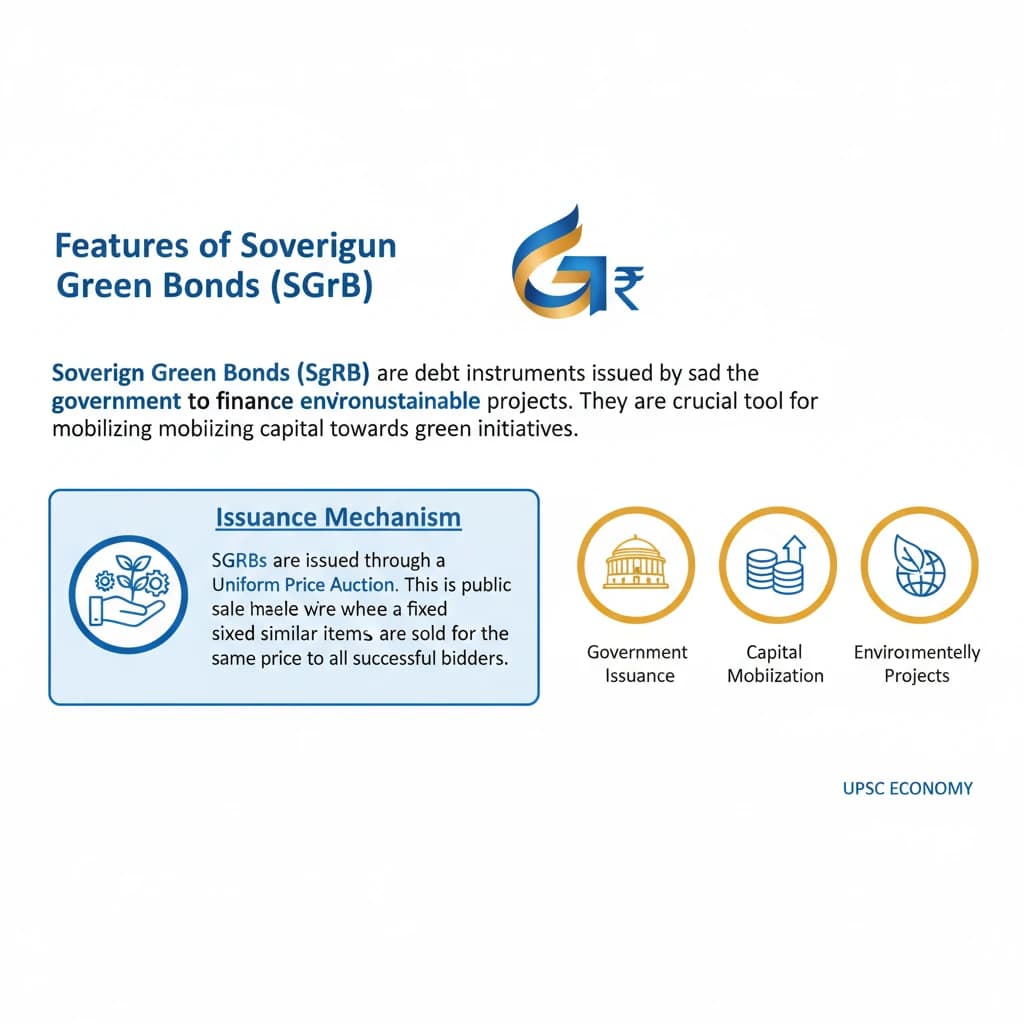
Sovereign Green Bonds (SGrB) are debt instruments issued by the government to finance environmentally sustainable projects. They are a crucial tool for mobilizing capital towards green initiatives.
Issuance Mechanism: SGrBs are issued through a Uniform Price Auction. This is a public sale where a fixed number of similar items are sold for the same price to all successful bidders.
These bonds are eligible for Repurchase Transactions (Repo), which means they can be used as collateral for short-term borrowing, enhancing their liquidity in the market.
Furthermore, SGrBs are reckoned as eligible investments for Statutory Liquidity Ratio (SLR) purposes. This makes them attractive for commercial banks, as they can hold these bonds to meet their mandatory SLR requirements.
Sovereign Green Bonds are also eligible for trading in the secondary market, providing investors with an exit option and contributing to market liquidity.
Management of Sovereign Green Bonds
The proceeds from Sovereign Green Bonds are deposited into the Consolidated Fund of India. This central fund manages all government revenues and expenditures.
Management Authority: The proceeds are managed by the Public Debt Management Cell within the Ministry of Finance.
To ensure transparency and accountability, the allocation and utilization of Green Bonds are subject to audit by the Comptroller and Auditor General (CAG) of India. This oversight mechanism ensures funds are used for their intended green purposes.
Advantages of Sovereign Green Bonds
Indian green bonds serve a dual purpose. They not only support the nation's sustainability goals but also contribute to strengthening the Indian currency.
By attracting international investors, green bonds lead to an inflow of foreign funds, increasing foreign exchange reserves within the central bank and bolstering the rupee.
The increasing global demand for socially responsible investments, coupled with a limited supply of high-quality green bonds, can lead to an increase in their price and yield, benefiting investors.
Sovereign Gold Bond Scheme (SGB) - Overview
The Sovereign Gold Bond (SGB) Scheme is a government-backed initiative aimed at reducing demand for physical gold.
UPSC Insight: The Union Government's Budget 2024-25 announced a significant reduction of the import duty on gold from 15% to 6%. This move aims to curb informal gold trade and potentially impact domestic gold prices.
The government is also actively deliberating on the future strategy and potential modifications for the Sovereign Gold Bonds (SGB) scheme itself.
Status of the Gold Industry in India
India holds substantial gold reserves. As per the National Mineral Inventory 2015, total reserves/resources of gold ore in India are estimated at 501.83 million tonnes.
Major Gold Ore Resources (2015):
- Bihar: 44%
- Rajasthan: 25%
- Karnataka: 21%
- West Bengal: 3%
- Andhra Pradesh: 3%
- Jharkhand: 2%
Despite these reserves, Karnataka accounts for approximately 80% of India’s total gold output. The historic Kolar Gold Fields (KGF) in Kolar district is renowned as one of the world's oldest and deepest gold mines.
India is the world's second-largest gold consumer. In 2023-24, India's gold imports increased by 30%, reaching USD 45.54 billion. However, March 2024 witnessed a notable decline of 53.56% in gold imports.
What is the Sovereign Gold Bond Scheme?
The SGB scheme was introduced in November 2015. Its primary objective is to decrease the demand for physical gold and channel domestic savings, otherwise spent on gold, into financial savings.
Issuance: These bonds are issued as Government of India Stock under the Government Securities (GS) Act, 2006. The Reserve Bank of India (RBI) issues them on behalf of the Government of India.
Eligibility for Purchase: The bonds are available to resident individuals, Hindu Undivided Families (HUFs), trusts, universities, and charitable institutions.
Channels for SGB Purchase
SGBs can be purchased through various authorized channels:
- Scheduled Commercial Banks (excluding Small Finance Banks, Payment Banks, and Regional Rural Banks)
- Stock Holding Corporation of India Limited (SHCIL)
- Clearing Corporation of India Limited (CCIL)
- Designated post offices
- National Stock Exchange of India Limited (NSE) and Bombay Stock Exchange Limited (BSE), either directly or through agents.
Key Features of Sovereign Gold Bonds
The issue price of gold bonds is directly linked to the price of gold of 999 purity (24 carats), as published by the India Bullion and Jewellers Association (IBJA), Mumbai.
Investment Limit: Gold bonds can be bought in multiples of one unit (1 gram). There are specific maximum limits for different investor categories:
- Retail (Individual) investors: Maximum 4 kilograms (4,000 units) per financial year.
- Hindu Undivided Family (HUF): Maximum 4 kilograms (4,000 units) per financial year.
💡 Key Takeaways
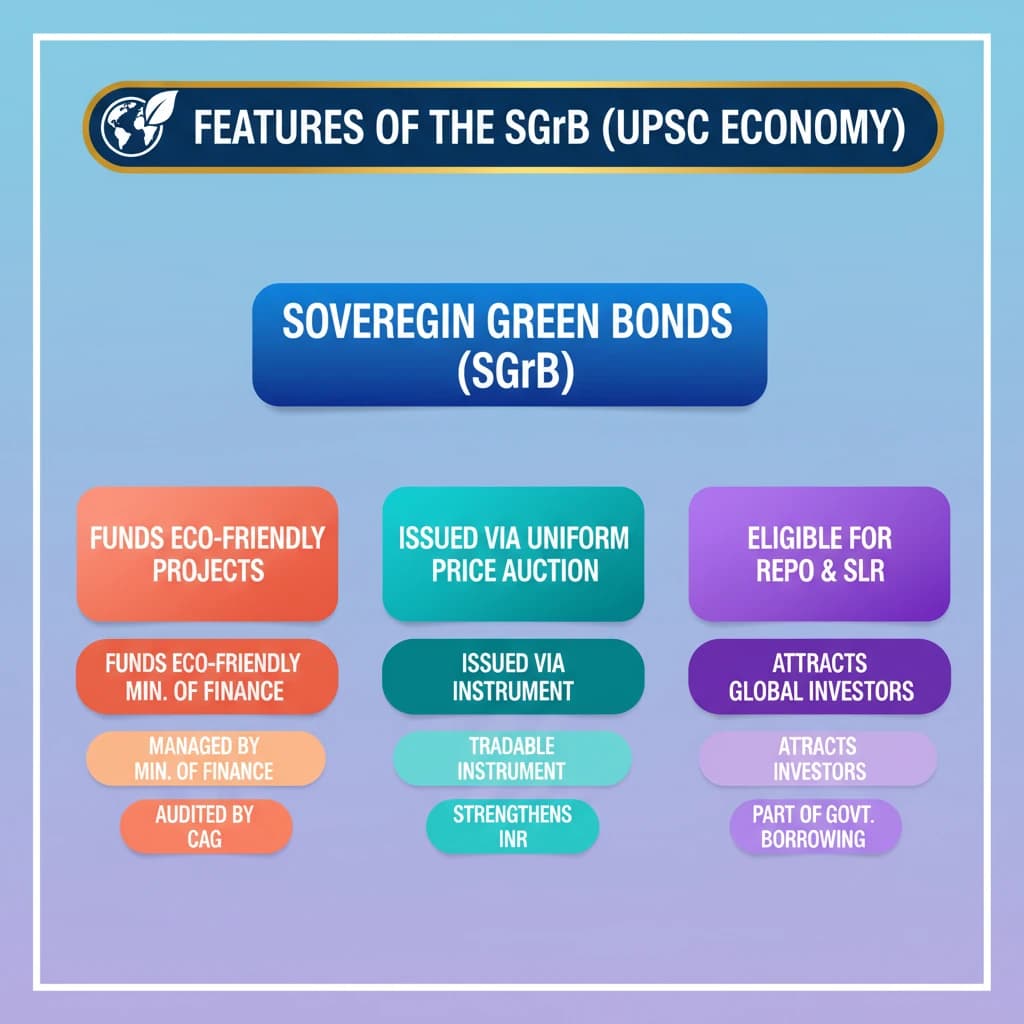
- •Sovereign Green Bonds (SGrB) fund eco-friendly projects, issued via Uniform Price Auction, eligible for Repo and SLR, and tradable.
- •SGrB proceeds are managed by the Ministry of Finance and audited by CAG, strengthening Indian currency by attracting green investors.
- •Sovereign Gold Bonds (SGB) scheme (Nov 2015) aims to reduce physical gold demand by offering gold-denominated government securities.
- •SGBs are issued by RBI on behalf of the Government of India, available to resident individuals, HUFs, trusts, etc., with specific investment limits.
- •India is the second-largest gold consumer; recent Budget 2024-25 reduced gold import duty from 15% to 6%, impacting SGB's future.
🧠 Memory Techniques
95% Verified Content