Loading page, please wait…
How did Cooperatives Evolve in India? - UPSC Economy
What is How did Cooperatives Evolve in India? in UPSC Economy?
How did Cooperatives Evolve in India? is a key topic under Economy for UPSC Civil Services Examination. Key points include: Cooperatives are people-centred, member-owned enterprises addressing common needs.. India has one of the world's largest cooperative networks, contributing significantly to agriculture, credit, and other sectors.. The movement began with the Cooperative Credit Societies Act of 1904, influenced by the Indian Famine Commission.. Understanding this topic is essential for both UPSC Prelims and Mains preparation.
Why is How did Cooperatives Evolve in India? important for UPSC exam?
How did Cooperatives Evolve in India? is a Medium-level topic in UPSC Economy. It is tested in both Prelims (factual MCQs) and Mains (analytical answer writing). Previous year UPSC questions have frequently covered aspects of How did Cooperatives Evolve in India?, making it essential for comprehensive IAS preparation.
How to prepare How did Cooperatives Evolve in India? for UPSC?
To prepare How did Cooperatives Evolve in India? for UPSC: (1) Study the comprehensive notes covering all key concepts on Vaidra. (2) Practice previous year questions on this topic. (3) Connect it with current affairs using daily updates. (4) Revise using key takeaways and mind maps available for Economy. (5) Write practice answers linking How did Cooperatives Evolve in India? to related GS Paper topics.
Key takeaways of How did Cooperatives Evolve in India? for UPSC
- Cooperatives are people-centred, member-owned enterprises addressing common needs.
- India has one of the world's largest cooperative networks, contributing significantly to agriculture, credit, and other sectors.
- The movement began with the Cooperative Credit Societies Act of 1904, influenced by the Indian Famine Commission.
- Key milestones include the Maclagan Committee (1915) and the provincialization of 'co-operation' by the Montague-Chelmsford Reforms (1919).
- Gandhian philosophy championed cooperatives for decentralization and empowerment, exemplified by the Phoenix Settlement.

How did Cooperatives Evolve in India?
Medium⏱️ 8 min read
economy
📖 Introduction
Understanding Cooperatives in India
Cooperatives are unique enterprises focused on people. They are owned, controlled, and operated by their members to fulfill common economic, social, and cultural needs and aspirations.
India boasts one of the world's largest cooperative networks. It comprises over 800,000 cooperatives spanning diverse sectors such as agriculture, credit, dairy, housing, and fisheries.
The cooperative sector makes significant contributions to the Indian economy. Its involvement includes 20% in agricultural loans, 35% in fertilizer distribution, 31% in sugar production, 13% in wheat purchase, and 20% in paddy purchase.
Cooperatives in the Pre-Independence Era
The foundation for cooperatives in India was laid in the early 20th century, driven by the need for rural credit and relief from indebtedness.
The Indian Famine Commission (1901) played a pivotal role. Its recommendations led to the enactment of the first Cooperative Credit Societies Act in 1904.
This initial act focused primarily on credit cooperatives. It was later followed by the more comprehensive Cooperative Societies Act, 1912, which expanded the scope to non-credit societies.
In 1915, the government appointed the Maclagan Committee, headed by Sir Edward Maclagan. Its mandate was to assess the cooperative movement's economic and financial soundness.
The Montague-Chelmsford Reforms of 1919 brought a significant change. They made 'co-operation' a provincial subject, which provided a crucial impetus for the movement's growth and adaptation to local needs.
The economic downturn of the Poonam Committee Depression in 1929 led to further scrutiny. Various committees were established in regions like Madras, Bombay, Travancore, Mysore, Gwalior, and Punjab to explore restructuring cooperative societies.
Gandhian Philosophy and Cooperation
Mahatma Gandhi's socialist philosophy strongly advocated for cooperation. He viewed it as essential for creating a socialistic society and achieving complete decentralization of power.
Gandhi believed that cooperation was a vital tool for empowering people, fostering self-reliance, and promoting collective well-being.
A practical manifestation of his ideals was the establishment of the 'Phoenix Settlement' in South Africa. He instituted it as a cooperative, embodying a socialistic pattern of living and working.
💡 Key Takeaways
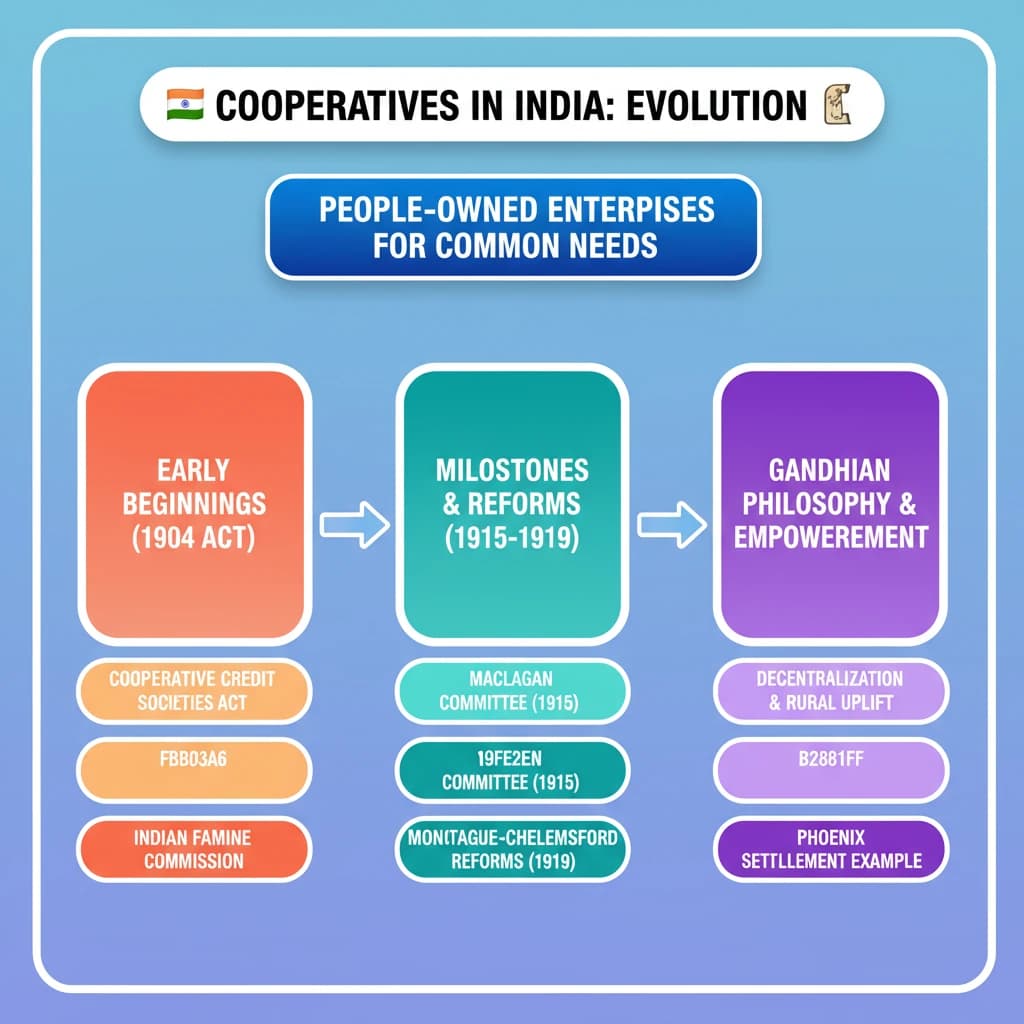
- •Cooperatives are people-centred, member-owned enterprises addressing common needs.
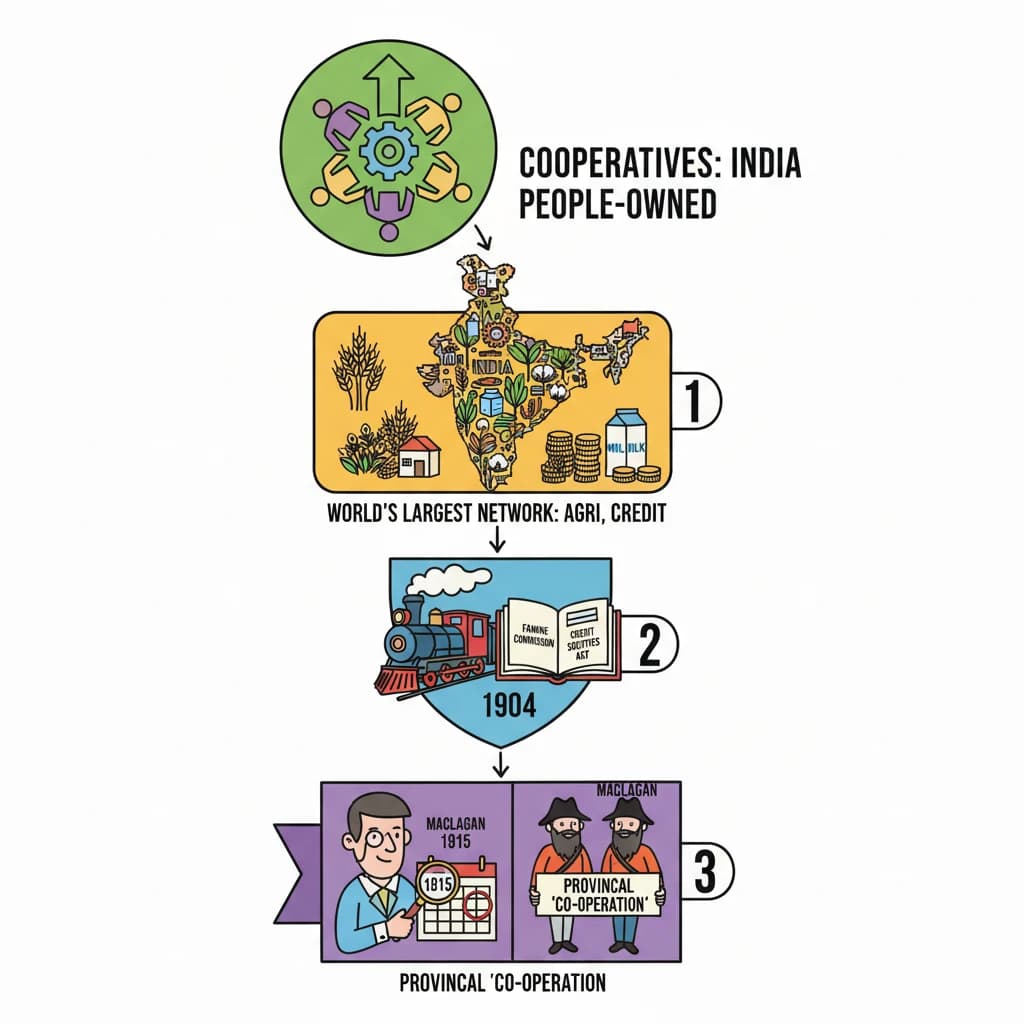
- •India has one of the world's largest cooperative networks, contributing significantly to agriculture, credit, and other sectors.
- •The movement began with the Cooperative Credit Societies Act of 1904, influenced by the Indian Famine Commission.
- •Key milestones include the Maclagan Committee (1915) and the provincialization of 'co-operation' by the Montague-Chelmsford Reforms (1919).
- •Gandhian philosophy championed cooperatives for decentralization and empowerment, exemplified by the Phoenix Settlement.
🧠 Memory Techniques
95% Verified Content