Loading page, please wait…
India Surpasses USD 1 Trillion in FDI - UPSC Economy
What is India Surpasses USD 1 Trillion in FDI in UPSC Economy?
India Surpasses USD 1 Trillion in FDI is a key topic under Economy for UPSC Civil Services Examination. Key points include: India has surpassed <strong>USD 1 Trillion in cumulative FDI inflows</strong> since <strong>2000</strong>, highlighting its global investment appeal.. <strong>FDI</strong> involves a <strong>controlling interest</strong> and brings <strong>capital, expertise, technology, and skills</strong> to the host country.. <strong>Greenfield FDI</strong> creates new operations; <strong>Brownfield FDI</strong> involves mergers, acquisitions, or joint ventures of existing assets.. Understanding this topic is essential for both UPSC Prelims and Mains preparation.
Why is India Surpasses USD 1 Trillion in FDI important for UPSC exam?
India Surpasses USD 1 Trillion in FDI is a Medium-level topic in UPSC Economy. It is tested in both Prelims (factual MCQs) and Mains (analytical answer writing). Previous year UPSC questions have frequently covered aspects of India Surpasses USD 1 Trillion in FDI, making it essential for comprehensive IAS preparation.
How to prepare India Surpasses USD 1 Trillion in FDI for UPSC?
To prepare India Surpasses USD 1 Trillion in FDI for UPSC: (1) Study the comprehensive notes covering all key concepts on Vaidra. (2) Practice previous year questions on this topic. (3) Connect it with current affairs using daily updates. (4) Revise using key takeaways and mind maps available for Economy. (5) Write practice answers linking India Surpasses USD 1 Trillion in FDI to related GS Paper topics.
Key takeaways of India Surpasses USD 1 Trillion in FDI for UPSC
- India has surpassed <strong>USD 1 Trillion in cumulative FDI inflows</strong> since <strong>2000</strong>, highlighting its global investment appeal.
- <strong>FDI</strong> involves a <strong>controlling interest</strong> and brings <strong>capital, expertise, technology, and skills</strong> to the host country.
- <strong>Greenfield FDI</strong> creates new operations; <strong>Brownfield FDI</strong> involves mergers, acquisitions, or joint ventures of existing assets.
- <strong>FDI in India</strong> is governed by the <strong>Foreign Exchange Management Act (FEMA), 1999</strong>, and administered by <strong>DPIIT</strong>.
- FDI is crucial for India's <strong>economic growth, job creation, technology transfer</strong>, and achieving targets like becoming a <strong>USD 5 trillion economy</strong>.

India Surpasses USD 1 Trillion in FDI
Medium⏱️ 8 min read
economy
📖 Introduction
India's Milestone in Global Investment
India has achieved a significant milestone, surpassing USD 1 trillion in Foreign Direct Investment (FDI) inflows. This cumulative figure has been recorded since the year 2000.
This remarkable achievement underscores India's increasing attractiveness as a global investment hub. It reflects the nation's growing economic potential and stable policy environment.
India has accumulated over USD 1 Trillion in FDI inflows since 2000, signifying its emergence as a preferred destination for global capital.
Understanding Foreign Direct Investment (FDI)
Foreign Direct Investment (FDI) is a crucial form of international investment. It involves an entity from one country making a direct investment into a business in another country.
The defining characteristic of FDI is the establishment of a controlling interest. This implies a long-term relationship and significant influence over the management of the foreign enterprise.
FDI Definition: An investment by a company or individual in one country into a business interest located in another country, establishing a controlling ownership.
Beyond Capital: The Broader Impact of FDI
FDI is not merely about the inflow of capital. It encompasses a much broader transfer of resources that are vital for economic development.
These additional contributions include essential expertise, advanced technology, and valuable skills. Such transfers significantly boost the capabilities of the host country's economy.
Key Contributions of FDI: Beyond capital, FDI brings managerial expertise, cutting-edge technology, and specialized skills, fostering overall economic growth and development.
Types of Foreign Direct Investment
FDI can broadly be categorized into two primary types, each with distinct characteristics and implications for the host economy.
- Greenfield Investment: This involves establishing completely new business operations from the ground up in a foreign country.
- Brownfield Investment: This type of investment occurs through mergers, acquisitions, or joint ventures, utilizing existing facilities and infrastructure.
Greenfield Investment: Creating entirely new production facilities or operations. Offers high control and customization.
Brownfield Investment: Expanding through M&A or JVs by acquiring or investing in existing assets. May offer less control than Greenfield but leverages existing structures.
Brownfield Investment: Expanding through M&A or JVs by acquiring or investing in existing assets. May offer less control than Greenfield but leverages existing structures.
Governance and Regulation of FDI in India
The regulatory framework for FDI in India is robust and well-defined. It ensures transparency and adherence to national economic objectives.
FDI inflows in India are primarily governed by the provisions of the Foreign Exchange Management Act (FEMA), 1999. This act provides the legal framework for foreign exchange transactions.
The administration and promotion of FDI in the country fall under the purview of the Department for Promotion of Industry and Internal Trade (DPIIT), part of the Ministry of Commerce and Industry.
Remember that FEMA, 1999, is the key legislation governing foreign exchange, including FDI, while DPIIT is the nodal government agency responsible for its promotion and policy formulation in India.
💡 Key Takeaways
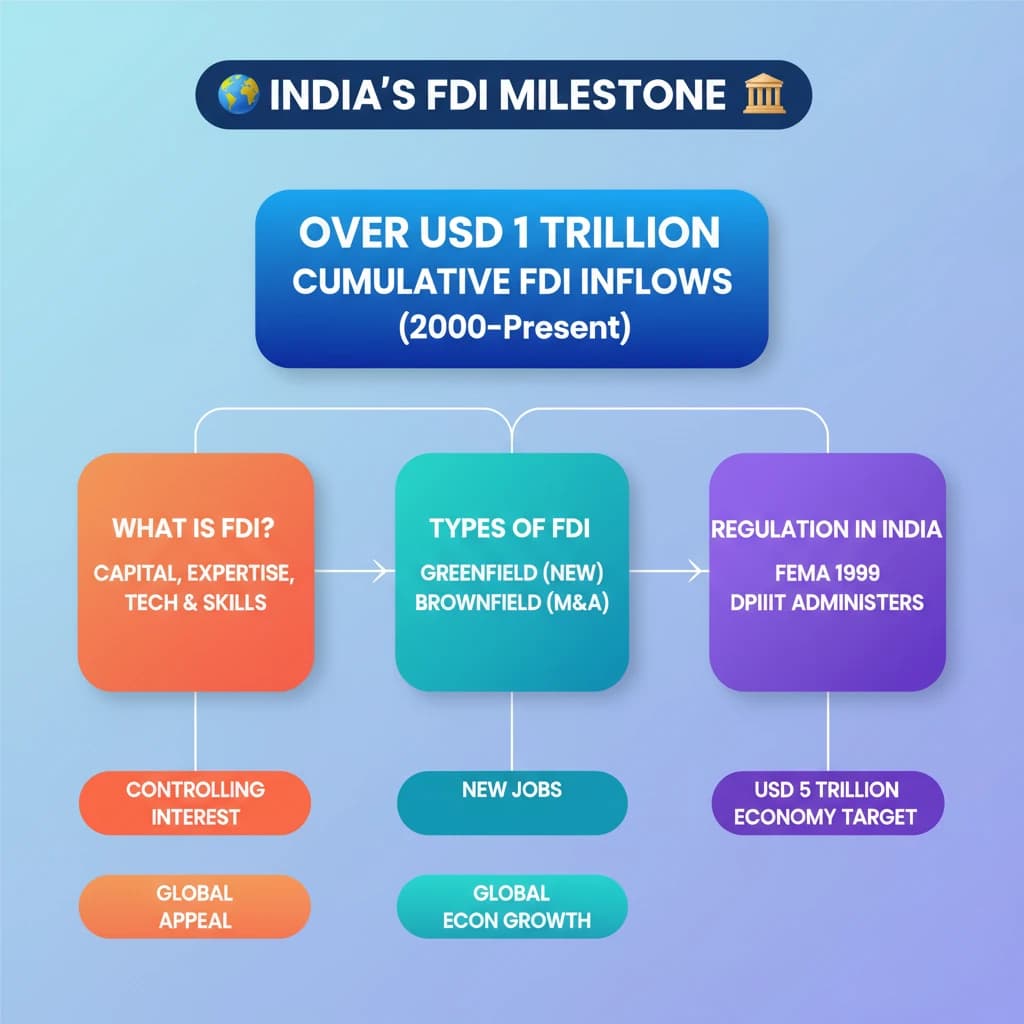
- •India has surpassed <strong>USD 1 Trillion in cumulative FDI inflows</strong> since <strong>2000</strong>, highlighting its global investment appeal.
- •<strong>FDI</strong> involves a <strong>controlling interest</strong> and brings <strong>capital, expertise, technology, and skills</strong> to the host country.
- •<strong>Greenfield FDI</strong> creates new operations; <strong>Brownfield FDI</strong> involves mergers, acquisitions, or joint ventures of existing assets.
- •<strong>FDI in India</strong> is governed by the <strong>Foreign Exchange Management Act (FEMA), 1999</strong>, and administered by <strong>DPIIT</strong>.
- •FDI is crucial for India's <strong>economic growth, job creation, technology transfer</strong>, and achieving targets like becoming a <strong>USD 5 trillion economy</strong>.
🧠 Memory Techniques

95% Verified Content
📚 Reference Sources
•Department for Promotion of Industry and Internal Trade (DPIIT), Ministry of Commerce & Industry, Government of India
•Reserve Bank of India (RBI) publications on Foreign Direct Investment
•Foreign Exchange Management Act (FEMA), 1999