Loading page, please wait…
India’s Geographical Indication Landscape - UPSC Economy
What is India’s Geographical Indication Landscape in UPSC Economy?
India’s Geographical Indication Landscape is a key topic under Economy for UPSC Civil Services Examination. Key points include: Geographical Indication (GI) links product quality/reputation to its specific geographical origin.. India's GI protection is governed by the TRIPS Agreement (WTO) and the national GI Act, 1999.. India's GI registration numbers are significantly lower than global leaders like Germany and China.. Understanding this topic is essential for both UPSC Prelims and Mains preparation.
Why is India’s Geographical Indication Landscape important for UPSC exam?
India’s Geographical Indication Landscape is a Medium-level topic in UPSC Economy. It is tested in both Prelims (factual MCQs) and Mains (analytical answer writing). Previous year UPSC questions have frequently covered aspects of India’s Geographical Indication Landscape, making it essential for comprehensive IAS preparation.
How to prepare India’s Geographical Indication Landscape for UPSC?
To prepare India’s Geographical Indication Landscape for UPSC: (1) Study the comprehensive notes covering all key concepts on Vaidra. (2) Practice previous year questions on this topic. (3) Connect it with current affairs using daily updates. (4) Revise using key takeaways and mind maps available for Economy. (5) Write practice answers linking India’s Geographical Indication Landscape to related GS Paper topics.
Key takeaways of India’s Geographical Indication Landscape for UPSC
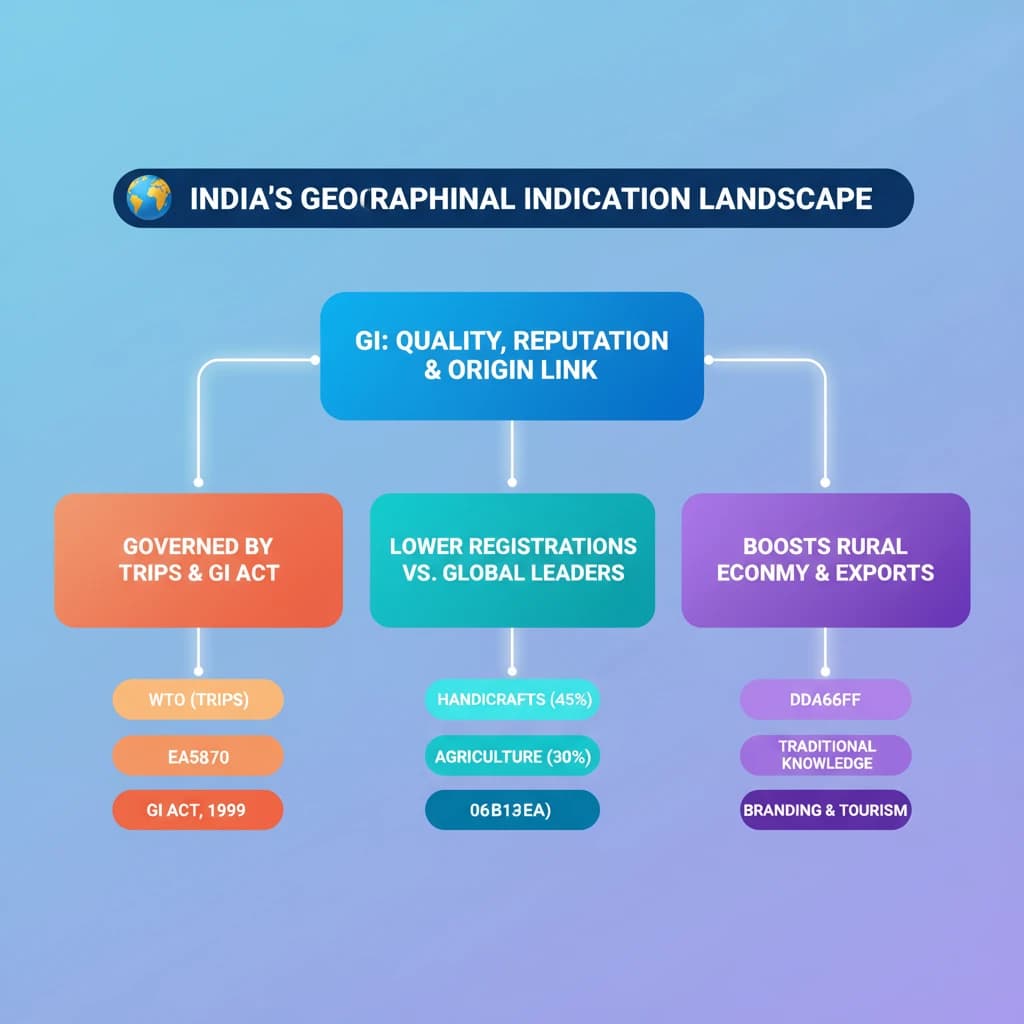
- Geographical Indication (GI) links product quality/reputation to its specific geographical origin.
- India's GI protection is governed by the TRIPS Agreement (WTO) and the national GI Act, 1999.
- India's GI registration numbers are significantly lower than global leaders like Germany and China.
- Handicrafts (45%) and Agriculture (30%) constitute the majority of India's GI products.
- GIs are crucial for rural economic development, preserving traditional knowledge, and boosting exports.
- Challenges in India's GI landscape include limited outcomes and a need for registration process reforms.
India’s Geographical Indication Landscape
Medium⏱️ 7 min read
economy
📖 Introduction
India's Geographical Indication Landscape: An Overview
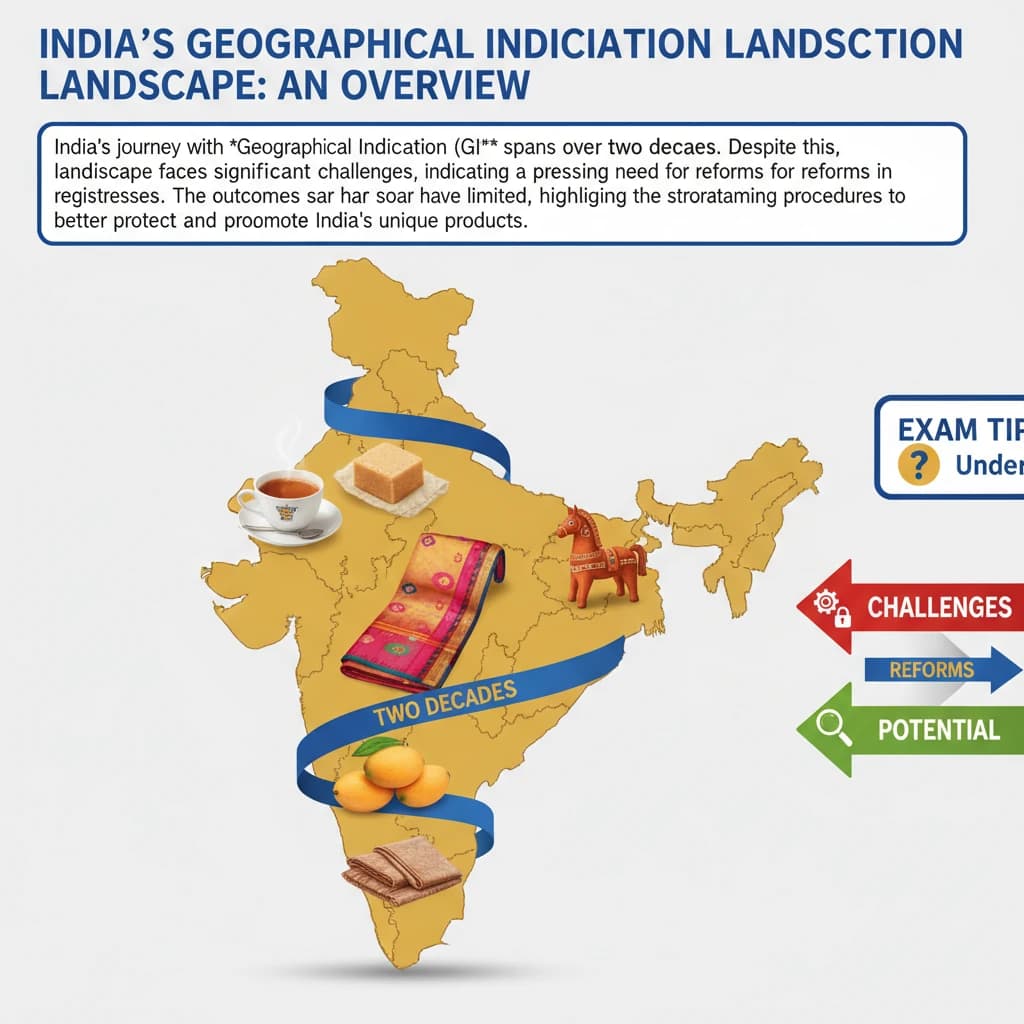
India's journey with Geographical Indication (GI) tags spans over two decades. Despite this, the landscape faces significant challenges, indicating a pressing need for reforms in the registration processes.
The outcomes so far have been limited, highlighting the importance of streamlining procedures to better protect and promote India's unique products.
Understanding the challenges and reforms in India's GI system is crucial for UPSC Mains GS-III (Economy), especially topics related to Intellectual Property Rights and economic development.
What is a Geographical Indication (GI)?
A Geographical Indication (GI) is a designation applied to products that originate from a specific geographical area. It signifies that the qualities, characteristics, or reputation of these products are inherently linked to that particular origin.
The concept extends beyond agricultural goods. It also covers non-agricultural products such as handicrafts, which are unique due to human skills, specific materials, and resources available in certain areas.
TRIPS Agreement Definition: Article 22 (1) of the Trade-Related Aspects of Intellectual Property Rights (TRIPS) defines GIs as “indications which identify a good as originating in the territory of a member, or a region or locality in that territory.”
Legal Framework Governing GIs
The protection of Geographical Indications is rooted in both international agreements and national legislation, providing a robust framework for safeguarding unique products.
- International Framework:
- TRIPS Agreement (WTO): GIs are governed under the Agreement on TRIPS at the World Trade Organization (WTO), making it a multilateral agreement for IPR protection.
- Paris Convention: The Paris Convention for the Protection of Industrial Property (1883) also emphasizes protecting industrial property and geographical indications in its Articles 1(2) and 10.
- National Framework (India):
- Geographical Indications of Goods (Registration and Protection) Act, 1999: This Indian Act provides for the registration and better protection of geographical indications relating to goods within India.
Status of GI Tag Registrations in India
Despite the legal framework, India's progress in GI registration lags significantly when compared to other nations globally.
Registration Data (as of December 2023): Intellectual Property India received 1,167 applications, out of which only 547 products have been successfully registered.
This indicates a relatively low success rate and volume compared to global leaders in GI registrations.
Global Comparison (2020 WIPO data):
- Germany: Leads with 15,566 registered products.
- China: Follows with 7,247 registered products.
In India, the majority of registered GI products fall into two primary categories:
- Handicrafts: Comprise approximately 45% of all GI products.
- Agriculture: Account for about 30% of the total GI products.
💡 Key Takeaways
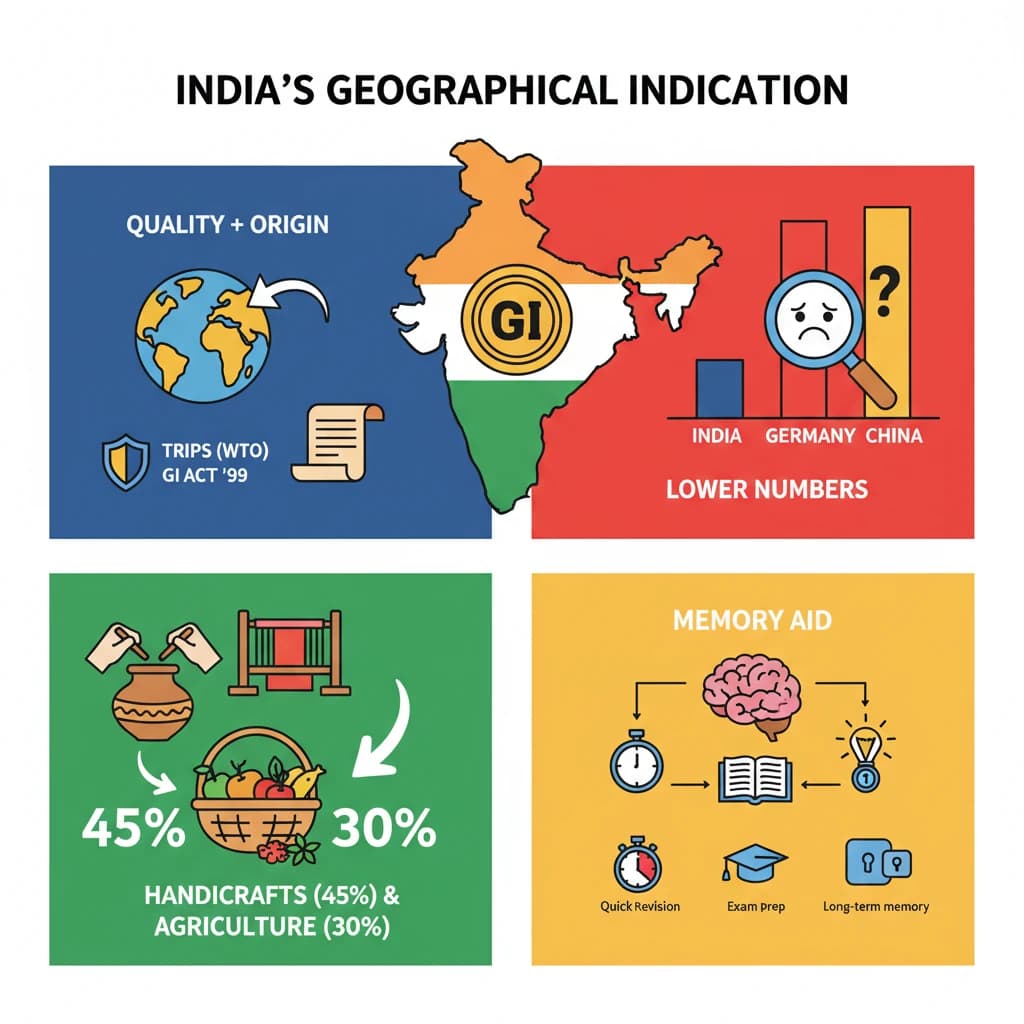
- •Geographical Indication (GI) links product quality/reputation to its specific geographical origin.
- •India's GI protection is governed by the TRIPS Agreement (WTO) and the national GI Act, 1999.
- •India's GI registration numbers are significantly lower than global leaders like Germany and China.
- •Handicrafts (45%) and Agriculture (30%) constitute the majority of India's GI products.
- •GIs are crucial for rural economic development, preserving traditional knowledge, and boosting exports.
- •Challenges in India's GI landscape include limited outcomes and a need for registration process reforms.
🧠 Memory Techniques
95% Verified Content
📚 Reference Sources
•World Intellectual Property Organization (WIPO) data (for global comparison)
•Intellectual Property India (for national registration data)