Loading page, please wait…
Lighthouses in India: Significance and Economic Impact - UPSC Economy
What is Lighthouses in India: Significance and Economic Impact in UPSC Economy?
Lighthouses in India: Significance and Economic Impact is a key topic under Economy for UPSC Civil Services Examination. Key points include: Lighthouses are vital maritime navigation aids, ensuring coastal safety for vessels.. India has diverse lighthouses, built by British, Portuguese, and post-independence efforts.. Mahabalipuram Lighthouse showcases a unique blend of ancient (Pallava) and colonial heritage.. Understanding this topic is essential for both UPSC Prelims and Mains preparation.
Why is Lighthouses in India: Significance and Economic Impact important for UPSC exam?
Lighthouses in India: Significance and Economic Impact is a Easy-level topic in UPSC Economy. It is tested in both Prelims (factual MCQs) and Mains (analytical answer writing). Previous year UPSC questions have frequently covered aspects of Lighthouses in India: Significance and Economic Impact, making it essential for comprehensive IAS preparation.
How to prepare Lighthouses in India: Significance and Economic Impact for UPSC?
To prepare Lighthouses in India: Significance and Economic Impact for UPSC: (1) Study the comprehensive notes covering all key concepts on Vaidra. (2) Practice previous year questions on this topic. (3) Connect it with current affairs using daily updates. (4) Revise using key takeaways and mind maps available for Economy. (5) Write practice answers linking Lighthouses in India: Significance and Economic Impact to related GS Paper topics.
Key takeaways of Lighthouses in India: Significance and Economic Impact for UPSC
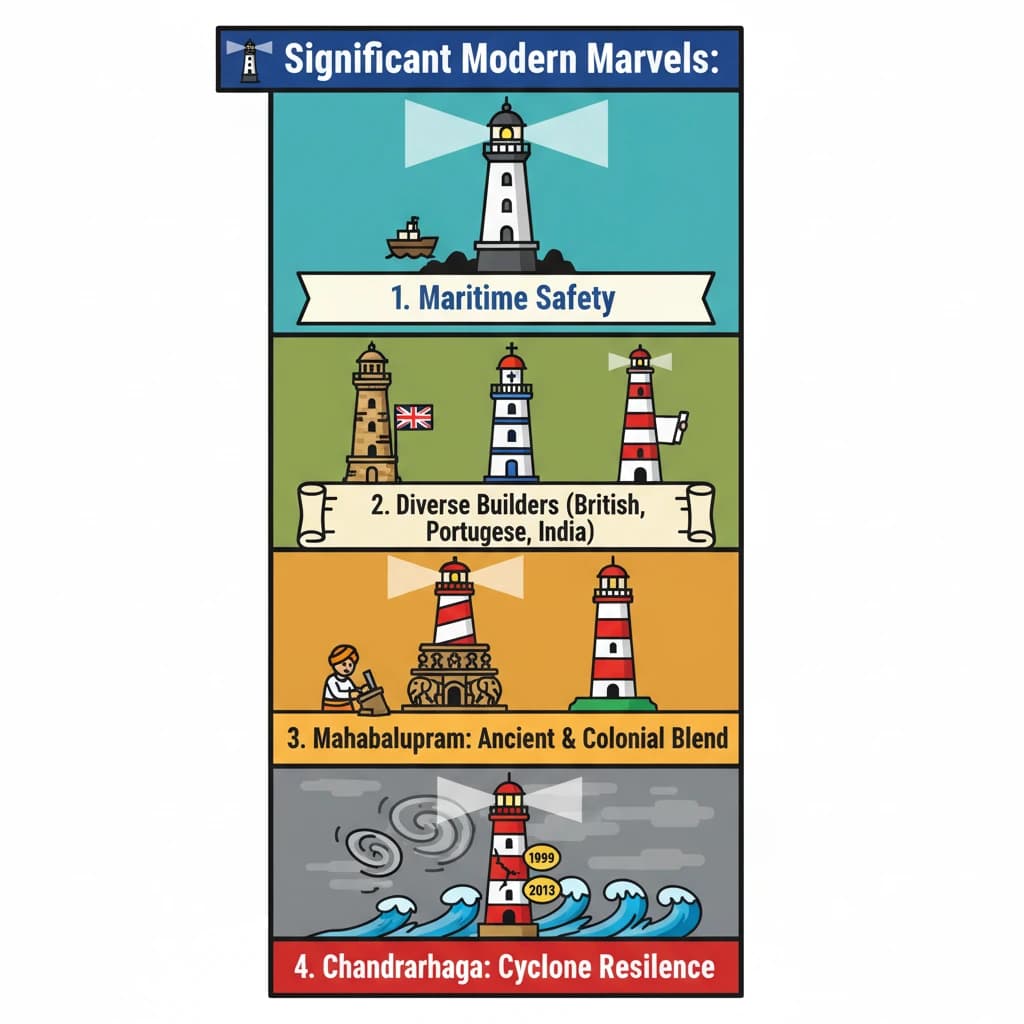
- Lighthouses are vital maritime navigation aids, ensuring coastal safety for vessels.
- India has diverse lighthouses, built by British, Portuguese, and post-independence efforts.
- Mahabalipuram Lighthouse showcases a unique blend of ancient (Pallava) and colonial heritage.
- Chandrabhaga Lighthouse exemplifies structural resilience against severe cyclones (1999, 2013, 2019).
- Beyond navigation, lighthouses serve as significant tourist attractions and heritage sites, contributing to coastal tourism.
- The ancient Pharos of Alexandria highlights the long history and engineering prowess behind lighthouse construction.
Lighthouses in India: Significance and Economic Impact
Easy⏱️ 8 min read
economy
📖 Introduction
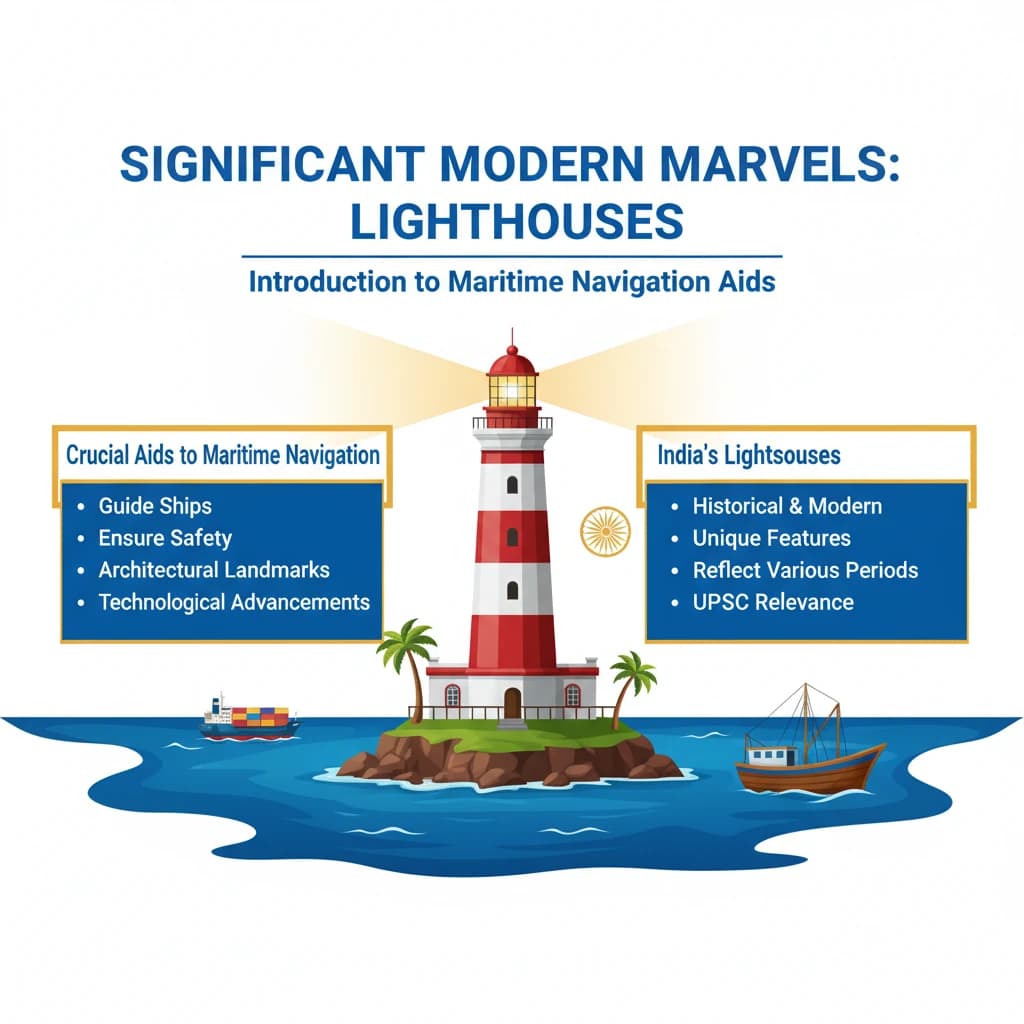
Introduction to Significant Modern Marvels: Lighthouses
Lighthouses serve as crucial aids to maritime navigation, guiding ships and ensuring safety along coastlines. India is home to numerous lighthouses, both historical and modern, each with unique features and stories.
These structures are not just functional but also stand as significant architectural and historical landmarks, reflecting various periods of construction and technological advancements.
Tangasseri Lighthouse, Kollam, Kerala
The Tangasseri Lighthouse is a prominent landmark located in Kollam, Kerala. It holds the distinction of being the tallest lighthouse in Kerala.
Key Features:
- Construction: Built by the British during the colonial period.
- Appearance: Distinctively painted in striking white and red bands, making it easily recognizable.
Mahabalipuram Lighthouse, Tamil Nadu
The Mahabalipuram Lighthouse in Tamil Nadu offers a unique blend of ancient and colonial history. It stands as an old lighthouse from the colonial period.
Interestingly, it was constructed adjacent to an even older lighthouse. This ancient structure was originally commissioned by Mahendra Pallava of the Pallava dynasty.
Current Status:
- The colonial lighthouse is non-functional but remains open for visitors to explore its historical significance.
- It provides a glimpse into the evolution of navigation aids in the region.
Kaup Beach Lighthouse, Udupi, Karnataka
Located at Kaup Beach, Udupi, Karnataka, this lighthouse is another testament to British engineering in India. The existing structure was built in 1901.
Over the years, the Kaup Beach Lighthouse has seen several enhancements, particularly in its lighting technology, to keep pace with modern navigation requirements.
Improvements:
- Since its construction, it has undergone various improvements.
- These include the installation of different types of lighting equipment to enhance its range and visibility.
Vizhinjam Lighthouse, Kovalam, Kerala
The history of navigation aids in the Kovalam area of Kerala dates back to the early 20th century. A lighted beacon was first established at nearby Kolachal in 1925.
Later, a day mark beacon was provided at Vizhinjam in 1968. The major lighthouse structure, which stands today, was completed in 1972.
Significance:
- It is considered one of the oldest and most picturesque lighthouses in India.
- Its scenic location contributes to its popularity among tourists.
Fort Aguada Lighthouse, Goa
The Fort Aguada Lighthouse is a significant historical structure located in Goa. It is a well-preserved example of Portuguese architecture and engineering.
This lighthouse is one of Goa’s primary attractions, drawing visitors with its historical charm and stunning views.
Attraction:
- It offers dreamy sea views, making it a highly recommended spot for tourists.
- The lighthouse is integrated into the larger Fort Aguada complex, a testament to Portuguese colonial presence.
Chandrabhaga Lighthouse, Odisha
The Chandrabhaga Lighthouse is situated near the famous Konark temple in Odisha. Its location in a coastal region makes it susceptible to natural disasters.
Despite facing severe climatic challenges, this lighthouse has demonstrated remarkable resilience, enduring multiple powerful cyclones.
Resilience:
- It successfully withstood the devastating Super Cyclone of 1999.
- Further proof of its robust construction came when it survived Cyclone Phailin in 2013 and Cyclone Fani in 2019.
The Ancient Marvel: Pharos of Alexandria
Beyond India, the history of lighthouses boasts one of the Seven Wonders of the Ancient World: the Pharos of Alexandria. This iconic structure was built in the 3rd century B.C. by Ptolemy II.
The Pharos of Alexandria served as a beacon for an astonishing 1600 years, a testament to ancient engineering prowess.
Construction and Demise:
- The tower was constructed using high-quality kedan stone bricks.
- These bricks were meticulously embedded in molten lead for structural integrity.
- Unfortunately, it collapsed in the 13th century A.D. due to a severe earthquake.
💡 Key Takeaways
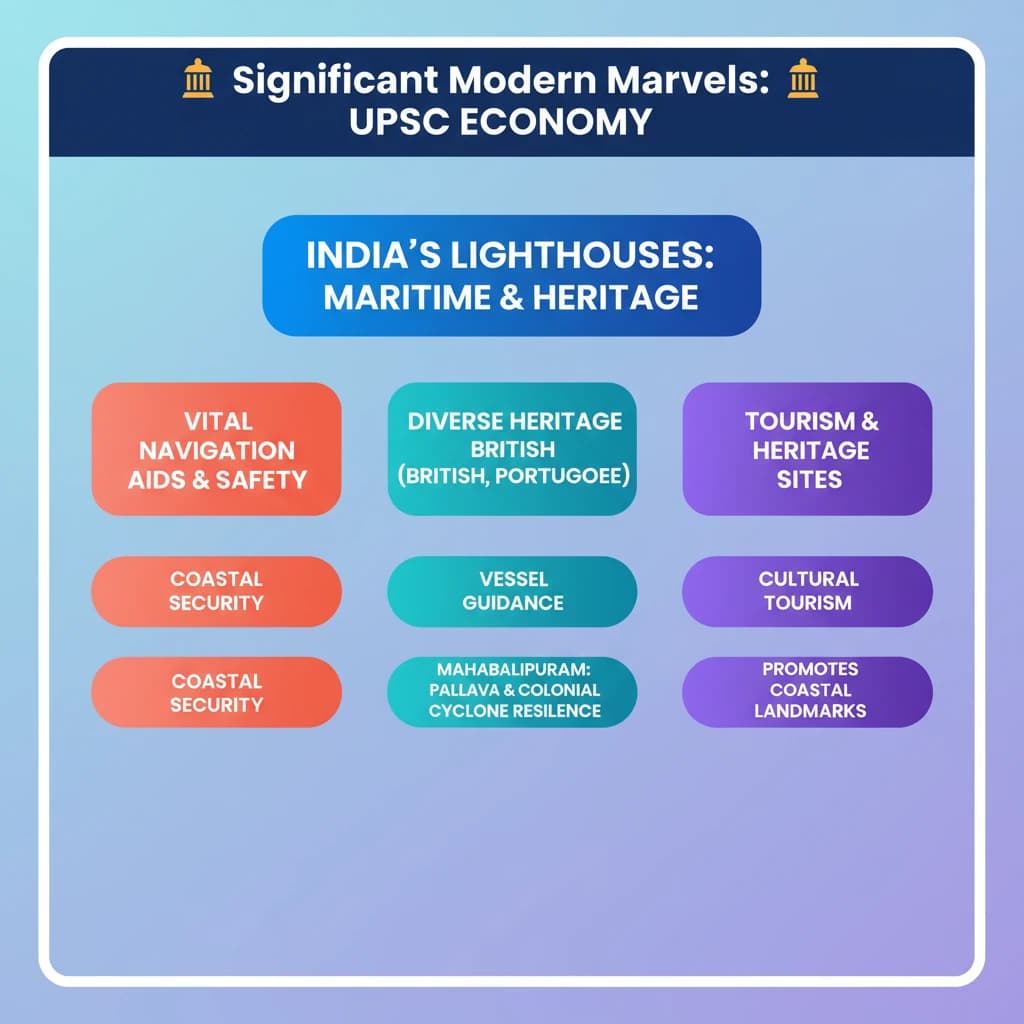
- •Lighthouses are vital maritime navigation aids, ensuring coastal safety for vessels.
- •India has diverse lighthouses, built by British, Portuguese, and post-independence efforts.
- •Mahabalipuram Lighthouse showcases a unique blend of ancient (Pallava) and colonial heritage.
- •Chandrabhaga Lighthouse exemplifies structural resilience against severe cyclones (1999, 2013, 2019).
- •Beyond navigation, lighthouses serve as significant tourist attractions and heritage sites, contributing to coastal tourism.
- •The ancient Pharos of Alexandria highlights the long history and engineering prowess behind lighthouse construction.
🧠 Memory Techniques
95% Verified Content
📚 Reference Sources
•General knowledge of Indian lighthouses and ancient history