Loading page, please wait…
Medium-Term Outlooks - UPSC Economy
What is Medium-Term Outlooks in UPSC Economy?
Medium-Term Outlooks is a key topic under Economy for UPSC Civil Services Examination. Key points include: RBI and IMF project moderate inflation (4.1-4.8%) for FY25-FY26, indicating economic stability.. India is projected to become a USD 5 trillion economy by FY28 and USD 6.3 trillion by FY30.. Achieving Viksit Bharat 2047 requires sustained 8% annual growth for two decades.. Understanding this topic is essential for both UPSC Prelims and Mains preparation.
Why is Medium-Term Outlooks important for UPSC exam?
Medium-Term Outlooks is a Medium-level topic in UPSC Economy. It is tested in both Prelims (factual MCQs) and Mains (analytical answer writing). Previous year UPSC questions have frequently covered aspects of Medium-Term Outlooks, making it essential for comprehensive IAS preparation.
How to prepare Medium-Term Outlooks for UPSC?
To prepare Medium-Term Outlooks for UPSC: (1) Study the comprehensive notes covering all key concepts on Vaidra. (2) Practice previous year questions on this topic. (3) Connect it with current affairs using daily updates. (4) Revise using key takeaways and mind maps available for Economy. (5) Write practice answers linking Medium-Term Outlooks to related GS Paper topics.
Key takeaways of Medium-Term Outlooks for UPSC
- RBI and IMF project moderate inflation (4.1-4.8%) for FY25-FY26, indicating economic stability.
- India is projected to become a USD 5 trillion economy by FY28 and USD 6.3 trillion by FY30.
- Achieving Viksit Bharat 2047 requires sustained 8% annual growth for two decades.
- Global challenges like geo-economic fragmentation pose risks to India's outlook.
- Robust Capex growth (38.8% CAGR) and infrastructure projects (NIP, Bharatmala, Sagarmala) are key growth drivers.
- Significant progress in rural/urban development (PMAY, Jal Jeevan Mission, ODF Plus) and digital/space sectors.
- Manufacturing sector showing strong growth, with increased domestic production (e.g., smartphones) and patent filings.
Medium-Term Outlooks
Medium⏱️ 12 min read
economy
📖 Introduction
Inflation Projections and Economic Stability
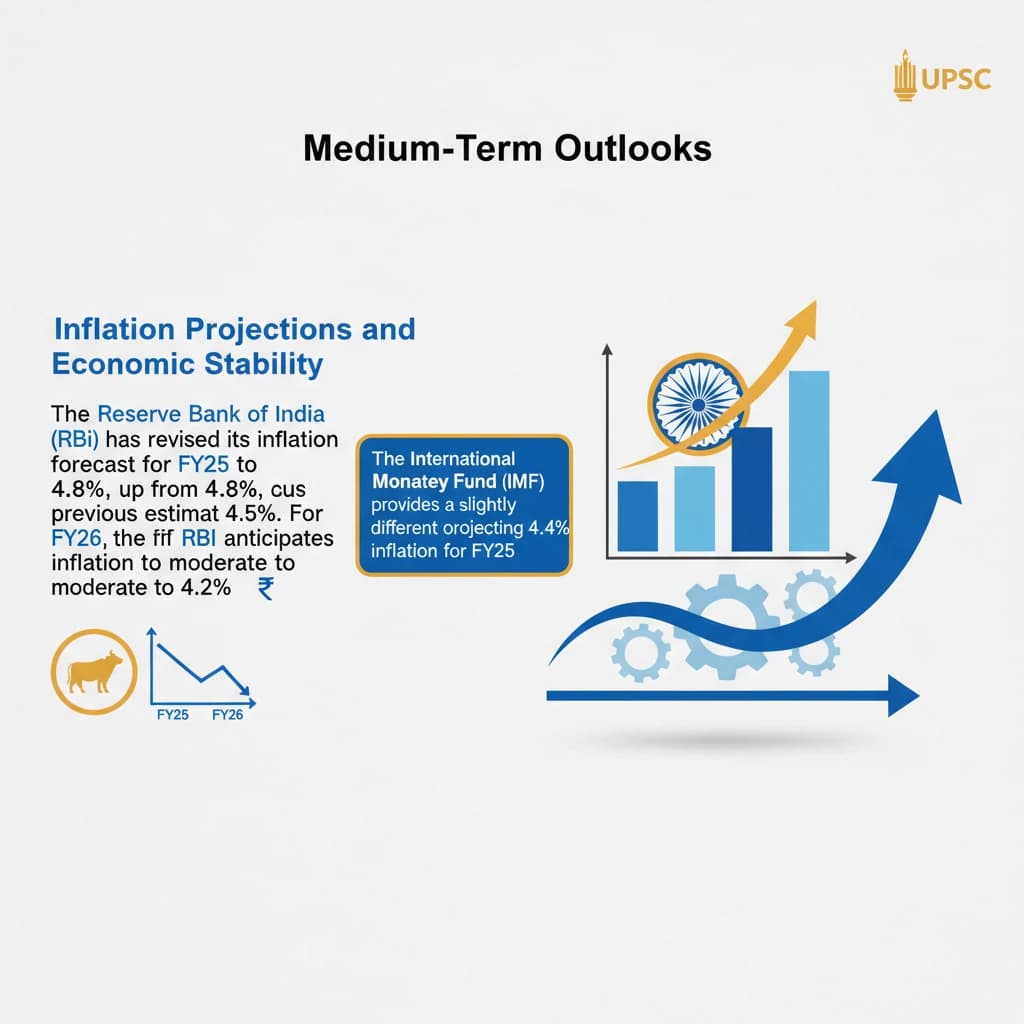
The Reserve Bank of India (RBI) has revised its inflation forecast for FY25 to 4.8%, up from a previous estimate of 4.5%. For FY26, the RBI anticipates inflation to moderate to 4.2%.
The International Monetary Fund (IMF) provides a slightly different outlook, projecting 4.4% inflation for FY25 and 4.1% for FY26. These forecasts assume stable economic conditions.
India's economic stability has shown improvement, with the rupee projected to depreciate mildly at only 0.5% per year. This indicates a stronger economic footing compared to previous decades.
Medium-Term Economic Growth Outlook
The IMF projects India to achieve significant economic milestones in the coming years. India is expected to become a USD 5 trillion economy by FY28.
Furthermore, the IMF forecasts India's economy to reach USD 6.3 trillion by FY30. This growth is underpinned by an anticipated nominal GDP growth rate of 10.2% between FY25 and FY30.
To realize its ambitious goal of Viksit Bharat 2047, India needs to sustain an annual economic growth rate of 8% for the next two decades. The IMF forecasts India's real GDP growth at 6.5% annually from FY26 to FY30.
The Current Account Deficit (CAD) is expected to see a moderate increase, projected to rise to 2.2% of GDP by FY30.
Global Challenges and Risks
Despite strong domestic projections, the global landscape presents several challenges. Geo-economic fragmentation poses a significant risk to global supply chains and investment flows.
Increased trade restrictions worldwide can impede India's export potential and integration into global value chains. China’s dominance in manufacturing and energy transition sectors also presents competitive pressures and supply chain vulnerabilities for India.
Investment and Infrastructure Boost
Capital expenditure (Capex) has been a major driver of growth, demonstrating a robust 38.8% Compound Annual Growth Rate (CAGR) from FY20 to FY24.
The government has launched several key initiatives to further boost infrastructure. These include the National Infrastructure Pipeline and the National Monetisation Pipeline, designed to channel significant investments into infrastructure development.
Key Infrastructure Developments
Significant progress has been made across various infrastructure sectors:
- Road Connectivity: National Highway construction under Bharatmala reached 6,215 km.
- Railways: 2031 km of railway network commissioned between April and November 2024. 17 new Vande Bharat trains have been introduced, enhancing modern rail travel.
- Aviation: 619 UDAN air routes have been operationalized under the Regional Connectivity Scheme, improving air access to remote areas.
- Ports: Port capacity has grown under the Sagarmala program, with projects like the Jawaharlal Nehru Port contributing to enhanced maritime trade capabilities.
Energy Sector: India's total installed power capacity reached 456.4 GW. Notably, renewable energy accounts for a substantial 209.4 GW, representing a 47% share of the total capacity.
Digital Connectivity: 5G services now cover 779 districts across the country. The BharatNet project has expanded optical fiber connectivity to 2.14 lakh Gram Panchayats, bridging the digital divide.
Rural and Urban Development Initiatives
Government schemes have significantly impacted rural and urban living standards:
- Housing: The Pradhan Mantri Awas Yojana (PMAY) has sanctioned 1.18 crore houses, providing affordable housing solutions.
- Water Supply: The Jal Jeevan Mission has successfully provided tap water connections to 15.3 crore households, covering 75.1% of rural households.
- Electrification: 18,374 villages have been electrified, and 2.9 crore households connected under schemes like Deen Dayal Upadhyaya Gram Jyoti Yojana (DDUGJY) and SAUBHAGYA.
- Sanitation: Under Swachh Bharat Mission (Phase II), 1.92 lakh villages were declared ODF Plus in 2024, contributing to a total of 3.64 lakh ODF Plus villages by 2024.
Space Assets and Future Missions
India currently operates 56 active space assets, showcasing its growing capabilities in space technology. The Space Vision 2047 aims for ambitious future missions.
These future missions include the human spaceflight program Gaganyaan and advanced lunar exploration with Chandrayaan-4, highlighting India's long-term strategic vision in space.
Industrial Growth and Manufacturing Prowess
The industrial sector is projected to grow by 6.2% in FY25, according to first advance estimates. This growth is primarily driven by robust performance in the electricity and construction sectors.
The government is actively promoting Smart Manufacturing and Industry 4.0 initiatives. Support is provided for establishing SAMARTH Udyog centres to foster technological adoption and innovation in manufacturing.
Key Sectoral Growth:
- Steel production saw an 8.3% increase from April to November FY24.
- Electronics output reached ₹8.9 lakh crore.
- 98% of smartphones are now made domestically, significantly reducing India's dependence on imports.
According to the WIPO Report 2022, India ranks sixth among the top 10 patent filing offices globally. Resident filings accounted for over half (55.5%) of all submissions, a first for the country.
MSME Sector Contributions
The MSME sector is a vital employer, providing livelihoods to 23.24 crore people. Formalization efforts have seen 2.35 crore businesses registered under Udyam Assist.
To provide crucial equity funding and support scaling up for promising MSMEs, the government launched the Self-Reliant India Fund. This initiative aims to strengthen the backbone of India's economy.
💡 Key Takeaways
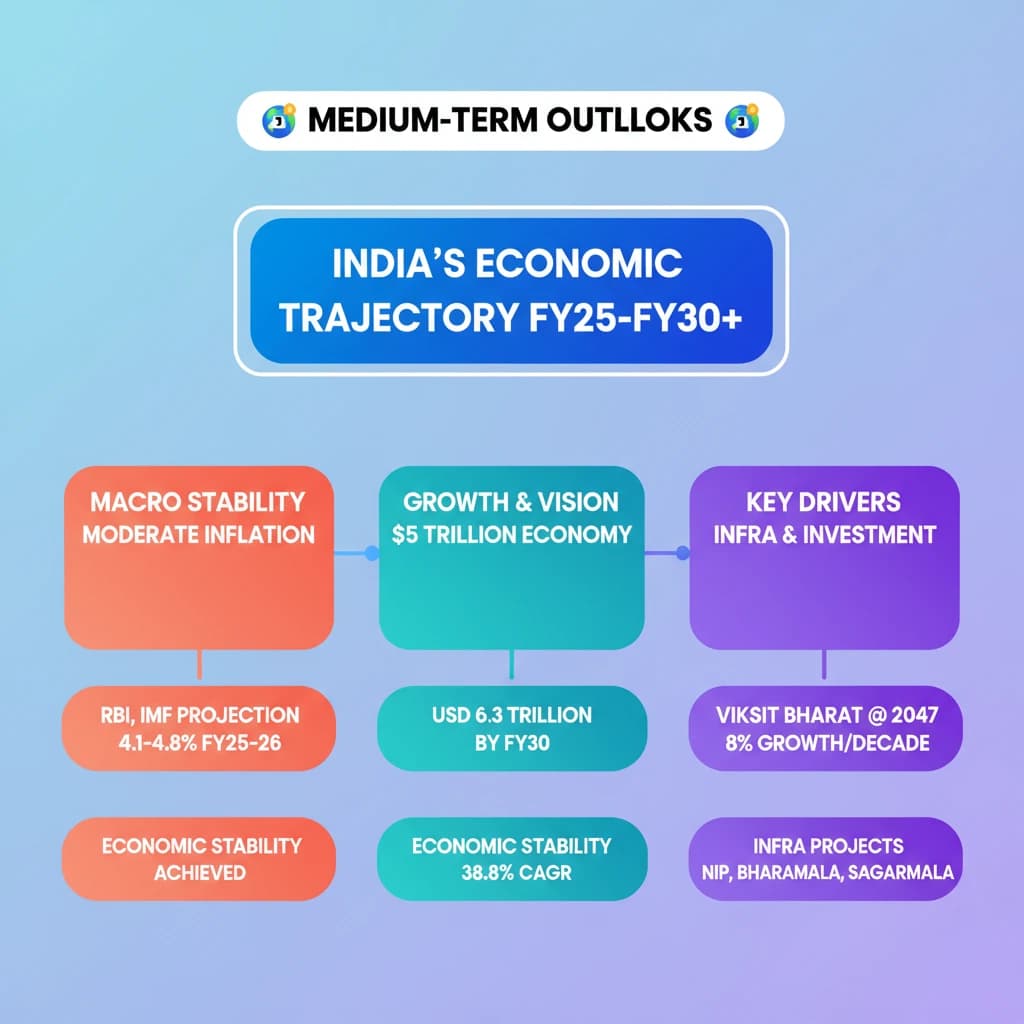
- •RBI and IMF project moderate inflation (4.1-4.8%) for FY25-FY26, indicating economic stability.
- •India is projected to become a USD 5 trillion economy by FY28 and USD 6.3 trillion by FY30.
- •Achieving Viksit Bharat 2047 requires sustained 8% annual growth for two decades.
- •Global challenges like geo-economic fragmentation pose risks to India's outlook.
- •Robust Capex growth (38.8% CAGR) and infrastructure projects (NIP, Bharatmala, Sagarmala) are key growth drivers.
- •Significant progress in rural/urban development (PMAY, Jal Jeevan Mission, ODF Plus) and digital/space sectors.
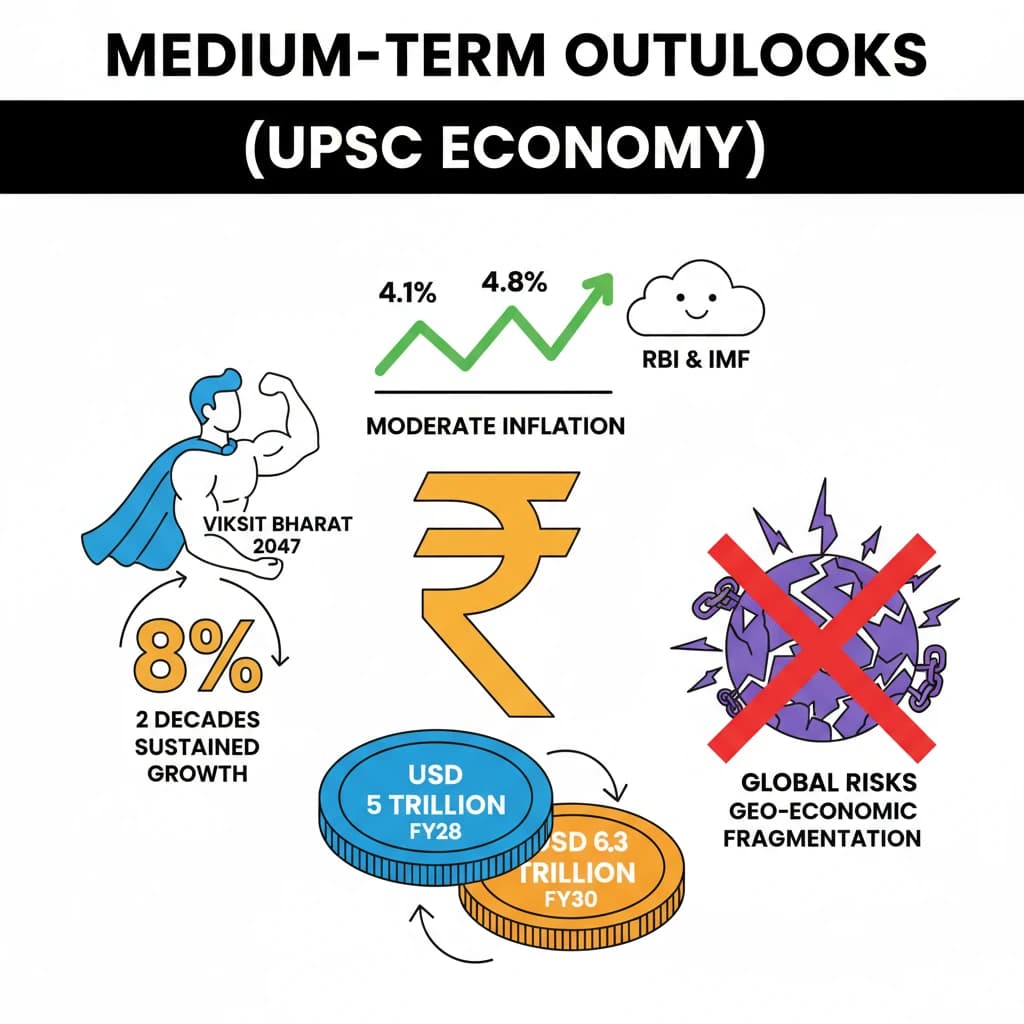
- •Manufacturing sector showing strong growth, with increased domestic production (e.g., smartphones) and patent filings.
🧠 Memory Techniques
95% Verified Content
📚 Reference Sources
•Reserve Bank of India (RBI) Monetary Policy Reports
•International Monetary Fund (IMF) World Economic Outlook reports
•Ministry of Finance, Government of India - Economic Survey
•Press Information Bureau (PIB) releases on government schemes