Loading page, please wait…
Need for Reforms in the Jute Industry - UPSC Economy
What is Need for Reforms in the Jute Industry in UPSC Economy?
Need for Reforms in the Jute Industry is a key topic under Economy for UPSC Civil Services Examination. Key points include: Jute is a natural bast fibre, primarily grown in West Bengal, Assam, and Bihar by small farmers.. Ideal conditions for jute cultivation include fertile alluvial soil, specific humidity, temperature, and rainfall.. Harvesting timing and the retting process are crucial for fibre quality and yield.. Understanding this topic is essential for both UPSC Prelims and Mains preparation.
Why is Need for Reforms in the Jute Industry important for UPSC exam?
Need for Reforms in the Jute Industry is a Medium-level topic in UPSC Economy. It is tested in both Prelims (factual MCQs) and Mains (analytical answer writing). Previous year UPSC questions have frequently covered aspects of Need for Reforms in the Jute Industry, making it essential for comprehensive IAS preparation.
How to prepare Need for Reforms in the Jute Industry for UPSC?
To prepare Need for Reforms in the Jute Industry for UPSC: (1) Study the comprehensive notes covering all key concepts on Vaidra. (2) Practice previous year questions on this topic. (3) Connect it with current affairs using daily updates. (4) Revise using key takeaways and mind maps available for Economy. (5) Write practice answers linking Need for Reforms in the Jute Industry to related GS Paper topics.
Key takeaways of Need for Reforms in the Jute Industry for UPSC
- Jute is a natural bast fibre, primarily grown in West Bengal, Assam, and Bihar by small farmers.
- Ideal conditions for jute cultivation include fertile alluvial soil, specific humidity, temperature, and rainfall.
- Harvesting timing and the retting process are crucial for fibre quality and yield.
- Jute is highly versatile, with uses ranging from fibre products to edible leaves and paper manufacturing.
- The Indian Jute Mills Association has called for reforms to address challenges and ensure industry sustainability.
- Reforms are needed for modernization, farmer support, and product diversification to enhance competitiveness.

Need for Reforms in the Jute Industry
Medium⏱️ 7 min read
economy
📖 Introduction
Introduction to Jute Industry Reforms
The Indian Jute Mills Association has highlighted significant challenges faced by the jute cultivation sector, emphasizing a critical need for comprehensive reforms. These reforms are essential to revitalize the industry and ensure its sustainable growth.
Understanding the challenges and proposed reforms in traditional industries like jute is crucial for UPSC Mains GS Paper 3 (Economy). Focus on both agricultural and industrial aspects.
Ideal Conditions for Jute Cultivation
Jute thrives under specific environmental conditions, although it can adapt to a wide range of soils. Optimal growth requires fertile loamy alluvial soil, which is commonly found in riverine plains.
- Relative Humidity: Between 70-90%
- Temperature: Between 17°C and 41°C
- Rainfall: Well-distributed over 120 cm
These conditions are predominantly met in the eastern parts of the Indian subcontinent, where jute has been traditionally cultivated.
Key Jute Species and Mesta
Commercially, two primary species of jute are cultivated, known for their distinct characteristics. These form the backbone of the jute fibre production.
- Jute Species: Primarily Tossa and White jute are produced on a commercial scale.
- Mesta: Another important bast fibre crop, Mesta, includes two cultivated species: Hibiscus cannabinus and Hibiscus Sabdariffa.
These different species offer variations in fibre quality and yield, catering to diverse industrial needs.
Harvesting Techniques and Fibre Quality
The timing of jute harvesting significantly impacts both the quality and quantity of the fibre. Farmers must balance these factors for optimal output.
A bast fibre crop like jute can be harvested at any stage after a certain period of vegetative growth, typically ranging from 100 to 150 days.
- Early Harvesting: Harvesting at the pre-bud or bud stage yields the best quality fibre but results in lower overall yields.
- Late Harvesting: Older crops produce a higher quantity of fibre, but the fibre tends to become coarse, and the stem does not ret properly, affecting processing efficiency.
Therefore, a compromise is often sought: harvesting at the early pod formation stage is considered best to achieve a balance between fibre quality and yield.
The Retting Process Explained
Retting is a crucial step in jute processing, involving the separation of plant fibres from the stem using moisture and microorganisms. This biological process is vital for extracting usable fibre.
The retting process involves keeping bundles of jute stems in water, usually placed side by side in layers and tied together. They are then covered with materials like water hyacinth or other weeds that do not release tannin and iron.
- Optimal Conditions: Retting is most effective in slow-moving clean water.
- Temperature: An optimum temperature of around 34 degrees Celsius facilitates efficient microbial action.
- Completion: The process is considered complete when the fibre can be easily separated from the woody stem, indicating successful decomposition of the non-fibrous material.
Versatility and Uses of Jute
Jute is a tall, hardy grass that can grow up to 2.5 metres in height, and remarkably, every part of the plant offers several valuable uses, highlighting its versatility.
- Fibre: The outer layer of the stem produces the fibre used in manufacturing various jute products, from sacks to textiles.
- Leaves: Jute leaves are edible and are used in cooking to prepare soups, stews, curries, and other vegetable dishes, particularly in certain cuisines.
- Inner Woody Stems: These can be utilized in the manufacture of paper, offering an alternative raw material for the pulp and paper industry.
- Roots: Left in the ground after harvest, the roots naturally enrich the soil, improving the yield of subsequent crops through nutrient cycling.
Major Jute Producing States
In India, jute cultivation is concentrated in specific regions, primarily in the eastern states, where suitable climatic and soil conditions prevail.
The major jute-growing states in India are West Bengal, Assam, and Bihar. Cultivation is predominantly carried out by marginal and small farmers, making the industry a significant source of livelihood for this demographic.
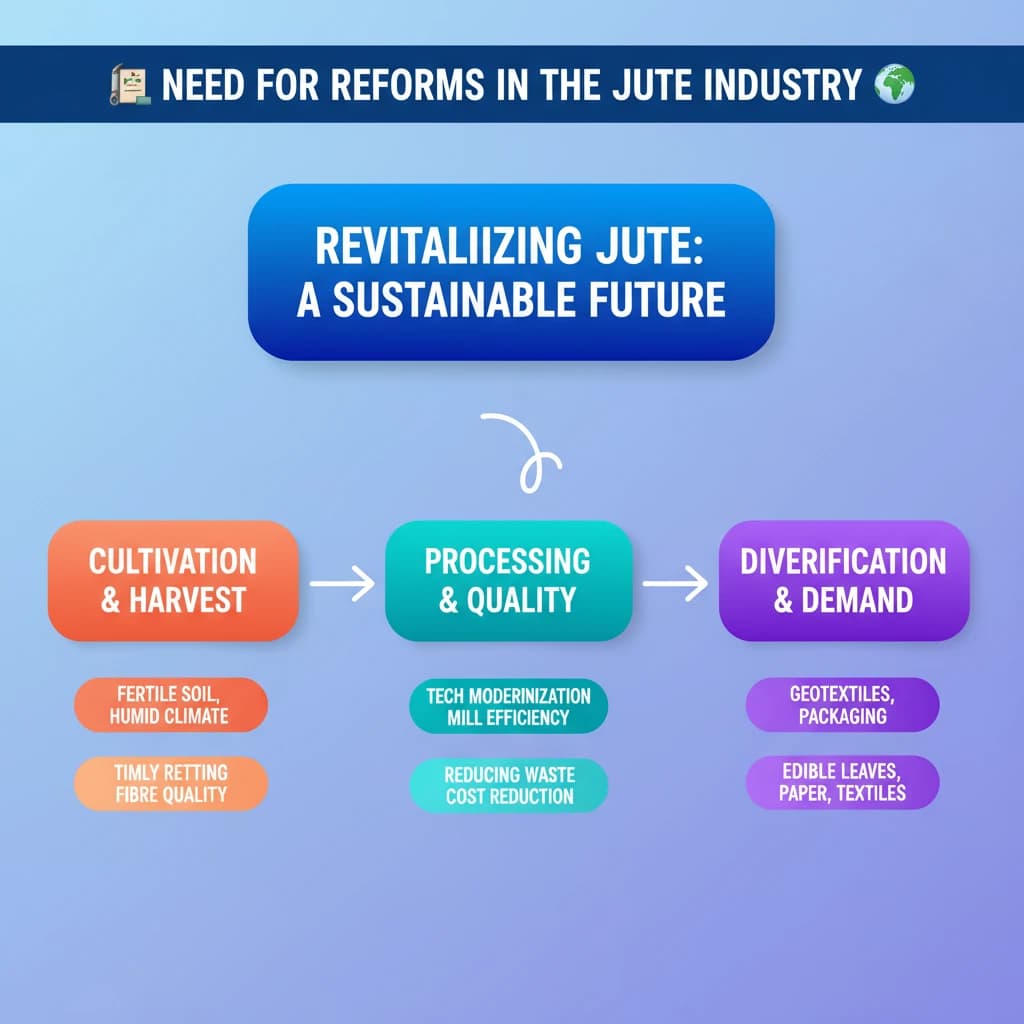
💡 Key Takeaways
- •Jute is a natural bast fibre, primarily grown in West Bengal, Assam, and Bihar by small farmers.
- •Ideal conditions for jute cultivation include fertile alluvial soil, specific humidity, temperature, and rainfall.
- •Harvesting timing and the retting process are crucial for fibre quality and yield.
- •Jute is highly versatile, with uses ranging from fibre products to edible leaves and paper manufacturing.
- •The Indian Jute Mills Association has called for reforms to address challenges and ensure industry sustainability.
- •Reforms are needed for modernization, farmer support, and product diversification to enhance competitiveness.
🧠 Memory Techniques

95% Verified Content